Computer Networks: LAN to WAN, Topologies, OSI, IP Addresses and VoIP
A simple guide to how computers talk to each other: network types, topologies, cables and devices, OSI and TCP/IP layers, IPv4 and IPv6, ARPANET, mobile networks and Voice over IP.
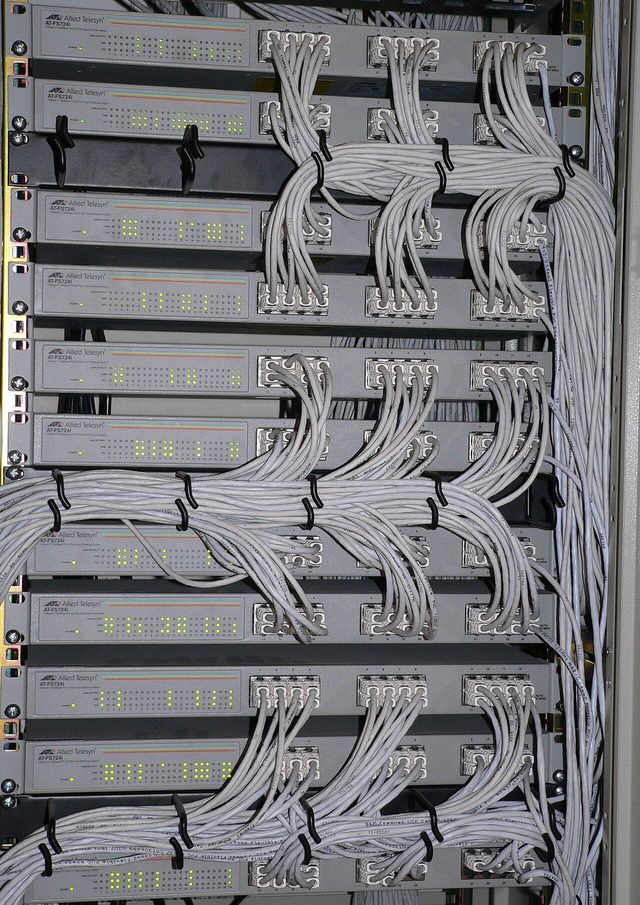
Network switches in a rack. Most cables here join one computer, printer or phone to the office network. Image: Parkis, Wikimedia Commons · CC BY-SA 3.0
A computer network is two or more computers joined so they can share data, files, printers and an internet connection. Networks are named by size (PAN, LAN, MAN, WAN), by layout (topology) and by the rules they follow (protocols such as TCP/IP). Every device on a network has an IP address. VoIP uses the same network to carry phone calls. This page covers all of it, as Punjab Police SI and Constable papers ask it.
60
Past questions on this page
Punjab Police SI & Constable
1969
ARPANET goes live
US Department of Defense
7
Layers in the OSI model
TCP/IP has 4
32 / 128
Bits in IPv4 / IPv6
Length of an IP address
What a network is, and PAN, LAN, MAN, WAN
Networks are named by how far they reach.
KEY TERM
Computer (data) communication
Computer communication is the process of transferring data between computers. It has five parts: a sender, a receiver, the message, the medium (cable or air) and the protocol (the agreed rules).
Sender→Medium→Receiver
FOUR NETWORK SIZES
PAN
LAN
MAN
WAN
Full form
Personal Area
Local Area
Metropolitan Area
Wide Area
Covers
One person, about 10 m
Room, building, campus
A city
Country or world
Example
Phone + Bluetooth earbuds
Office or school lab
City cable TV network
The internet
The internet is the biggest WAN, not a MAN. "TAN" is not a type of network.
End device
Client
The end-user device, such as a computer or smartphone. It asks for services.
Provider
Server
A powerful computer that gives services: web pages, files, email.
Inside a LAN
Switch
Joins devices of one LAN and sends data to the right one using its MAC address.
Between networks
Router
Joins different networks and chooses the path using IP addresses.
QUICK CHECK
Which of the following is NOT a basic type of computer network?
Tap an option to answer
Answer: C — TAN
Punjab Police SI, 2023. LAN, MAN and WAN (and PAN) are the standard sizes. TAN is made up.
QUICK CHECK
Identify whether the statements are true or false. I. The internet is the most popular example of a Metropolitan Area Network (MAN). II. Web pages written in HTML do not support hyperlinks.
Tap an option to answer
Answer: B — I - False, II - False
Punjab Police SI, 2023. The internet is a WAN, so I is false. Hyperlinks are the heart of HTML pages, so II is false too.
Topologies and transmission media
How devices are arranged, and what carries the signal.
KEY TERM
Topology
Topology is the physical arrangement of network devices and cables, the "shape" of the network. Routing, switching and surfing are actions, not arrangements.
Topology
Shape
Good point
Weak point
Bus
All devices on one main cable
Cheap, little cable
A break in the main cable stops everyone
Star
Every device to one central switch or hub
Easy to add devices; one bad cable affects one device
If the centre fails, all stop
Ring
Each device joined to two neighbours in a circle
Orderly: data goes round in turn
One break can stop the ring
Mesh
Devices joined to many or all others
Most reliable: many paths
Costly, lots of cable
Tree
Stars joined in levels, like branches
Easy to grow
Top link failing cuts a branch
A mix of two or more of these is a hybrid topology. Most home and office LANs today are star.
WIRED MEDIA
Twisted pair
Coaxial cable
Optical fibre
Made of
Two twisted copper wires
Copper core with a shield
Thin glass or plastic threads
Carries
Electric signals
Electric signals
Light
Used for
Local phone lines, LAN cable
Cable TV
Long-distance WAN links
Optical fibre has the highest speed and the lowest loss. It is the usual medium for long-distance WAN and internet backbones.
Wireless
Infrared
Very short range, in a straight line. Example: TV remote.
Wireless
Radio: Wi-Fi, Bluetooth
Wi-Fi for a wireless LAN; Bluetooth for a PAN.
Wireless
Microwave
Tower to tower, needs a clear line of sight.
Wireless
Satellite
The C band (about 4–6 GHz) was the first band for commercial satellite links.
QUICK CHECK
______ refers to the physical arrangement of network components and media within an enterprise network structure.
Tap an option to answer
Answer: B — Topology
Punjab Police SI, 2021. Topology is the layout: bus, star, ring, mesh, tree. The other three are actions.
QUICK CHECK
______ are thin threads of glass or plastic hair, which are used as a data communication medium.
Tap an option to answer
Answer: B — Optical fibre
Punjab Police SI, 2021. Glass or plastic threads that carry light are optical fibre. The other three are copper cables.
Network hardware: NIC, Ethernet, MAC and modem
The parts that plug a computer into a network.
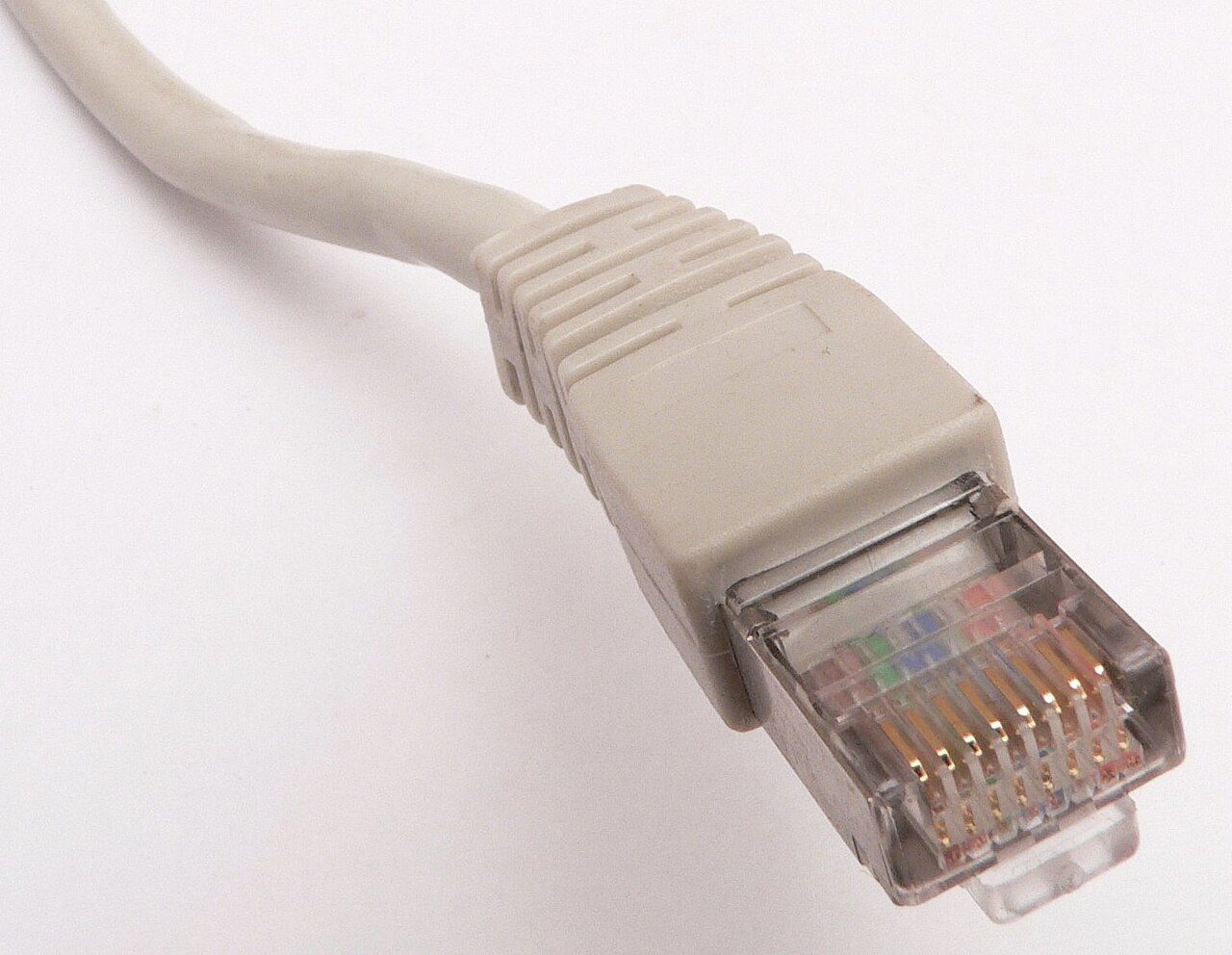
An RJ45 plug on a Category 5 twisted-pair cable. It clicks into the Ethernet port of a computer, switch or router. Image: David Monniaux (assumed), Wikimedia Commons · CC BY-SA 3.0
Part
What it does
NIC (Network Interface Card)
The card that connects a device to a network. It gives the LAN port, even in a VoIP phone.
Ethernet card
The network adapter used to set up a wired network
Ethernet port
The socket built into computers for a wired network (RJ45)
MAC address
Media Access Control address: a 48-bit hardware number fixed in every NIC. Ethernet needs it to deliver data.
Parallel, VGA and PS/2 ports are for printers, monitors and old keyboards, not for networks.
A MODEM: MODULATOR + DEMODULATOR
Computer
Digital data (0 and 1)
↓
sender
Modulation
Digital → analog, to travel on the line
↓
receiver
Demodulation
Analog → digital, at the other end
↓
Computer
Digital data again
If a paper swaps these two meanings, both statements are wrong.
REMEMBER
MOD = Make it Old (digital → old analog). DEMOD = DEcode to Modern (analog → digital).
QUICK CHECK
______ is a network adapter that is used to set up a wired network.
Tap an option to answer
Answer: A — Ethernet card
Punjab Police SI, 2023. "Wired" points to Ethernet. "Network card" is the general family name, which also includes Wi-Fi cards.
QUICK CHECK
Which statement(s) is/are true about data transmission? I. Modulation: technique to convert analog to digital signal. II. Demodulation: technique to convert digital to analog signal.
Tap an option to answer
Answer: C — Neither I nor II
Punjab Police SI, 2021. The meanings are reversed. Modulation is digital to analog; demodulation is analog to digital.
Rules of the network: OSI, TCP/IP, packets and IP addresses
Layers, protocols, packets, addresses and ports.
THE 7 LAYERS OF THE OSI MODEL (TOP TO BOTTOM)
7. Application
What the user's app talks: HTTP, FTP, SMTP, DNS.
↓
6. Presentation
Data format, encryption, compression.
↓
5. Session
Opens, keeps and closes a conversation.
↓
4. Transport
TCP (reliable) or UDP (fast).
↓
IP
3. Network
IP addresses and routing. Router works here.
↓
MAC
2. Data link
MAC addresses. Switch works here.
↓
1. Physical
Cables, signals, bits. Hub works here.
OSI = Open System(s) Interconnection, a reference model published by ISO.
REMEMBER
Bottom to top: "Please Do Not Throw Sausage Pizza Away" = Physical, Data link, Network, Transport, Session, Presentation, Application.
OSI VS TCP/IP
OSI
TCP/IP
Layers
7
4
Layer names
See the list above
Application, Transport, Internet, Network access
Used as
A teaching and design model
What the internet actually runs on
TCP/IP = Transmission Control Protocol / Internet Protocol.
TCP VS UDP (TRANSPORT LAYER)
TCP
UDP
Connection
Connection-oriented
Connectionless
Lost data
Sent again
Not sent again
Best for
Web pages, email, files
VoIP, live video, games
TCP turns a stream of bytes into segments, numbers them and makes sure they all arrive in order. That is the "quality of transport".
KEY TERM
Packets
Data is sent over the internet in small, manageable pieces called packets. Each packet carries the sender's and receiver's IP addresses and a number. Packets may take different roads and are put back together at the end. This is called packet switching.
Message→Packets→Message again
IPV4 VS IPV6
IPv4
IPv6
Length
32 bits
128 bits
Written as
4 numbers, dots
8 hex groups, colons
Example
192.168.1.10
2001:db8::1
How many
About 4.3 billion
Far more
An IP address is the unique number of every device on a network. Each IPv4 number is 0 to 255.
Service
Port number
HTTP
80
HTTPS
443
FTP
20, 21
SSH
22
SMTP (sending email)
25
DNS
53
A port is a numbered door on a computer for one kind of service.
Connection-oriented services
Connectionless services
Reliable message stream
Unreliable datagram
Reliable byte stream
Acknowledged datagram
Unreliable connection
Request-reply
In a connectionless service, no link is set up first. Each message finds its own way.
QUICK CHECK
Identify which statements are true or false. I. The length of an IPv4 address is 32 bits. II. Google is a web search engine.
Tap an option to answer
Answer: A — I – True, II – True
Punjab Police SI, 2023. IPv4 is 32 bits: four parts of 8 bits each. IPv6 is 128 bits. Google is a search engine, so both are true.
QUICK CHECK
Which protocol of internet architecture determines how to transform a stream of bytes in an IP packet while ensuring the quality of transport of this IP packet?
Tap an option to answer
Answer: C — TCP
Punjab Police SI, 2023. TCP cuts the byte stream into segments and guarantees delivery. IP only addresses and routes the packets.
QUICK CHECK
The data is sent over the internet in the form of manageable ______.
Tap an option to answer
Answer: B — packets
Punjab Police SI, 2023. The internet uses packet switching. Each packet travels on its own and is put back in order at the end.
ARPANET, ISPs, VPN and mobile networks
Where the internet came from, how it is built, and the phone network.
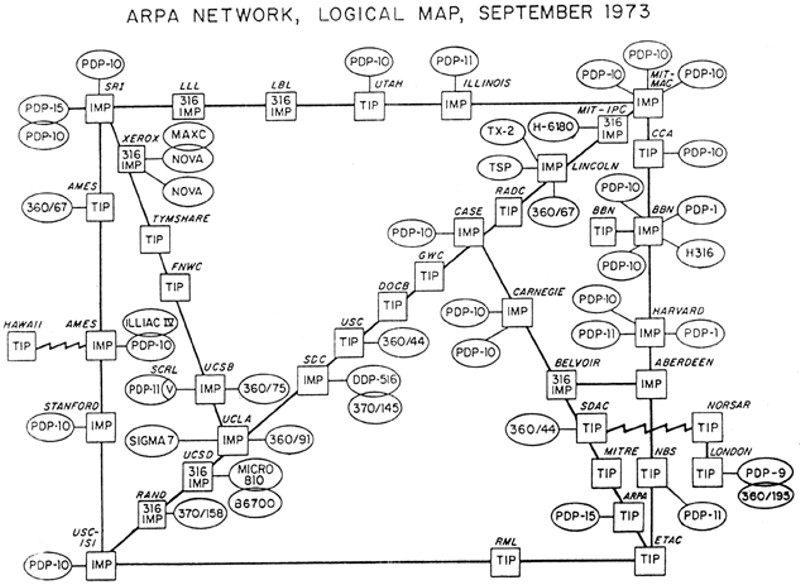
The ARPANET map of September 1973. Note the satellite links to Hawaii and London. This network grew into today's internet. Image: Bolt Beranek and Newman Inc., Wikimedia Commons · Public domain
FROM ARPANET TO INTERNET CALLS
1969
ARPANET
Started by the US Department of Defense (ARPA). First four nodes: UCLA, SRI, UC Santa Barbara, University of Utah.
1973
Satellite links
ARPANET reaches Hawaii and London.
1984
OSI model
ISO publishes the 7-layer reference model.
1995
First VoIP software
VocalTec's "Internet Phone" lets one PC call another over the internet.
HOW THE INTERNET IS BUILT, IN TIERS
Backbones
Very fast fibre-optic trunk lines across countries and under oceans.
↓
NAP
Network Access Points
Meeting points where networks join the backbones.
↓
ISP
Internet Service Providers
ISPs connect to the backbones at NAPs with high-speed lines.
↓
You
Your home or phone connects to the ISP.
KEY TERM
VPN: Virtual Private Network
A VPN extends a private network across a public network like the internet. It makes an encrypted connection (a "tunnel") from your device to the network. Staff use it to reach the office network from home.
Your device→Encrypted tunnel→Private network
Mobile term
Full form
Identifies
IMEI
International Mobile Equipment Identity
The phone (handset) itself. 15 digits; dial *#06# to see it.
SIM
Subscriber Identity Module
The subscriber: the small card from your mobile company
IMSI
International Mobile Subscriber Identity
The subscriber number stored on the SIM
MCC / MNC
Mobile Country Code / Mobile Network Code
The country and the mobile company
QUICK CHECK
ARPANET is a network of devices which was started by the American Department of Defence in the year ______.
Tap an option to answer
Answer: B — 1969
Punjab Police SI, 2023. ARPANET went live in 1969 with four nodes. 1958 is when ARPA itself was set up, a common trap.
QUICK CHECK
In mobile device security, a/an ______ extends a private network across a public network.
Tap an option to answer
Answer: C — Virtual Private Network (VPN)
Punjab Police SI, 2023. The stem is the textbook definition of a VPN, word for word.
VoIP: phone calls over the internet
The most-asked topic on this page: about 30 past questions.
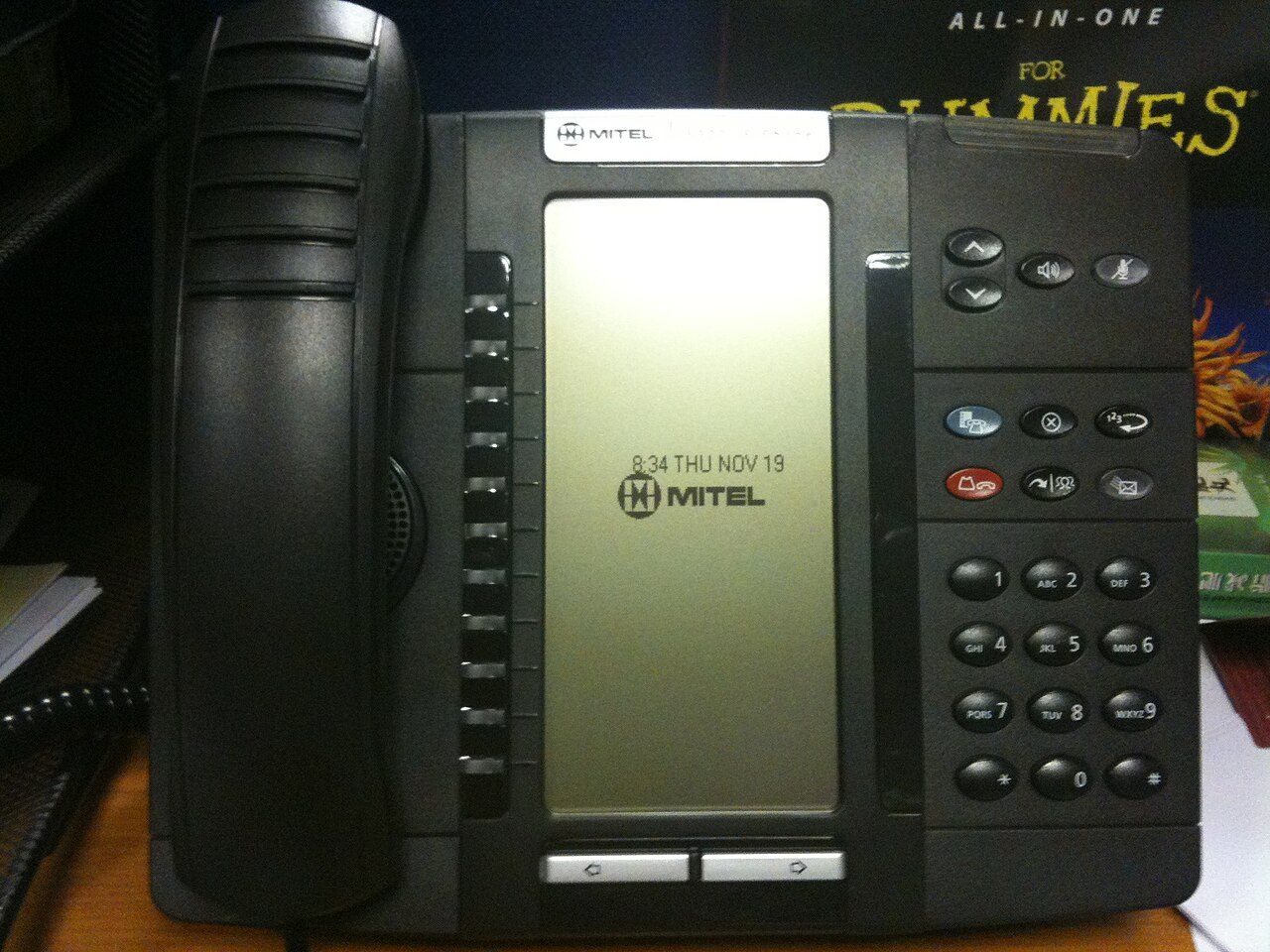
A VoIP phone (IP phone) on an office desk in London. It plugs into the computer network, not a telephone line. Image: Ged Carroll, Wikimedia Commons · CC BY 2.0
KEY TERM
VoIP = Voice over Internet Protocol
VoIP lets you make voice calls over a broadband internet connection instead of a regular (analog) phone line. Its other name is IP telephony. You need a computer or mobile device (or an IP phone) and a good internet connection.
HOW A VOIP CALL TRAVELS
You speak
The microphone picks up an analog sound wave.
↓
codec
Voice → digital signal
A codec turns it into digital data and compresses it.
↓
UDP
Packets over IP
Sent in packets, usually with UDP for speed.
↓
Back to sound
The other end joins the packets and plays the voice.
Any network that runs TCP/IP, private or public, can carry VoIP. A cable modem, DSL or a LAN can all give the speed it needs.
ADVANTAGES
Low cost, even for long-distance calls
Accessibility: call from any connected device
Portability: your number goes where you go
Scalability: add lines in software
Multitasking: voice, video and files together; extra features such as call notification
DISADVANTAGES
Needs a good internet connection; quality depends on its speed
Latency and jitter: delay and broken sound
Needs a continuous power supply
Security risks on the open internet
Weak support for emergency calls; often no directory / white-page listing
COMMON TRAPS
"Requirement for an internet connection" is a disadvantage, never an advantage.
Low cost and portability are advantages, so they are "NOT disadvantages".
Latency and jitter are a disadvantage, so they are "NOT an advantage".
"Call notification is not possible with VoIP" is false.
VoIP protocol
What to remember
SIP
Session Initiation Protocol. A signalling protocol: it starts, changes and ends a call, like the old phone system's dialling and ringing.
Transport protocols (e.g. RTP over UDP)
Carry the voice packets made by the codec
UDP
Used instead of TCP for voice: it does not wait to resend lost packets, so it is faster
SCCP (Skinny)
Skinny Client Control Protocol. Made by Selsius Systems; now a Cisco product (Cisco bought Selsius in 1998).
Punjab Police SI, 2022. SIP starts (initiates) a call session. "Initial" is the near-miss spelling trap.
QUICK CHECK
Which of the following is NOT an advantage of VoIP?
Tap an option to answer
Answer: B — Requirement for an internet connection
Punjab Police SI, 2023. Needing the internet is a limit: no connection, no call. The other three are benefits.
QUICK CHECK
Which of the following are examples of VoIP communication services? (i) Skype (ii) Netflix (iii) Amazon Prime Video (iv) Nextiva
Tap an option to answer
Answer: B — Only (i) and (iv)
Punjab Police SI, 2023. Skype (a VoIP app until Microsoft closed it in 2025) and Nextiva carry calls. Netflix and Prime Video only stream films and shows to you.
Quick revision
Full forms, traps and one-line facts.
FLASHCARDS
Full forms: tap to check
LAN
Local Area Network
MAN
Metropolitan Area Network
WAN
Wide Area Network
PAN
Personal Area Network
NIC
Network Interface Card
MAC
Media Access Control
OSI
Open System(s) Interconnection
TCP/IP
Transmission Control Protocol / Internet Protocol
UDP
User Datagram Protocol
VoIP
Voice over Internet Protocol
SIP
Session Initiation Protocol
VPN
Virtual Private Network
ISP
Internet Service Provider
SIM
Subscriber Identity Module
IMEI
International Mobile Equipment Identity
ARPANET
Advanced Research Projects Agency Network
COMMON TRAPS
IMEI vs SIM: IMEI identifies the phone; SIM identifies the subscriber.
IP vs MAC: IP address can change with the network; the MAC address is fixed in the card.
IPv4 = 32 bits, not 32 bytes. IPv6 = 128 bits.
VoIP: "Intranet" and "Internal" are wrong; it is Voice over Internet Protocol.
VoIP turns voice into digital signals, not analog or optical signals.
Also asked onceTap to open
Twisted pair is used for local telephone lines and short distances.
Fibre optics is the usual technology for long-distance WAN links.
Using 4–6 GHz for satellite transmission and retransmission is C-band transmission.
The Ethernet port is built into computers to connect them to a wired network.
HTTPS works on port 443.
The first VoIP service came from the company VocalTec in 1995.
VoIP can also be called IP telephony.
Both are true: signalling protocols handle the call functions taken from the telephone system, and transport protocols carry the codec's voice packets.
Both are true: any TCP/IP network can run VoIP, and UDP helps VoIP run on any type of network.
In a VoIP phone, the NIC does provide the LAN port, and a MAC address is needed to join an Ethernet network.
The quality of a voice call over a network depends on the speed of the internet connection.
CHECK YOURSELF
Name the network size for each: (a) your phone and smartwatch, (b) a school computer lab, (c) the internet. Then say which medium carries the internet across oceans.
Show answer
(a) PAN, (b) LAN, (c) WAN, the biggest one. Optical fibre cables carry it across oceans.
❧
Frequently Asked Questions
What are the types of computer network?
By size there are four: PAN (one person), LAN (a building or campus), MAN (a city) and WAN (a country or the world). The internet is the largest WAN.
What is network topology?
Topology is the physical arrangement of devices and cables in a network. The main types are bus, star, ring, mesh, tree and hybrid.
What are the 7 layers of the OSI model?
From bottom to top: Physical, Data link, Network, Transport, Session, Presentation and Application. OSI stands for Open Systems Interconnection.
What is the difference between IPv4 and IPv6?
An IPv4 address is 32 bits, written as four numbers with dots (like 192.168.1.10). An IPv6 address is 128 bits, written in hexadecimal groups with colons, and allows far more addresses.
What is a MAC address?
MAC stands for Media Access Control. A MAC address is a 48-bit hardware number fixed in every network interface card, used to deliver data inside a local network like Ethernet.
Which port does HTTPS use?
HTTPS uses port 443. Plain HTTP uses port 80.
When was ARPANET started?
ARPANET went live in 1969. It was funded by the US Department of Defense and linked four university and research sites at first. It grew into the internet.
What is VoIP and how does it work?
VoIP (Voice over Internet Protocol) carries phone calls over the internet. Your voice is turned into a digital signal, split into packets, sent over IP and turned back into sound at the other end.
What are the advantages and disadvantages of VoIP?
Advantages: low cost, accessibility, portability, scalability and multitasking. Disadvantages: it needs a good internet connection and power, and suffers from latency, jitter, security risks and weak emergency-call support.
What is a VPN?
A Virtual Private Network makes an encrypted connection over the internet from your device to a private network, so you can use that network safely from anywhere.