Coal and petroleum, LPG, CNG and biogas, combustion and fire control, flame zones and calorific value, fibres and plastics such as nylon and PVC, and chemicals of daily life.
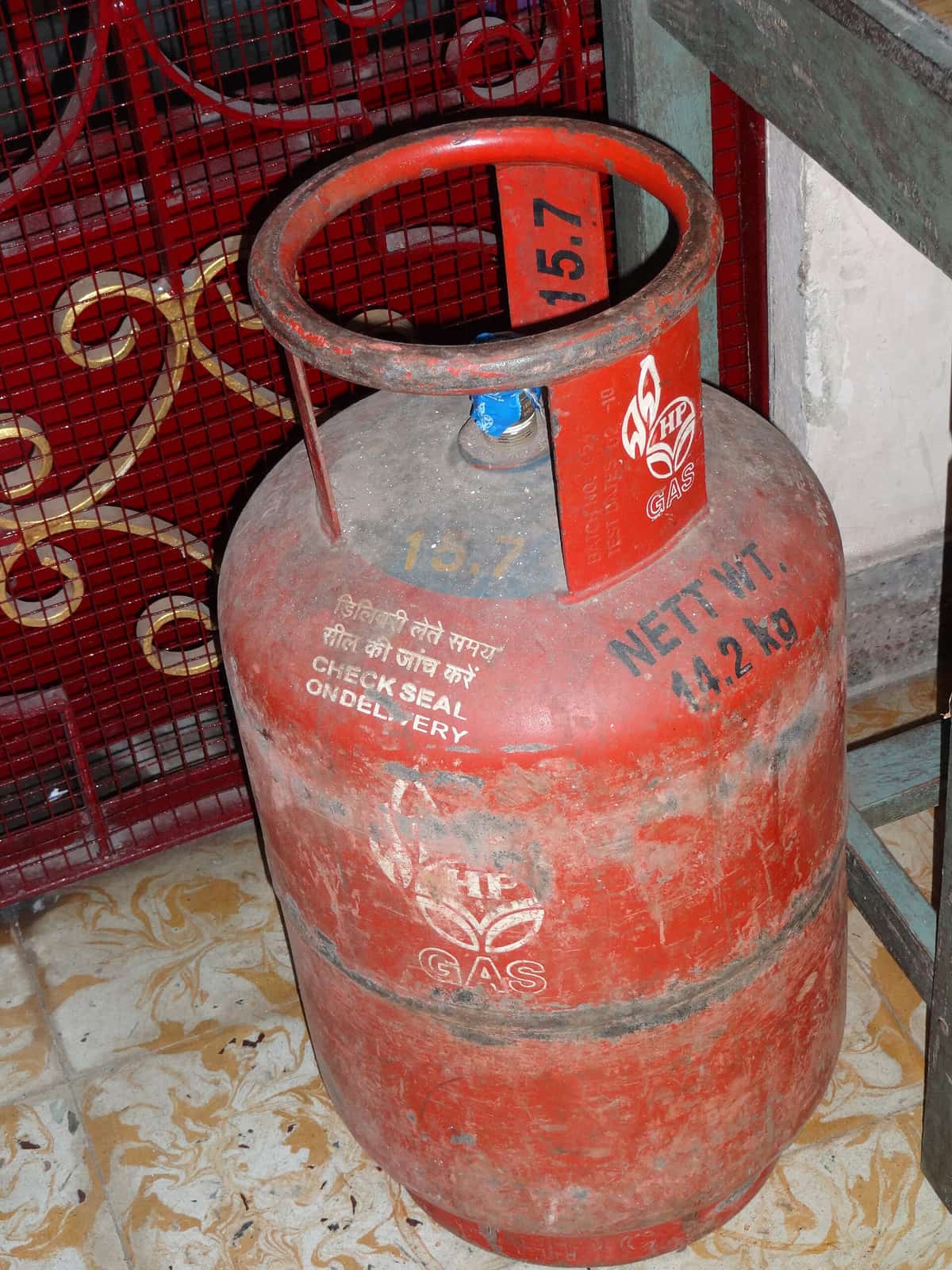
A domestic LPG cylinder (14.2 kg). LPG is mostly butane and propane, kept as a liquid under pressure. It has no smell of its own, so a strong-smelling compound is added to reveal leaks. Image: Prabhupuducherry, Wikimedia Commons · CC BY-SA 3.0
Kitchen fires, vehicles and most of India's electricity run on fuels — mostly coal, petroleum and natural gas, formed from living things buried millions of years ago. Burning them is combustion. Petroleum also gives us synthetic fibres and plastics. Exams ask about LPG, CNG and methane, fire control, flame zones, polymers like PVC, and chemicals used every day.
On this page you will learn:
Coal, petroleum and natural gas, and their products
Gas fuels: LPG, CNG, biogas and the many names of methane
Combustion, ignition temperature and putting out fires
Flame zones and calorific value
Polymers: fibres and plastics
Chemicals and materials of daily life
150,000
kJ/kg from hydrogen
Highest calorific value
CH4
Methane
CNG, biogas, marsh gas
3
Needs of a fire
Fuel, air, heat
Coal, petroleum and natural gas
Rule in one line: fossil fuels formed from dead organisms over millions of years and cannot be replaced.
KEY TERM
Carbonisation
Dead plants buried deep under the earth, at high temperature and pressure, slowly turned into coal. This is carbonisation. Because coal came from living things, it is a fossil fuel. Petroleum and natural gas formed in a similar way from tiny sea organisms.
Dead plants→Buried→Heat + pressure→Coal
Product of coal
What it is
Uses
Coke
Tough, porous, almost pure carbon
Making steel
Coal tar
Thick black liquid, a mixture of about 200 substances
Unrefined petroleum is crude oil, a dark oily mixture. A refinery separates it into these parts by fractional distillation. Its high value gives it the name black gold.
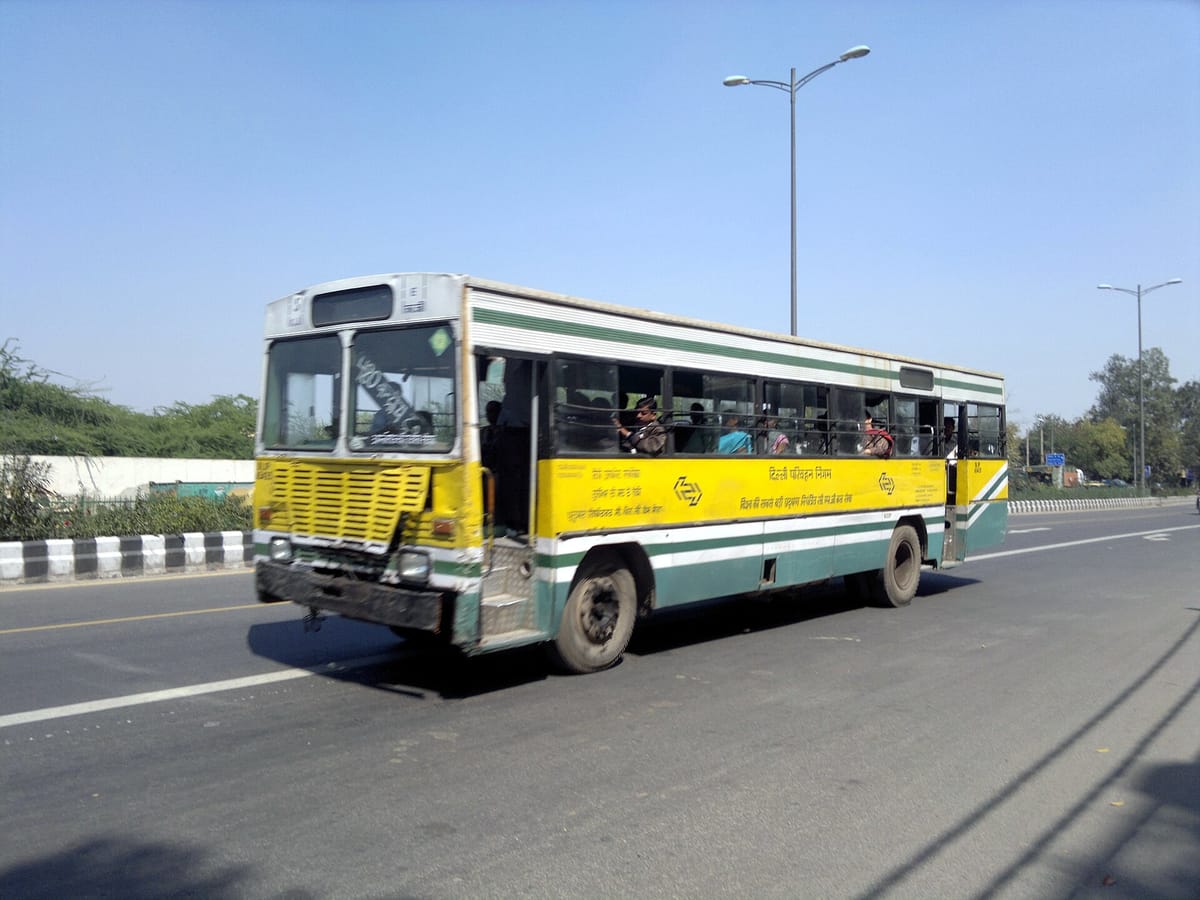
A CNG bus of the Delhi Transport Corporation, which runs one of the world's largest CNG bus fleets. CNG is natural gas — mainly methane — pressed into cylinders. It burns cleaner than petrol and diesel. Image: Ramesh NG, Wikimedia Commons · CC BY-SA 2.0
CNG VS LPG
CNG
LPG
Mainly
Methane
Butane + propane
Comes from
Gas wells, oil fields
Refining crude oil
Stored as
Gas, under high pressure
Liquid, under pressure
Main use
Vehicles
Cooking
CNG is a clean fuel: being a gas, it mixes fully with air and burns completely, leaving little smoke. It cannot easily be adulterated.
QUICK CHECK
PYQ · PSSSB Patwari 2023 — Petroleum is also famous as
Tap an option to answer
Answer: C — Crude oil
Unrefined petroleum is crude oil. Petrol is only one of the products made from it.
QUICK CHECK
PYQ · PPSC NE 2019 — Which one of the following statements about Compressed Natural Gas (CNG) is not true ?
Tap an option to answer
Answer: B — It is obtained during refining of crude oil.
CNG comes from gas wells and oil fields, not from refining crude oil. LPG is the gas from refining. PPSC RO and TA 2019 asked the same.
QUICK CHECK
PYQ · Punjab Police SI 2023 — Why is CNG considered a better fuel than petrol and diesel?
Tap an option to answer
Answer: B — It burns more efficiently.
Being a gas, CNG mixes well with air and burns almost completely, with less smoke and pollution.
LPG, biogas and the names of methane
Rule in one line: cooking gas is butane and propane; marsh gas, gobar gas and CNG are mostly methane.
Name
Where it comes from
Main gas
Marsh gas
Rotting plants under marsh and paddy water
Methane, CH4
Gobar gas (biogas)
Cattle dung rotting without air
Methane, with carbon dioxide
Firedamp
Coal mines
Methane
CNG
Natural gas wells
Methane
LPG (cooking gas)
Refining crude oil
Butane and propane
One gas, many names. Methane is also a greenhouse gas.
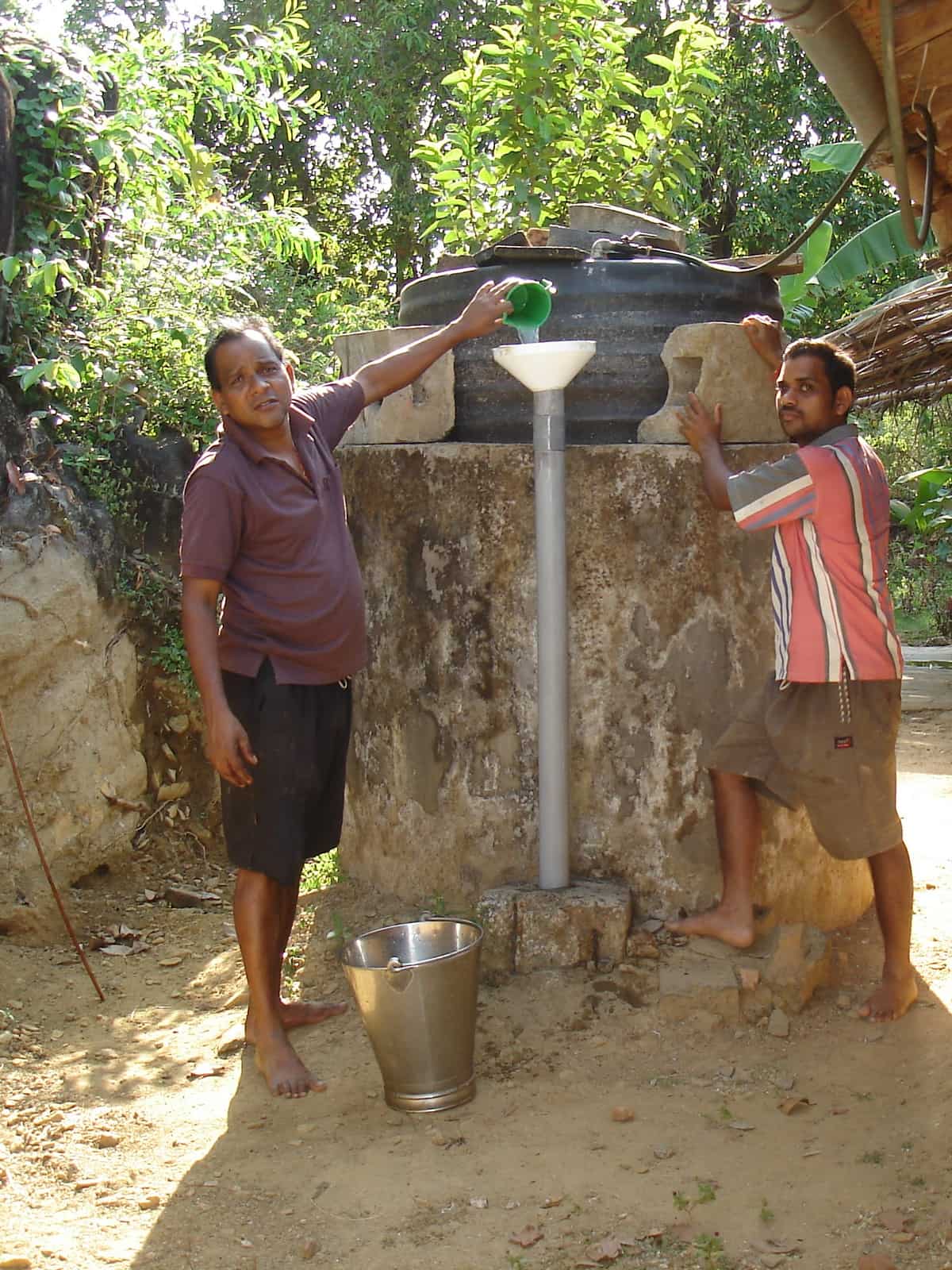
A small household biogas plant in India being fed with waste slurry. Bacteria break the waste down without air and give off gas that is mostly methane. The leftover slurry is good manure. Image: Priyadarshini Karve, Wikimedia Commons · CC BY-SA 4.0
QUICK CHECK
PYQ · PPSC OHE 2016 — Cooking gas is a mixture of:
Tap an option to answer
Answer: B — Butane and propane
LPG is mainly butane and propane, liquefied under pressure in the cylinder.
QUICK CHECK
PYQ · PPSC SEVE 2016 — Which one of the following is known as Marsh gas?
Tap an option to answer
Answer: B — CH4
Methane (CH4) forms when plants rot under water in marshes and paddy fields, so it is called marsh gas.
Combustion and fire control
Rule in one line: fire needs fuel, air and heat; take away any one and the fire goes out.
Combustion is a chemical reaction in which a substance joins with oxygen and gives off heat, often with light. The chemical energy stored in the fuel turns into heat (thermal) energy.
THE THREE NEEDS OF A FIRE
1
Fuel
Wood, LPG, petrol
↓
2
Air
Oxygen supports burning
↓
3
Heat
Enough to reach the ignition temperature
KEY TERM
Ignition temperature
The lowest temperature at which a substance catches fire. A paper cup of water does not burn over a flame, because the water takes the heat away. Substances that catch fire very easily — petrol, alcohol, LPG — are inflammable.
Type of combustion
What happens
Example
Rapid
Burns quickly with heat and light
LPG on a stove
Spontaneous
Catches fire on its own
White phosphorus in air
Explosion
Sudden burning with heat, light and sound
Firecrackers; methane and air in coal mines
Kinds of combustion
Kind of fire
Use water?
Why
Wood, paper, cloth
Yes
Water cools the fuel below its ignition temperature
Electrical
No
Water conducts electricity; risk of shock
Oil or petrol
No
Water sinks below the oil, which keeps burning on top
For electrical and oil fires, carbon dioxide is best: it is heavier than air, covers the fire like a blanket and cuts off oxygen.
QUICK CHECK
PYQ · PPSC EO 2018 — Combustion is the process of conversion of which of the following energies?
Tap an option to answer
Answer: B — chemical → thermal
A fuel stores chemical energy in its bonds; burning releases it as heat (and light). PPSC SSO 2018 asked the same.
QUICK CHECK
PYQ · PPSC NE 2019 — Most of the explosions in mines occur due to the mixing of
Tap an option to answer
Answer: B — Methane with air
Coal seams give off methane (firedamp). Mixed with air, it explodes at the smallest spark. PPSC RO and TA 2019 asked the same.
Flame and calorific value
Rule in one line: the outer, blue part of a flame is hottest; hydrogen gives the most heat per kilogram.
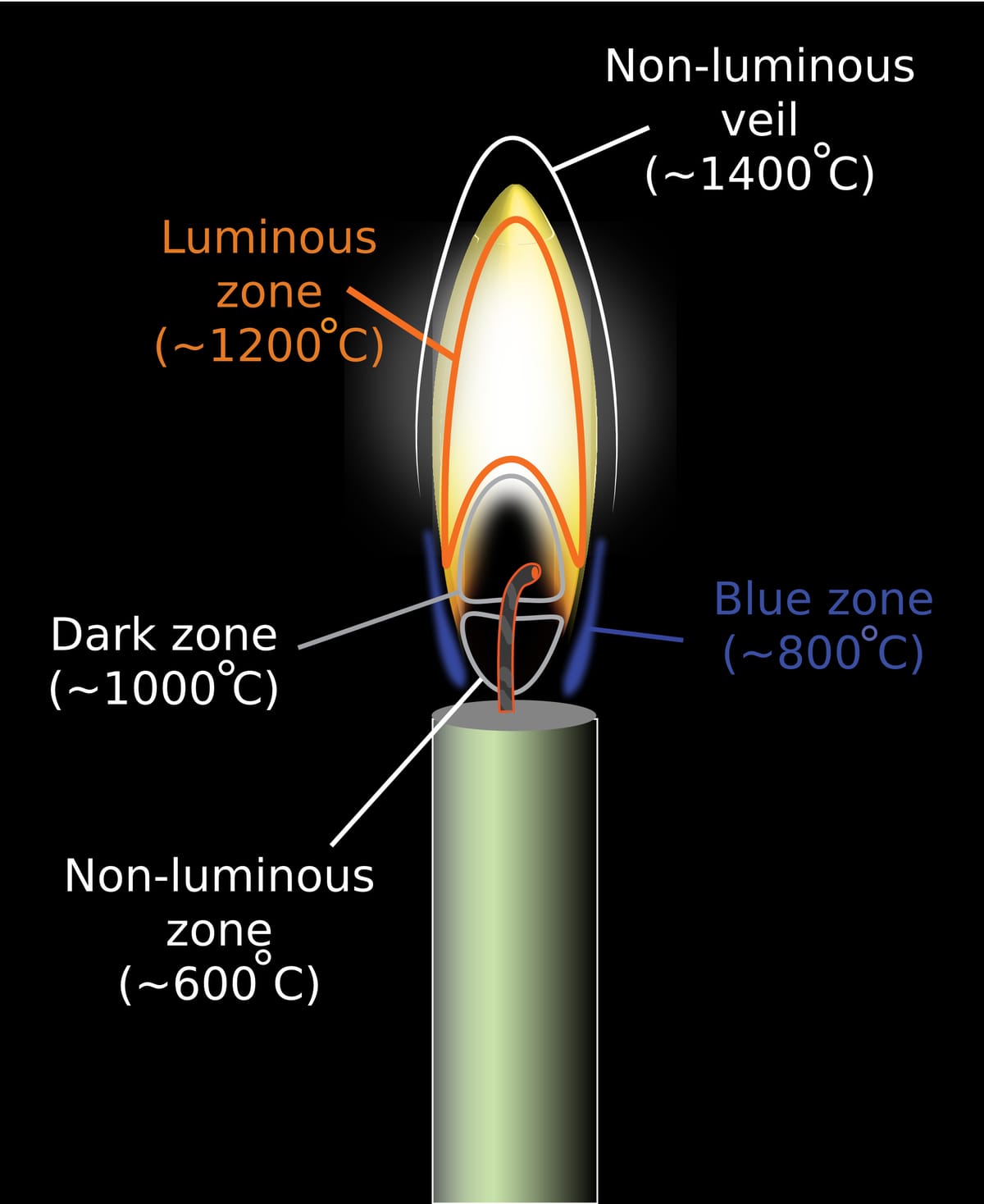
Zones of a candle flame. The dark inner zone holds unburnt wax vapour. The yellow zone glows but burns only partly. The faint outer zone burns completely and is the hottest. (The drawing shows more detail than the textbook's three zones.) Image: A loose necktie, Wikimedia Commons · CC BY-SA 4.0
Zone
Colour
Burning
Heat
Innermost
Dark
Unburnt wax vapour
Least hot
Middle
Yellow, bright
Partial
Moderate
Outermost
Blue, not bright
Complete
Hottest
Goldsmiths blow the outermost zone onto gold and silver to melt them.
Calorific value of fuels
Cow dung cake
6,000–8,000
Wood
17,000–22,000
Coal
25,000–33,000
Biogas
35,000–40,000
Petrol, kerosene, diesel
45,000
Methane, CNG
50,000
LPG
55,000
Hydrogen
150,000
Calorific value is the heat from burning 1 kg of a fuel completely. Values are approximate, as in the class 8 textbook.
HARM FROM BURNING FUELS
Incomplete burning gives carbon monoxide, a deadly gas — never sleep in a closed room with a coal fire. Extra carbon dioxide adds to global warming. Sulphur and nitrogen oxides dissolve in rain and cause acid rain.
Polymers: fibres and plastics
Rule in one line: a polymer is a giant molecule made of many small repeating units.
KEY TERM
Polymer
'Poly' means many and 'mer' means part. Small units called monomers join into long chains. Polythene is made of thousands of ethene units. Natural polymers exist too: cotton is cellulose, and proteins are polymers of amino acids.
Monomer→+ monomer→+ monomer …→Polymer
Fibre
Made from / known as
Uses
Rayon
Wood pulp; artificial silk
Bed sheets, carpets
Nylon
First fully synthetic fibre
Ropes, parachutes, toothbrushes, socks
Polyester
Terylene and PET are forms of it
Wrinkle-free clothes, bottles
Acrylic
Artificial wool
Sweaters, shawls, blankets
Synthetic fibres melt when heated, so wear cotton, not synthetics, near a stove.
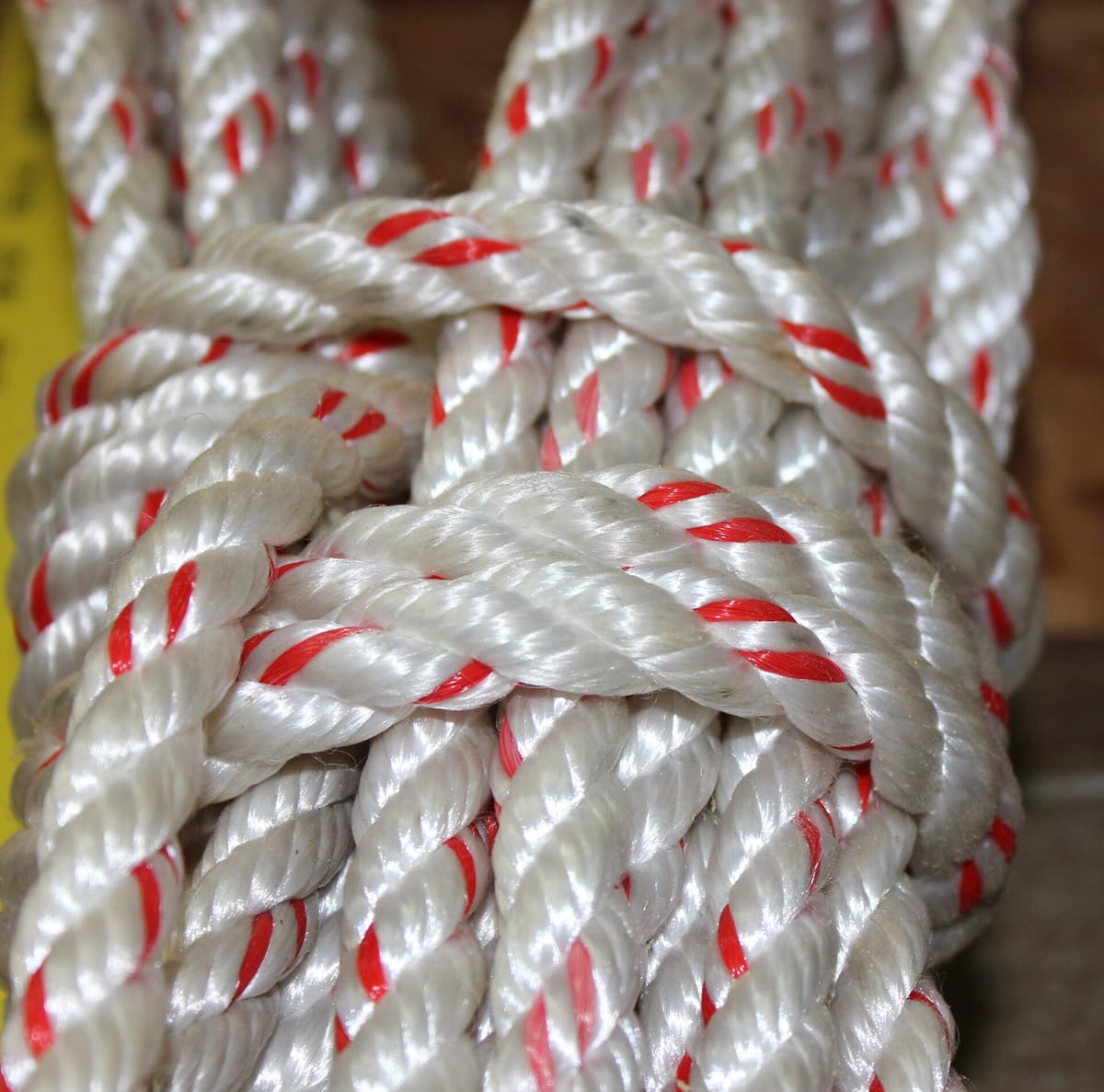
Nylon rope. Nylon is strong, light and elastic, and it does not rot in water. That is why it is used for ropes, fishing nets and parachutes. Image: Angelsharum, Wikimedia Commons · CC BY-SA 3.0
TWO KINDS OF PLASTIC
Thermoplastics
Thermosetting
On heating
Soften; can be reshaped
Do not soften
Examples
Polythene, PVC
Bakelite, melamine
Uses
Bags, pipes, toys
Switches, pan handles
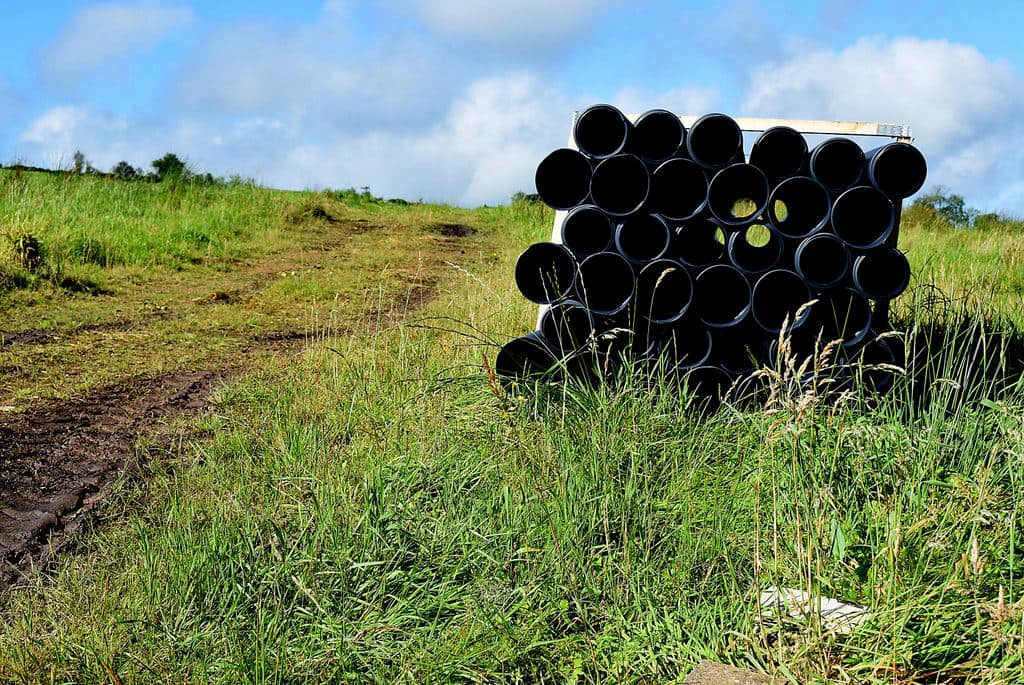
Teflon gives non-stick pans; melamine resists fire. Plastics do not rot, so follow the 3Rs: reduce, reuse, recycle.Plastic pipes waiting to be laid (the Commons file is titled "PVC pipes"; the photo alone cannot show which plastic). PVC (polyvinyl chloride) is a thermoplastic made from the monomer vinyl chloride. It is tough and does not rust, so it is widely used for water and drain pipes. Image: Kenneth Allen, Wikimedia Commons · CC BY-SA 2.0
QUICK CHECK
PYQ · PPSC ICS 2016 — A large molecule with many repeating structural units is a
Tap an option to answer
Answer: A — Polymer
A polymer is the general name. A monomer is one unit; polythene and polypeptides are particular polymers.
QUICK CHECK
PYQ · Punjab Police SI 2016 — The term PVC used in the plastic industry stands for
Tap an option to answer
Answer: B — polyvinyl chloride
PVC is polyvinyl chloride, a polymer of vinyl chloride used for pipes, cable covers and flooring.
Chemicals and materials of daily life
Rule in one line: match each chemical or material to the job it does.
Item
What it is
Used for
Aspartame, saccharin
Artificial sweeteners
Sugar-free drinks and sweets
Mosquito coils, mats, liquids
Insecticides
Killing or driving away mosquitoes
Silicon carbide (carborundum)
A very hard compound
Cutting and grinding hard things
Concrete, fibreglass
Composites
Buildings; boats, helmets, tanks
Cement
Made by heating limestone and clay; gypsum is added
Binding bricks and concrete
Glass
Made mainly from sand (silica)
Windows, bottles, optical fibres
A composite joins two or more materials so the whole is stronger: concrete is cement, sand and stones; fibreglass is glass fibres set in plastic.
QUICK CHECK
PYQ · Punjab Police Constable 2024 — Aspartame is a compound of amino acids named aspartic acid and a form of phenylalanine, which is used as a/an ________.
Tap an option to answer
Answer: A — Artificial Sweetener
Aspartame is far sweeter than sugar, so a tiny amount sweetens 'diet' and sugar-free products.
QUICK CHECK
PYQ · PPSC EO 2018 — The mosquito repellent (coils, mats and liquids) that we generally use in our homes are:
Tap an option to answer
Answer: A — Insecticides
Mosquitoes are insects, so these products are insecticides. Germicides kill germs; weedicides kill weeds. PPSC SSO 2018 asked the same.
QUICK CHECK
PYQ · PPSC EO 2018 — In which of following activities silicon carbide is used?
Tap an option to answer
Answer: D — Cutting very hard substances
Silicon carbide is one of the hardest substances, so it is used in grinding wheels and cutting tools. Casts for statues use plaster of Paris.
QUICK CHECK
PYQ · PPSC AA 2022 — Concrete and fiber glass are_________
Tap an option to answer
Answer: A — Composite materials
Each is made of two or more materials joined together, which is what a composite is.
Traps and practice
Last revision — where the options try to fool you.
COMMON TRAPS
CNG comes from gas wells, not from refining crude oil; LPG comes from refining.