Types of reaction, exothermic change, oxidation as loss of electrons, the acids in lemon, milk and ant stings, litmus and the pH scale, and salts such as baking soda.
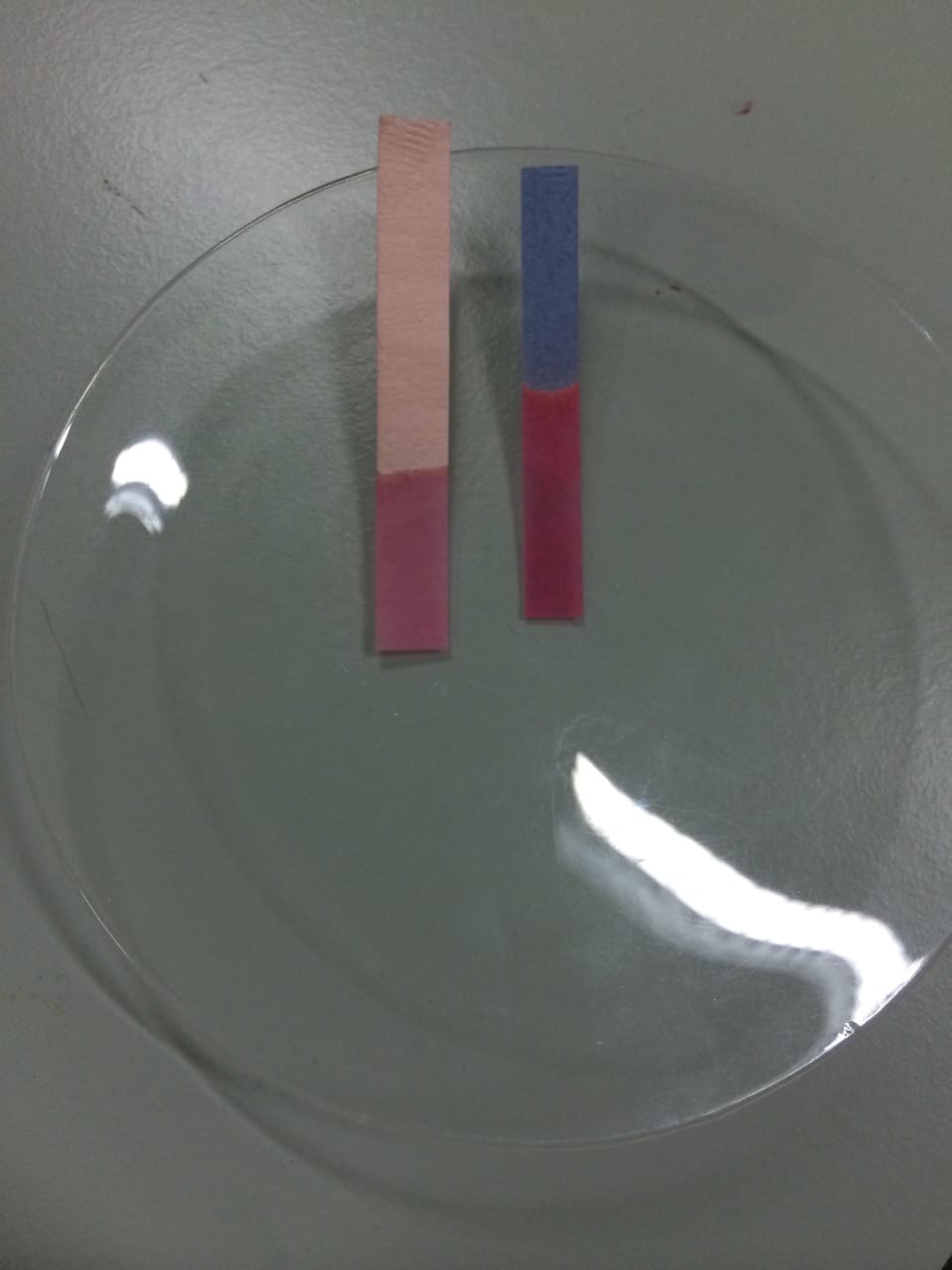
Litmus in acid. The lower ends of both strips were dipped in an acid. The blue strip turned red; the red strip stayed red. A base does the opposite: it turns red litmus blue. Image: Kanesskong, Wikimedia Commons · CC BY-SA 4.0
In a chemical reaction, substances change into new ones: milk turns into curd, iron rusts, coal burns. Many everyday reactions involve acids and bases — the sourness of lemon, the sting of an ant, the relief from an antacid. Exams ask about reaction types, which acid is in which food, litmus and pH, and the names of common salts.
On this page you will learn:
Types of chemical reaction; exothermic and endothermic
Oxidation and reduction; rusting and rancidity
Acids in food and in stings
Indicators and the pH scale; neutralisation
Common salts: baking soda, washing soda, bleaching powder, plaster of Paris
0–14
Range of the pH scale
Below 7 acidic, above 7 basic
7
pH of pure water
Neutral
NaHCO3
Baking soda
Asked in SI 2016
Types of chemical reaction
Rule in one line: a balanced equation has the same number of each atom on both sides.
QUICK FACT
Signs that a reaction has taken place: a change of colour, a gas given off, a change of temperature, or an insoluble solid (precipitate) forming. Equations are balanced because mass is conserved: 2H2 + O2 → 2H2O.
Type
What happens
Example
Combination
Two or more substances form one
CaO + H2O → Ca(OH)2
Decomposition
One substance breaks into simpler ones
CaCO3 → CaO + CO2 (on heating)
Displacement
A more reactive metal pushes out a less reactive one
Fe + CuSO4 → FeSO4 + Cu (blue turns green)
Double displacement
Two compounds swap partners, often giving a precipitate
Na2SO4 + BaCl2 → BaSO4 (white) + 2NaCl
Types of chemical reaction. One reaction can belong to two types: lime + water is both a combination and an exothermic reaction.
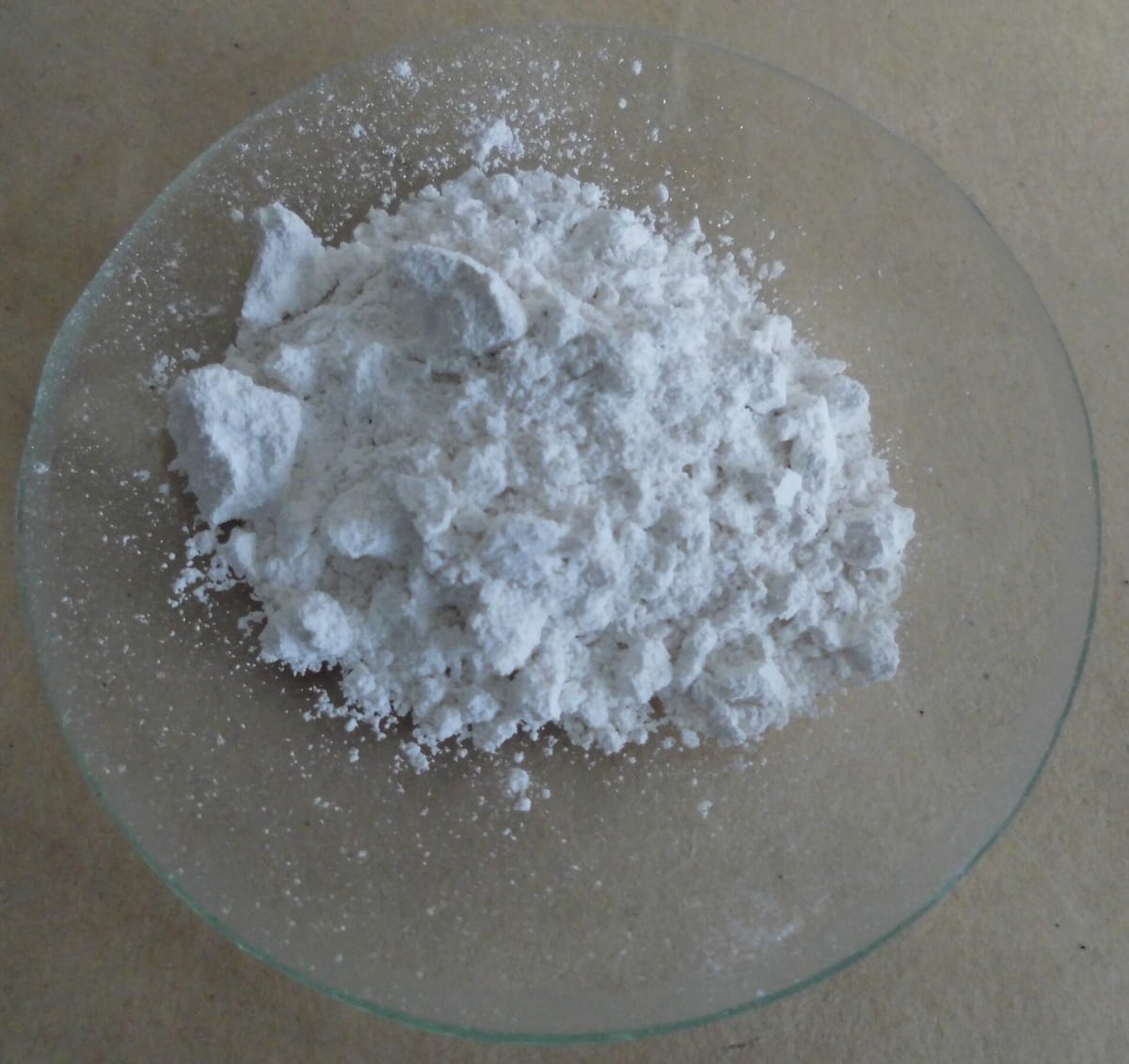
Quicklime (calcium oxide, CaO). With water it becomes slaked lime, Ca(OH)2, and gives out so much heat that the water may boil. Slaked lime is used for whitewash. Image: Leiem, Wikimedia Commons · CC BY-SA 4.0
EXOTHERMIC VS ENDOTHERMIC
Exothermic
Endothermic
Heat
Given out
Taken in
Mixture gets
Hotter
Colder
Examples
Burning, respiration, lime + water
Photosynthesis; heating limestone
QUICK CHECK
PYQ · RSMSSB LDC 2024 — CaO + H₂O → Ca(OH)₂ + Heat. The given chemical equation is: (a) a double displacement reaction (b) a combination reaction (c) a decomposition reaction (d) exothermic reaction. Choose the most appropriate answer.
Tap an option to answer
Answer: B — b and d only
Two substances join into one product (combination), and heat is given out (exothermic).
QUICK CHECK
PYQ · PPSC ICS 2016 — If two substances react and the temperature of the mixture increases, the reaction is
Tap an option to answer
Answer: D — Exothermic
A reaction that gives out heat warms the mixture: it is exothermic. PPSC OHE 2016 asked the same question.
Oxidation and reduction
Rule in one line: oxidation is gain of oxygen or loss of electrons; reduction is the opposite.
OXIDATION VS REDUCTION
Oxidation
Reduction
Oxygen
Gained
Lost
Hydrogen
Lost
Gained
Electrons
Lost
Gained
Example
C + O2 → CO2
CuO + H2 → Cu + H2O
Memory aid OIL RIG: Oxidation Is Loss, Reduction Is Gain (of electrons). When both happen together the reaction is called redox.
Slow oxidation
Rusting
Iron + oxygen + water gives reddish-brown rust.
Slow oxidation
Rancidity
Fats and oils in food go stale; chips packets are filled with nitrogen to stop it.
Fast oxidation
Burning
Coal, wood and LPG join oxygen quickly, giving heat and light.
Oxidation in daily life
QUICK CHECK
PYQ · PPSC OHE 2016 — Oxidation is a chemical reaction involving the:
Tap an option to answer
Answer: B — Loss of Electrons
In terms of electrons, oxidation is loss and reduction is gain. Protons stay in the nucleus during reactions.
QUICK CHECK
PYQ · RSMSSB LDC 2024 — Burning of coal to form carbon dioxide is a/an _____ reaction.
Tap an option to answer
Answer: C — Oxidation
C + O2 → CO2: carbon gains oxygen, so it is oxidised. It is also a combination and an exothermic reaction.
Acids and bases around us
Rule in one line: acids taste sour and turn blue litmus red; bases taste bitter, feel soapy and turn red litmus blue.
Source
Acid
Lemon, orange
Citric acid
Curd, sour milk
Lactic acid
Vinegar
Acetic acid
Tamarind, grapes
Tartaric acid
Tomato, spinach
Oxalic acid
Ant sting, nettle sting
Formic (methanoic) acid
Amla, citrus fruits (vitamin C)
Ascorbic acid
Apple
Malic acid
Our stomach
Hydrochloric acid
Natural sources of acids — one of the most-asked lists. 'Formic' comes from the Latin word for ant.
Base
Common name or use
Sodium hydroxide, NaOH
Caustic soda; soap making
Calcium hydroxide, Ca(OH)2
Slaked lime, lime water; whitewash
Magnesium hydroxide, Mg(OH)2
Milk of magnesia; antacid
Ammonium hydroxide, NH4OH
Window cleaners
Common bases. Bases that dissolve in water are called alkalis. Sulphuric acid is called the king of chemicals.
QUICK CHECK
PYQ · PPSC OHE 2016 — The acid present in lemons and oranges is:
Tap an option to answer
Answer: C — Citric acid
Citrus fruits get their sour taste from citric acid. Acetic acid is in vinegar; oxalic acid in tomato and spinach.
QUICK CHECK
PYQ · PPSC OHE 2016 — Milk contains …………… acid.
Tap an option to answer
Answer: C — Lactic
Bacteria turn the milk sugar (lactose) into lactic acid. That is what makes milk sour and sets curd.
Baking powder, antacid, soda-acid fire extinguisher
Washing soda
Sodium carbonate, Na2CO3·10H2O
Cleaning; removing hardness of water; glass making
Bleaching powder
Calcium oxychloride, CaOCl2
Disinfecting drinking water; bleaching cloth
Plaster of Paris
Calcium sulphate hemihydrate, CaSO4·½H2O
Plaster for broken bones, statues, toys
Gypsum
Calcium sulphate dihydrate, CaSO4·2H2O
Heated to make plaster of Paris; added to cement
Blue vitriol
Copper sulphate, CuSO4·5H2O
Turns white on heating as it loses its water
Important salts. Baking soda is not baker's yeast: yeast is a living fungus.
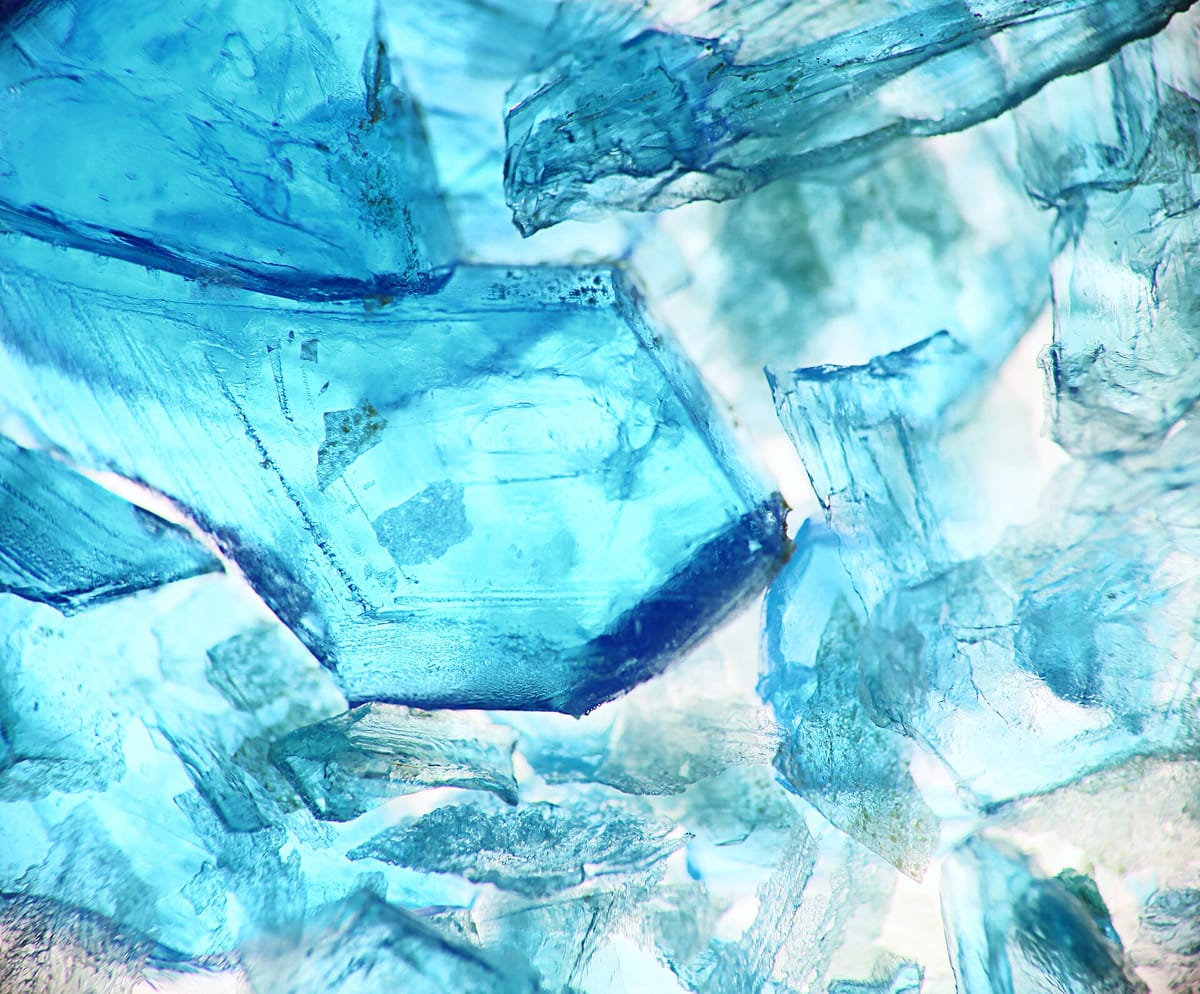
Copper sulphate (blue vitriol) crystals. The blue colour comes from water of crystallisation held inside the crystal. Heated, the crystals lose this water and turn white; add water and the blue comes back. Image: Дарья Могилевцева, Wikimedia Commons · CC BY 4.0
KEY TERM
Soda water and carbonic acid
Soda water is water with carbon dioxide dissolved in it under pressure. A little of the gas forms the weak carbonic acid, which gives the drink its slight sour bite. When the bottle is opened, the extra gas escapes as bubbles.
QUICK CHECK
PYQ · Punjab Police SI 2016 — Chemical name of baking soda is
Tap an option to answer
Answer: D — sodium bicarbonate
Baking soda is sodium bicarbonate, NaHCO3. On heating it gives carbon dioxide, which makes cakes rise. Sodium chloride is common salt.
QUICK CHECK
PYQ · Punjab Police Constable 2021 — Soda water contains which of the following gases?
Tap an option to answer
Answer: A — Carbon Dioxide
Soda water is carbonated: carbon dioxide is dissolved in it under pressure.
QUICK CHECK
PYQ · Punjab Police SI 2016 — The ‘stones’ formed in the human kidney consist mostly of
Tap an option to answer
Answer: D — calcium oxalate
Most kidney stones are calcium oxalate, a salt. 'Calcium' alone is only part of it, so it is not the best answer.
Traps and practice
Last revision — where the options try to fool you.
COMMON TRAPS
Oxidation is loss of electrons, not gain. Gain of electrons is reduction.
Temperature goes up = exothermic; goes down = endothermic.