Properties of metals and their exceptions, sodium in kerosene, ores like bauxite, rusting and galvanising, alloys, diamond and graphite, hydrocarbons, alcohols and soaps.
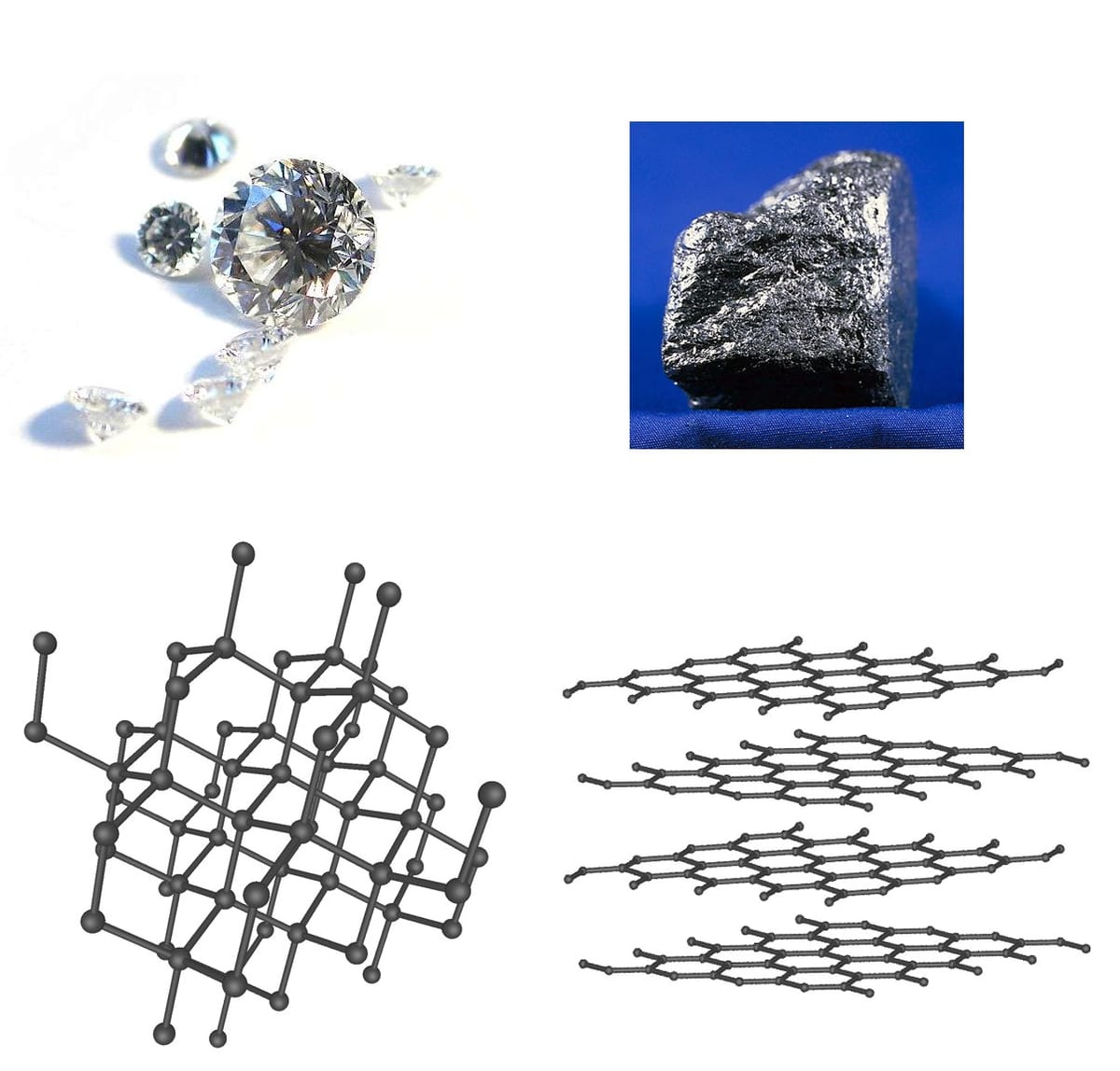
Diamond (left) and graphite (right) are both pure carbon. In diamond each carbon holds four others in a rigid 3-D net, so it is the hardest natural substance. In graphite the atoms form flat layers that slide, so it is soft and conducts electricity. Image: Itub, Wikimedia Commons · CC BY-SA 3.0
Elements are mostly metals (iron, copper, gold) or non-metals (oxygen, sulphur, carbon). Their properties decide their uses — copper for wires and pan bottoms, zinc to protect iron, aluminium for aircraft. Carbon is special: it forms millions of compounds, from diamond to every fuel and food. Exams love the exceptions and the everyday uses.
On this page you will learn:
Metals vs non-metals, and the exceptions
The reactivity series and ores
Rusting and how galvanising stops it
Alloys, and metals in living things
Carbon: diamond, graphite and other forms
Hydrocarbons, alcohols, soaps and detergents
4
Valency of carbon
It shares 4 electrons
Zn
Coat on galvanised iron
Asked in 4 PPSC/PSSSB papers
24
Carats in pure gold
Jewellery is often 22 carat
Metals and non-metals
Rule in one line: metals are shiny, malleable, ductile and good conductors; non-metals usually are not.
METALS VS NON-METALS
Metals
Non-metals
Look
Shiny (lustrous)
Dull
Beaten or drawn
Malleable, ductile
Brittle
Heat, electricity
Good conductors
Poor conductors
When struck
Ringing sound
Dull sound
Oxides
Basic (MgO)
Acidic (SO2, CO2)
Fact
Answer
Liquid metal at room temperature
Mercury
Liquid non-metal
Bromine
Metals soft enough to cut with a knife
Lithium, sodium, potassium
Lightest metal
Lithium
Metals that melt in the palm
Gallium, caesium
Shiny non-metal
Iodine
Non-metal that conducts electricity
Graphite
Hardest natural substance
Diamond
Best conductor of electricity
Silver, then copper
Most malleable and ductile
Gold
Highest melting point (bulb filament)
Tungsten
The exceptions and record-holders
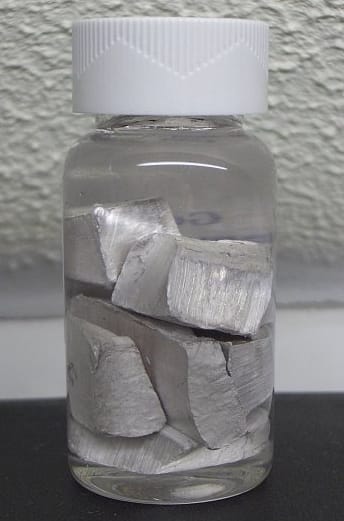
Sodium kept under oil. It reacts so fast with air and water that it is stored under kerosene. Its cut faces show how soft it is — it can be cut with a knife. Image: W. Oelen, Wikimedia Commons · CC BY-SA 3.0
QUICK CHECK
PYQ · PPSC OHE 2016 — Which of the following does NOT describe a metal?
Tap an option to answer
Answer: D — Brittle
Brittleness belongs to non-metals such as sulphur and phosphorus. Metals bend and stretch instead of breaking.
QUICK CHECK
PYQ · RSMSSB LDC 2024 — Which of the following metals can easily be cut with a knife?
Tap an option to answer
Answer: A — Lithium
Lithium, like sodium and potassium, is a soft alkali metal. Magnesium, aluminium and copper are much harder.
QUICK CHECK
PYQ · RSMSSB LDC 2024 — Sodium metal is stored in:
Tap an option to answer
Answer: A — Kerosene
Sodium catches fire with water and reacts with air, so it is kept under kerosene, which does not react with it.
Reactivity and ores
Rule in one line: a more reactive metal pushes a less reactive one out of its compound.
KEY TERM
Reactivity series
Metals listed from most to least reactive. Potassium and sodium at the top react violently with water. Gold and silver at the bottom hardly react, so they are found free in nature and used for jewellery.
K→Na→Ca→Mg→Al→Zn→Fe→Pb→Cu→Hg→Ag→Au
Metal
Main ore
Aluminium
Bauxite
Iron
Haematite
Mercury
Cinnabar
Lead
Galena
Zinc
Zinc blende
Copper
Copper pyrites
An ore is a mineral from which a metal can be taken out at a profit.
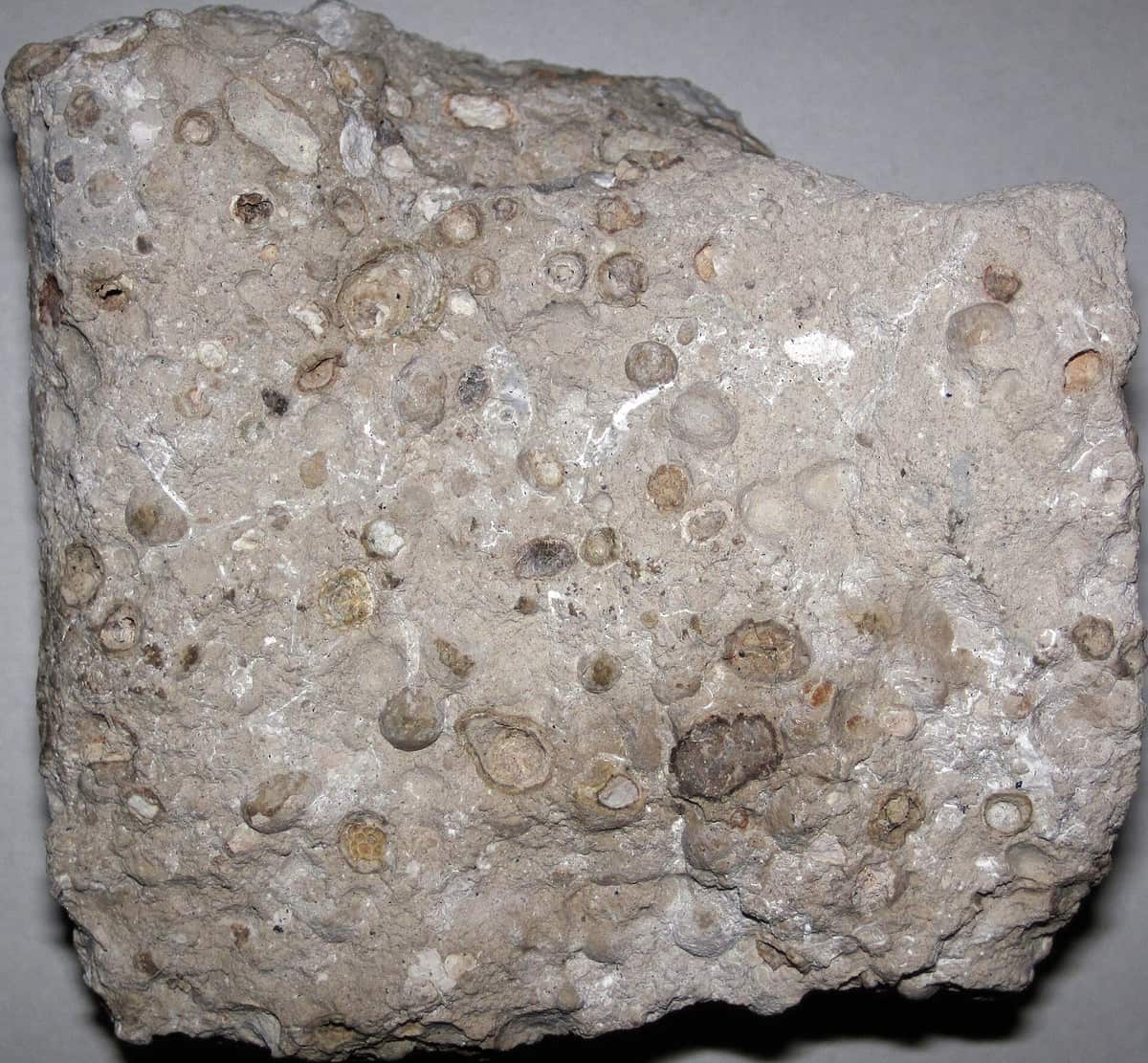
Bauxite, the main ore of aluminium (from Arkansas, USA). It is rich in aluminium oxide. In India it is mined in Odisha, Jharkhand and Gujarat. Image: James St. John, Wikimedia Commons · CC BY 2.0
QUICK CHECK
PYQ · PPSC ICS 2016 — The metal extracted from the ore bauxite is
Tap an option to answer
Answer: A — Aluminium
Bauxite is purified to alumina, and aluminium is then taken out by electrolysis. Iron comes from haematite.
Rusting and how to stop it
Rule in one line: iron rusts only when both air (oxygen) and water are present.
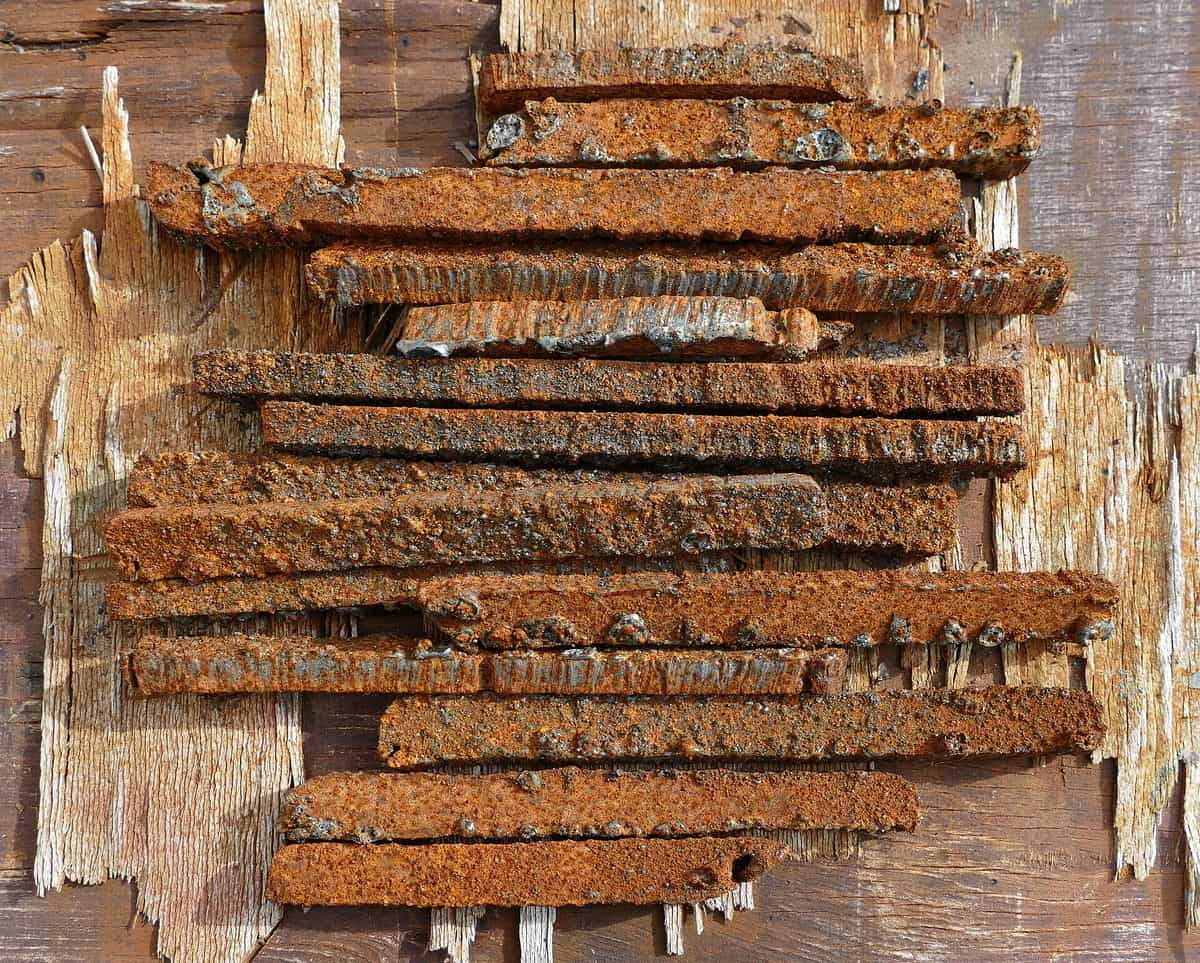
Rust on scrap iron. Rust is reddish-brown iron oxide; it flakes off and lets the iron below rust too. Rusting is a chemical change and a slow oxidation. Salt water makes it faster. Image: W.carter, Wikimedia Commons · CC BY-SA 4.0
HOW IRON RUSTS
1
Iron
Fe
↓
2
+ oxygen of air
↓
3
+ water or moisture
↓
4
Rust
Hydrated iron oxide
Method
How it works
Paint, oil, grease
Keeps air and water away
Galvanisation
A coat of zinc; zinc is more reactive and corrodes first, saving the iron
Tin plating
A coat of tin, used on food cans
Chromium plating
Shiny coat on taps and bicycle parts
Alloying
Stainless steel (with chromium and nickel) does not rust
Copper slowly gets a green coat (basic copper carbonate); silver turns black (silver sulphide). Coating one metal on another using electricity is electroplating.
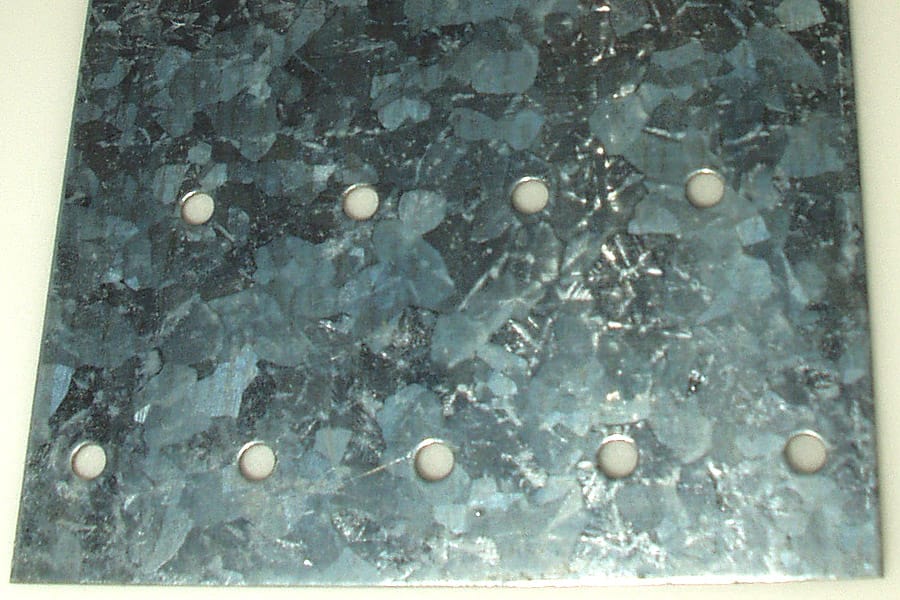
A hot-dip galvanised steel plate. The flake-like pattern is the zinc coat that crystallised as it cooled. Galvanised iron (GI) sheets and water pipes are made this way. Image: Splarka, Wikimedia Commons · Public domain
QUICK CHECK
PYQ · PPSC EO 2018 — Galvanised iron sheets are protected from rusting due to the presence of a layer of:
Tap an option to answer
Answer: C — Zinc
Galvanising is coating iron with zinc. PPSC SSO 2018 and PPSC SEVE 2016 asked the same fact.
QUICK CHECK
PYQ · PSSSB Election Kanungo 2018 — The process of coating iron pipes with a layer of zinc to prevent corrosion is termed as:
Tap an option to answer
Answer: B — Galvanization
Zinc coating is galvanization. Vulcanization is hardening rubber with sulphur; annealing is slow heating and cooling of metal.
QUICK CHECK
PYQ · RSMSSB LDC 2024 — Identify the statements which are incorrect with respect to rusting: (a) coat of paint on iron rods prevents rusting (b) galvanised water pipes are not normally used in homes (c) rusting is a physical change (d) salt water makes the process of rust formation faster.
Tap an option to answer
Answer: D — b and c only
(b) is wrong: galvanised pipes are common in homes. (c) is wrong: rusting is a chemical change. (a) and (d) are true.
Alloys and metals at work
Rule in one line: a metal is chosen for the job its properties suit best.
Alloy
Made of
Use
Brass
Copper + zinc
Utensils, fittings
Bronze
Copper + tin
Statues, medals
Steel
Iron + a little carbon
Buildings, tools
Stainless steel
Iron + chromium + nickel + carbon
Utensils; does not rust
Solder
Lead + tin
Joining wires (low melting point)
Amalgam
Mercury + another metal
Dental fillings (older use)
Common alloys. 22-carat gold is 22 parts gold to 2 parts copper or silver, which makes it harder than 24-carat gold.
Copper
Pan bottoms, wires
Conducts heat far better than steel, so food heats evenly.
Magnesium
Chlorophyll
The metal at the centre of the green pigment of leaves.
Iron
Haemoglobin
The metal in the red pigment of blood that carries oxygen.
Mercury
Poison
Builds up in fish and people; it causes Minamata disease.
Metals at work in kitchens and in living things
QUICK CHECK
PYQ · PPSC EO 2018 — Why are stainless steel cooking pans fabricated with copper bottom?
Tap an option to answer
Answer: B — Conductivity of copper is more than the stainless steel
Copper is a much better conductor of heat. The copper base spreads heat quickly and evenly across the pan.
QUICK CHECK
PYQ · PPSC OHE 2016 — Chlorophyll is a naturally occurring compound in which the central metal is:
Tap an option to answer
Answer: D — Magnesium
Magnesium sits at the centre of chlorophyll. The similar ring in haemoglobin holds iron.
Carbon and its forms
Rule in one line: allotropes are different forms of the same element.
Allotrope
Structure
Properties and uses
Diamond
Each carbon joined to 4 others in a rigid 3-D net
Hardest natural substance; does not conduct; cutting tools, jewellery
Coal is not an allotrope: it is an impure fuel made mostly of carbon with other substances mixed in.
QUICK CHECK
PYQ · Punjab Police Constable 2021 — Diamond is made of which element?
Tap an option to answer
Answer: B — Carbon
Diamond is pure carbon. PPSC OHE 2016 asked the same: diamond is chemically pure carbon.
QUICK CHECK
PYQ · PPSC JEE 2022 — Carbon, diamond and graphite are together called:
Tap an option to answer
Answer: A — Allotropes
Diamond and graphite are allotropes: the same element, carbon, in different forms. Isotopes differ in neutrons, not in structure.
QUICK CHECK
PYQ · PPSC OHE 2016 — Which one of the following is not an allotrope of carbon?
Tap an option to answer
Answer: A — Coal
Coal is an impure mixture, not a pure form of carbon. Diamond, graphite and graphene are allotropes.
Carbon compounds, alcohols and soaps
Rule in one line: carbon shares electrons and links to itself in long chains, so it forms millions of compounds.
KEY TERM
Why carbon is special
Carbon has 4 outer electrons, which it shares to make covalent bonds (valency 4). Carbon atoms also join one another in long chains, branches and rings — this is catenation. Most carbon compounds are poor conductors and have low melting and boiling points.
4 outer electrons→Shares them→Joins other carbons→Millions of compounds
Family
Carbon–carbon bond
First member
Alkanes (saturated)
Single only
Methane, CH4
Alkenes (unsaturated)
At least one double
Ethene, C2H4
Alkynes (unsaturated)
At least one triple
Ethyne (acetylene), C2H2 — welding
Hydrocarbons contain only carbon and hydrogen.
Name ends in
Family
Example
-ane
Alkane
Propane (in LPG)
-ol
Alcohol (–OH group)
Propanol, ethanol
-al
Aldehyde
Methanal (formalin)
-oic acid
Carboxylic acid
Ethanoic acid (vinegar)
The end of the name tells the family. Ethanol is the alcohol in drinks and is blended with petrol as a fuel.
SOAP VS DETERGENT
Soap
Detergent
Salt of
Long-chain carboxylic acid
Sulphonic acid
In hard water
Forms scum
Works well
Breaks down in nature
Yes
Often not
Soap molecules wrap oily dirt with their oil-loving tails and face the water with their water-loving heads. These balls are micelles; they lift the dirt into the water.
QUICK CHECK
PYQ · RSMSSB LDC 2024 — Identify from the following statements which are true for carbon compounds: (a) They form long chains of carbon atoms which are arranged in branch and ring structures. (b) They are good conductors of electricity. (c) They have high melting and boiling points. (d) They form covalent bonds.
Tap an option to answer
Answer: B — a and d only
Chains (a) and covalent bonds (d) are true. Carbon compounds are poor conductors and have low melting and boiling points.
QUICK CHECK
PYQ · PPSC OHE 2016 — A hydrocarbon in which all the atoms are connected by single bonds is:
Tap an option to answer
Answer: A — An alkane
Only single bonds means a saturated hydrocarbon: an alkane, such as methane. Alkenes have a double bond, alkynes a triple bond.
QUICK CHECK
PYQ · RSMSSB LDC 2024 — Propanol is an:
Tap an option to answer
Answer: D — Alcohol
The ending '-ol' means an –OH group, so propanol is an alcohol.
QUICK CHECK
PYQ · RSMSSB LDC 2024 — Identify the true statements related to soaps and detergents: (a) Soaps are sodium or potassium salts of long chain of sulphuric acids while detergents are generally sodium salts of carboxylic acids. (b) The soap molecules form micelles when they interact with water and dirt (Oil). (c) These micelles are able to pull out the dirt in water. (d) Soaps are effective in hardwater also. (e) The detergent remain ineffective in hard water.
Tap an option to answer
Answer: C — b and c
(b) and (c) are true. (a) swaps soap and detergent; soaps fail in hard water (d is false); detergents work in it (e is false).
Traps and practice
Last revision — where the options try to fool you.
COMMON TRAPS
Brittle describes non-metals, not metals.
Galvanising = zinc, not tin, lead or chromium.
Vulcanisation is for rubber (with sulphur), not for iron.
Rusting is a chemical change; salt water speeds it up.