Heat and temperature, the three scales, steam and latent heat, how heat travels, air pressure and boiling, floating, friction, SI units and the instruments exams ask about.
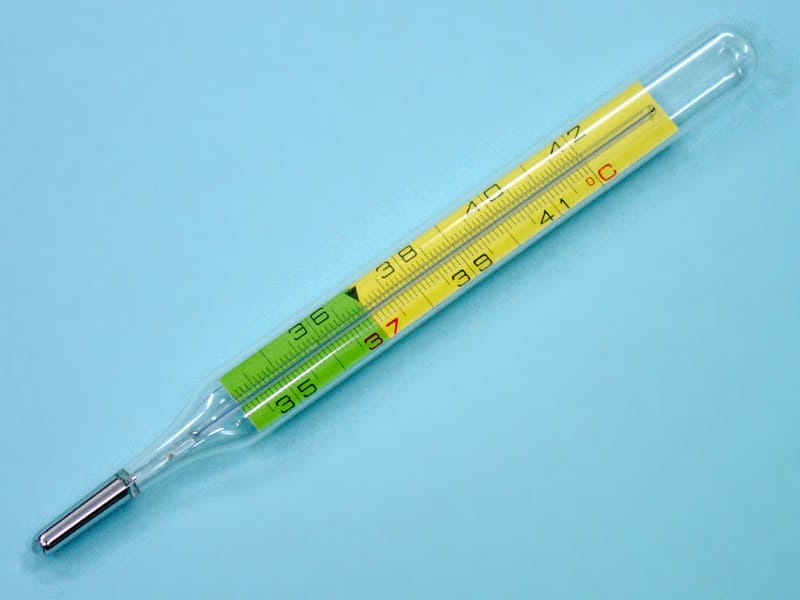
A glass clinical thermometer. Its scale runs only from 35 °C to 42 °C, the range of human body temperature. Normal body temperature, about 37 °C (98.6 °F), is marked in red. A kink near the bulb stops the liquid from falling back before you read it. Image: Daniel FR, Wikimedia Commons · Public domain
A doctor's thermometer, a burn from steam, dal that takes long to cook in the hills, an iron ship that floats, a tyre with deep treads — all of this is everyday physics. Exams ask you to convert Celsius, Fahrenheit and Kelvin, to explain boiling and pressure, to say why things float, to rank kinds of friction, and to match an instrument with what it measures.
On this page you will learn:
Heat vs temperature, the three scales, thermometers and the thermostat
Latent heat, steam burns and the odd behaviour of water
Conduction, convection, radiation and sea breeze
Air pressure, boiling in the hills and Bernoulli's principle
Floating, density, the lactometer, viscosity and surface tension
Friction, SI units and measuring instruments
37 °C
Normal body temperature
= 98.6 °F
−40
Same on °C and °F
The only such reading
4 °C
Water is densest
So lakes freeze from the top
Heat and temperature
Rule in one line: heat is energy that flows from hot to cold; temperature tells how hot a body is.
HEAT VS TEMPERATURE
Heat
Temperature
What it is
A form of energy
Degree of hotness
SI unit
Joule (J)
Kelvin (K)
Other unit
Calorie
°C, °F
Measured with
Calorimeter
Thermometer
Heat always flows from the hotter body to the colder one, until both reach the same temperature.
KEY TERM
Temperature scales
On the Celsius scale, water freezes at 0 °C and boils at 100 °C. On the Fahrenheit scale, these are 32 °F and 212 °F. The Kelvin scale is the SI scale. It starts at absolute zero, 0 K, about −273 °C. It is written K, with no degree sign. Use F = 9C/5 + 32 and K = C + 273.
Point
Celsius
Fahrenheit
Kelvin
Ice melts
0 °C
32 °F
273 K
Normal human body
37 °C
98.6 °F
310 K
Water boils at sea level
100 °C
212 °F
373 K
°C equals °F
−40 °C
−40 °F
233 K
A change of 1 °C equals a change of 1 K, and of 1.8 °F.
TWO KINDS OF THERMOMETER
Clinical thermometer
Laboratory thermometer
Measures
Body temperature
Other things
Range
35 °C to 42 °C
−10 °C to 110 °C
Kink near bulb
Yes; mercury stays up
No; read it in place
Mercury is poisonous, so digital thermometers are now common. Mercury freezes at about −39 °C, so very cold places use alcohol thermometers.
KEY TERM
Thermostat
A thermometer only measures temperature. A thermostatregulates it. It senses the temperature and switches a heater or cooler on and off to hold it steady. Electric irons, geysers, fridges and ovens have one. Many use a bimetallic strip, two metals that bend when heated.
Senses→Switches→Steady temperature
KEY TERM
Latent heat
While ice melts or water boils, the temperature does not rise. The heat goes into changing the state. This hidden heat is latent heat. Steam at 100 °C holds about 22.5 × 10⁵ J per kg more than water at 100 °C. When steam touches skin it condenses and gives out this extra heat. So a steam burn is worse than a burn from boiling water.
WATER BREAKS THE RULE
Most things shrink when cooled. Water shrinks down to 4 °C, then expands from 4 °C to 0 °C. Water also expands when it freezes, so ice is lighter and floats. Water is densest at 4 °C. In winter a lake freezes at the top; the water below stays near 4 °C, and fish live. Frozen water pipes can burst for the same reason.
QUICK CHECK
PYQ · Punjab Police SI 2016 — A thermostat is a device for
Tap an option to answer
Answer: C — Regulating temperature
A thermostat keeps a temperature steady by switching devices on and off. Measuring is the thermometer's job.
QUICK CHECK
PYQ · Punjab Police SI 2016 — Scalding with steam is more severe than scalding by boiling water because of which of the following?
Tap an option to answer
Answer: C — Steam contains more energy than boiling water
Both are at 100 °C. Steam also carries latent heat, which it gives out on the skin as it condenses.
QUICK CHECK
PYQ · PPSC OHE 2016 — Which word completes the sentence: Water __________ when it freezes?
Tap an option to answer
Answer: A — Expands
Water expands as it turns into ice. That is why ice floats and frozen pipes can burst.
How heat travels
Rule in one line: solids conduct, liquids and gases convect, and radiation needs no medium.
Mode
How heat moves
Example
Conduction
From particle to particle; mainly in solids
A steel spoon in hot tea gets hot
Convection
Warm liquid or gas rises; cool part takes its place
Water heating in a pan; sea breeze
Radiation
Travels with no medium, even through space
Sun's heat reaching Earth
Metals are good conductors, so pans are made of them. Wood, plastic, wool and air are poor conductors, so handles are made of wood or plastic.
COASTAL BREEZES ARE CONVECTION
Sea breeze
Land breeze
When
Daytime
Night
Warmer side
Land
Sea
Blows from
Sea to land
Land to sea
Land heats and cools faster than water. A breeze is named after the place it comes from.
QUICK FACT
Dark surfaces absorb more heat; light colours reflect it. So we wear light clothes in summer. Wool keeps us warm because it traps air, a poor conductor. Two thin blankets are warmer than one thick one, because of the air layer between them.
KEY TERM
Thermos (vacuum) flask
A thermos blocks all three modes of heat transfer. Its double glass wall has a vacuum in between, which stops conduction and convection. The walls are silvered, which reflects radiation. An insulating stopper closes the top. When a system can exchange no heat with its surroundings, the process is called adiabatic.
Vacuum: no conduction→Vacuum: no convection→Silvering: radiation back
Process
What stays fixed
Adiabatic
No heat goes in or out
Isothermal
Temperature
Isochoric
Volume
Isobaric
Pressure
Four process names for a gas. 'Iso' means 'same'.
QUICK CHECK
PYQ · PSSSB Excise Inspector 2023 — What do we call the process in which no exchange of heat energy takes place between the gas and the surroundings?
Tap an option to answer
Answer: A — Adiabatic
Adiabatic means no heat exchange. Isothermal keeps temperature fixed; isochoric, volume; isobaric, pressure.
Pressure, air pressure and boiling
Rule in one line: pressure = force ÷ area; less air pressure means a lower boiling point.
KEY TERM
Pressure
Pressure = Force ÷ Area. Its SI unit is the pascal (Pa), 1 newton per square metre. The same force on a smaller area gives more pressure. So a sharp knife cuts better, and school bags have wide straps.
Force→÷ Area→Pressure→Pa = N/m²
Liquid pressure grows with depth. Water spurts farthest from the lowest hole of a bottle. A dam wall is thicker at the bottom to hold the greater push there. Gases press on their container too; that is why a balloon swells.
KEY TERM
Atmospheric pressure
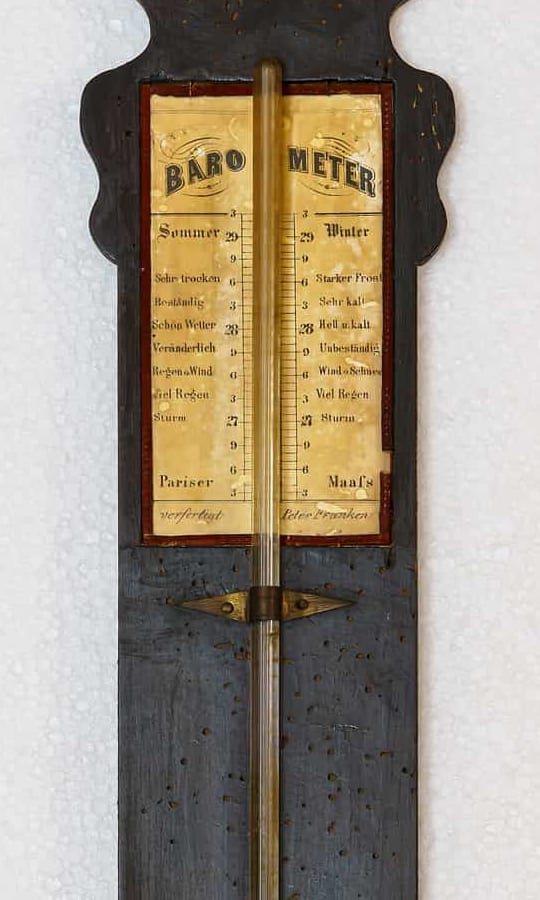
The air around us presses on everything. At sea level this pressure equals a mercury column about 76 cm high, about 1 × 10⁵ Pa. A barometer measures it. Air pressure falls with height.
Top of a 19th-century mercury barometer from Germany (photo cropped). Air pressure holds up the mercury in the glass tube, and its height is read on the scale. A falling reading warns of rain or storm; a rising one means fair weather. Image: Franz van Duns, Wikimedia Commons · CC BY-SA 4.0
WHY DAL TAKES LONGER IN THE HILLS
1
Go up a mountain
↓
2
Air pressure is lower
↓
3
Water boils below 100 °C
↓
4
Food gets less heat; cooks slowly
A pressure cooker does the opposite. It raises the pressure, so water boils above 100 °C and food cooks fast.
KEY TERM
Bernoulli's principle
Where a fluid moves faster, its pressure is lower. Air rushes faster over the curved top of an aeroplane wing, so the pressure there falls and the wing is lifted. A strong wind over a roof can lift a tin sheet for the same reason.
Faster flow→Lower pressure→Lift
QUICK CHECK
PYQ · Punjab Police SI 2016 — It takes much longer to cook things in the hills than in the plains, because
Tap an option to answer
Answer: B — In the hills the atmospheric pressure is lower than in the plains and therefore water boils at lower temperature
Low pressure lowers the boiling point, so the boiling water is not hot enough to cook fast. Option A wrongly says the boiling point is raised.
QUICK CHECK
PYQ · Punjab Police SI 2021 — The theory that states that speed of a fluid increases with a decrease in static pressure upon it or with the decrease in the fluid's potential energy is known as:
Tap an option to answer
Answer: A — Bernoulli's Principle
Faster fluid, lower pressure: that is Bernoulli's principle. The other three are advanced equations of fluid flow.
Floating, density and liquids
Rule in one line: the upward push equals the weight of the liquid pushed aside.
KEY TERM
Buoyancy and Archimedes' principle
A liquid pushes up on anything put in it. This is buoyant force or upthrust. Archimedes' principle: the upthrust equals the weight of the liquid displaced. It does not depend on the body's shape or depth. Ships, hydrometers and lactometers work on this.
Idea
Meaning
Density
Mass per volume; water is 1000 kg/m³
Floats
Less dense than the liquid, like cork and ice
Sinks
Denser than the liquid, like an iron nail
Relative density
Density ÷ density of water; no unit
An iron ship floats because its hollow shape pushes aside its own weight of water. Salty sea water is denser, so it is easier to float in the sea.
THE LACTOMETER AND SKIMMED MILK
A lactometer floats in milk. How deep it sinks shows the milk's density. Water added to milk lowers its density. But fat is lighter than milk, so skimmed milk is denser than whole milk. Add water to skimmed milk and its density can look normal again. So a lactometer cannot catch watered skimmed milk.
TWO PROPERTIES OF LIQUIDS
Viscosity
Surface tension
What it is
Inner friction of a fluid
Pull that makes a surface act like a stretched skin
Example
Honey flows slower than water
Drops are round; insects walk on water
Unit
Poise; stokes for kinematic viscosity
Newton per metre
When heated
Liquids get thinner
Gets weaker
Hot soup has low surface tension, so butter stays in drops. As the soup cools, its surface tension rises and spreads the butter into a thin layer.
QUICK CHECK
PYQ · PPSC TM 2015 — Buoyancy depends on:
Tap an option to answer
Answer: C — The mass of the liquid displaced
By Archimedes' principle, upthrust equals the weight (mass × g) of the liquid displaced.
QUICK CHECK
PYQ · PPSC PCSEB 2018 — Consider the following statements: 1) A lactometer cannot test adulteration of skimmed milk correctly. 2) The density of skimmed milk is less than that of unskimmed milk. Which of the above statements is/are true?
Tap an option to answer
Answer: C — 1 only
Statement 1 is true. Statement 2 is false: removing light fat makes skimmed milk denser, not lighter.
QUICK CHECK
PYQ · Punjab Police SI 2021 — Stokes is the physical unit of:
Tap an option to answer
Answer: C — Kinematic viscosity
The stokes is a CGS unit of kinematic viscosity. Pressure is in pascals; surface tension in newtons per metre.
QUICK CHECK
PYQ · PPSC PRIN 2020 — Butter floats in droplets on the surface of a hot soup. But when the soup cools, the droplets spread out to form a thin layer on the surface. This happens because
Tap an option to answer
Answer: C — Surface tension of the soup increases on cooling
Surface tension falls as a liquid heats and rises as it cools. The stronger pull of the cool soup's surface spreads the butter.
Friction
Rule in one line: friction opposes motion; static is the largest, then sliding, and rolling is the smallest.
KEY TERM
Friction
Friction is the force that opposes motion between two touching surfaces. Tiny bumps on the surfaces lock into each other. Rough surfaces and harder pressing give more friction. Friction always acts against the motion, and it makes heat — rub your palms and feel it.
KINDS OF FRICTION, LARGEST TO SMALLEST
Largest
Static friction
Before motion starts
↓
Sliding friction
One surface slides on another
↓
Smallest
Rolling friction
A wheel or ball rolls
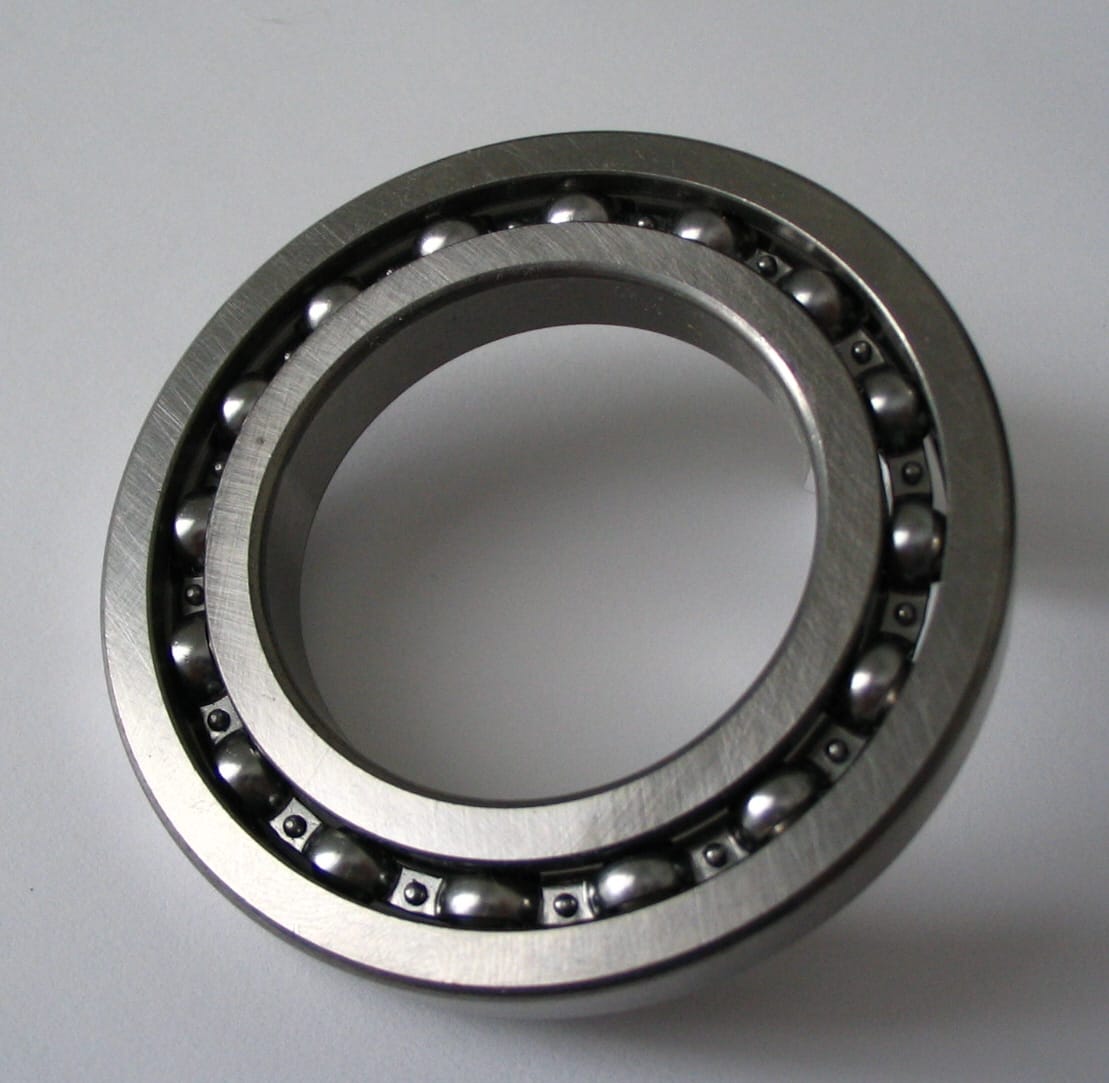
Rolling a heavy drum is easier than sliding it. That is why wheels and ball bearings save effort.A ball bearing. The steel balls roll between the two rings, so the parts do not slide on each other. Rolling friction is less than sliding friction, so bearings in fans, cycles and motors save energy and wear. Image: Solaris2006, Wikimedia Commons · CC BY-SA 3.0
WAYS TO INCREASE FRICTION
Treads on tyres
Grooves on shoe soles
Brake pads pressing the wheel
Kabaddi players rub soil on hands
WAYS TO REDUCE FRICTION
Oil and grease between moving parts
Ball bearings in fans and cycles
Wheels on suitcases
Powder on a carrom board
KEY TERM
Fluid friction (drag)
Air and water also slow down things moving through them. This is drag. It depends on speed and shape. A streamlined shape — pointed in front, like a fish or a bird — cuts drag. Aeroplanes, boats and racing cars are built this way.
A NECESSARY EVIL
Without friction we could not walk, write or stop a cycle. But friction also wears out tyres and machine parts, and wastes energy as heat. So we add it where we need grip and cut it where we need smooth motion.
Units and measuring instruments
Rule in one line: the SI system has seven base units; every other unit is built from them.
Quantity
SI base unit
Symbol
Length
metre
m
Mass
kilogram
kg
Time
second
s
Electric current
ampere
A
Temperature
kelvin
K
Amount of substance
mole
mol
Luminous intensity
candela
cd
SI means the International System of Units.
Quantity
Unit
Made of
Force
newton (N)
kg m/s²
Work, energy, heat
joule (J)
N m
Power
watt (W)
J/s
Pressure
pascal (Pa)
N/m²
Frequency
hertz (Hz)
1 per second
Some other units: light year (distance), nautical mile = 1852 m, calorie ≈ 4.2 J, bar = 10⁵ Pa.
Instrument
Measures
Thermometer
Temperature
Barometer
Air pressure
Hygrometer
Humidity of air
Hydrometer
Density of liquids
Lactometer
Purity of milk
Anemometer
Wind speed
Seismograph
Earthquake waves
Spring balance
Force, such as weight
Hygro = moisture, hydro = water, anemo = wind, seismo = shaking. The word root gives the answer.
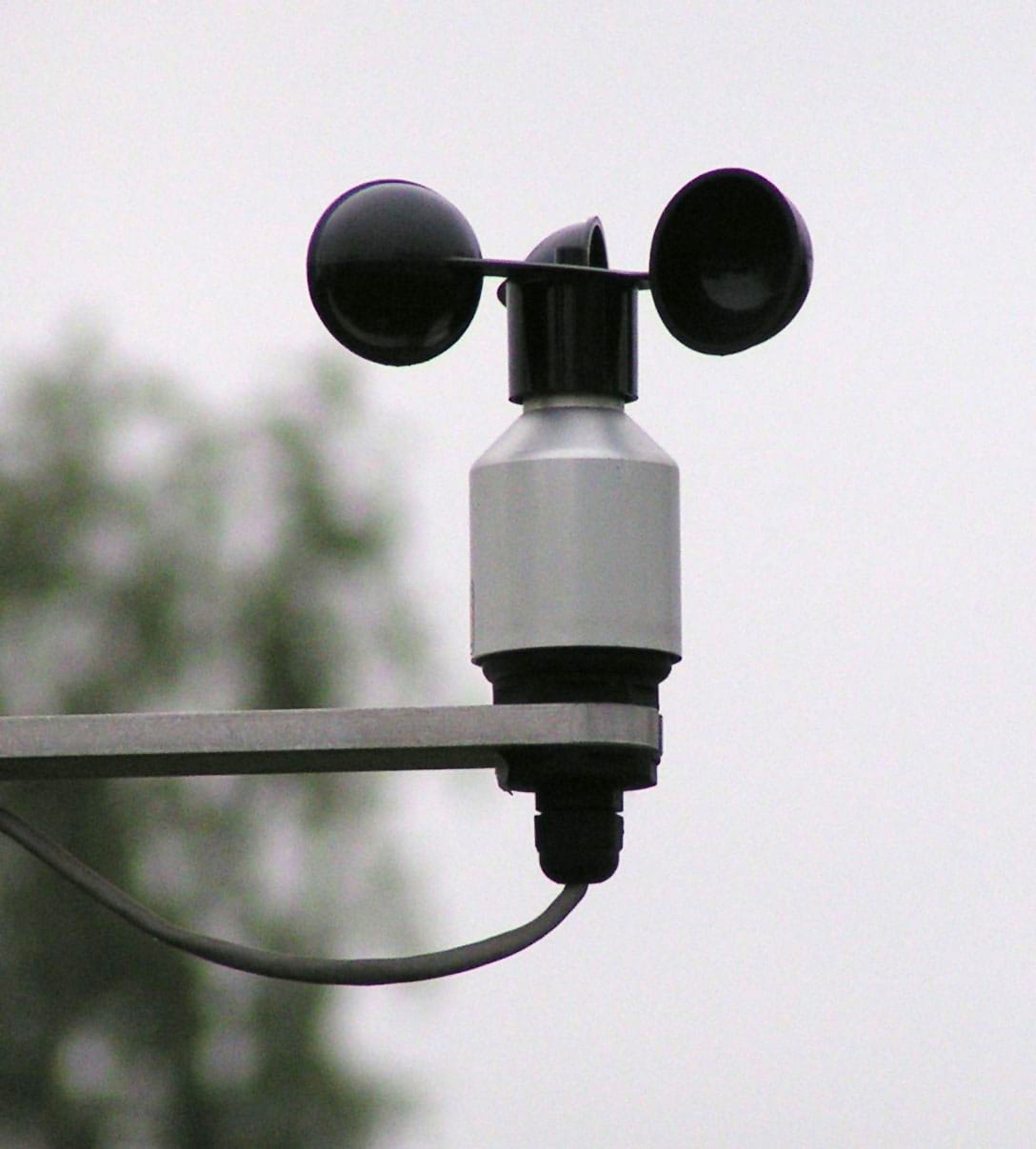
A cup anemometer. The wind spins the cups; the faster they turn, the stronger the wind. An anemometer measures wind speed (anemo = wind). Image: Stefan Kühn, Wikimedia Commons · CC BY 3.0
QUICK CHECK
PYQ · PPSC OHE 2016 — Humidity in the air is measured by
Tap an option to answer
Answer: B — Hygrometer
A hygrometer measures humidity. A hydrometer measures the density of liquids; an opisometer measures curved lines on a map.
QUICK CHECK
PYQ · Punjab Patwari 2016 — Which instrument is used to measure velocity of wind?
Tap an option to answer
Answer: C — Anemometer
An anemometer, often with spinning cups, measures wind speed. An actinometer measures the strength of sunlight.
QUICK CHECK
PYQ · Punjab Election Kanungo 2021 — The instrument used for recording earthquake waves is:
Tap an option to answer
Answer: D — seismograph
A seismograph records earthquake waves. Punjab Excise Inspector 2018 asked the same question.
Earthquakes: more factsTap to open
The Earth's outer layer is made of moving plates. When plates rub, collide or slide under each other, an earthquake can occur.
Size is given on the Richter scale. A rise of 2 on the scale means about 1000 times more destructive energy.
The point on the surface right above the start of an earthquake is the epicentre.
Indoors, take cover under a strong table, away from glass. Outdoors, move to an open place away from buildings and wires.
The scales are named after Anders Celsius, Daniel Gabriel Fahrenheit and Lord Kelvin. The pascal honours Blaise Pascal.
Traps and practice
Last revision — where the options try to fool you.
COMMON TRAPS
A thermostat regulates temperature; a thermometer measures it.
Steam burns more because of latent heat, not because it is hotter than 100 °C.
In the hills water boils at a LOWER temperature, not a higher one.
Water expands on freezing and is densest at 4 °C, not 0 °C.