Part of the Punjab Police ASI 2026 course.Practise Life Processes: Digestion, Respiration, Transport and Excretion questions →Take a mock test →
GENERAL SCIENCE · CLASS 8–10 SERIES

Life Processes: Digestion, Respiration, Transport and Excretion

How food is digested, how cells release energy, how the heart and blood work, how sap moves in plants, and how the kidneys clean the blood.

Punjab PolicePSSSBPPSC16 MIN READ

Every living thing must do four jobs to stay alive. It takes in food (nutrition), releases energy from it (respiration), moves materials around (transport) and throws out wastes (excretion). These are the life processes. Papers mostly ask which organ, juice, vessel or blood cell does which job.

On this page you will learn:

  • Modes of nutrition: autotrophic and heterotrophic
  • The human digestive system, its juices and enzymes
  • Aerobic and anaerobic respiration; the lungs
  • Heart, blood vessels, blood cells and blood groups
  • Transport in plants: xylem and phloem
  • Kidneys, nephrons, urine and dialysis
4
Chambers in the human heart
2 atria and 2 ventricles
72
Heartbeats per minute at rest
In an adult
15–18
Breaths per minute at rest
In an adult (NCERT class 7)

Modes of nutrition

Rule in one line: green plants make their own food; animals depend on others.

TWO MODES OF NUTRITION
Autotrophic
Heterotrophic
Food
Made by the organism
Taken from others
Raw materials
CO2, water, sunlight
Ready-made food
Examples
Green plants, algae
Animals, fungi
Heterotrophic typeHow food is takenExamples
HolozoicSolid food is eaten, then digested insideHumans, cow, amoeba
SaprophyticFood is absorbed from dead, decaying matterMushroom, bread mould
ParasiticFood is taken from a living host, harming itCuscuta (amarbel), lice, tapeworm
Kinds of heterotrophic nutrition

Human digestion

Rule in one line: big food molecules are broken into small ones that the blood can absorb.
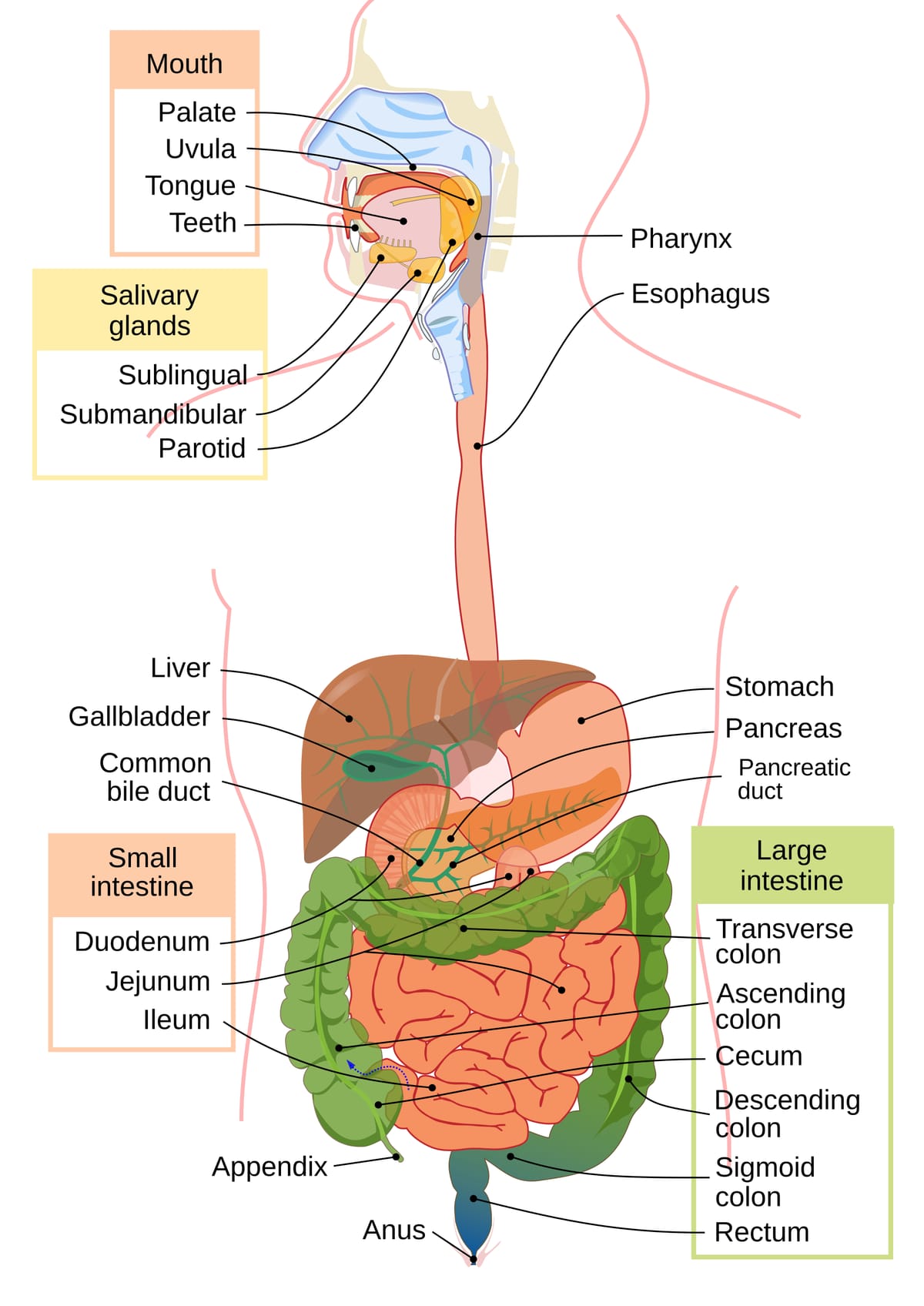
Labelled diagram of the human digestive system from the mouth and salivary glands down the oesophagus to the stomach, liver, gall bladder, pancreas, small and large intestine, rectum and anus
The alimentary canal runs from mouth to anus. The liver (largest gland) makes bile, stored in the gall bladder. The pancreas pours its juice into the duodenum, the first part of the small intestine. Image: Mariana Ruiz and Jmarchn, Wikimedia Commons · Public domain
THE PATH OF FOOD
  1. 1
    Mouth
    Teeth chew food; saliva starts turning starch into sugar.
  2. 2
    Food pipe (oesophagus)
    Wave-like squeezing called peristalsis pushes food down.
  3. 3
    Stomach
    Hydrochloric acid kills germs; pepsin starts digesting proteins; mucus protects the wall.
  4. 4
    Small intestine
    Bile, pancreatic juice and intestinal juice finish digestion; villi absorb the food.
  5. 5
    Large intestine
    Absorbs water and salts; undigested waste moves on.
  6. 6
    Anus
    Undigested waste leaves the body as faeces (egestion).
JuiceMade byWhat it does
SalivaSalivary glandsSalivary amylase turns starch into sugar
Gastric juiceStomach wallHCl makes it acidic; pepsin digests protein
BileLiver; stored in the gall bladderNo enzyme; breaks fat into tiny drops (emulsifies)
Pancreatic juicePancreasTrypsin digests protein; lipase digests fat; amylase digests starch
Intestinal juiceSmall intestine wallFinishes digestion into glucose, amino acids, fatty acids and glycerol
Digestive juices. Bile comes from the liver and pepsin from the stomach — not from the pancreas.
KEY TERM
The pancreas: two jobs

The pancreas is both a digestive gland and a hormone gland. It pours pancreatic juice into the small intestine. Small groups of cells in it, the islets of Langerhans, release the hormone insulin into the blood. Insulin lowers blood sugar; too little insulin causes diabetes.

Pancreas→Insulin→Blood sugar falls
QUICK FACT

Villi — millions of finger-like folds in the small intestine — give a huge surface for absorbing digested food. An adult has 32 teeth (8 incisors, 4 canines, 8 premolars, 12 molars); a child has 20 milk teeth.

Respiration

Rule in one line: respiration breaks down glucose in cells to release energy.

KEY TERM
Breathing is not respiration

Breathing is the physical act of taking air into the lungs and pushing it out. Respiration is the chemical breakdown of food (glucose) inside cells that releases energy. Breathing supplies the oxygen that respiration uses.
Glucose + oxygen→Mitochondria→CO2 + water + energy
AEROBIC VS ANAEROBIC RESPIRATION
Aerobic
Anaerobic
Oxygen
Needed
Not needed
Products
CO2, water, energy
Ethanol or lactic acid
Energy
A lot
Much less
Where
Mitochondria
Cytoplasm
Example
Most plants and animals
Yeast; tired muscles
Yeast makes ethanol and carbon dioxide (fermentation), which is why dough rises. Muscles short of oxygen make lactic acid; NCERT links its build-up to cramps.
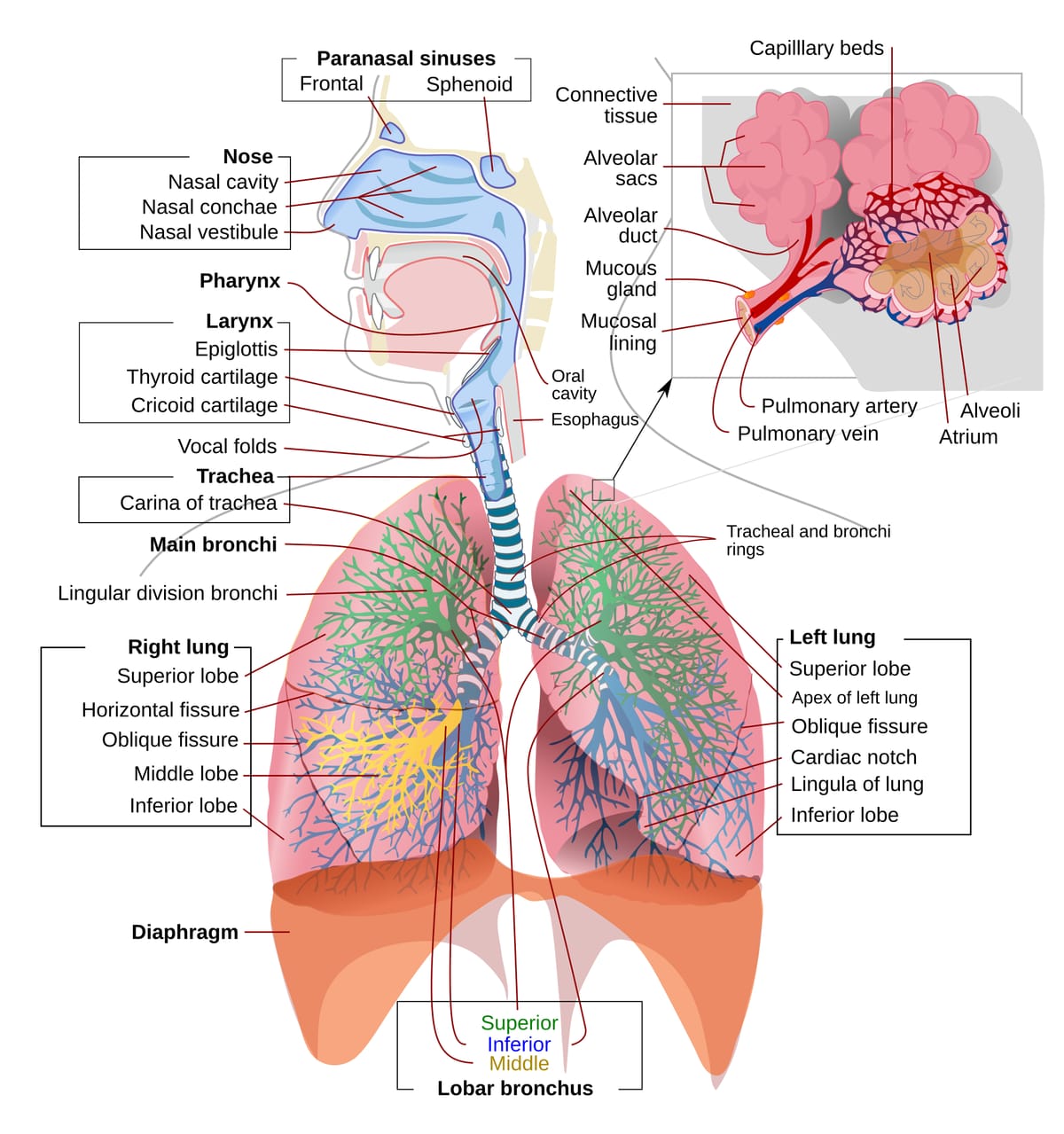
Labelled diagram of the human respiratory system: nose, pharynx, larynx, trachea with rings, bronchi branching into both lungs, the diaphragm below, and an enlarged view of alveoli wrapped in capillaries
Air goes nose → trachea (windpipe, kept open by rings of cartilage) → bronchi → tiny air sacs called alveoli. The box shows alveoli wrapped in capillaries, where oxygen enters the blood. The diaphragm below moves down when we breathe in. Image: LadyofHats and Jmarchn, Wikimedia Commons · Public domain
Inhaled vs exhaled air
Oxygen in
21%
Oxygen out
16.4%
CO2 in
0.04%
CO2 out
4.4%
We breathe out less oxygen and about 100 times more carbon dioxide than we breathe in (NCERT class 7 values).

Heart and blood vessels

Rule in one line: arteries carry blood away from the heart; veins bring it back.
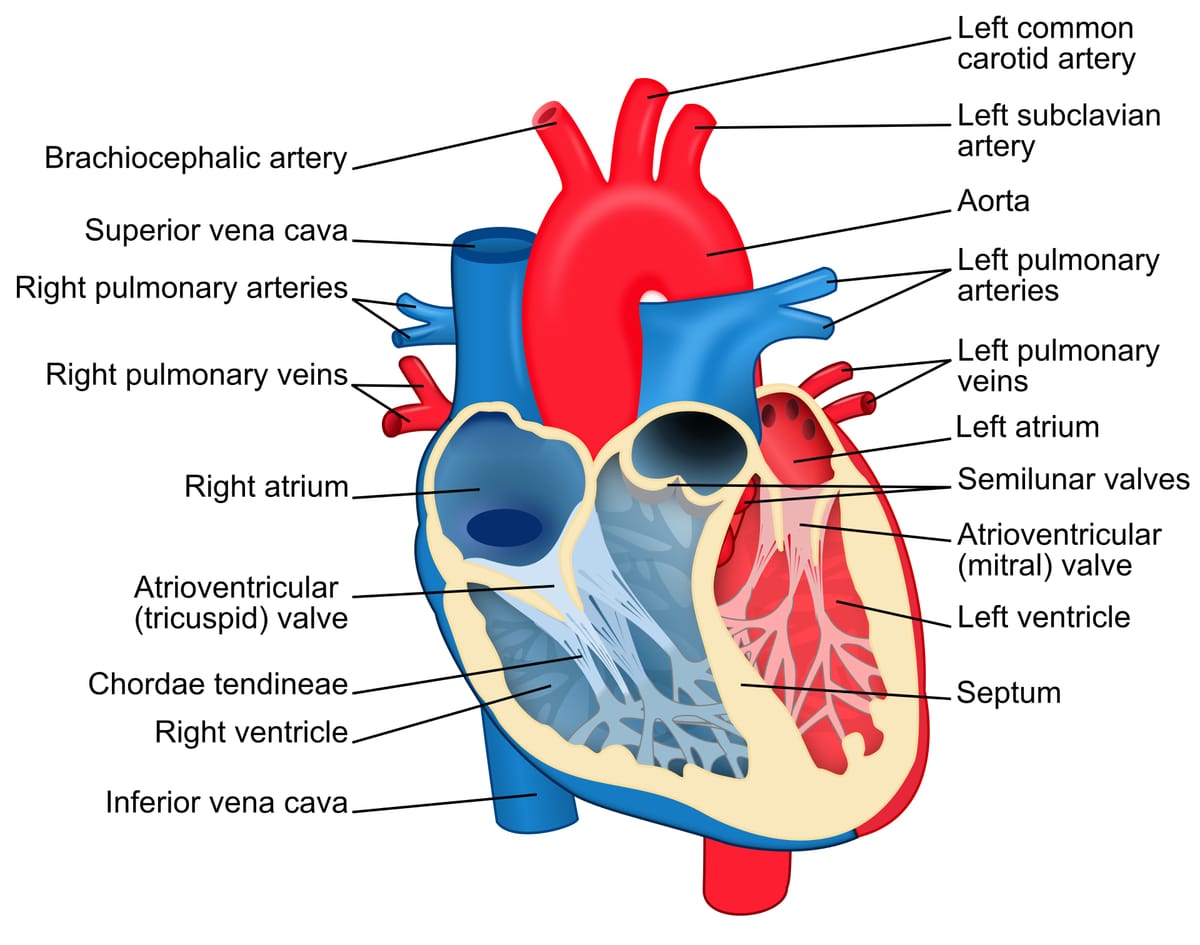
Labelled cut-away diagram of the human heart showing the right and left atria and ventricles, the septum, valves, the aorta in red and the pulmonary arteries and venae cavae in blue
The human heart has four chambers: two atria above and two ventricles below. Blue marks oxygen-poor blood; red marks oxygen-rich blood. Note the blue pulmonary arteries — they carry oxygen-poor blood to the lungs. Image: ZooFari, Wikimedia Commons · CC BY-SA 3.0
DOUBLE CIRCULATION
  1. 1
    Body
    Oxygen-poor blood returns by the venae cavae
  2. 2
    Right atrium → right ventricle
    Pumped into the pulmonary artery
  3. 3
    Lungs
    Blood picks up oxygen, drops CO2
  4. 4
    Left atrium → left ventricle
    Back by the pulmonary veins, then pumped into the aorta
Blood passes through the heart twice in one round of the body. That is why it is called double circulation.
ARTERIES VS VEINS
Arteries
Veins
Carry blood
Away from heart
Towards heart
Usually
Oxygen-rich
Oxygen-poor
Walls
Thick, elastic
Thin, with valves
Exception
Pulmonary artery
Pulmonary vein
Capillaries are the thinnest vessels, where blood exchanges food and gases with cells. Substances such as histamine (released in allergy) widen blood vessels; they are called vasodilators.
QUICK CHECK
PYQ · Punjab Police Constable 2021 — Human heart has how many chamber/s?
Tap an option to answer
QUICK CHECK
PYQ · PPSC PCSEB 2018 — The artery that carries non-oxygenated blood is:
Tap an option to answer
QUICK CHECK
PYQ · Punjab Police SI 2023 — Which of the following is a vasodilator?
Tap an option to answer

Blood and blood groups

Rule in one line: blood is plasma plus red cells, white cells and platelets.
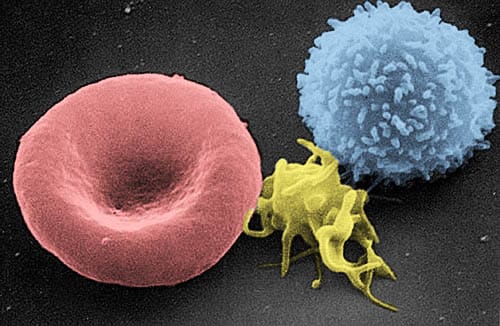
Coloured electron-microscope picture of three blood cells: a red disc dented in the middle, a small yellow spiky fragment, and a round blue cell with a rough surface
From left: a red blood cell, a platelet and a white blood cell, seen with an electron microscope (colours added). There is no such thing as a 'blue blood cell'. Image: Electron Microscopy Facility, National Cancer Institute, Wikimedia Commons · Public domain
Part of bloodJob
PlasmaYellowish liquid that carries food, salts, hormones and wastes
Red blood cellsCarry oxygen using haemoglobin; no nucleus; live about 120 days
White blood cellsFight germs and make antibodies
PlateletsHelp blood to clot at a wound
Blood is a fluid connective tissue. Red blood cells are made in the bone marrow.
Blood groupMarker (antigen) on red cellsAntibody in plasma
AAAnti-B
BBAnti-A
ABA and BNone — universal recipient
ONoneAnti-A and anti-B — universal donor
The ABO groups, found by Karl Landsteiner. A group's plasma has the antibody against the marker it lacks.
QUICK FACT

Group AB has no anti-A or anti-B antibody, so it can receive red cells of any ABO group. Group O cells carry no marker, so they can be given to anyone. Normal adult blood pressure is about 120/80 mm Hg, measured with a sphygmomanometer.

QUICK CHECK
PYQ · Punjab Police Constable 2021 — Human blood has all of the following components, except:
Tap an option to answer

Transport in plants

Rule in one line: xylem carries water up; phloem carries food both ways.

XYLEM VS PHLOEM
Xylem
Phloem
Carries
Water and minerals
Food made in leaves
Direction
Roots to leaves, upward
Up and down
Cells
Mostly dead
Living
Movement of food in phloem is translocation. Loss of water vapour through stomata is transpiration; it creates the pull that draws water up the xylem.

Excretion

Rule in one line: the kidneys filter blood and remove urea as urine.

THE HUMAN EXCRETORY SYSTEM
  1. 1
    Kidneys
    A pair of bean-shaped organs; each has about a million filtering units called nephrons.
  2. 2
    Ureters
    Two tubes carry urine down.
  3. 3
    Urinary bladder
    Stores urine.
  4. 4
    Urethra
    Urine leaves the body.
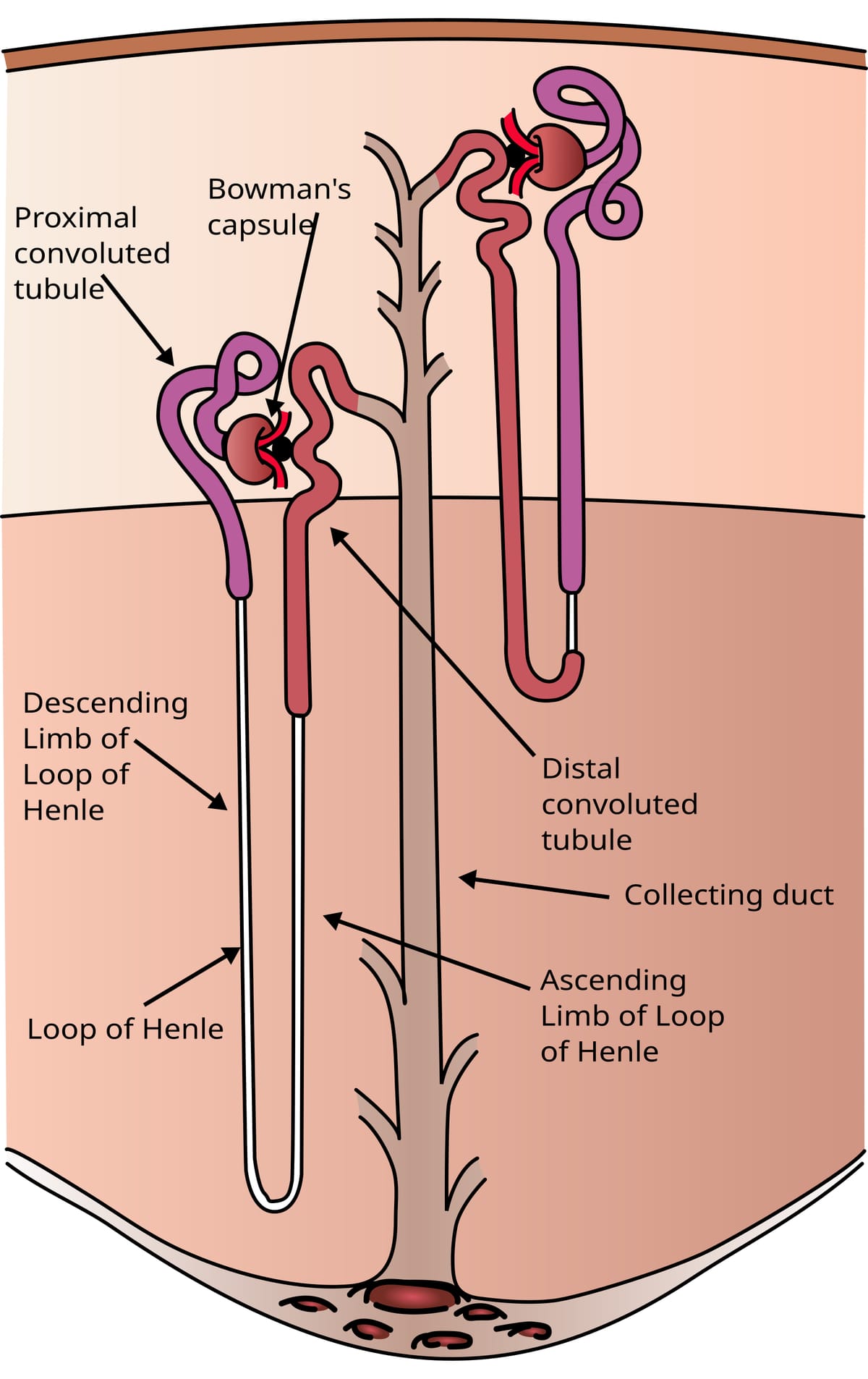
Labelled diagram of two kidney nephrons: the cup-shaped Bowman's capsule, the coiled proximal and distal tubules, the long U-shaped loop of Henle, and a shared collecting duct
A nephron, the filtering unit of the kidney. Blood is filtered in Bowman's capsule; useful substances are taken back along the tubules; the rest flows down the collecting duct as urine. Image: Holly Fischer, Wikimedia Commons · CC BY 3.0
OrganRemoves
KidneysUrea, extra salts and water as urine
LungsCarbon dioxide and water vapour
SkinSweat: water, salts and a little urea
LiverTurns toxic ammonia into urea
Organs that remove wastes. Most kidney stones are made of calcium oxalate.
KEY TERM
Dialysis: the artificial kidney

When both kidneys fail, a dialysis machine cleans the blood. Blood flows past a thin membrane with a clean fluid on the other side. Urea and extra salts move across by diffusion, from where there is more of them to where there is less. Clean blood goes back to the body.

Blood with urea→Membrane→Clean blood back
QUICK FACT

Fresh urine hardly smells. On standing, bacteria turn its urea into ammonia, which gives the sharp smell. Plants have no excretory organs: they lose gases through stomata, shed wastes with old leaves and bark, and store some as gums and resins.

QUICK CHECK
PYQ · Punjab Election Kanungo 2021 — Dialysis is used for people with defective kidneys. It involves the process of:
Tap an option to answer
QUICK CHECK
PYQ · PPSC PCSEB 2018 — Freshly passed urine has hardly any smell but when it is allowed to stand, it develops a strong ammoniacal odour owing to:
Tap an option to answer
More facts that are asked onceTap to open
  • The aorta is the largest artery; it leaves the left ventricle.
  • William Harvey described the circulation of blood in 1628.
  • The spleen removes old red blood cells; it is called the graveyard of red cells.
  • Normal body temperature is about 37 °C (98.6 °F).
  • Ruminants such as the cow chew the cud; bacteria in their gut digest cellulose.
  • Amoeba takes in food with its false feet (pseudopodia).

Traps and practice

Last revision — where the options try to fool you.

COMMON TRAPS
  • Bile has no enzyme and comes from the liver; the pancreas gives pancreatic juice and insulin.
  • Breathing is physical; respiration is chemical and happens in every cell.
  • Not all arteries carry oxygen-rich blood — the pulmonary artery does not.
  • O is the universal donor; AB is the universal recipient.
  • Dialysis works by diffusion, not osmosis.
  • Nephron (kidney) and neuron (nerve) sound alike — do not mix them.
CHECK YOURSELF

Why is the small intestine lined with villi?

Show answer

Villi greatly increase the surface area for absorbing digested food, and each has a network of blood capillaries to carry it away.

FLASHCARDS
Life process flashcards
Largest gland
Liver
Gland that makes insulin
Pancreas
Protein-digesting enzyme in the stomach
Pepsin
Site of gas exchange in lungs
Alveoli
Chambers in the human heart
Four
Artery with oxygen-poor blood
Pulmonary artery
Universal recipient
Group AB
Unit of the kidney
Nephron
QUICK BYTES
  • Saliva acts on starch; pepsin on protein; lipase on fat
  • Bile: liver, stored in gall bladder, no enzyme
  • Aerobic: CO2 + water + energy; yeast makes ethanol
  • Heart: 4 chambers, double circulation, about 72 beats a minute
  • Blood: plasma, RBC, WBC, platelets — no 'blue' cells
  • O donor, AB recipient; histamine is a vasodilator
  • Xylem: water up; phloem: food both ways
  • Nephron filters blood; dialysis uses diffusion

Frequently Asked Questions

What is the difference between breathing and respiration?

Breathing is taking air in and out of the lungs. Respiration is the breakdown of glucose inside cells that releases energy, using the oxygen that breathing brings in.

Where is bile made and stored?

Bile is made in the liver and stored in the gall bladder. It has no enzyme but breaks fats into tiny droplets so that lipase can digest them.

What does the pancreas secrete?

Pancreatic juice, with enzymes for protein, fat and starch, into the small intestine; and the hormone insulin into the blood.

How many chambers does the human heart have?

Four: two atria that receive blood and two ventricles that pump it out. Blood passes through the heart twice in one round (double circulation).

Which artery carries oxygen-poor blood?

The pulmonary artery, from the right ventricle to the lungs. The pulmonary vein is the vein that carries oxygen-rich blood.

What are the parts of blood?

Plasma, red blood cells (carry oxygen), white blood cells (fight germs) and platelets (help clotting).

Which blood group is the universal donor and which the universal recipient?

O is the universal donor because its red cells carry no A or B marker. AB is the universal recipient because its plasma has no anti-A or anti-B.

What do xylem and phloem carry?

Xylem carries water and minerals from the roots up to the leaves. Phloem carries food made in the leaves to all parts of the plant, up and down.

What is the functional unit of the kidney?

The nephron. Each kidney has about a million nephrons that filter the blood and form urine, which carries urea out of the body.

How does dialysis work?

Blood flows past a thin membrane with clean fluid on the other side. Urea and extra salts pass out by diffusion, and the cleaned blood returns to the body.

Now sit the questions they actually set

Previous-year PPSC questions on this topic, free to read with the worked answer.

More in Biology

← All Biology notes