Part of the Punjab Police ASI 2026 course.Practise Atoms, Atomic Structure and the Periodic Table questions →Take a mock test →
GENERAL SCIENCE · CLASS 8–10 SERIES

Atoms, Atomic Structure and the Periodic Table

Elements and Latin symbols, Lavoisier and Dalton, electrons, protons and neutrons, bonds, isotopes, radioactivity and carbon dating, and the groups of the periodic table.

Punjab PolicePSSSBPPSC15 MIN READ
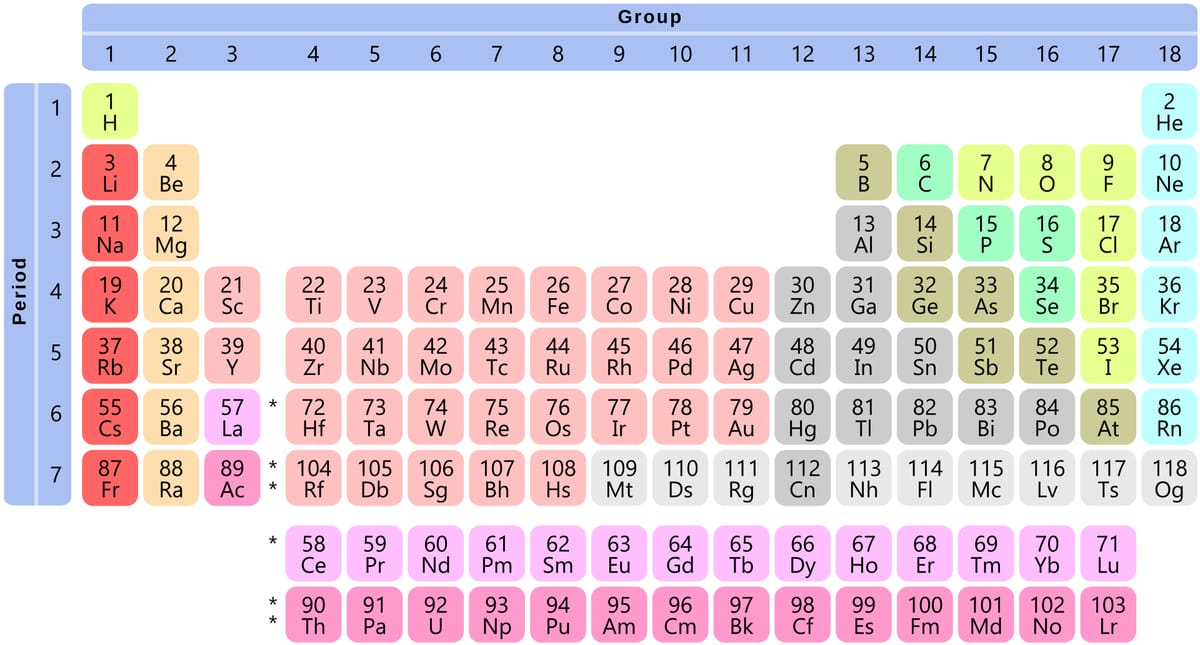
The modern periodic table: 118 element boxes with symbols and atomic numbers, in 18 numbered columns (groups) and 7 rows (periods), coloured by family
The modern periodic table: 118 elements in order of atomic number, in 18 groups (columns) and 7 periods (rows). Group 1 (red) holds the alkali metals, group 17 the halogens and group 18 (blue) the noble gases. Image: Offnfopt, Wikimedia Commons · Public domain

All matter is made of atoms. A substance made of only one kind of atom is an element; 118 are known. Atoms join to form molecules. Inside every atom are electrons, protons and neutrons. Arranging elements by their protons gave us the periodic table. Exams ask the scientist behind each discovery, isotopes and their uses, and the families of the table.

On this page you will learn:

  • Elements, Latin symbols and the laws of Lavoisier and Proust
  • Electron, proton and neutron, and the atomic models
  • How atoms join: ionic and covalent bonds
  • Isotopes, radioactivity and carbon dating
  • The periodic table: alkali metals, halogens, noble gases
118
Known elements
In 18 groups and 7 periods
1869
Mendeleev's table
Arranged by atomic mass
1932
Neutron found
By James Chadwick

Elements, symbols and the first laws

Rule in one line: in a chemical reaction, mass is neither made nor lost.
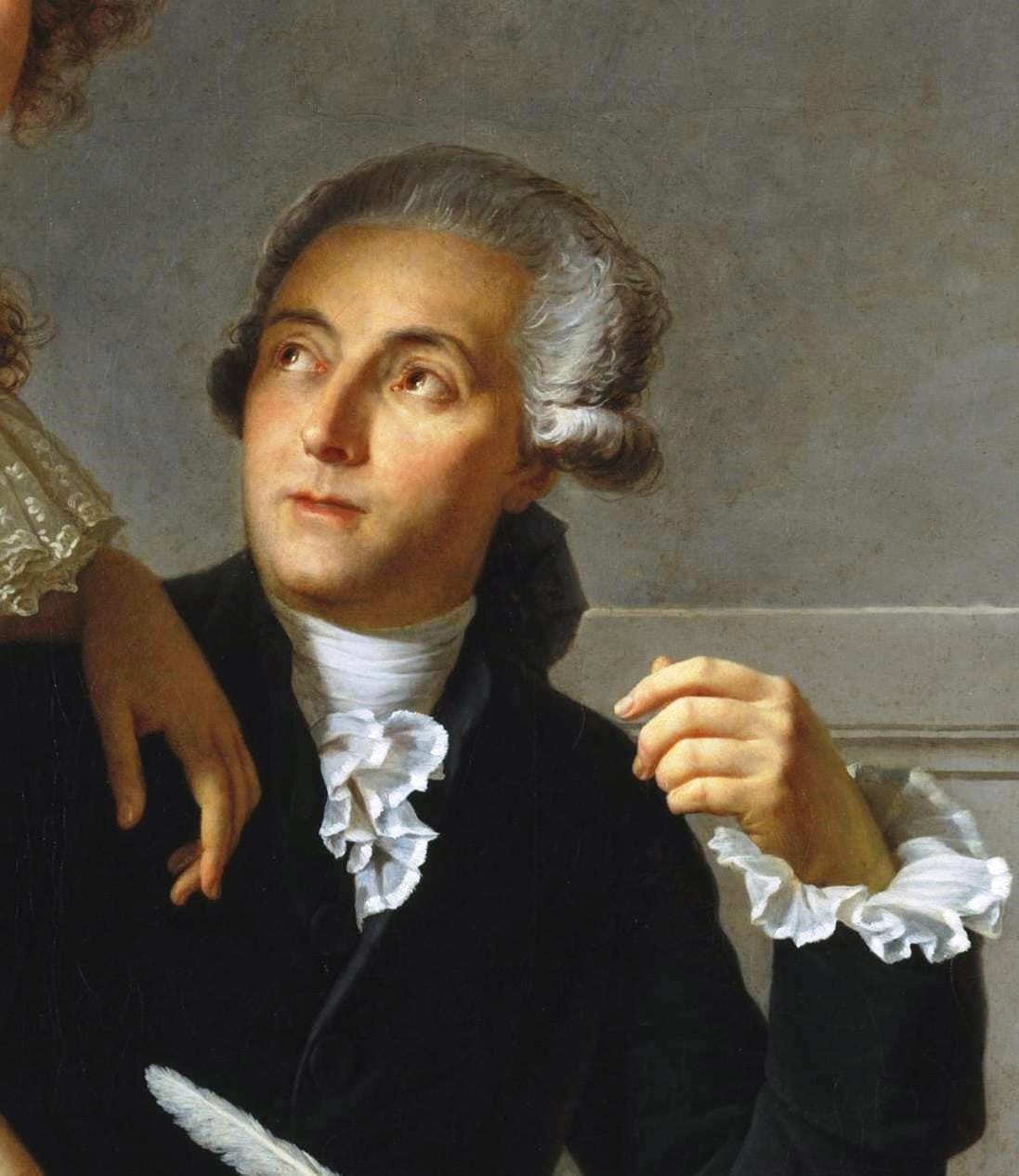
Painted portrait of a man in a powdered grey wig, black coat and white lace collar, holding a quill pen
Antoine Lavoisier (1743–1794), French chemist, painted by Jacques-Louis David in 1788. He gave the law of conservation of mass and named oxygen and hydrogen. He is called the father of modern chemistry. Image: Jacques-Louis David, Wikimedia Commons · Public domain
LAWS OF CHEMICAL COMBINATION
Conservation of mass
Constant proportions
Given by
Antoine Lavoisier
Joseph Proust
Says
Mass before = mass after
Same ratio by mass, always
Example
Burning in a sealed flask
Water: H to O is 1 : 8
John Dalton built his atomic theory (1808) on these two laws. His idea that atoms cannot be divided was later proved wrong.
ElementSymbolFrom the Latin
SodiumNaNatrium
PotassiumKKalium
IronFeFerrum
CopperCuCuprum
SilverAgArgentum
GoldAuAurum
LeadPbPlumbum
MercuryHgHydrargyrum
TinSnStannum
Symbols that come from Latin names — a favourite trap. K is potassium, not krypton (Kr).
KEY TERM
The mole

A mole is a fixed count of particles: 6.022 × 10²³, the Avogadro number — just as a dozen means 12. One mole of a substance weighs its formula mass in grams. One mole of water (H2O, 18 u) weighs 18 g.

QUICK CHECK
PYQ · Punjab Police SI 2021 — Which of these scientists is credited with the discovery of the law of conservation of mass?
Tap an option to answer
QUICK CHECK
PYQ · PPSC EO 2018 — Which one of the following is an element?
Tap an option to answer

Inside the atom, and how atoms join

Rule in one line: protons and neutrons sit in the nucleus; electrons move round it in shells.

ParticleChargeFound byYear
ElectronNegativeJ. J. Thomson (cathode rays)1897
ProtonPositiveE. Goldstein found canal rays; Rutherford named the proton1886
NeutronNoneJames Chadwick1932
A proton is about 2000 times heavier than an electron. The number of protons is the atomic number (Z); protons + neutrons is the mass number (A).
MODELS OF THE ATOM
  1. 1897
    Thomson's model

    Electrons stuck in a ball of positive charge, like seeds in a watermelon.

  2. 1911
    Rutherford's model

    Gold-foil experiment: the atom is mostly empty, with a tiny, heavy, positive nucleus.

  3. 1913
    Bohr's model

    Electrons move in fixed shells (K, L, M, N) without losing energy.

  4. 1932
    Chadwick

    Finds the neutron in the nucleus.
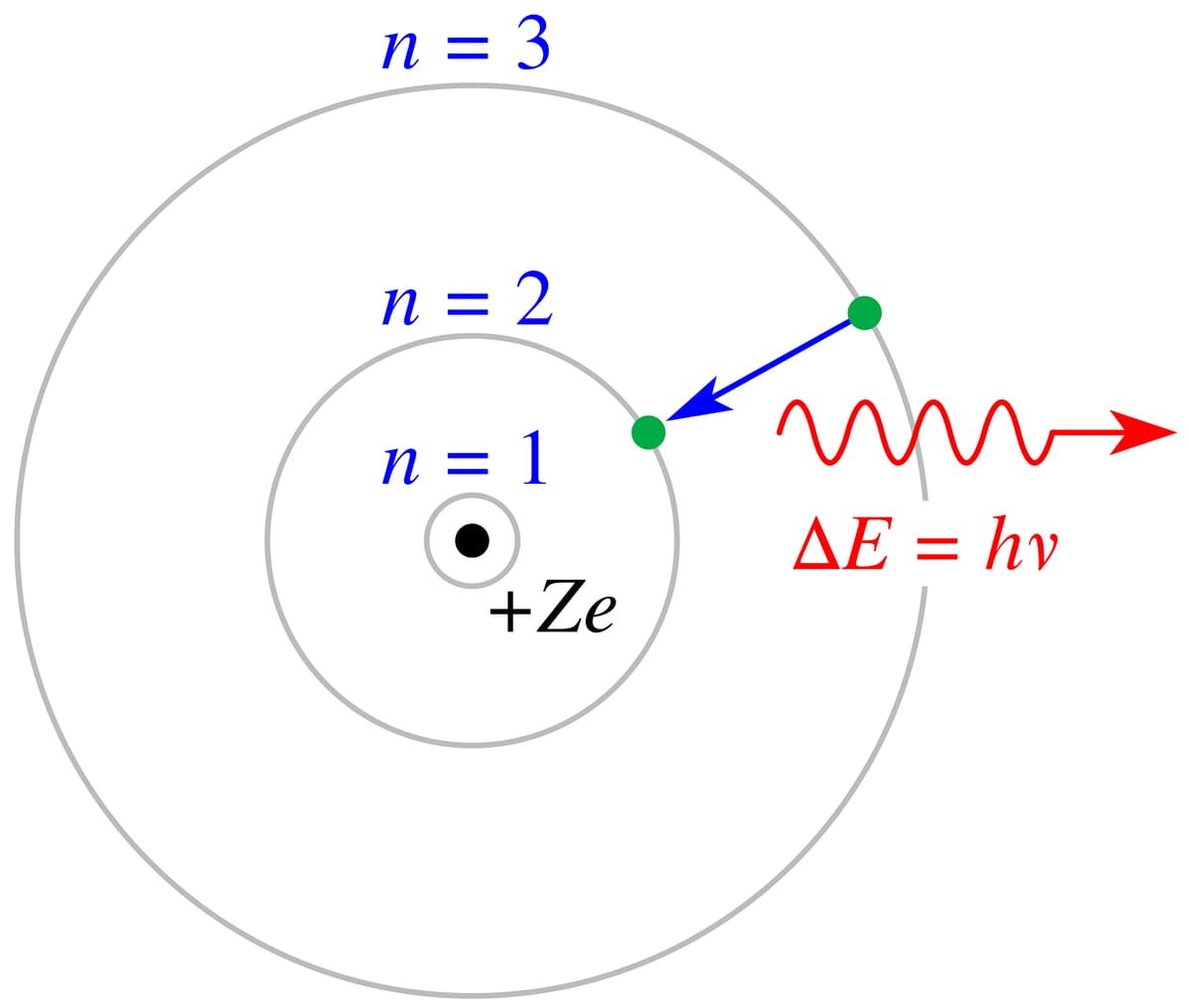
Diagram of a small black nucleus with three circular shells marked n = 1, 2 and 3; an electron jumps from shell 3 to shell 2 and a wavy red arrow shows light given out
Bohr's model. Electrons stay in fixed shells round the positive nucleus. When an electron drops to a lower shell, it gives out the extra energy as light. Image: JabberWok, Wikimedia Commons · CC BY-SA 3.0
ElementZShells K, L, M, N
Hydrogen11
Carbon62, 4
Oxygen82, 6
Sodium112, 8, 1
Chlorine172, 8, 7
Argon182, 8, 8
A shell holds at most 2n² electrons (K 2, L 8, M 18), but the outermost shell holds no more than 8. Outer-shell electrons decide how an atom combines (its valency).
TWO WAYS ATOMS BOND
Ionic bond
Covalent bond
Electrons
Given and taken
Shared
Between
Metal and non-metal
Non-metals
Example
NaCl (common salt)
H2, H2O, CH4
Noble gases such as argon already have a full outer shell, so they make no ordinary bonds. Their atoms pull each other only by very weak van der Waals forces.
QUICK CHECK
PYQ · PPSC OHE 2016 — When two hydrogen atoms combine to form a hydrogen molecule, the bond formed is:
Tap an option to answer
QUICK CHECK
PYQ · PPSC ICS 2016 — Two argon atoms are attracted to each other due to
Tap an option to answer

Isotopes and radioactivity

Rule in one line: isotopes have the same protons but different neutrons.

ISOTOPES VS ISOBARS
Isotopes
Isobars
Same
Atomic number
Mass number
Different
Mass number
Atomic number
Element
Same element
Different elements
Example
C-12, C-14
Ca-40, Ar-40
H-1
Protium

1 proton, no neutron. Almost all hydrogen.

H-2
Deuterium

1 proton, 1 neutron. Makes heavy water, used in nuclear reactors.

H-3
Tritium

1 proton, 2 neutrons. Radioactive; it is not a mineral.

The three isotopes of hydrogen. Mineral water carries minerals such as calcium, magnesium and potassium — never tritium.

KEY TERM
Radioactivity and carbon dating

Some atoms are unstable. They break down on their own and give out rays — this is radioactivity, found by Henri Becquerel in 1896 from uranium salts. Living things take in a little radioactive carbon-14. After death no new carbon-14 comes in, and the old amount halves every 5,730 years. Measuring what is left tells the age of bones, wood and other remains of once-living things. This is radiocarbon dating.

Alive: takes in C-14→Dies→C-14 slowly decays→Age from what is left
QUICK CHECK
PYQ · Punjab Police Constable 2021 — The mineral that is NOT often present in mineral water is ____.
Tap an option to answer
QUICK CHECK
PYQ · Punjab Police SI 2016 — Radiocarbon dating is a technique used to estimate the age of
Tap an option to answer
QUICK CHECK
PYQ · PPSC OHE 2016 — Radioactivity was discovered by
Tap an option to answer

The periodic table

Rule in one line: the modern table arranges elements by increasing atomic number.

HOW THE PERIODIC TABLE GREW
  1. 1817
    Döbereiner's triads

    Groups of three alike elements; the middle mass is the average of the other two.

  2. 1866
    Newlands' octaves

    Every eighth element is like the first, as in music; works only up to calcium.

  3. 1869
    Mendeleev's table

    By atomic mass; left gaps for elements not yet found, such as gallium and germanium.

  4. 1913
    Moseley

    Showed atomic number is the true basis — the modern periodic law.
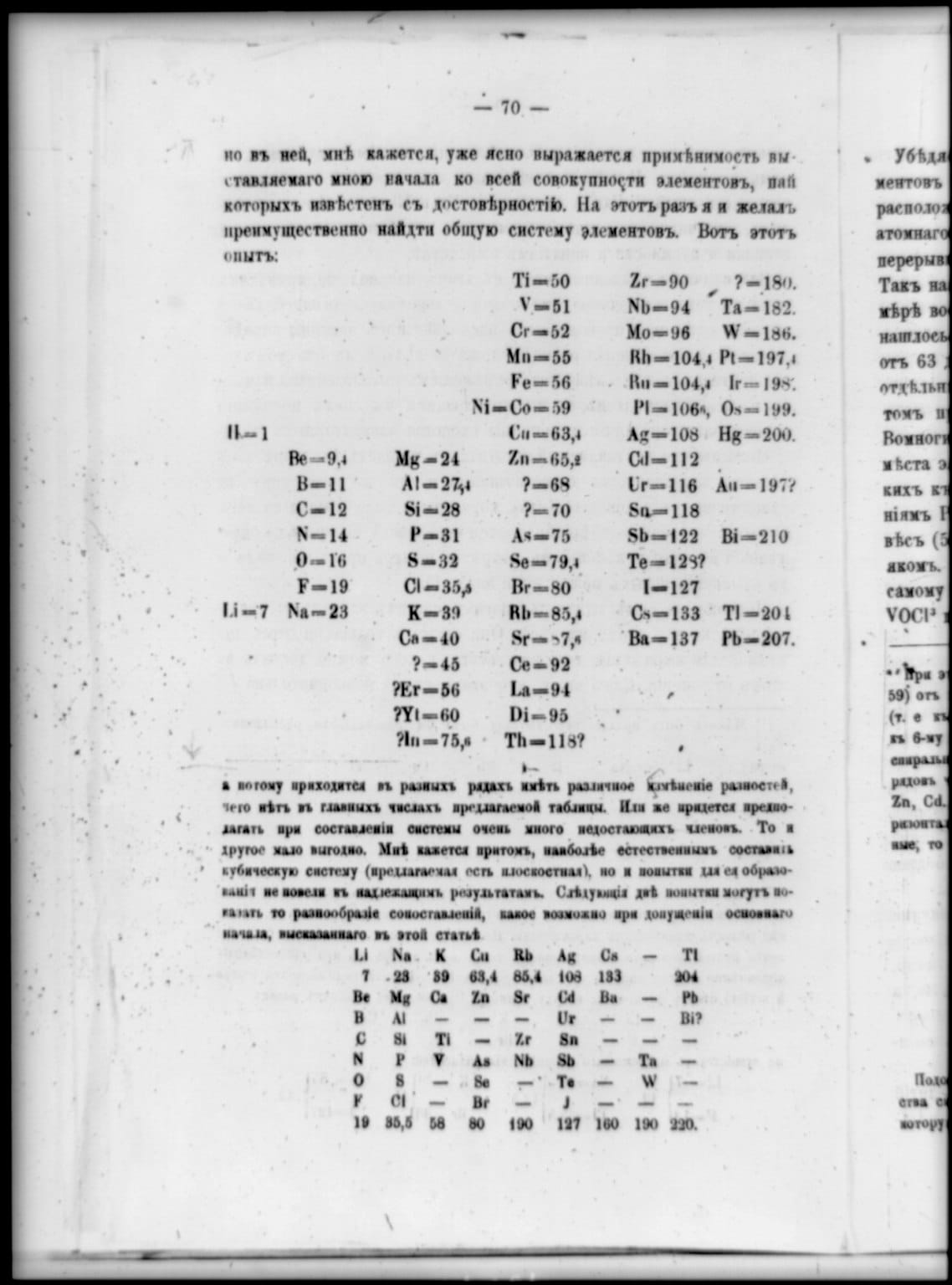
A printed page in old Russian with columns of element symbols and their atomic weights, including entries written as a question mark
Mendeleev's table of 1869, arranged by atomic weight. Look for ?=68 and ?=70: gaps he left for unknown elements. They were later found as gallium and germanium. Image: Dmitri Mendeleev, Wikimedia Commons · Public domain
TrendAcross a period (left to right)Down a group
Atomic sizeDecreasesIncreases
Metallic characterDecreasesIncreases
Valence electronsRise from 1 to 8Stay the same
Metals sit on the left, non-metals on the right. Groups 3–12 in the middle are the d-block metals (iron, copper, zinc, mercury); most are transition metals, though zinc, cadmium and mercury (group 12) usually are not counted as transition metals. Their compounds are usually coloured: copper sulphate is blue.
QUICK CHECK
PYQ · PPSC SEVE 2016 — Which of the following elements is a metal?
Tap an option to answer
QUICK CHECK
PYQ · RSMSSB LDC 2024 — Which of the following is not an alkali metal?
Tap an option to answer
QUICK CHECK
PYQ · PPSC ICS 2016 — Transition metal compounds are usually
Tap an option to answer

Families to know: halogens and noble gases

Rule in one line: elements in the same group behave alike, because they have the same number of outer electrons.

Group 1
Alkali metals

Li, Na, K: soft, very reactive, kept under kerosene.

Group 2
Alkaline earth metals

Be, Mg, Ca: magnesium is in chlorophyll, calcium in bones.

Group 17
Halogens

F, Cl, Br, I: 'salt-makers'. Bromine is the only liquid non-metal.

Group 18
Noble gases

He, Ne, Ar: full outer shell, so they hardly react.

The four families asked most often
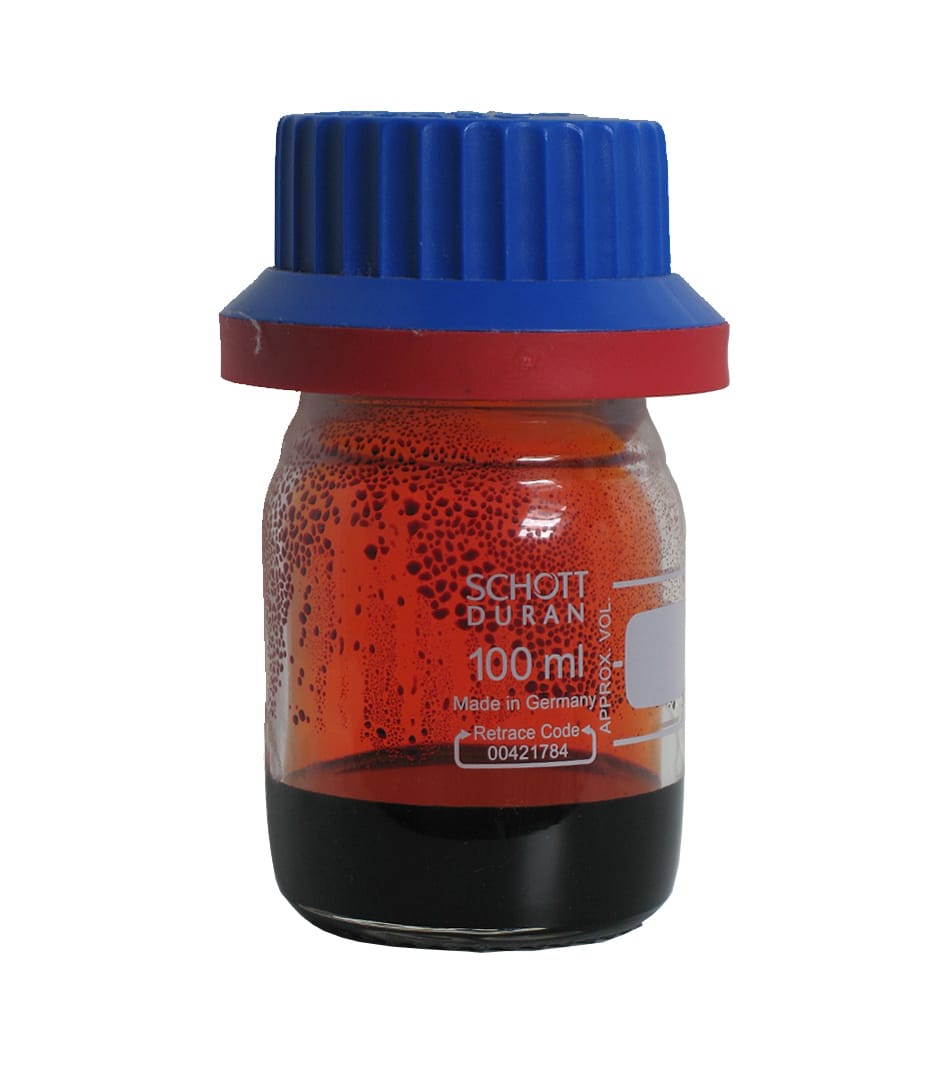
A small glass bottle with a blue cap holding a dark red-brown liquid at the bottom and orange-red vapour filling the space above
Bromine, a halogen, is a dark red-brown liquid at room temperature, and it gives off red-brown fumes. It is the only non-metal that is liquid; mercury is the only liquid metal. Image: W. Oelen, Wikimedia Commons · CC BY-SA 3.0
Noble gasCommon use
HeliumBalloons (light, does not burn); mixed with oxygen for patients and deep-sea divers
NeonGlowing orange-red advertisement signs
ArgonFilling electric bulbs, often with nitrogen
A filament bulb is filled with an unreactive gas — nitrogen and/or argon — so that the hot tungsten filament does not burn away as it would in oxygen.
QUICK CHECK
PYQ · PPSC ICS 2016 — The elements fluorine, chlorine, bromine and iodine are collectively called
Tap an option to answer
QUICK CHECK
PYQ · PPSC ICS 2016 — Which of the following is a non-metal that remains liquid at room temperature?
Tap an option to answer
QUICK CHECK
PYQ · PSSSB Election Kanungo 2018 — Which of the following gases is inside an electric bulb?
Tap an option to answer
QUICK CHECK
PYQ · PPSC PRIN 2020 — In hospitals, the oxygen tubes for respiration contain oxygen and
Tap an option to answer

Traps and practice

Last revision — where the options try to fool you.

COMMON TRAPS
  • Conservation of mass: Lavoisier, not Boyle or Dalton.
  • Thomson: electron; Rutherford: nucleus; Chadwick: neutron; Bohr: shells; Becquerel: radioactivity.
  • Tritium is a radioactive isotope of hydrogen, not a mineral.
  • Carbon dating is for things that were once alive — not rocks or soil.
  • H2 has a covalent bond; NaCl has an ionic bond.
  • Mercury is a liquid metal but not an alkali metal; bromine is the liquid non-metal.
  • Mendeleev used atomic mass; the modern table uses atomic number.
CHECK YOURSELF

An atom has 11 protons and 12 neutrons. Find its atomic number, mass number and the element.

Show answer

Atomic number 11; mass number 11 + 12 = 23; the element is sodium.

FLASHCARDS
Atom flashcards
Law of conservation of mass
Lavoisier
Discovered the electron
J. J. Thomson
Discovered the neutron
James Chadwick
Discovered radioactivity
Henri Becquerel
Radioactive isotope of hydrogen
Tritium
Dates fossils
Carbon-14
F, Cl, Br, I
Halogens
Gas in filament bulbs
Nitrogen or argon
QUICK BYTES
  • Lavoisier: conservation of mass; Proust: constant proportions
  • Electron 1897 Thomson; neutron 1932 Chadwick
  • Z = protons; A = protons + neutrons
  • Hydrogen isotopes: protium, deuterium, tritium
  • Carbon-14 half-life about 5,730 years
  • Group 1 alkali metals; 17 halogens; 18 noble gases
  • Transition metal compounds are coloured

Frequently Asked Questions

Who gave the law of conservation of mass?

Antoine Lavoisier, the French chemist. It says that mass is neither created nor destroyed in a chemical reaction.

Is diamond an element or a compound?

An element. Diamond is pure carbon. Gems such as ruby, sapphire and topaz are compounds.

Who discovered the electron, proton and neutron?

J. J. Thomson found the electron in 1897. Goldstein's canal rays led to the proton, named by Rutherford. James Chadwick found the neutron in 1932.

What kind of bond is there in a hydrogen molecule?

A covalent bond. The two hydrogen atoms share their electrons.

What are isotopes?

Atoms of the same element with the same atomic number but different mass numbers, because they have different numbers of neutrons — for example carbon-12 and carbon-14.

What is tritium?

A radioactive isotope of hydrogen with one proton and two neutrons. It is not a mineral and is not found in mineral water.

What is radiocarbon dating used for?

To find the age of remains of once-living things, such as bones, wood and fossils, by measuring the carbon-14 left in them.

Who discovered radioactivity?

Henri Becquerel, in 1896, using uranium salts. Marie and Pierre Curie carried the work forward.

What are halogens?

The group 17 elements — fluorine, chlorine, bromine and iodine. The name means 'salt-makers'. Bromine is the only liquid among them.

What is the basis of the modern periodic table?

Atomic number. Moseley showed this in 1913. Mendeleev's table of 1869 was based on atomic mass.

Now sit the questions they actually set

Previous-year PPSC questions on this topic, free to read with the worked answer.

More in Chemistry

← All Chemistry notes