Part of the Punjab Police ASI 2026 course.Practise Matter: States, Mixtures and Separation questions →Take a mock test →
GENERAL SCIENCE · CLASS 8–10 SERIES

Matter: States, Mixtures and Separation

Solids, liquids and gases, melting, condensation and sublimation, elements, compounds and mixtures, air and sea water, solutions and colloids, and how mixtures are separated.

Punjab PolicePSSSBPPSC14 MIN READ
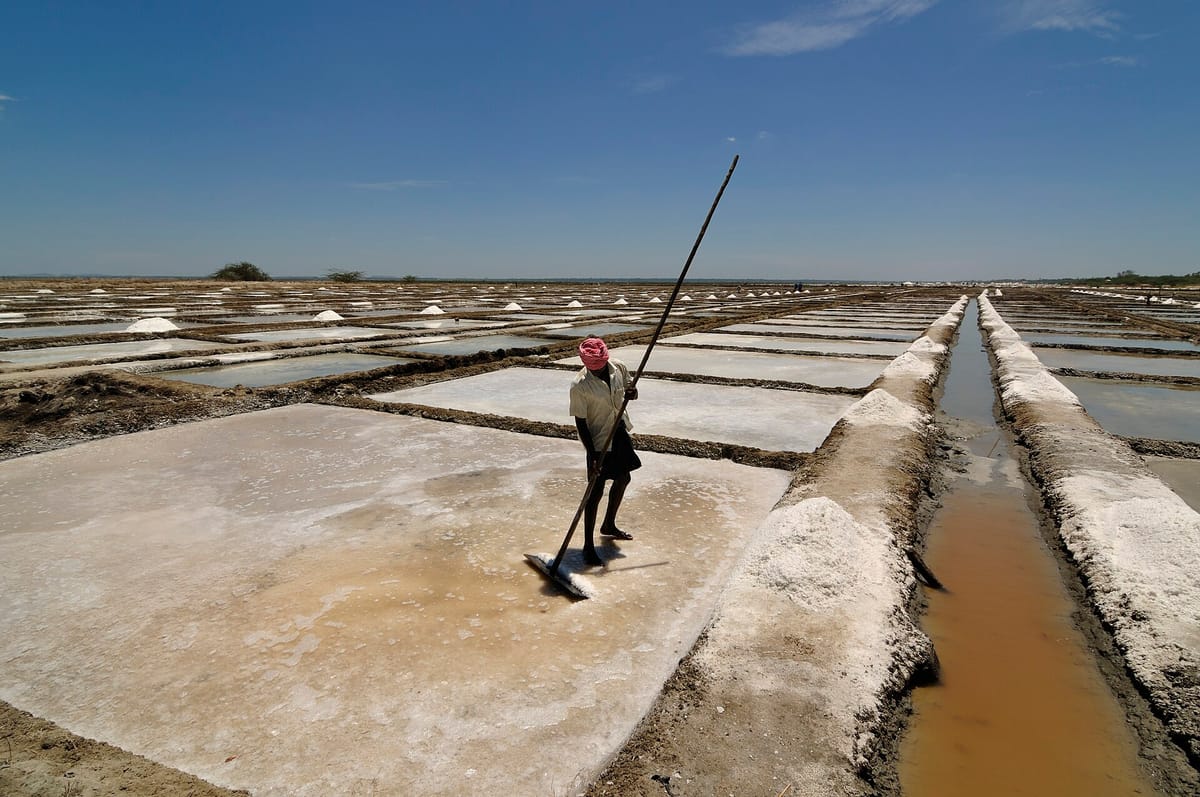
Rows of shallow square salt pans with white salt crust and small heaps, and a worker raking salt with a long wooden pusher
Salt pans at Marakkanam, Tamil Nadu. Sea water is let into shallow pans and the Sun evaporates the water. Common salt is left behind. Sea water is a mixture; this is the oldest way to separate it. Image: Dey.sandip, Wikimedia Commons · CC BY 3.0

Anything that has mass and takes up space is matter — air, water, a stone, our body. Matter is made of tiny particles that keep moving. How close the particles are decides whether it is a solid, a liquid or a gas. Exams ask about changes of state, which things are mixtures, and the right way to separate them.

On this page you will learn:

  • The three states of matter, and why ice floats
  • Melting, boiling, condensation and sublimation
  • Elements, compounds and mixtures: air, sea water, iodised salt
  • Solutions, colloids and suspensions
  • Separation methods; physical and chemical changes
78%
Nitrogen in air
By volume; asked in PSSSB Patwari 2023
0 °C
Ice melts
= 273 K
100 °C
Water boils
= 373 K, at normal air pressure

States of matter

Rule in one line: solids keep shape and volume, liquids keep only volume, gases keep neither.

SOLID, LIQUID AND GAS
Solid
Liquid
Gas
Shape
Fixed
Of the container
Fills container
Volume
Fixed
Fixed
Not fixed
Can be pressed
Almost not
Very little
Easily
Particles
Packed tight
Loose, slide
Far apart, fast
Gases can be pressed into a small space. That is why CNG and LPG fit into cylinders. Gases also spread (diffuse) fastest; solids slowest.
KEY TERM
Water expands when it freezes

Most liquids shrink when they become solid. Water is different. When it freezes, its particles lock into an open pattern with gaps. So ice takes more space than the same water. Ice is lighter (less dense) than water and floats. Water pipes can burst on very cold nights for this reason.

Water cools→Freezes at 0 °C→Ice takes more space→Ice floats
QUICK FACT

Besides solid, liquid and gas, matter can be plasma — the glowing gas inside stars and neon signs — or a Bose–Einstein condensate, a very cold state named after the Indian scientist Satyendra Nath Bose and Albert Einstein.

QUICK CHECK
PYQ · PPSC OHE 2016 — Which word completes the sentence: Water __________ when it freezes?
Tap an option to answer

Changing state

Rule in one line: heating or cooling (and pressure) moves matter from one state to another.

ChangeFrom → toExample
MeltingSolid → liquidIce melts at 0 °C
FreezingLiquid → solidWater turns to ice
BoilingLiquid → gas, all through the liquidWater boils at 100 °C
EvaporationLiquid → gas, only at the surface, at any temperatureWet clothes dry
CondensationGas → liquidDew; drops outside a cold glass
SublimationSolid → gas directlyCamphor, naphthalene balls, dry ice
DepositionGas → solid directlyFrost on very cold nights
Changes of state. To change °C into kelvin, add 273: 27 °C = 300 K.
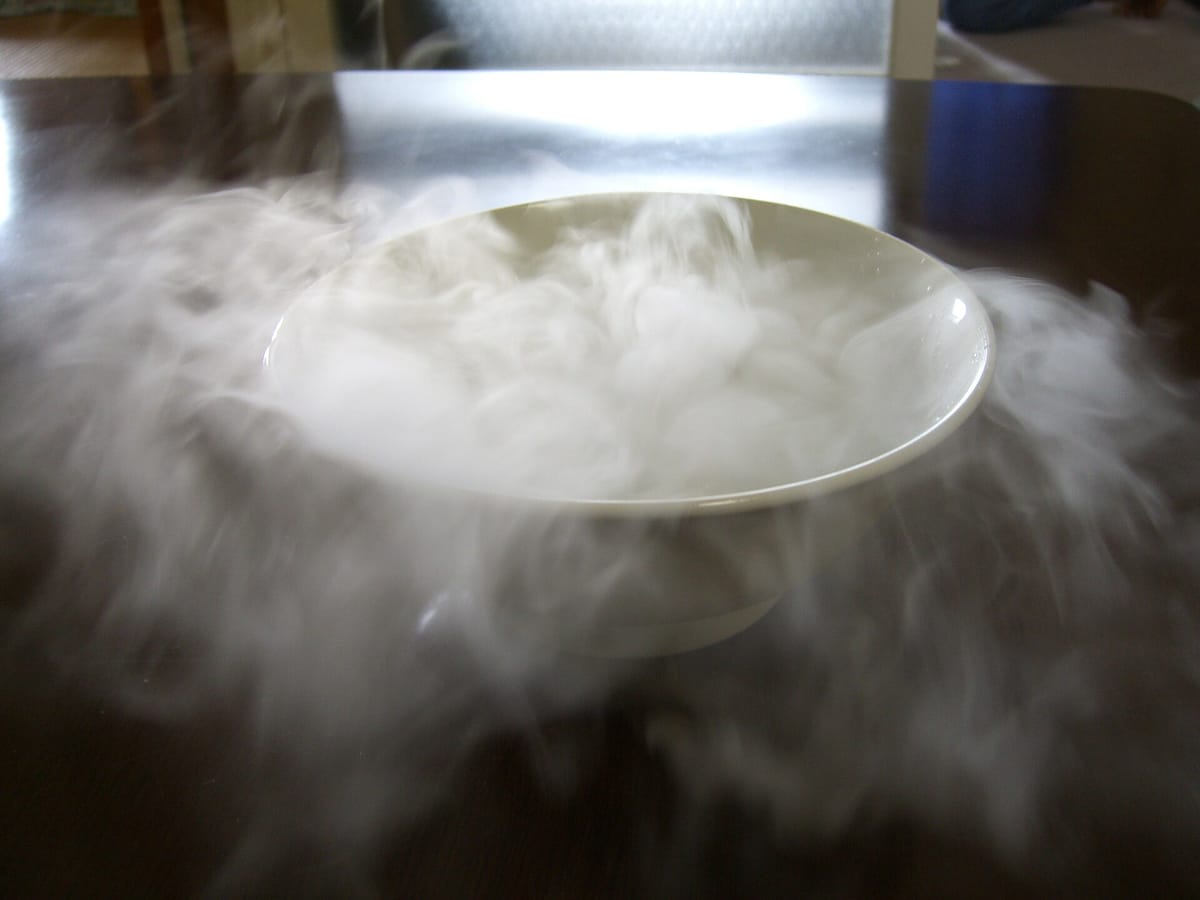
A white bowl of dry ice overflowing with thick white fog that spreads across a dark table
Dry ice is solid carbon dioxide. It turns straight into gas without melting — this is sublimation. The white fog is water vapour of the air condensing in the cold gas. Image: Sarathtly, Wikimedia Commons · Public domain
WHY EVAPORATION COOLS

Evaporating particles take heat from their surroundings. So the place they leave becomes cooler. Sweat cools the body, and water in an earthen pot (ghara) stays cool. Evaporation is faster with a larger surface, higher temperature, dry air and wind.

QUICK CHECK
PYQ · PPSC SEVE 2016 — When a gas turns into a liquid, the process is called:
Tap an option to answer

Elements, compounds and mixtures

Rule in one line: a compound has a fixed make-up and new properties; a mixture does not.

SORTING MATTER
  1. Matter
    Anything with mass that takes up space
  2. Pure substances
    Elements (iron, gold, sulphur, diamond) and compounds (water, salt)
  3. Mixtures
    Uniform: air, sea water, brass. Not uniform: soil, sand in water
COMPOUND VS MIXTURE
Compound
Mixture
Make-up
Fixed ratio
Any ratio
Properties
New ones
Parts keep theirs
Separated by
Chemical means only
Physical methods
Example
Water (H2O)
Air, iodised salt
Iron filings and sulphur powder make a mixture — a magnet pulls the iron out. Heated together they form iron sulphide, a compound that a magnet cannot separate.
KEY TERM
Iodised salt

Common salt (sodium chloride) with a very small amount of potassium iodide (or potassium iodate) mixed in. The two do not react; they are only mixed. So iodised salt is a mixture. The iodine prevents goitre.

QUICK CHECK
PYQ · PPSC OHE 2016 — Which of the following is a mixture?
Tap an option to answer
QUICK CHECK
PYQ · PPSC OHE 2016 — Which of the following is not a mixture?
Tap an option to answer
QUICK CHECK
PYQ · PPSC EO 2018 — Iodised salt is a:
Tap an option to answer

Air: a mixture of gases

Rule in one line: the share of each gas in air is counted by volume.

Gases in dry air, by volume
Nitrogen
78%
Oxygen
21%
Argon
0.93%
Carbon dioxide
0.04%
Air also holds water vapour, dust and tiny amounts of neon, helium and other gases. Because the share can change and the gases keep their own properties, air is a mixture.
QUICK CHECK
PYQ · PSSSB Patwari 2023 — What is the percentage of nitrogen in the atmosphere?
Tap an option to answer
QUICK CHECK
PYQ · PPSC ICS 2016 — Nitrogen constitutes about 78% of the atmosphere
Tap an option to answer

Solutions, colloids and suspensions

Rule in one line: the smaller the particles, the clearer the mixture and the less it settles.

TypeParticlesBehaviourExamples
SolutionSmallestClear; never settles; passes through filter paperSalt water, soda water, air
ColloidMediumLooks uniform; scatters a light beam (Tyndall effect)Milk, fog, smoke, jelly
SuspensionLargestCloudy; settles on standing; can be filteredMuddy water, chalk in water
In a solution, the part that dissolves is the solute; the part it dissolves in is the solvent. Water dissolves so many things that it is called the universal solvent.
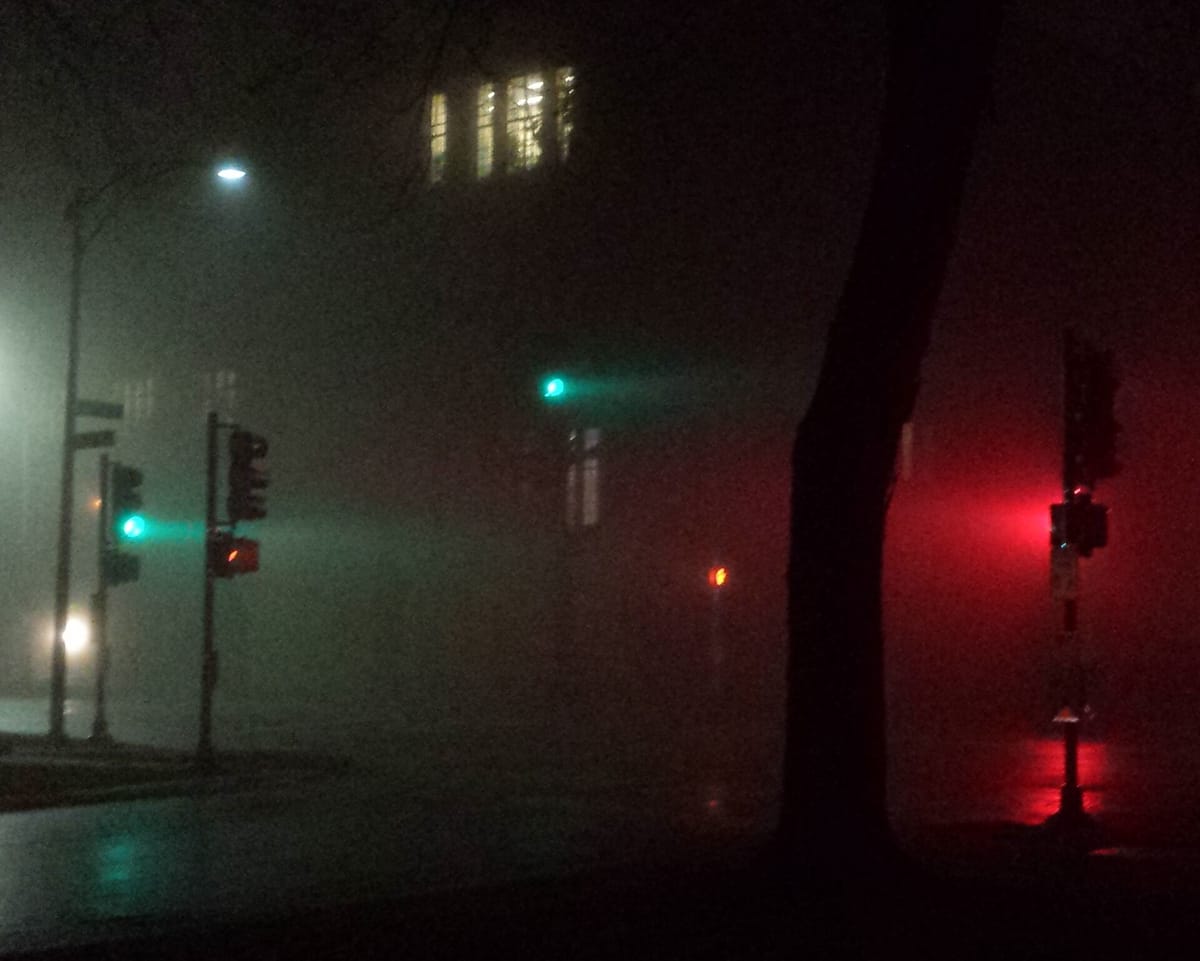
A street corner at night in thick fog; beams of green and red light spread out around the traffic signals
Tyndall effect in fog. Fog is a colloid of tiny water drops in air. The drops scatter the light, so the beams become visible. A true solution, like salt water, does not do this. Image: Domala72, Wikimedia Commons · CC BY 4.0
KEY TERM
Soda water

Soda water (an aerated drink) is carbon dioxide gas dissolved in water under pressure. So it is a gas-in-liquid solution: carbon dioxide is the solute and water is the solvent. When the bottle is opened, the pressure falls and the gas bubbles out.

QUICK CHECK
PYQ · RSMSSB LDC 2024 — The aerated drinks (soda water) constitute: (a) A mixture of gases (b) Gas in liquid solution (c) Liquid in gas solution (d) Carbon dioxide as solute and water as solvent (e) Carbon dioxide as solvent and water as solute.
Tap an option to answer

Separating mixtures

Rule in one line: pick the method that uses a difference between the parts.

MethodUses the difference inExample
EvaporationOne part turns to vapourSalt from sea water
DistillationBoiling points far apartPure water from salt water
Fractional distillationBoiling points close togetherGases of air; parts of petroleum
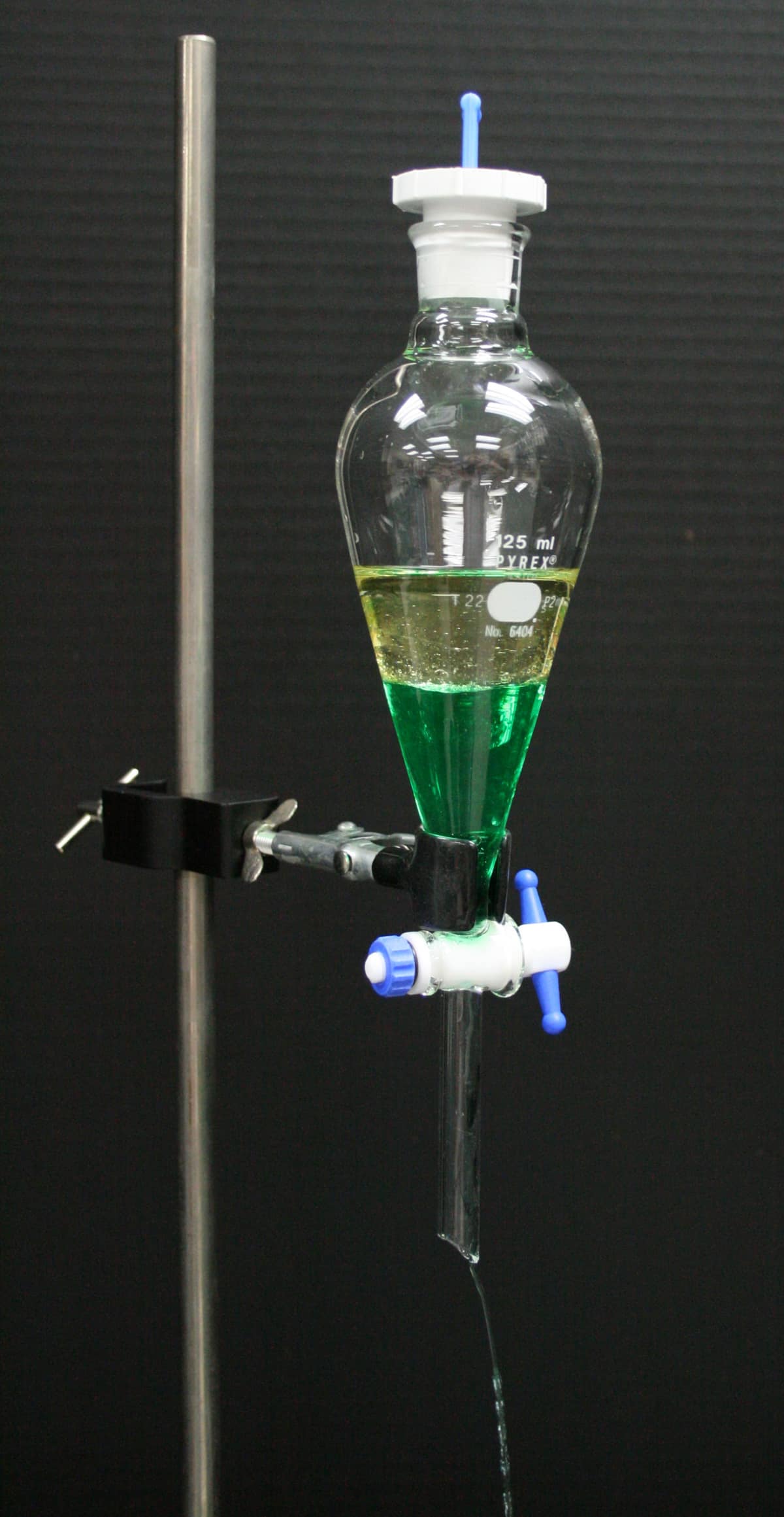
Separating funnelLiquids that do not mixOil from water
CentrifugationDensity, by fast spinningCream from milk; blood tests
ChromatographyHow far each part travelsColours in ink
SublimationOne part sublimesAmmonium chloride from salt
CrystallisationSolubility on coolingPure copper sulphate, alum, sugar
MagnetMagnetic propertyIron filings from sand
WinnowingWeight, using windHusk from grain
Separation methods. Alum (phitkari) makes mud settle faster before the clear water is poured off (decanting).
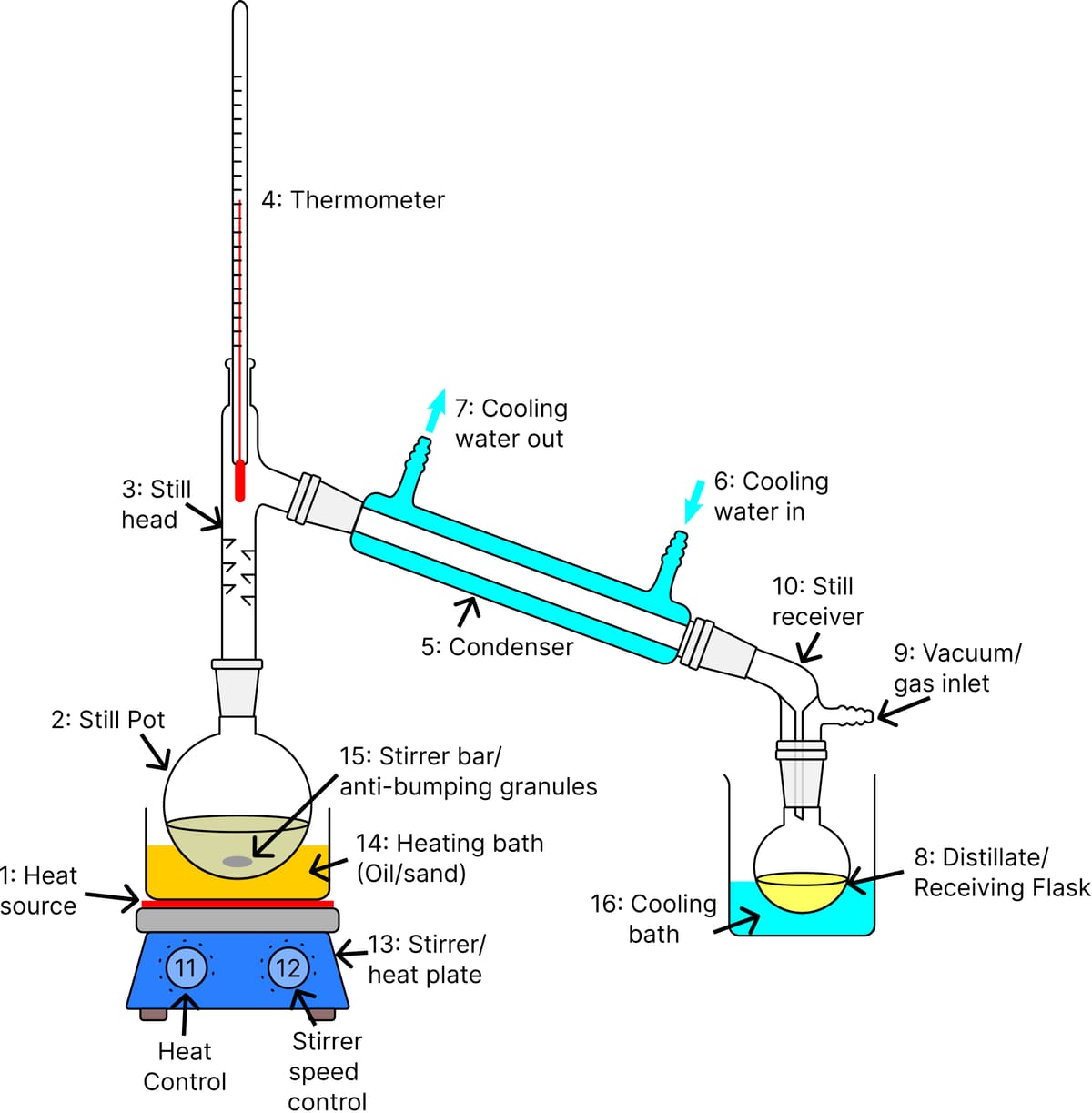
Labelled drawing of a distillation set-up: a heated round flask, a thermometer, a long condenser with cooling water, and a receiving flask
Distillation. The liquid in the flask (2) is heated and turns to vapour. The vapour cools in the condenser (5) and drips into the receiving flask (8) as pure liquid. This is evaporation + condensation. Image: Fadingblitz, Wikimedia Commons · CC0
Two lab methods
Image
QUICK CHECK
PYQ · PPSC OHE 2016 — The substance present in abundant amounts in sea water is:
Tap an option to answer

Physical and chemical changes

Rule in one line: a chemical change makes a new substance; a physical change does not.

PHYSICAL VS CHEMICAL CHANGE
Physical change
Chemical change
New substance
No
Yes
Usually
Can be reversed
Cannot be reversed
Examples
Melting ice, dissolving sugar
Rusting, burning, curdling milk
All changes of state, dissolving and separating a mixture are physical changes. Rusting of iron is a chemical change; it needs both air and water.

Traps and practice

Last revision — where the options try to fool you.

COMMON TRAPS
  • Water expands on freezing; that is why ice floats.
  • Gas → liquid is condensation; solid → gas is sublimation.
  • Diamond is an element (carbon), not a mixture. Air, soil and sea water are mixtures.
  • Iodised salt is a mixture with potassium iodide, not a compound, and not 'molecular iodine'.
  • Nitrogen is 78% of air by volume, not by mass.
  • In soda water, CO2 is the solute and water the solvent.
  • Milk and fog are colloids, not true solutions.
CHECK YOURSELF

Convert 27 °C to kelvin, and 373 K to °C.

Show answer

27 + 273 = 300 K; 373 − 273 = 100 °C.

FLASHCARDS
Matter flashcards
Gas to liquid
Condensation
Solid straight to gas
Sublimation
Solid carbon dioxide
Dry ice
Main gas of air
Nitrogen, 78% by volume
Main salt in sea water
Common salt (sodium chloride)
Cream from milk
Centrifugation
Colours in ink
Chromatography
Light beam seen in fog
Tyndall effect
QUICK BYTES
  • Solid: fixed shape and volume; gas: neither
  • Ice is lighter than water and floats
  • Sublimes: camphor, naphthalene, dry ice, ammonium chloride
  • Air: N2 78%, O2 21%, Ar 0.93%, CO2 0.04% by volume
  • Mixtures: air, soil, sea water, iodised salt, brass
  • Soda water: CO2 dissolved in water
  • K = °C + 273

Frequently Asked Questions

Why does ice float on water?

Water expands when it freezes, so ice takes more space than the same mass of water. Ice is therefore less dense than water and floats.

What is condensation?

The change of a gas into a liquid on cooling, such as dew forming or drops appearing outside a cold glass.

What is sublimation? Give examples.

The direct change of a solid into a gas without becoming a liquid. Camphor, naphthalene balls, ammonium chloride and dry ice sublime.

Is air a compound or a mixture?

A mixture. Its gases are not joined chemically, keep their own properties, and their share can vary. They can be separated by fractional distillation of liquid air.

How much nitrogen is there in air?

About 78 percent by volume. Oxygen is about 21 percent, argon about 0.93 percent and carbon dioxide about 0.04 percent.

Is iodised salt a compound?

No. It is common salt with a small amount of potassium iodide mixed in, so it is a mixture.

What is the difference between a compound and a mixture?

A compound has a fixed make-up and new properties, and can be split only by chemical means. A mixture can have any make-up, its parts keep their properties, and it can be separated by physical methods.

What kind of solution is soda water?

A solution of a gas in a liquid: carbon dioxide (the solute) is dissolved in water (the solvent) under pressure.

What is the Tyndall effect?

The scattering of a beam of light by the particles of a colloid, which makes the beam visible — as in fog, or sunlight entering a dusty room.

How is common salt obtained from sea water?

By evaporation. Sea water is kept in shallow salt pans; the Sun evaporates the water and the salt is left behind.

Now sit the questions they actually set

Previous-year PPSC questions on this topic, free to read with the worked answer.

More in Chemistry

← All Chemistry notes