Light lets us see the world, and it follows a few simple rules. It travels in straight lines, bounces back from a mirror (reflection) and bends when it passes from one medium into another (refraction). The human eye uses refraction through a living lens to form an image on the retina. Exams ask about the laws of reflection, which mirror is used where, lens power in dioptres, eye defects and the lenses that correct them, and why the sky is blue.
On this page you will learn:
- How light travels, and the two laws of reflection
- Images in plane, concave and convex mirrors, and their uses
- Refraction, refractive index, lenses and power in dioptres
- Parts of the human eye, accommodation and eye defects
- Dispersion, rainbow, scattering and atmospheric refraction
- Total internal reflection: optical fibres, diamonds and mirages
Light and reflection
Rule in one line: the angle of incidence always equals the angle of reflection.
Objects that give out their own light, like the Sun, a candle flame or a glowing bulb, are luminous. Most things, including the Moon, are non-luminous: we see them only because light falling on them is reflected into our eyes. Light travels in straight lines, which is why opaque objects cast shadows and a pinhole camera forms an inverted image. In vacuum light travels at about 3 × 10⁸ m/s, the fastest speed known.
First law: the angle of incidence is equal to the angle of reflection. Second law: the incident ray, the reflected ray and the normal at the point of incidence all lie in the same plane. Both angles are measured from the normal, not from the mirror surface. These laws hold for every reflecting surface, flat or curved.
| Property of the image | In a plane mirror |
|---|---|
| Real or virtual | Virtual; it cannot be caught on a screen |
| Erect or inverted | Erect |
| Size | Same size as the object |
| Distance | As far behind the mirror as the object is in front |
| Sides | Laterally inverted: left appears as right |
Two plane mirrors at an angle θ form 360/θ − 1 images of an object between them: at 90° you see 3 images, and parallel mirrors give endless images. A kaleidoscope uses mirror strips set at an angle to make repeating patterns, and a periscope uses two plane mirrors to see over obstacles.
Spherical mirrors
Rule in one line: a concave mirror converges light and can magnify; a convex mirror diverges light and shows a wider view.
A spherical mirror is part of a hollow sphere. Its centre is the pole (P); the centre of the sphere is the centre of curvature (C) and its radius is the radius of curvature (R). Rays parallel to the principal axis meet, or appear to meet, at the principal focus (F). The distance PF is the focal length, and for small mirrors f = R/2.
| Object placed | Image formed | Nature and size |
|---|---|---|
| At infinity | At F | Real, inverted, point-sized |
| Beyond C | Between F and C | Real, inverted, diminished |
| At C | At C | Real, inverted, same size |
| Between C and F | Beyond C | Real, inverted, enlarged |
| At F | At infinity | Real, inverted, highly enlarged |
| Between P and F | Behind the mirror | Virtual, erect, enlarged |
1/v + 1/u = 1/f, where u is the object distance, v the image distance and f the focal length. All distances are measured from the pole; distances in the direction of the incident light are positive and those against it are negative. So the focal length of a concave mirror is negative and that of a convex mirror is positive. Magnification m = −v/u; a negative m means a real, inverted image.
Large concave mirrors concentrate sunlight to produce heat in solar furnaces. A dentist uses a concave mirror to see a large image of the teeth, and the reflector behind a torch bulb or a headlight is concave, so that light from a bulb placed at its focus comes out as a strong parallel beam.
Refraction and lenses
Rule in one line: light bends towards the normal when it slows down in a denser medium, and away from it when it speeds up.
Refraction is the bending of light when it passes obliquely from one transparent medium into another, because its speed changes. Going from air into water or glass (rarer to denser), a ray bends towards the normal; coming out (denser to rarer), it bends away from the normal. A ray falling along the normal passes straight through. That is why a pencil dipped in water looks bent at the surface, a swimming pool looks shallower than it is, and letters seen through a thick glass slab appear raised.
The refractive index of a medium tells how much light slows down in it: n = speed of light in vacuum ÷ speed of light in the medium. It has no unit. A medium with a higher refractive index is optically denser. The ratio of the sine of the angle of incidence to the sine of the angle of refraction is constant for a given pair of media; this is Snell's law.
The power of a lens is its ability to converge or diverge light: P = 1/f, with f in metres. The SI unit is the dioptre (D); 1 D is the power of a lens of focal length 1 m. A lens of +2.0 D is a convex lens with f = 0.5 m, and one of −2.0 D is a concave lens with f = −0.5 m. The powers of lenses placed in contact simply add up.
When light passes from one medium into another, its speed and wavelength change, but its frequency stays the same. Frequency is fixed by the source.
For a convex lens, an object at 2F gives a real, inverted image of the same size at 2F on the other side. An object between F and the lens gives a virtual, erect, enlarged image: this is the magnifying glass.
For lenses, 1/v − 1/u = 1/f, and magnification m = v/u. Distances are measured from the optical centre. The focal length of a convex lens is positive and that of a concave lens is negative. Note the minus sign: the mirror formula has a plus sign.
The human eye and its defects
Rule in one line: myopia is corrected with a concave lens, hypermetropia with a convex lens.
| Part of the eye | What it does |
|---|---|
| Cornea | Transparent front layer; most of the bending of light entering the eye happens here |
| Iris | Dark muscular diaphragm that controls the size of the pupil; gives the eye its colour |
| Pupil | Opening that lets light in; small in bright light, wide in dim light |
| Eye lens | Flexible convex lens that forms a real, inverted image on the retina |
| Ciliary muscles | Hold the lens and change its curvature, and so its focal length |
| Retina | Light-sensitive screen at the back, with rods and cones |
| Optic nerve | Carries electrical signals from the retina to the brain |
| Blind spot | Where the optic nerve leaves the eye; no rods or cones, so no vision |
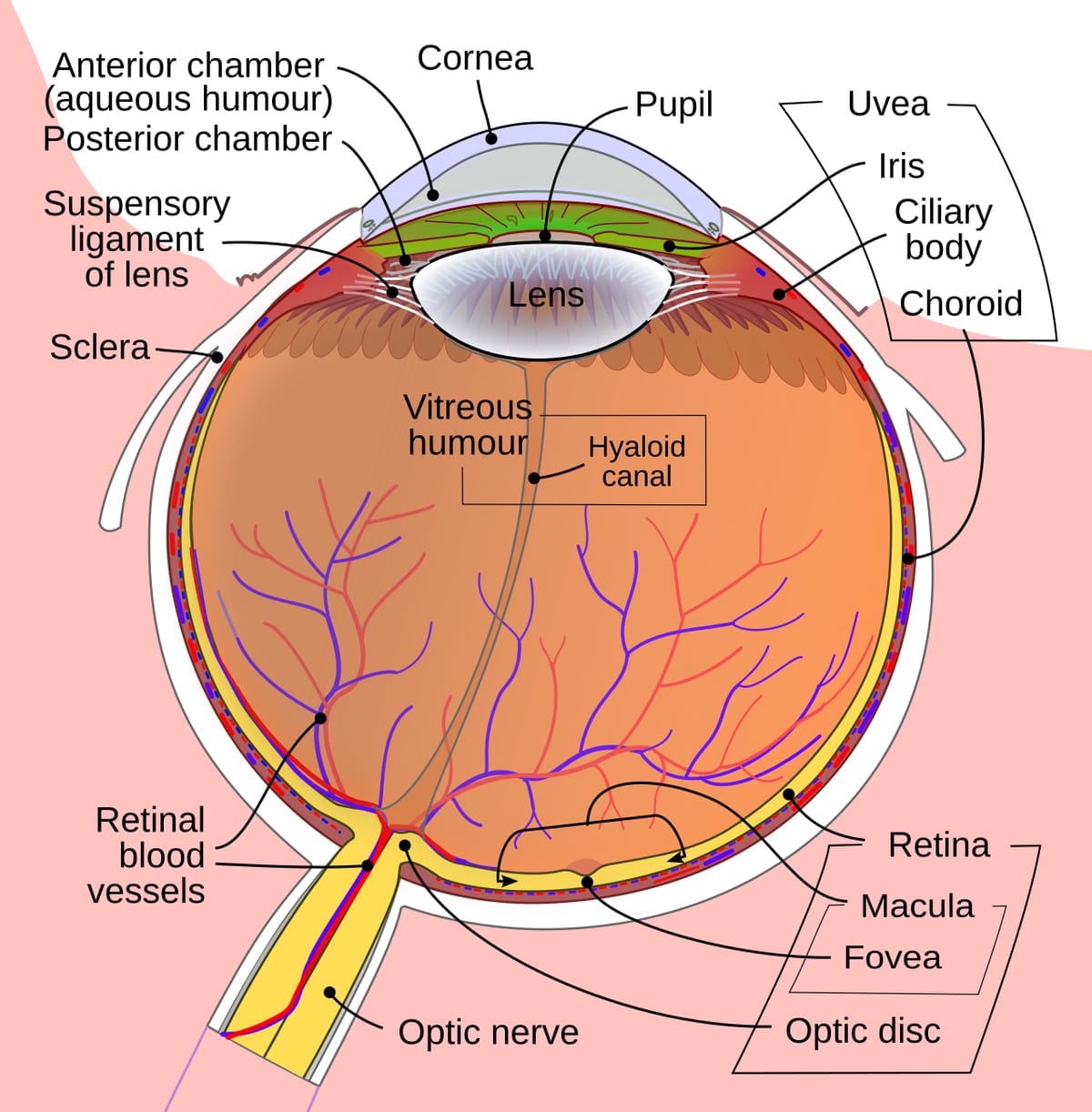
- CorneaLight enters and bends
- PupilControls how much light passes
- Eye lensFine-tunes the focus
- RetinaImage forms; cells fire signals
- Optic nerveSignals reach the brain
The ability of the eye lens to change its focal length. When the ciliary muscles relax, the lens becomes thin and we see distant objects; when they contract, the lens becomes thicker and we see nearby objects. The closest point at which a normal eye sees clearly without strain is the near point, about 25 cm, also called the least distance of distinct vision. The far point of a normal eye is at infinity.
| Defect | What goes wrong | Correction |
|---|---|---|
| Myopia (near-sightedness) | Distant objects blur; image forms in front of the retina; eyeball too long or lens too curved | Concave lens |
| Hypermetropia (far-sightedness) | Near objects blur; near point moves beyond 25 cm; image forms behind the retina; eyeball too short | Convex lens |
| Presbyopia | With age the ciliary muscles weaken and the lens loses flexibility | Bifocal lens |
| Cataract | Eye lens becomes milky and cloudy, often in old age | Surgery |
| Astigmatism | Unequal curvature of the cornea; horizontal and vertical lines are not focused together | Cylindrical lens |
The retina has two kinds of light-sensitive cells: rods respond to the intensity of light and help in dim light, while cones respond to colour and work in bright light. A person whose cones do not work properly cannot tell some colours apart; this is colour blindness.
Colours of light and the atmosphere
Rule in one line: red light bends least and scatters least; violet and blue bend and scatter most.
The splitting of white light into its seven colours by a glass prism. Each colour bends through a different angle: red deviates the least and violet the most. The band of colours is the spectrum. Isaac Newton was the first to obtain the spectrum of sunlight with a glass prism, and he showed that a second, inverted prism recombines the colours into white light.
VIBGYOR: Violet, Indigo, Blue, Green, Yellow, Orange, Red. Violet is at the bottom of the spectrum because it bends the most; red is at the top and has the longest wavelength of visible light.
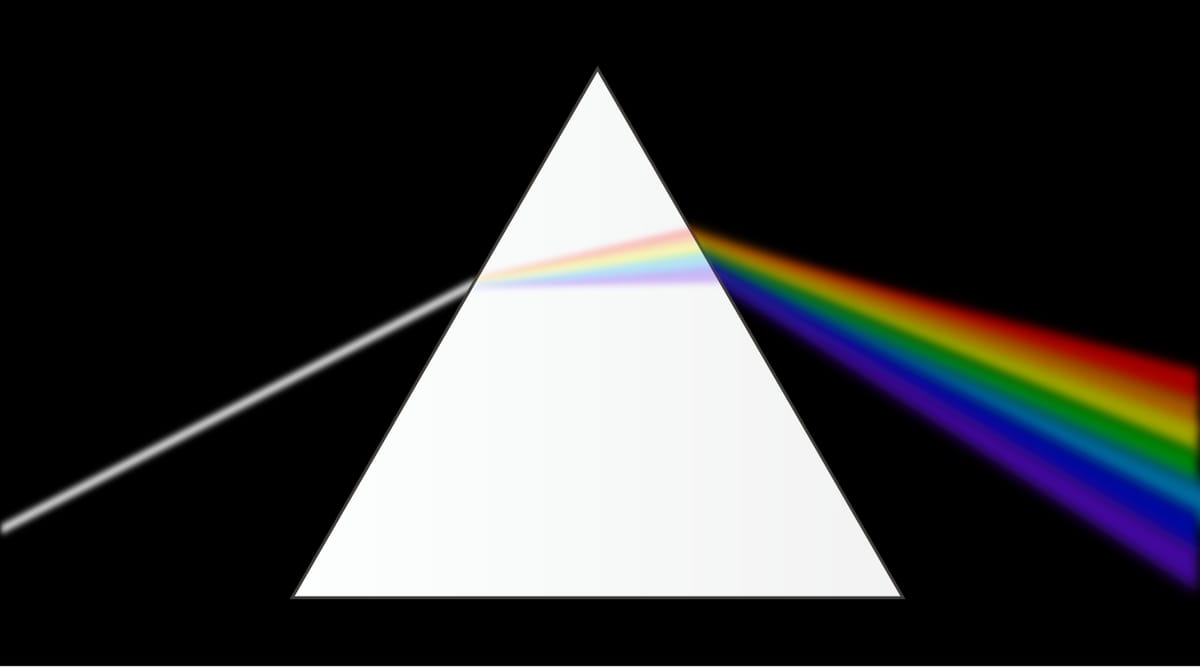
A rainbow is a natural spectrum seen after a shower. Tiny water droplets in the air act like small prisms: sunlight is refracted and dispersed as it enters a drop, reflected inside it, and refracted again as it comes out. A rainbow always forms on the side of the sky opposite the Sun, so you see one only with the Sun behind you.

| What we see | Cause |
|---|---|
| Blue sky | Air molecules scatter short-wavelength blue light much more than red |
| Red Sun at sunrise and sunset | Light crosses a thicker layer of air; blue is scattered away and mostly red reaches us |
| Red danger and stop signals | Red is scattered the least by fog and smoke, so it is seen from far |
| Dark sky for astronauts | Above the atmosphere there is almost no scattering |
| Twinkling of stars | Atmospheric refraction: starlight bends by changing amounts as the air moves |
| Planets do not twinkle | They are much closer and act as extended sources, so the changes average out |
| Sun seen early and set late | Atmospheric refraction: about 2 minutes before actual sunrise and after actual sunset |
When light travels from a denser medium towards a rarer one and the angle of incidence is greater than a certain critical angle, no light passes out: it is all reflected back into the denser medium. It explains the sparkle of a diamond, whose very small critical angle traps light inside; optical fibres, which carry light along bent glass threads for telephone and internet signals and for endoscopy; and the mirage of water seen on hot roads and in deserts, where the air near the ground is hotter and rarer.
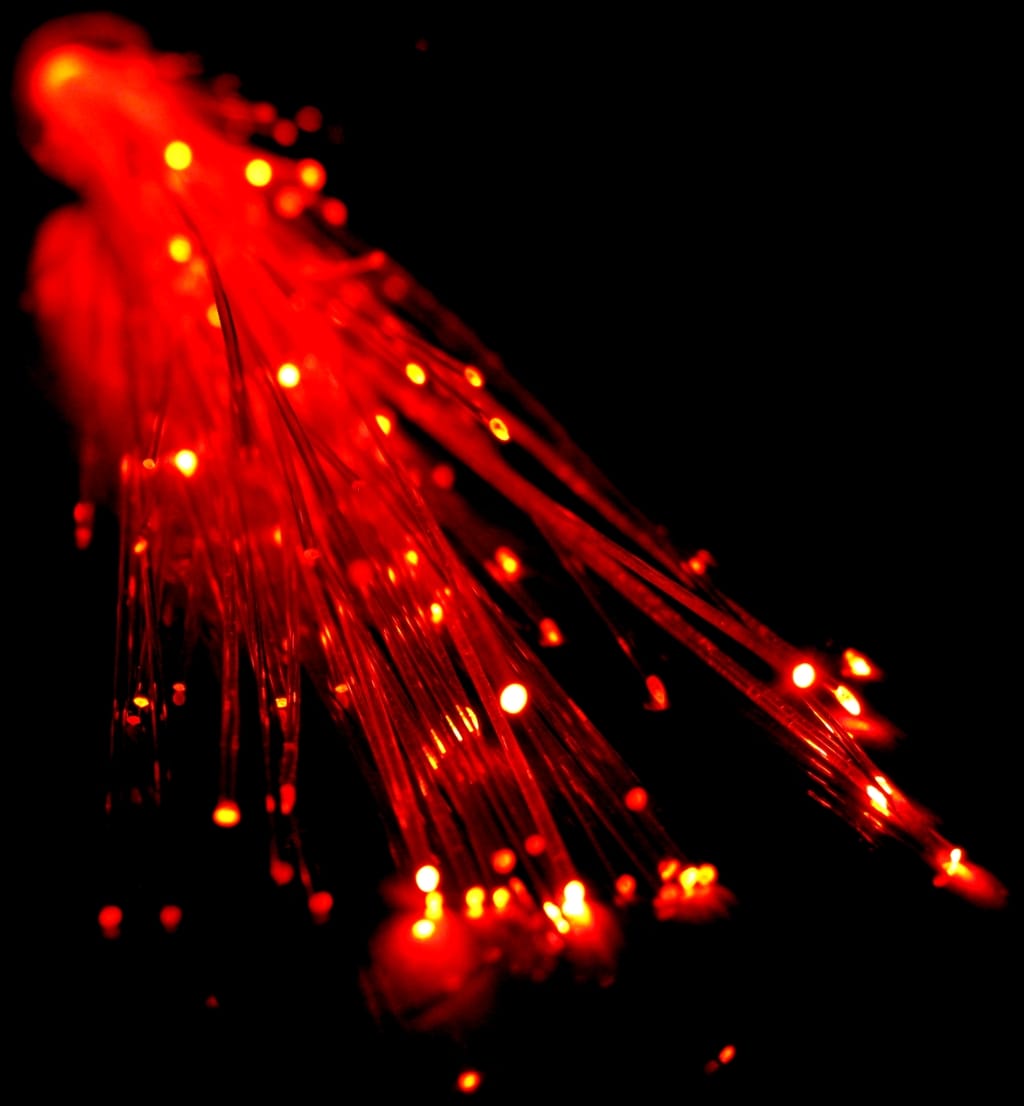
Uses of optical fibres: long-distance telephone and internet links, endoscopy (seeing inside the body), sensors that read the temperature inside jet engines, and pipes that carry sunlight from a roof into rooms of a building.
More facts examiners askTap to open
Light from the Sun takes about 8 minutes to reach the Earth. Light does not need a medium, so it can travel through empty space.
To see your full height in a plane mirror, the mirror needs to be at least half your height.
Kerosene has a higher refractive index than water, so it is optically denser, even though it is lighter and floats on water. Optical density is not the same as mass density.
Night birds such as the owl have many rods and few cones in the retina, so they see well in dim light. Day birds such as the kite and eagle have more cones and fewer rods.
Lack of vitamin A can cause night blindness. Blindness caused by a damaged cornea can be cured by transplanting a cornea from a donated eye.
Traps and practice
- A plane mirror reverses left and right, not top and bottom; its image is virtual, never real.
- Focal length is half the radius of curvature: f = R/2, not 2R.
- Convex mirror diverges, but convex lens converges.
- In P = 1/f the focal length must be in metres; a concave lens has negative power.
- Myopia means you see NEAR things clearly; it needs a concave lens.
- Danger signals are red because red is scattered the LEAST, not the most.
- Stars twinkle because of atmospheric refraction, not scattering; planets do not twinkle.
An optician prescribes a lens of power −2.5 D. What kind of lens is it, and what is its focal length?
Show answer
f = 1/P = 1/(−2.5) = −0.4 m = −40 cm. The negative sign shows it is a concave lens, the kind used to correct myopia.
Why do stars twinkle while planets do not?
Show answer
Stars are so far away that they act as point sources. As their light passes through moving layers of air, atmospheric refraction keeps changing its path, so the star seems to flicker. Planets are much closer and look like small discs; the changes from different points cancel out, so they shine steadily.
- Image in a plane mirror
- Virtual, erect, same size, laterally inverted
- Mirror behind a headlight bulb
- Concave
- Unit of power of a lens
- Dioptre (D)
- Least distance of distinct vision
- 25 cm
- Lens for hypermetropia
- Convex
- Colour deviated most by a prism
- Violet
- Sparkle of a diamond
- Total internal reflection
- Persistence of vision
- About 1/16 s
- Speed of light in vacuum: 3 × 10⁸ m/s
- Angle of incidence = angle of reflection
- f = R/2; mirror: 1/v + 1/u = 1/f
- Concave mirror: headlights, shaving, dentist; convex: rear-view
- P = 1/f in metres; unit dioptre
- Myopia: concave; hypermetropia: convex; presbyopia: bifocal; astigmatism: cylindrical
- VIBGYOR: red bends least, violet most
- Blue sky and red sunset: scattering; twinkling: atmospheric refraction