Part of the Punjab Police ASI 2026 course.Practise Solar System, Stars and India's Space Missions questions →Take a mock test →
GENERAL SCIENCE · CLASS 8–10 SERIES

Solar System, Stars and India's Space Missions

The Sun and the planets with their records, the Moon and eclipses, stars and galaxies, satellites and NavIC, and India's space story from Aryabhata to Chandrayaan-3, Aditya-L1 and NISAR.

Punjab PolicePSSSBPPSC17 MIN READ
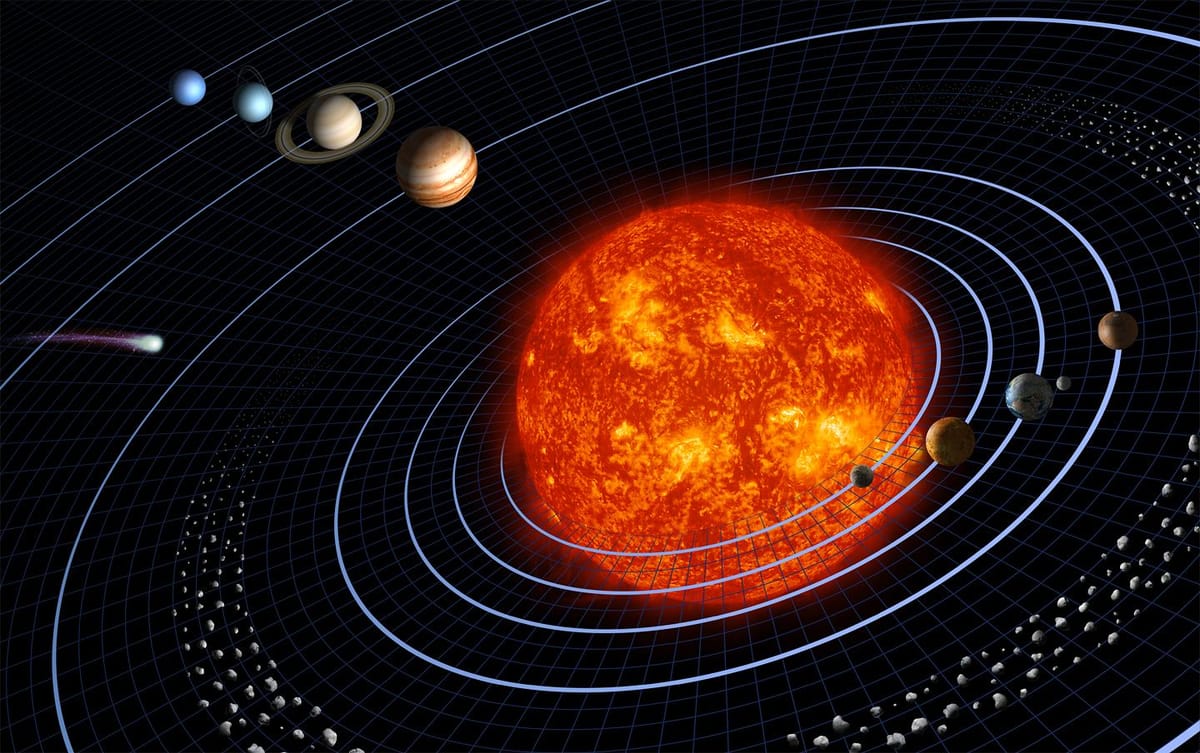
Artist's drawing of the Sun at the centre with planets on circular orbits, a comet and belts of small rocks
The solar system — an artist's illustration, not to scale. Eight planets go round the Sun. The asteroid belt lies between Mars and Jupiter. Real sizes and distances are very different from this picture. Image: NASA (Harman Smith and Laura Generosa), Wikimedia Commons · Public domain

The solar system is the Sun and everything that goes round it: eight planets and their moons, dwarf planets, asteroids and comets. Beyond it lie the stars, so far away that we measure their distance in light years. Exams ask planet records, the cause of eclipses, satellites, and India's space milestones from Aryabhata to Chandrayaan-3.

On this page you will learn:

  • The Sun, the planets in order and each planet's record
  • The Moon, its phases, and solar and lunar eclipses
  • Stars, light years, the Milky Way, comets and meteors
  • Geostationary and polar satellites, IRS and NavIC
  • ISRO's people, places and missions, with dates
8
Planets
Pluto became a dwarf planet in 2006
8 min
Sunlight to reach Earth
About 8 min 20 s
23 Aug
National Space Day
Chandrayaan-3 landing, 2023

The Sun and the planets

Rule in one line: the Sun is a star; eight planets go round it in orbits.

KEY TERM
The Sun

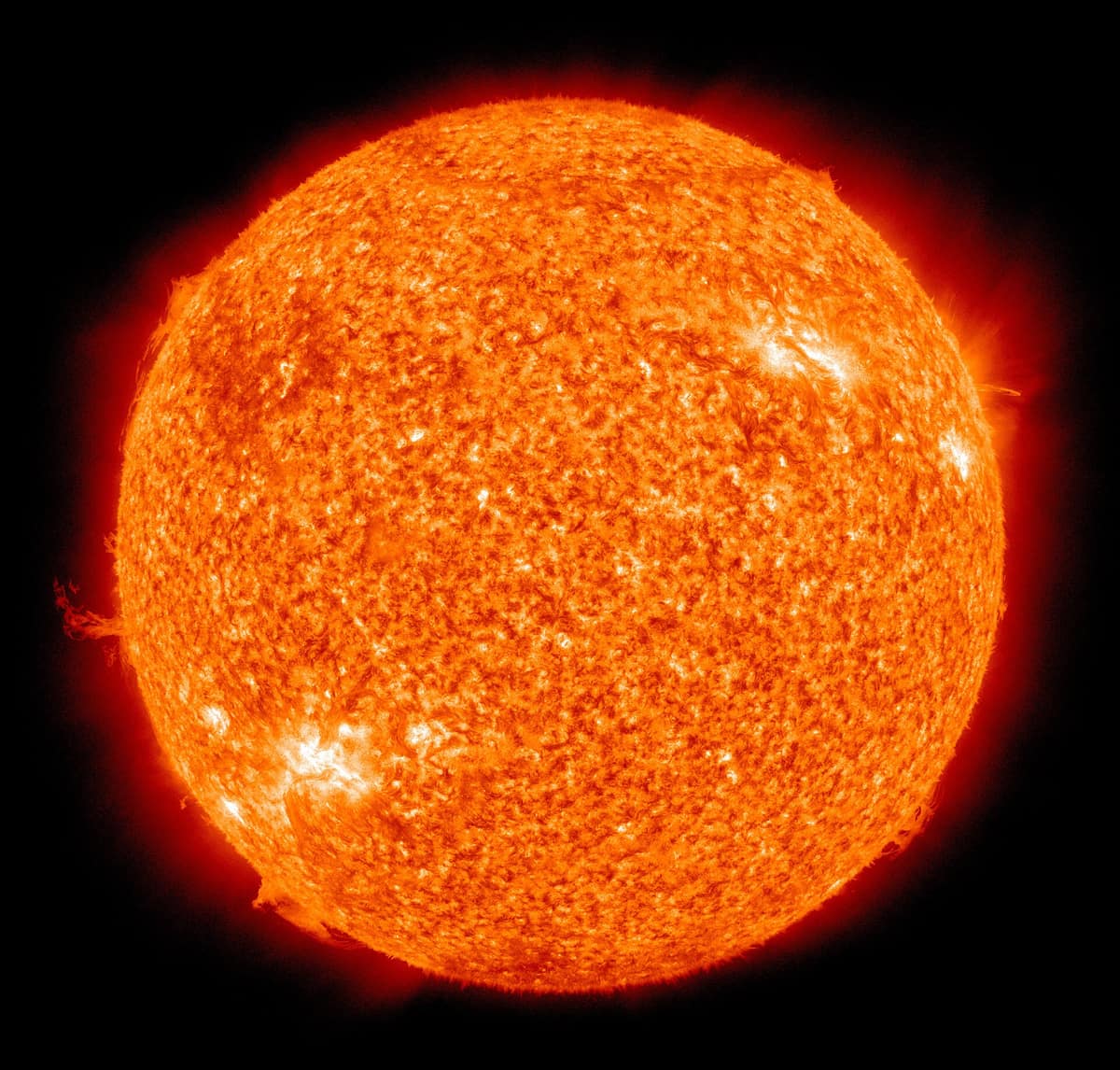
The Sun is the star nearest to us. It is a huge ball of hot gas, mostly hydrogen and helium. In its core, hydrogen nuclei join to form helium. This is nuclear fusion, and it releases enormous energy. The Sun is about 1.5 × 10⁸ km away; its light takes about 8 minutes 20 seconds to reach us.
Hydrogen→Fusion→Helium + energy
The whole Sun as a glowing orange ball with bright patches and loops of gas at its edge, on a black background
The Sun, photographed in ultraviolet light by NASA's Solar Dynamics Observatory (colours added). It is a star: a ball of hot hydrogen and helium that shines by nuclear fusion. Its light takes about 8 minutes 20 seconds to reach Earth. Image: NASA/SDO (AIA), Wikimedia Commons · Public domain
REMEMBER

Planets from the Sun: Mercury, Venus, Earth, Mars, Jupiter, Saturn, Uranus, Neptune — My Very Efficient Mother Just Served Us Nuts.
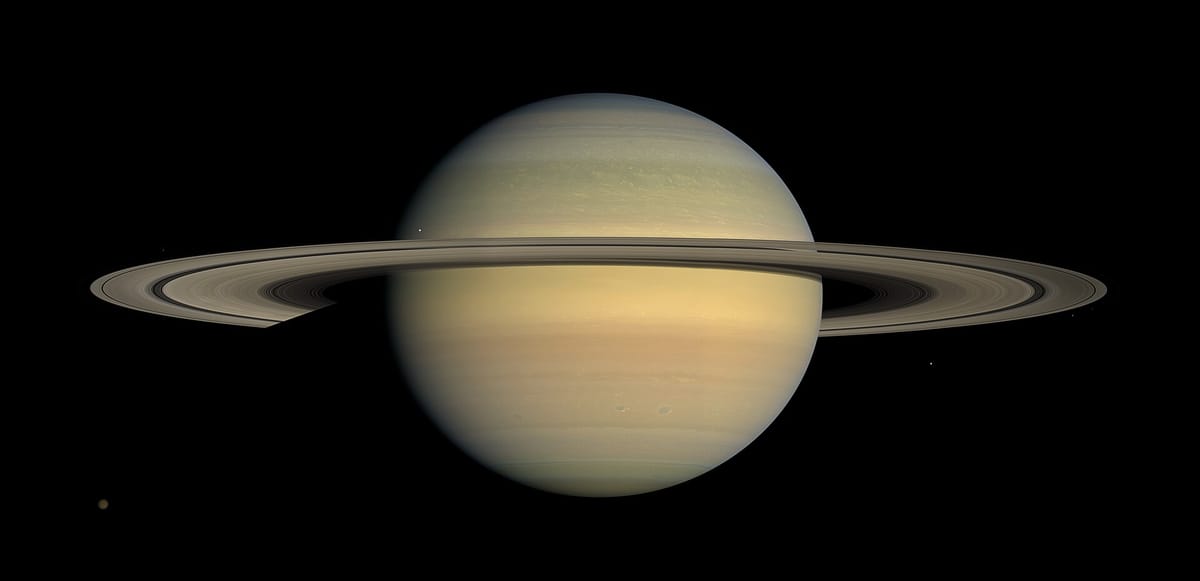
Saturn, a pale yellow banded planet, with its wide flat rings seen almost edge-on
Saturn, photographed by the Cassini spacecraft in 2009. It is the second-largest planet. Its bright rings are made of pieces of ice and rock. Saturn is so light that its average density is less than that of water. Image: NASA/JPL/Space Science Institute, Wikimedia Commons · Public domain
PlanetWhat examiners ask
MercuryClosest to the Sun; smallest planet; no moon
VenusHottest and brightest; Earth's twin (similar size); spins east to west; no moon
EarthBlue planet; only known home of life; one moon
MarsRed planet (iron oxide); two small moons
JupiterLargest planet; shortest day; Great Red Spot
SaturnBright rings; less dense than water
UranusTilted on its side; spins east to west
NeptuneFarthest planet; longest year (about 165 Earth years)
Venus is hotter than Mercury: its thick carbon dioxide air traps heat.
KEY TERM
Dwarf planet

Until 2006, Pluto was the ninth planet. In 2006 the International Astronomical Union set a new rule for a planet, and Pluto became a dwarf planet. Ceres and Eris are dwarf planets too. So there are now eight planets.

QUICK CHECK
PYQ · Punjab Police SI 2016 — The process responsible for enormous energy in the sun is
Tap an option to answer
QUICK CHECK
PYQ · PPSC TM 2015 — Which of the following planets rotates upon its axis from east to west?
Tap an option to answer

The Moon and eclipses

Rule in one line: solar eclipse = Moon in the middle (new moon); lunar eclipse = Earth in the middle (full moon).

KEY TERM
The Moon

The Moon is Earth's only natural satellite, about 384,000 km away. It has no light of its own; it reflects sunlight. It has no atmosphere, so there is no sound or weather. Its gravity is about 1/6 of Earth's. We always see the same face, because it spins once in the time it takes to go round Earth once.

PHASES OF THE MOON
  1. New moon
    Moon not seen
  2. Waxing
    Bright part grows
  3. Full moon
    Whole face lit
  4. Waning
    Bright part shrinks
One full moon to the next takes a little over 29 days.
TWO KINDS OF ECLIPSE
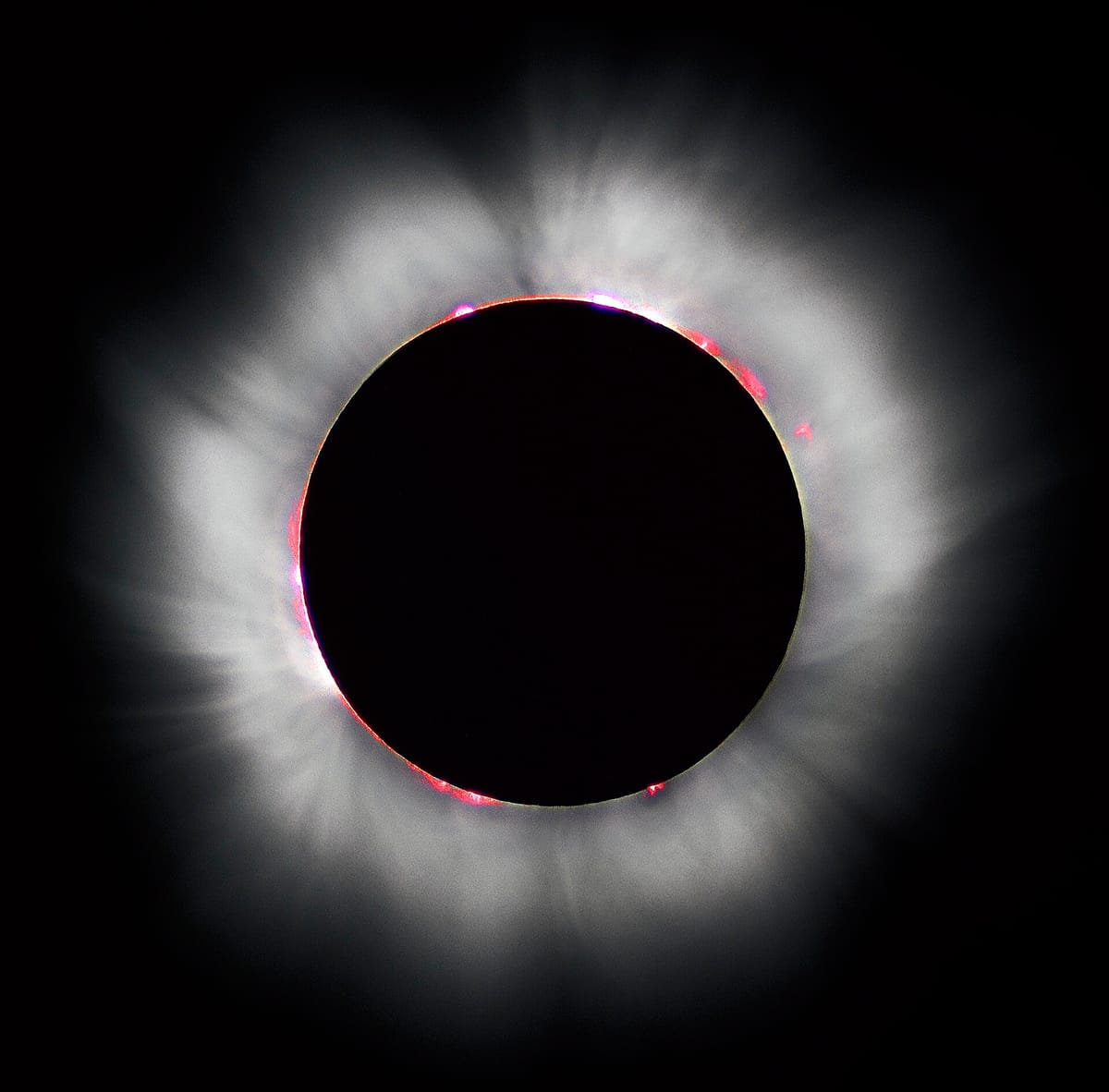
Solar eclipse
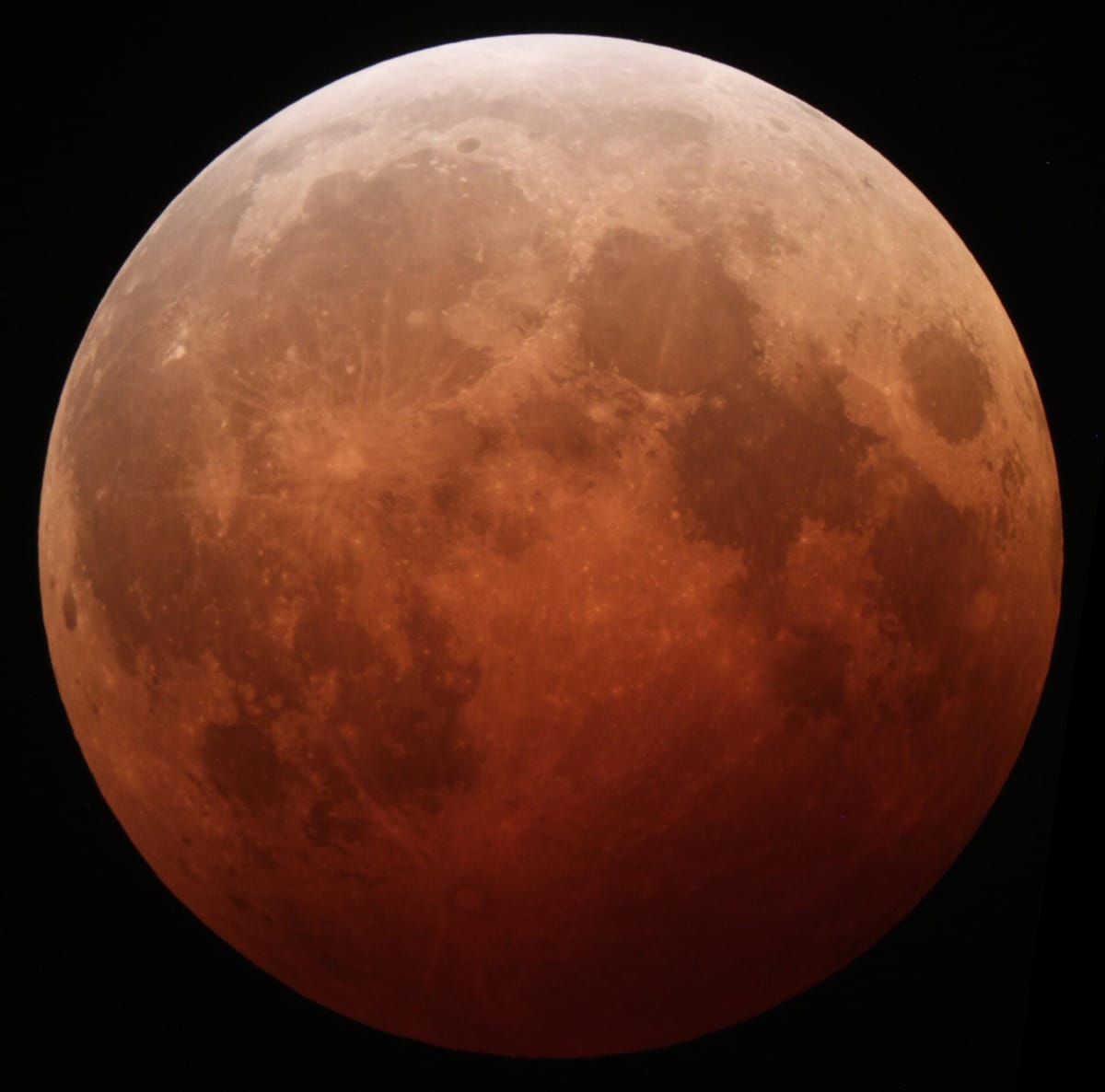
Lunar eclipse
In the middle
Moon
Earth
Order
Sun – Moon – Earth
Sun – Earth – Moon
Shadow
Moon's, on Earth
Earth's, on Moon
Moon phase
New moon
Full moon
Look directly?
No; harms eyes
Yes, safe
Eclipses do not happen every month, because the Moon's orbit is slightly tilted.
Solar eclipse and lunar eclipse
Image
QUICK CHECK
PYQ · PPSC ICS 2016 — A solar eclipse occurs when the
Tap an option to answer
QUICK CHECK
PYQ · PSSSB Election Kanungo 2018 — Lunar eclipse occurs when:
Tap an option to answer
QUICK CHECK
PYQ · PPSC PRIN 2020 — On the moon, an astronaut cannot drink lemonade with the help of a straw because
Tap an option to answer

Stars, galaxies and small bodies

Rule in one line: a light year is a distance, and our Sun is one star of the Milky Way.

KEY TERM
Stars, light years and galaxies

Stars are hot balls of gas that make their own light. A light year is the distance light travels in a year, about 9.46 × 10¹² km. It measures distance, not time. Billions of stars form a galaxy. Our solar system is in the Milky Way galaxy (Akash Ganga).
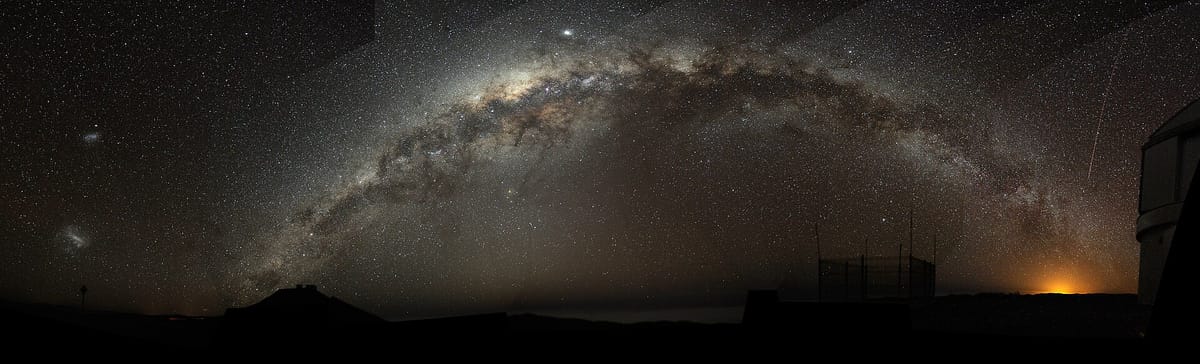
A wide night-sky panorama with a bright band of countless stars and dark dust arching over dark hills and a telescope dome
The Milky Way, our own galaxy, seen from Chile. We see it from inside, as a bright band of billions of stars. The two faint patches on the left are the Magellanic Clouds, small nearby galaxies. Image: Bruno Gilli/ESO, Wikimedia Commons · CC BY 4.0
BodyWhat it is
AsteroidsRocky bits, mostly in a belt between Mars and Jupiter
CometsIce and dust; grow a tail near the Sun that points away from it
MeteorsBurn up in the air; called shooting stars
MeteoritesPieces big enough to reach the ground
Halley's comet returns about every 76 years; it was last seen in 1986.
THE POLE STAR AND SAPTARISHI

Stars seem to move east to west because Earth spins west to east. The Pole Star sits almost above Earth's axis in the north, so it seems fixed. Two end stars of Saptarishi (Ursa Major, the Big Dipper) point to it. Stars twinkle; planets do not.

QUICK CHECK
PYQ · Punjab Patwari 2016 — The solar system is a part of which galaxy?
Tap an option to answer

Satellites and navigation

Rule in one line: a geostationary satellite goes round once a day, so it seems to hang over one spot.

TWO COMMON ORBITS
Geostationary
Polar
Height
About 36,000 km, over the equator
Much lower, over both poles
One orbit takes
24 hours (one day)
About 1–2 hours
From the ground
Seems fixed
Scans the whole Earth
Used for
TV, phones, weather
Remote sensing, maps
Indian series
INSAT, GSAT
IRS, Cartosat
A geostationary satellite is not still in space. It moves, but at the same rate as Earth spins.
KEY TERM
Remote sensing (IRS)

Indian Remote Sensing (IRS) satellites photograph Earth from space. They help find minerals and groundwater, check crop health, map forests and track floods. They are not used for telephone calls or traffic control.

SystemCountry
GPSUSA
GLONASSRussia
GalileoEurope
NavIC (IRNSS)India
Satellite navigation systems. India's NavIC covers India and about 1500 km around it. In 2020 the International Maritime Organization (IMO) accepted it for ships in the Indian Ocean.
QUICK CHECK
PYQ · PSSSB Election Kanungo 2018 — The period of revolution of a geostationary satellite is:
Tap an option to answer
QUICK CHECK
PYQ · PPSC JE 2021 — In which of the following activities are Indian Remote Sensing (IRS) satellites used? 1. Telecommunications 2. Traffic control 3. Mineral exploration 4. Locating ground water resources 5. Assessment of crop productivity. Select the correct answer from the code given below.
Tap an option to answer
QUICK CHECK
PYQ · Punjab Police SI 2023 — India's independent regional navigation satellite system is known as:
Tap an option to answer

ISRO: people, places and first steps

Rule in one line: Sarabhai founded it, Bengaluru runs it, Sriharikota launches it.

CentrePlace
ISRO headquartersBengaluru, Karnataka
Satish Dhawan Space Centre (SHAR) — launch siteSriharikota, Andhra Pradesh
Vikram Sarabhai Space Centre (rockets)Thiruvananthapuram, Kerala
Semi-Conductor LaboratoryMohali (SAS Nagar), Punjab, next to Chandigarh; now under MeitY, not ISRO
Bhabha Atomic Research Centre (not ISRO)Trombay, Mumbai
VSSC is in Thiruvananthapuram, not Bengaluru — a favourite 'wrongly matched' option.
INDIA'S FIRST STEPS IN SPACE
  1. 1962
    INCOSPAR set up

    Indian space research begins under Vikram Sarabhai, the father of India's space programme.

  2. 1963
    First rocket from Thumba

    A sounding rocket from near Thiruvananthapuram.

  3. 1969
    ISRO founded

    15 August 1969.

  4. 1975
    Aryabhata

    India's first satellite, launched on 19 April 1975 by a Soviet rocket.

  5. 1981
    APPLE

    India's first experimental geostationary communication satellite.

  6. 1984
    Rakesh Sharma

    First Indian in space, on a Soviet mission.

  7. 1997
    Kalpana Chawla

    First India-born woman in space, on the US shuttle Columbia.

QUICK CHECK
PYQ · Punjab Police SI 2023 — Who is the father of India's space programme?
Tap an option to answer
QUICK CHECK
PYQ · Punjab Police SI 2016 — Which of the following is incorrectly matched?
Tap an option to answer
QUICK CHECK
PYQ · PSSSB Clerk 2021 — In which of the following years was the first satellite of India, Aryabhatta, launched?
Tap an option to answer
QUICK CHECK
PYQ · RSMSSB LDC 2024 — Which one was the first geostationary satellite launched by ISRO in 1981?
Tap an option to answer

India's missions, with dates

Rule in one line: learn each mission with its year — papers ask the year.

INDIA'S MISSIONS
  1. 2008
    Chandrayaan-1

    India's first Moon mission; it found signs of water on the Moon.

  2. 2013–14
    Mangalyaan (Mars Orbiter Mission)

    Launched November 2013; reached Mars orbit in September 2014, at the first attempt.

  3. 2019
    Chandrayaan-2

    Launched 22 July 2019. The orbiter worked; the Vikram lander crashed in September 2019.

  4. 2022
    Satellite broadband

    ISRO and Hughes Communications India started India's first high-throughput satellite broadband service.

  5. 2023
    Chandrayaan-3

    Vikram landed near the Moon's south pole on 23 August 2023, with the Pragyan rover.

  6. 2023–24
    Aditya-L1

    India's first Sun mission; launched September 2023, reached its orbit round point L1 in January 2024.

  7. 2025
    NISAR

    ISRO–NASA Earth-watching radar satellite, launched July 2025 from Sriharikota.

KEY TERM
Chandrayaan-3 and National Space Day

With Chandrayaan-3, India became the first country to land near the Moon's south pole, and the fourth to land softly on the Moon. The landing spot is named Shiv Shakti point. 23 August is now National Space Day.
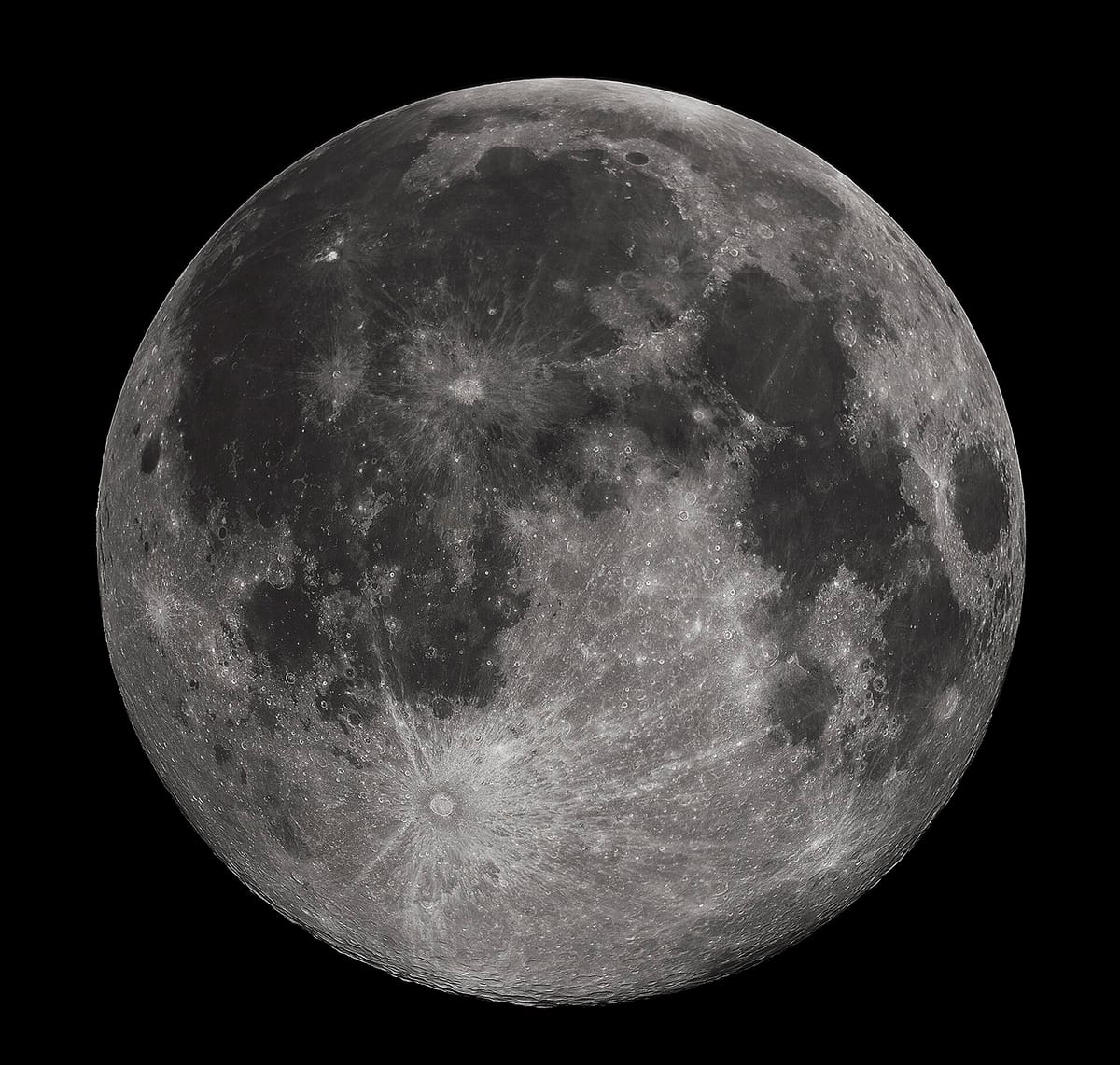
The full Moon in grey and white, with dark patches and bright rayed craters, on a black sky
The full Moon. The Moon has no light of its own; it reflects sunlight. The dark patches are old lava plains, and the bright spots are craters. The same side always faces Earth, because the Moon spins once on its axis in the time it takes to go once round Earth. Image: Gregory H. Revera, Wikimedia Commons · CC BY-SA 3.0
PLANS AHEAD — CHECK THE LATEST NEWS

Gaganyaan is India's planned human spaceflight. Its crew-module re-entry test, CARE, flew in December 2014. In June 2025, Shubhanshu Shukla flew to the International Space Station on the Axiom-4 mission. In October 2024 the government said India's own space station, the Bharatiya Antariksh Station, is planned by 2035. Dates of future missions can change; check current news before the exam.

QUICK CHECK
PYQ · Punjab Police Constable 2021 — In which year was Chandrayaan-2 mission launched?
Tap an option to answer
QUICK CHECK
PYQ · Punjab Police Constable 2025 — In 2025, ISRO and NASA jointly launched the 'NISAR' satellite equipped with dual-frequency Synthetic Aperture Radar. What is the main objective of the NISAR mission?
Tap an option to answer
QUICK CHECK
PYQ · Punjab Police Constable 2025 — According to the announcement made by the Government of India in October 2024, when is India expected to have its own space station, known as the "Bharatiya Antriksh Station"?
Tap an option to answer

Traps and practice

Last revision — where the options try to fool you.

COMMON TRAPS
  • The Sun shines by fusion, not fission and not burning.
  • Mercury is closest to the Sun, but Venus is the hottest.
  • Venus and Uranus spin east to west.
  • Solar eclipse: Moon in the middle. Lunar eclipse: Earth in the middle.
  • A light year is a distance, not a time.
  • A geostationary satellite takes one day per orbit; it is not truly still.
  • VSSC is in Thiruvananthapuram; ISRO HQ is in Bengaluru.
  • NISAR watches Earth; Aditya-L1 watches the Sun.
CHECK YOURSELF

Why can an astronaut not drink with a straw on the Moon?

Show answer

Sucking lowers the pressure inside the straw, and air pressure outside pushes the drink up. The Moon has no air, so nothing pushes the drink up.

FLASHCARDS
Space flashcards
Sun's energy
Nuclear fusion
Spins east to west
Venus, Uranus
Our galaxy
Milky Way
Geostationary orbit time
One day
India's navigation system
NavIC
Father of India's space programme
Vikram Sarabhai
First Indian satellite
Aryabhata, 1975
Chandrayaan-2 launch
2019
QUICK BYTES
  • Sun: fusion; light reaches us in about 8 minutes
  • Largest Jupiter; closest Mercury; hottest Venus
  • Solar eclipse on new moon; lunar on full moon
  • No air on the Moon: no straw, no sound
  • Geostationary: 24 hours, 36,000 km; IRS: land, water, crops
  • Aryabhata 1975; APPLE 1981; Chandrayaan-2 2019; Chandrayaan-3 2023
  • NISAR 2025 (Earth); Bharatiya Antariksh Station target 2035

Frequently Asked Questions

Where does the Sun get its energy?

From nuclear fusion: hydrogen nuclei join to form helium in its core, releasing huge energy.

What is the order of the planets?

Mercury, Venus, Earth, Mars, Jupiter, Saturn, Uranus, Neptune. Remember: My Very Efficient Mother Just Served Us Nuts.

Which planets spin from east to west?

Venus and Uranus. All other planets spin west to east, like Earth.

What is the difference between a solar and a lunar eclipse?

In a solar eclipse the Moon comes between the Sun and Earth, on a new moon day. In a lunar eclipse Earth comes between the Sun and Moon, on a full moon night.

Which galaxy is our solar system in?

The Milky Way, called Akash Ganga in India.

What is a geostationary satellite?

A satellite about 36,000 km above the equator that goes round once a day, the same as Earth's spin. So it seems fixed over one place and is used for TV and phones.

What is NavIC?

India's own regional satellite navigation system, also called IRNSS. The International Maritime Organization accepted it for ships in the Indian Ocean in 2020.

Who is called the father of India's space programme?

Vikram Sarabhai. The rocket centre in Thiruvananthapuram (VSSC) is named after him.

When were Chandrayaan-2 and Chandrayaan-3 launched?

Chandrayaan-2 in July 2019. Chandrayaan-3 in July 2023; it landed near the Moon's south pole on 23 August 2023.

What is the NISAR mission for?

NISAR is an ISRO–NASA radar satellite, launched in July 2025. It monitors Earth's ecosystems, ice and natural hazards such as earthquakes and floods.

Now sit the questions they actually set

Previous-year PPSC questions on this topic, free to read with the worked answer.

More in Physics

← All Physics notes