Every sound — a temple bell, a friend's voice, a clap of thunder — begins with something vibrating. The vibration passes through a medium such as air, water or a solid as a wave and reaches our ears; sound cannot cross empty space. Exams ask for the units (hertz, decibel), what decides pitch and loudness, where sound travels fastest, how far a wall must be to give an echo, the limits of human hearing, and the uses of ultrasound.
On this page you will learn:
- How sound is produced, and why it needs a medium
- Longitudinal waves: wavelength, frequency, time period, amplitude
- Pitch, loudness, quality and the range of hearing
- Speed of sound in solids, liquids and gases
- Echo, reverberation, SONAR and uses of ultrasound
- The human ear and noise pollution
How sound is produced and travels
Rule in one line: sound is made by vibrating objects and needs a medium; it cannot travel through a vacuum.
A vibration is a rapid to-and-fro motion of an object. A struck bell, a plucked rubber band and the skin of a beaten tabla all vibrate and produce sound. Often the vibration is too small to see, but it can be felt — touch a ringing bell and the sound stops when the vibration is stopped.
Humans speak with the larynx, at the upper end of the windpipe. Two vocal cords are stretched across it, leaving a narrow slit. When the lungs force air through the slit, the vocal cords vibrate and produce sound. Muscles make the cords tighter or looser to change the voice. The vocal cords of men are about 20 mm long, those of women about 5 mm shorter, and those of children very short — which is why their voices differ.
| Musical instrument | Part that vibrates |
|---|---|
| Sitar, veena, ektara | Stretched string |
| Tabla, dholak, drum | Stretched membrane |
| Flute, whistle | Column of air |
| Bell, manjira, cymbals | The metal body itself |
Sound travels through solids, liquids and gases, but not through a vacuum. Put a ringing electric bell in an airtight glass jar and pump the air out: the sound grows fainter and fainter, though the bell keeps vibrating. On the Moon, which has no air, astronauts cannot hear each other directly and talk by radio.
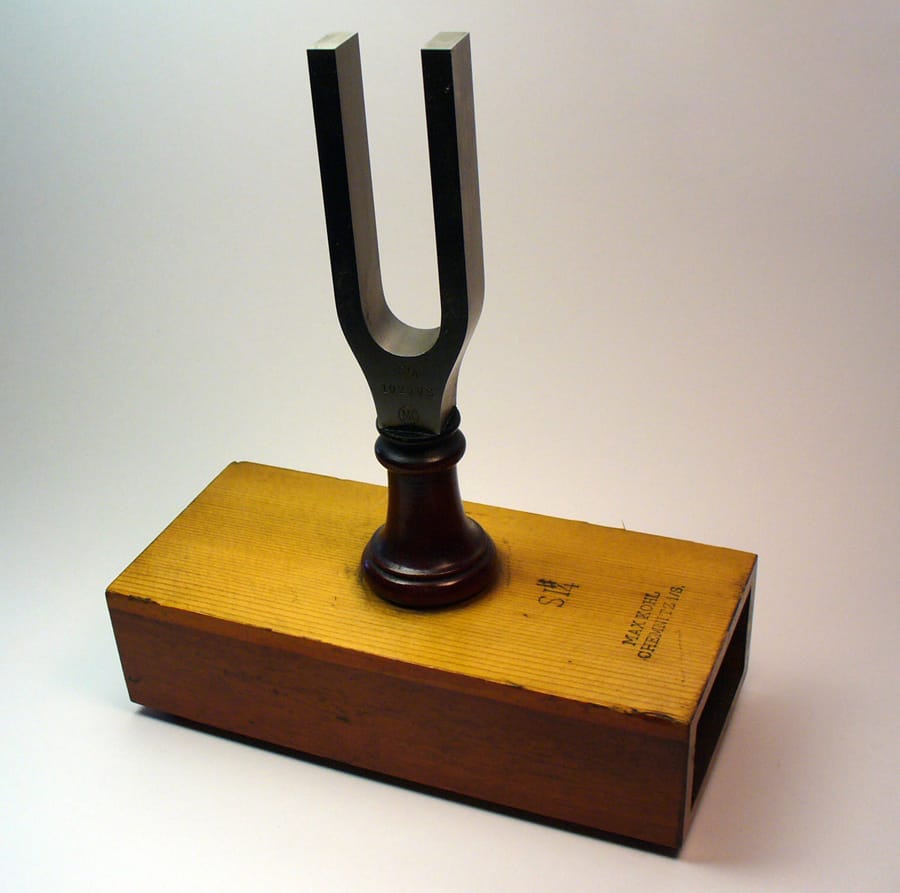
Sound as a wave
Rule in one line: sound in air is a longitudinal wave of compressions and rarefactions; speed = frequency × wavelength.
Sound is a mechanical wave. The particles of the medium do not travel along with the sound; each one vibrates about its own position and passes the disturbance to the next. What travels is the disturbance, carrying energy with it.
As a vibrating object moves forward it pushes the air in front of it together, making a region of high pressure and density — a compression. As it moves back it leaves a region of low pressure and density — a rarefaction. A series of compressions and rarefactions travels outward as the sound wave.
| Term | Meaning | Remember |
|---|---|---|
| Wavelength (λ) | Distance between two neighbouring compressions or two neighbouring rarefactions | SI unit: metre |
| Frequency (ν) | Number of oscillations per second | SI unit: hertz (Hz) |
| Time period (T) | Time for one complete oscillation | T = 1/ν; unit second |
| Amplitude | Largest disturbance of the medium on either side of its mean value | Larger amplitude, louder sound |
Speed = frequency × wavelength. A sound of frequency 2000 Hz and wavelength 0.17 m travels at 2000 × 0.17 = 340 m/s. In a given medium the speed of sound stays the same, so a higher frequency means a shorter wavelength.
Pitch, loudness and the range of hearing
Rule in one line: frequency decides pitch, amplitude decides loudness; humans hear from 20 Hz to 20 kHz.
| Characteristic | Decided by | Example |
|---|---|---|
| Pitch | Frequency | A woman's or child's voice is shriller than a man's; a bird's chirp is high, a lion's roar is low |
| Loudness | Amplitude | A drum hit harder sounds louder; a lion's roar is loud though low-pitched |
| Quality (timbre) | The mix of frequencies, or shape of the wave | Tells a sitar from a flute playing the same note |
Loudness is proportional to the square of the amplitude: if the amplitude doubles, the loudness becomes 4 times. Loudness is expressed in decibels (dB).
| Unit | Measures |
|---|---|
| Hertz (Hz) | Frequency |
| Decibel (dB) | Loudness of sound |
| Mach number | Speed, as a multiple of the speed of sound |
| Parsec | Distance between stars |


Speed of sound, echo and ultrasound at work
Rule in one line: sound is fastest in solids and slowest in gases; an echo needs a reflector at least 17.2 m away.
The speed of sound depends on the medium and its temperature: it is highest in solids, lower in liquids and lowest in gases, and it rises as the temperature rises. Light travels at about 3 × 10⁸ m/s, enormously faster than sound — so we see a flash of lightning first and hear the thunder later.
Temperature: warmer air carries sound faster. Humidity: moist air is lighter than dry air, so sound is faster in humid air. Pressure: at a fixed temperature, changing the pressure changes the density in the same ratio, so the speed does not change.
Sound bounces off hard surfaces, obeying the same laws of reflection as light. The reflected sound heard after the original is an echo. The sensation of a sound stays in the brain for about 0.1 s, so the echo must arrive at least 0.1 s later to be heard separately. At 22 °C sound travels 344 m/s; in 0.1 s it covers 34.4 m — there and back — so the reflecting surface must be at least 17.2 m away. The rolling of thunder is due to repeated reflections of sound from clouds and the land.
In a big hall, sound is reflected again and again from the walls, ceiling and floor, and lingers after the source has stopped. This persistence is reverberation; too much of it makes speech and music unclear. Halls are made to sound right by covering the roof and walls with sound-absorbing materials such as compressed fibreboard, rough plaster or heavy curtains, and by choosing seats that absorb sound.
| Device or design | How reflection of sound helps |
|---|---|
| Megaphone, horn, shehnai, trumpet | Sends sound in one direction without spreading |
| Stethoscope | The heartbeat reaches the doctor's ears by repeated reflection inside the tube |
| Curved ceiling of a concert hall | Reflected sound reaches every corner of the hall |
| Sound board behind the stage | A curved board reflects the speaker's voice evenly across the hall |
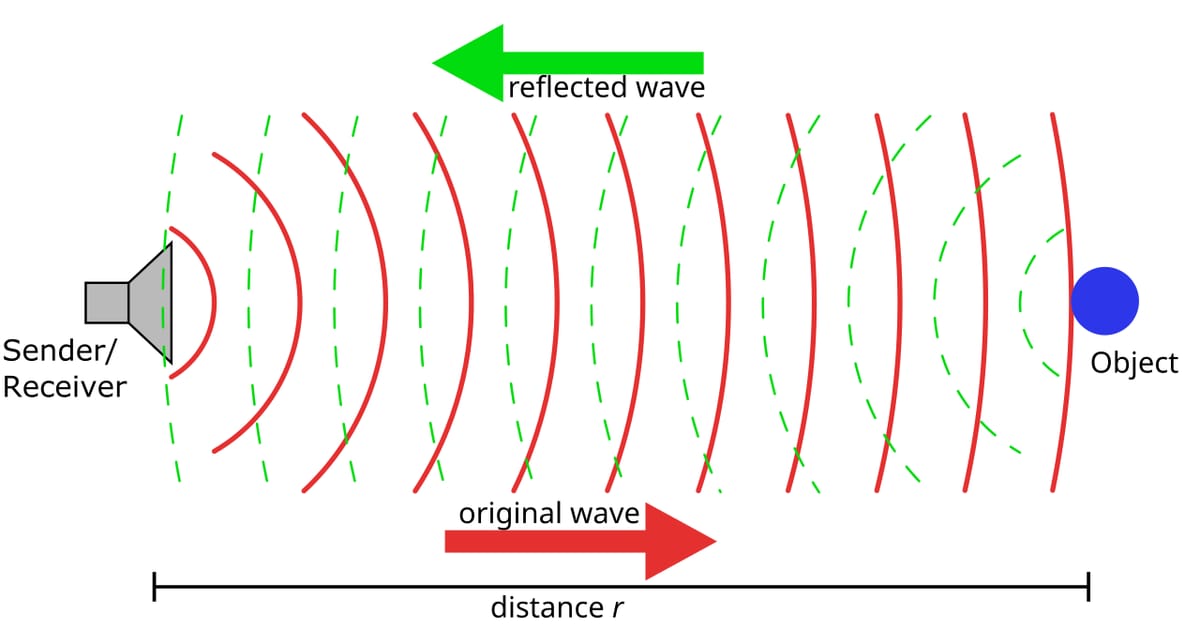
SOund Navigation And Ranging. A transmitter on a ship sends out pulses of ultrasound; they reflect from the seabed or an underwater object, and a detector picks up the echo. If the echo returns after time t and the speed of sound in sea water is v, the distance is d = v × t ÷ 2. SONAR finds the depth of the sea and locates submarines, icebergs, sunken ships, and underwater hills and valleys.
| Use of ultrasound | What it does |
|---|---|
| Cleaning | Cleans spiral tubes, odd-shaped parts and electronic parts that are hard to reach |
| Testing metals | Detects hidden cracks and flaws in metal blocks |
| Echocardiography | Forms an image of the heart |
| Ultrasonography | Images of internal organs such as the liver, kidney and uterus, and of a foetus |
| Kidney stones | Breaks small stones into fine grains that pass out with urine |
| Navigation by animals | Bats fly and catch prey in the dark by the echoes of their ultrasonic squeaks; porpoises also use it |
RADAR uses radio waves, not ultrasound; SONAR uses ultrasound under water. Besides bats and dolphins, dogs and some whales (the toothed whales) also hear ultrasound.
The human ear and noise pollution
Rule in one line: the ear turns vibrations into nerve signals; unwanted, too-loud sound is noise pollution.
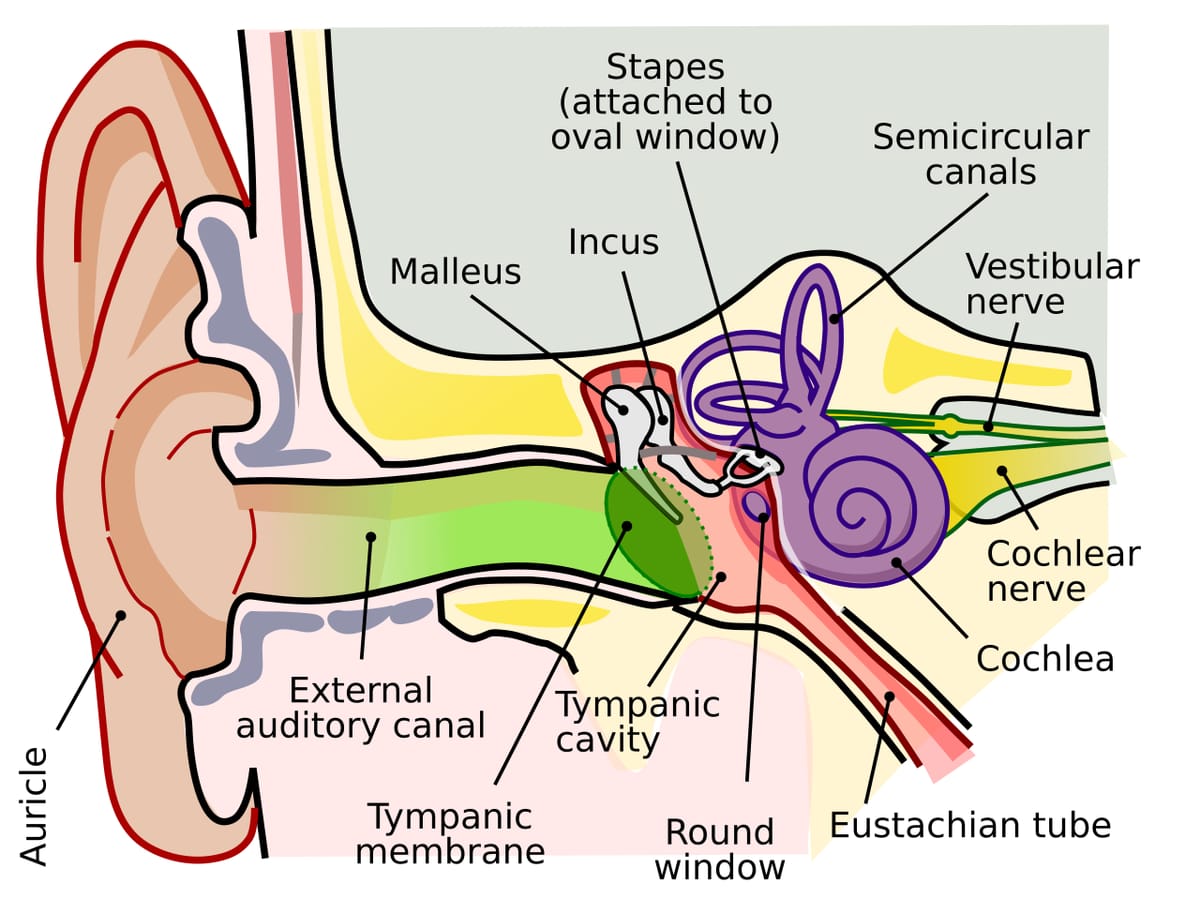
- Outer earThe pinna collects sound and sends it down the ear canal
- EardrumA thin membrane that vibrates with the sound
- Middle earThree small bones — hammer, anvil and stirrup — amplify the vibrations
- Inner earThe cochlea turns the vibrations into electrical signals
- BrainThe auditory nerve carries the signals to the brain, which reads them as sound
The stirrup (stapes) of the middle ear is the smallest bone in the human body. The three ear bones are also called malleus (hammer), incus (anvil) and stapes (stirrup).
Unpleasant sound is noise; pleasant sound is music. The presence of excessive or unwanted sound in the surroundings is noise pollution.
- Vehicles and their horns
- Bursting of crackers and other explosions
- Machines and loudspeakers
- TV and music at high volume, desert coolers, air conditioners
- Lack of sleep
- High blood pressure (hypertension)
- Anxiety and other health problems
- Temporary or permanent loss of hearing
Fit silencers to aircraft engines, vehicles, industrial machines and home appliances; keep noisy industries away from homes; use horns as little as possible; keep TV and music at low volume; and plant trees along roads and around buildings to absorb sound.
More facts examiners askTap to open
An object moving faster than sound is supersonic — bullets, jet aircraft and rockets. It produces shock waves that make a loud sonic boom, strong enough to shatter glass panes.
The laws of reflection hold for sound as for light: the angle of incidence equals the angle of reflection, and the incident sound, the reflected sound and the normal lie in the same plane.
A hearing aid is a battery-operated device for people with hearing loss: a microphone turns sound into electrical signals, an amplifier strengthens them, and a small speaker turns them back into sound.
As people grow older, their ears become less sensitive to high frequencies.
Traps and practice
- Pitch depends on frequency; loudness depends on amplitude. Do not swap them.
- The least distance for an echo is 17.2 m, not 34.4 m — 34.4 m is the distance there and back.
- Sound is fastest in solids and slowest in gases — the opposite of what many students guess.
- Sound in air is a longitudinal wave; light is transverse and needs no medium.
- Bats and dolphins use ultrasound; elephants, whales and rhinoceroses use infrasound.
- In SONAR the echo time is for the round trip, so divide v × t by 2.
A person claps near a cliff and hears the echo after 2 s. If the speed of sound is 346 m/s, how far away is the cliff?
Show answer
Total distance travelled = 346 × 2 = 692 m. This is there and back, so the cliff is 692 ÷ 2 = 346 m away.
A ship's SONAR receives the echo from the seabed 3.42 s after sending the pulse. If the speed of sound in sea water is 1531 m/s, how deep is the sea?
Show answer
d = v × t ÷ 2 = 1531 × 3.42 ÷ 2 = about 2618 m.
- Unit of frequency
- Hertz (Hz)
- Unit of loudness
- Decibel (dB)
- Range of human hearing
- 20 Hz to 20 kHz
- Persistence of hearing
- About 0.1 s
- Smallest bone in the body
- Stirrup (stapes)
- Voice box
- Larynx
- SONAR uses
- Ultrasound
- Part of ear that makes nerve signals
- Cochlea
- Sound comes from vibration; no sound in a vacuum
- Longitudinal: compressions and rarefactions
- v = νλ; 1 Hz = 1 oscillation per second
- Pitch: frequency; loudness: amplitude, in dB
- Audible 20 Hz to 20 kHz; below is infrasound, above is ultrasound
- Speed: solids, then liquids, then gases
- Echo: 0.1 s and at least 17.2 m
- Ear: hammer, anvil, stirrup; cochlea to brain