How green plants make food, nitrogen-fixing roots, rabi and kharif crops, ploughing and cropping patterns, pests and Bt cotton, and the Green and White Revolutions.
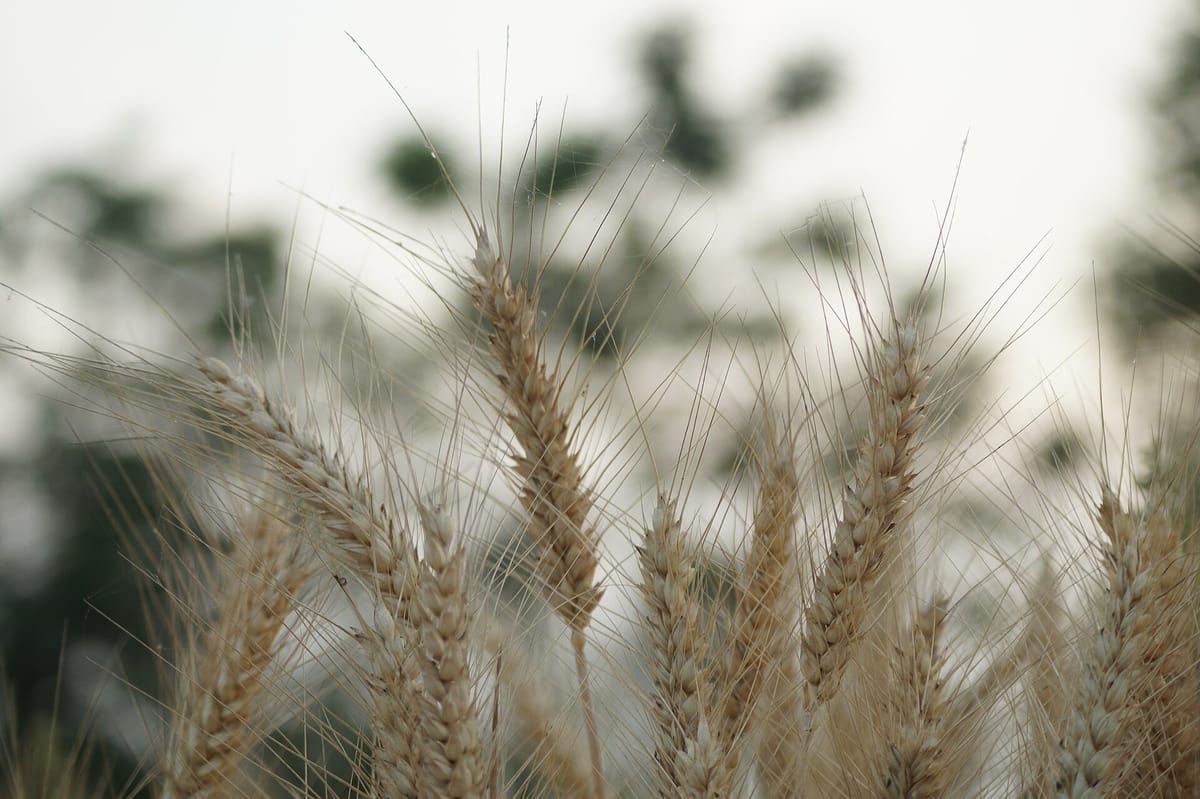
Ripe wheat in Punjab. Wheat is the main rabi crop: sown in October–November, harvested in March–April. Its grain is stored food made by photosynthesis. Image: Satpal Dandiwal, Wikimedia Commons · CC BY-SA 4.0
Green plants are the only living things that can turn sunlight into food. That food feeds every animal, including us. The oxygen they give off keeps the air fit to breathe. Punjab, the food bowl of India, also lives by the second half of this chapter: which crop is sown when, how soil is fed and watered, and how pests are controlled.
On this page you will learn:
Photosynthesis, chlorophyll and why trees give off CO2 at night
Plant nutrition: root nodules, parasites and plant poisons
Kharif, rabi and zaid crops of Punjab
Ploughing, cropping patterns, manure and fertilisers
Pests, Bt cotton and ripening of fruit
The Green, White and other farm revolutions
Mg
Metal at the centre of chlorophyll
Magnesium
3
Crop seasons
Kharif, rabi, zaid
1960s
Green Revolution begins
High-yield wheat; Punjab led
Photosynthesis
Rule in one line: in light, leaves make glucose from CO2 and water and give off oxygen.
KEY TERM
Photosynthesis
Green plants make glucose from carbon dioxide and water. The energy comes from sunlight, trapped by the green pigment chlorophyll. Oxygen is given off. This happens in the chloroplasts of leaf cells, so leaves are the food factories of the plant. Extra glucose is stored as starch.
6CO2 + 6H2O→sunlight + chlorophyll→C6H12O6 + 6O2
Needed
Comes from
Carbon dioxide
Air, entering through stomata
Water
Soil, taken up by roots and carried up the xylem
Sunlight
The sun
Chlorophyll
Chloroplasts in leaf cells; has magnesium at its centre
What photosynthesis needs. Haemoglobin in our blood has iron at its centre; chlorophyll has magnesium.
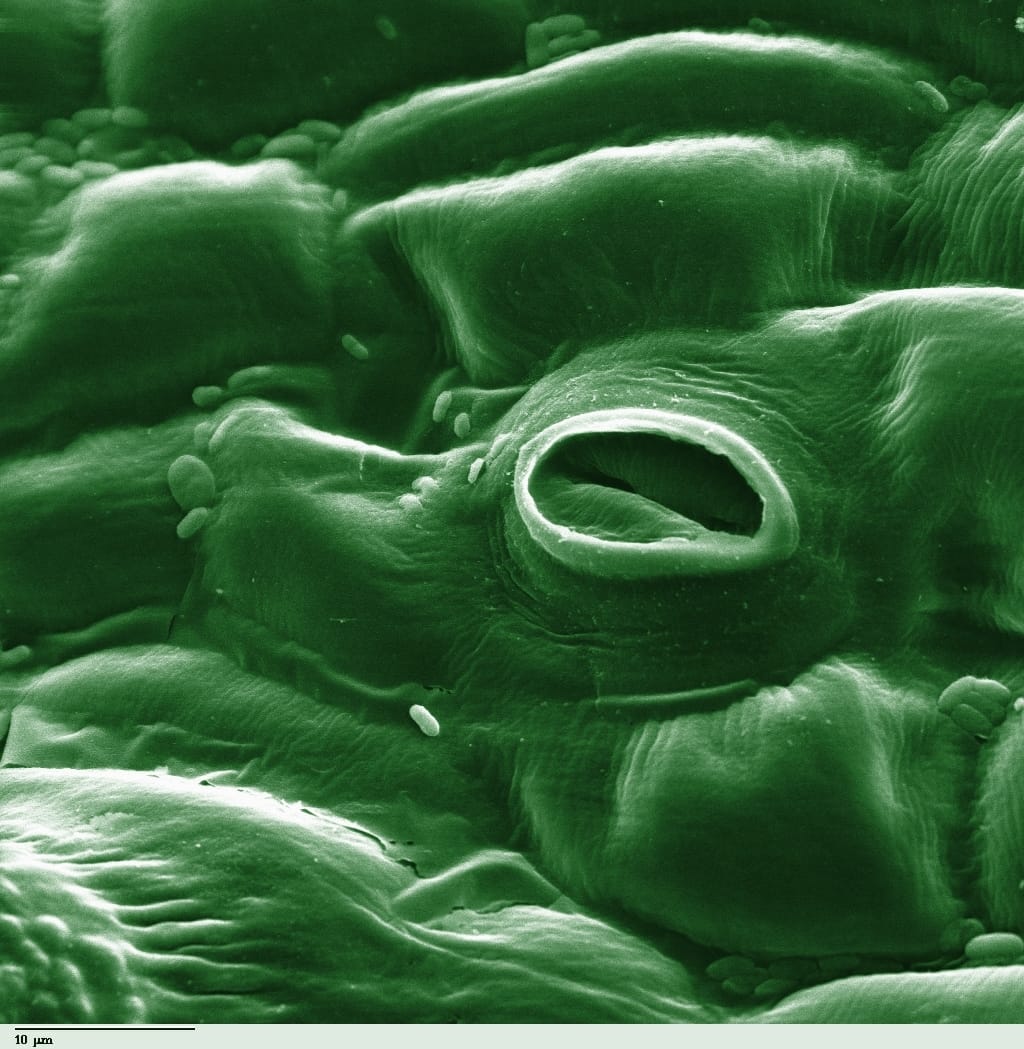
A stoma on a tomato leaf, seen under an electron microscope (colour added). Two guard cells open and close the pore. CO2 enters and oxygen and water vapour leave through it. Image: Photohound, Wikimedia Commons · Public domain
PHOTOSYNTHESIS VS RESPIRATION IN A PLANT
Photosynthesis
Respiration
When
Only in light
All the time, day and night
Takes in
CO2 and water
Oxygen and glucose
Gives off
Oxygen
CO2 and water
Energy
Stored in food
Released from food
At night there is no photosynthesis, but respiration goes on. So a tree gives off carbon dioxide at night.
QUICK FACT
To test a leaf for starch, boil it in alcohol to remove the chlorophyll. Then add iodine: it turns blue-black. A leaf kept in the dark for two days gives no blue-black colour. This shows that light is needed.
QUICK CHECK
PYQ · PPSC OHE 2016 — Chlorophyll is a naturally occurring compound in which the central metal is:
Tap an option to answer
Answer: D — Magnesium
A magnesium ion sits at the centre of the chlorophyll ring. Iron is at the centre of haemoglobin.
QUICK CHECK
PYQ · Punjab Police SI 2016 — It is not advisable to sleep under a tree at night because of the
Tap an option to answer
Answer: D — release of carbon dioxide
At night only respiration goes on, so the tree gives off carbon dioxide. Plants do not give off carbon monoxide.
Plant nutrition beyond photosynthesis
Rule in one line: pulses get nitrogen from bacteria living in their root nodules.
TWO KINDS OF ROOTS
Tap root
Fibrous root
Shape
One main root with branches
Bunch of similar roots
Leaf veins
Net-like (reticulate)
Parallel
Examples
Mustard, carrot, gram
Wheat, maize, grass
Mode
What it means
Example
Parasitic
Takes food from a living host plant
Cuscuta (amarbel)
Insectivorous
Traps insects for extra nitrogen
Pitcher plant, Venus flytrap
Saprophytic
Absorbs food from dead matter
Mushrooms (fungi)
Symbiotic
Two organisms live together and both gain
Lichen (alga + fungus); Rhizobium in pulses
Plants that do not rely only on photosynthesis. The pitcher plant still has chlorophyll; insects only add nitrogen.
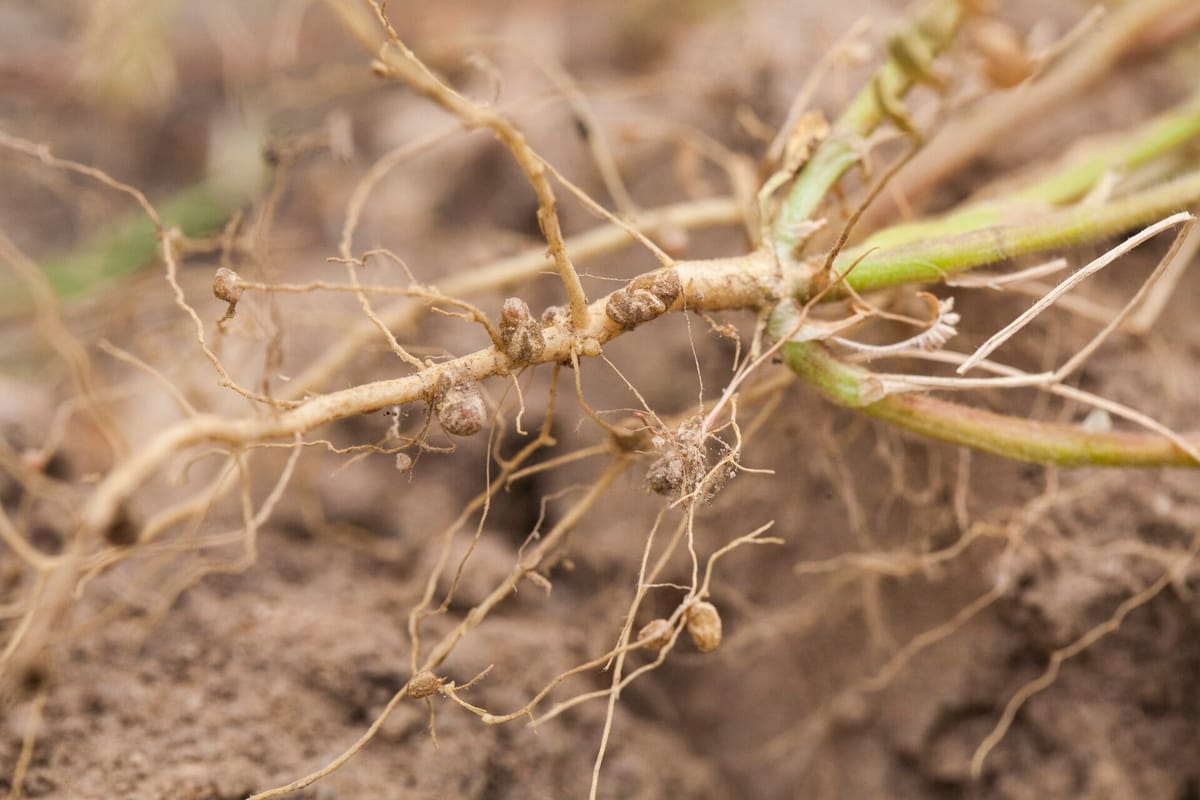
Root nodules on a legume. Inside live Rhizobium bacteria. They turn nitrogen gas from the air into compounds the plant can use. In return the plant feeds them. Image: Terraprima, Wikimedia Commons · CC BY-SA 3.0
QUICK CHECK
PYQ · Punjab Police SI 2023 — Where can you find nitrogen fixing bacteria?
Tap an option to answer
Answer: C — In the root nodules of legumes
Rhizobium lives in the root nodules of legumes such as gram, pea, moong and groundnut. Bamboo is a grass and has no such nodules.
QUICK CHECK
PYQ · Punjab Police Constable 2025 — Which of the following plant families are the major sources of Pyrrolizidine Alkaloids (PAs)?
Tap an option to answer
Answer: A — Boraginaceae, Asteraceae, and Fabaceae
Most plants known to make PAs belong to the borage, daisy and pea families.
Crop seasons
Rule in one line: kharif is sown with the monsoon; rabi is sown with the winter.
Season
Sown
Harvested
Crops
Kharif (sauni)
June–July
September–October
Paddy, maize, cotton, bajra, groundnut, soybean
Rabi (hari)
October–November
March–April
Wheat, gram, pea, mustard, barley
Zaid
March
June
Watermelon, cucumber, moong
Crop seasons of India. In Punjab the main cycle is paddy (kharif) followed by wheat (rabi).
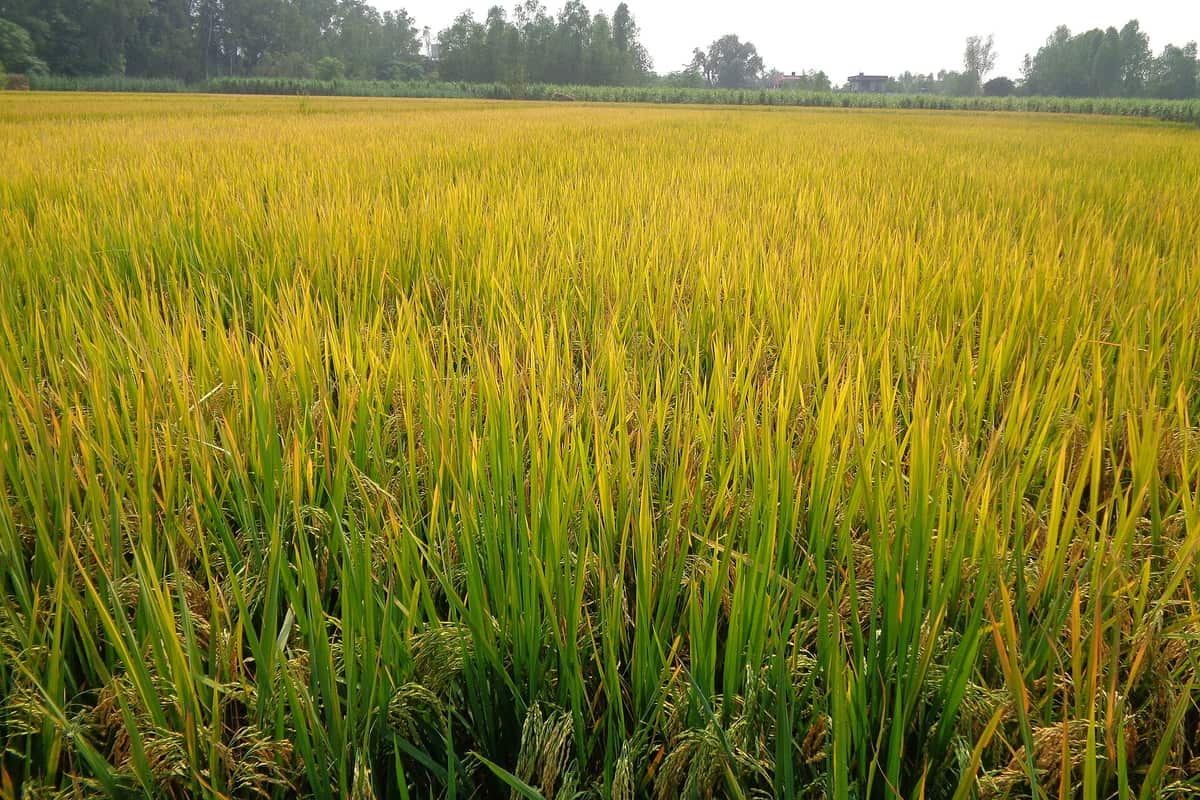
A paddy field in Punjab, nearly ready for harvest. Paddy is a kharif crop that needs a lot of water. Its stubble is often burnt before wheat is sown. Image: Sarbjit Bahga, Wikimedia Commons · CC BY-SA 4.0
QUICK FACT
Kharif crops need heat and plenty of water. Rabi crops need a cool season to grow and a warm, dry spell to ripen. Zaid crops are short summer crops grown between the two.
QUICK CHECK
PYQ · PPSC APRO 2016 — Which of the following is a Kharif crop?
Tap an option to answer
Answer: B — Maize
Maize is sown with the monsoon. Wheat, gram and barley are rabi crops.
QUICK CHECK
PYQ · PSSSB Patwari 2021 — Which of the following are NOT grown in the Kharif season in Punjab?
Tap an option to answer
Answer: C — Barley and mustard
Barley and mustard are rabi crops, sown in October–November. The other pairs grow in the monsoon season.
Farming practices and cropping patterns
Rule in one line: plough first; then sow, feed, water, weed, harvest and store.
STEPS OF CROP PRODUCTION
1
Preparing the soil
Ploughing loosens and turns the soil to the needed depth. Levelling stops water loss.
↓
2
Sowing
Good seeds are sown at the right depth, often with a seed drill.
↓
3
Manure and fertiliser
Put back the nutrients that crops take from the soil.
↓
4
Irrigation
Wells, canals and tube-wells; sprinkler and drip systems save water.
↓
5
Weeding
Weeds are removed by hand or with weedicides such as 2,4-D.
↓
6
Harvest and storage
A combine cuts and threshes; grain is dried and kept in silos and granaries.
Pattern
What it means
Example
Monocropping
Only one crop on the same land, year after year
Cotton on the same field every year
Mixed cropping
Two or more crops sown together, mixed in one field
Wheat + gram; wheat + mustard
Intercropping
Two or more crops together in set rows
Soybean + maize
Crop rotation
Different crops one after another on the same land
Wheat, then moong
Catch crop
A short crop in the gap between two main crops
Summer moong after wheat
Relay cropping
The next crop is sown before the first is harvested
—
Cropping patterns. Growing a pulse between cereals puts nitrogen back into the soil.
MANURE VS FERTILISER
Manure
Fertiliser
Made from
Plant and animal waste
Factory chemicals
Nutrients
Low, but many kinds
High: N, P, K
Humus
Adds humus
Adds none
Overuse
Little harm
Harms soil and water
Urea supplies nitrogen. Vermicompost is manure made by earthworms.
QUICK CHECK
PYQ · Punjab Police Constable 2021 — The most essential operation for making the soil loose and porous to a desired depth as per requirement of the crop is _____.
Tap an option to answer
Answer: B — Ploughing
Ploughing is the first, main tillage. It loosens the soil to the depth the roots need. Harrowing and clod crushing only finish the surface.
QUICK CHECK
PYQ · Punjab Police Constable 2021 — Which cropping refers to growing of only one crop on the same piece of land year after year?
Tap an option to answer
Answer: D — Monocropping
Monocropping means one crop, the same land, every year. It drains the same nutrients and lets pests build up.
QUICK CHECK
PYQ · Punjab Patwari 2016 — A short duration crop in between two main seasonal crops is termed as:
Tap an option to answer
Answer: D — catch crop
A catch crop 'catches' the short gap between two main crops, such as summer moong after wheat. An inter crop grows alongside the main crop.
QUICK CHECK
PYQ · PPSC OHE 2016 — The nitrogenous supply of the soil is maintained when _____ is alternated with other crops.
Tap an option to answer
Answer: A — Moong
Moong is a pulse. Rhizobium in its root nodules fixes nitrogen, so rotating it with cereals restores soil nitrogen.
Crop protection, Bt cotton and ripening
Rule in one line: know the pest by its crop — pink bollworm attacks cotton.
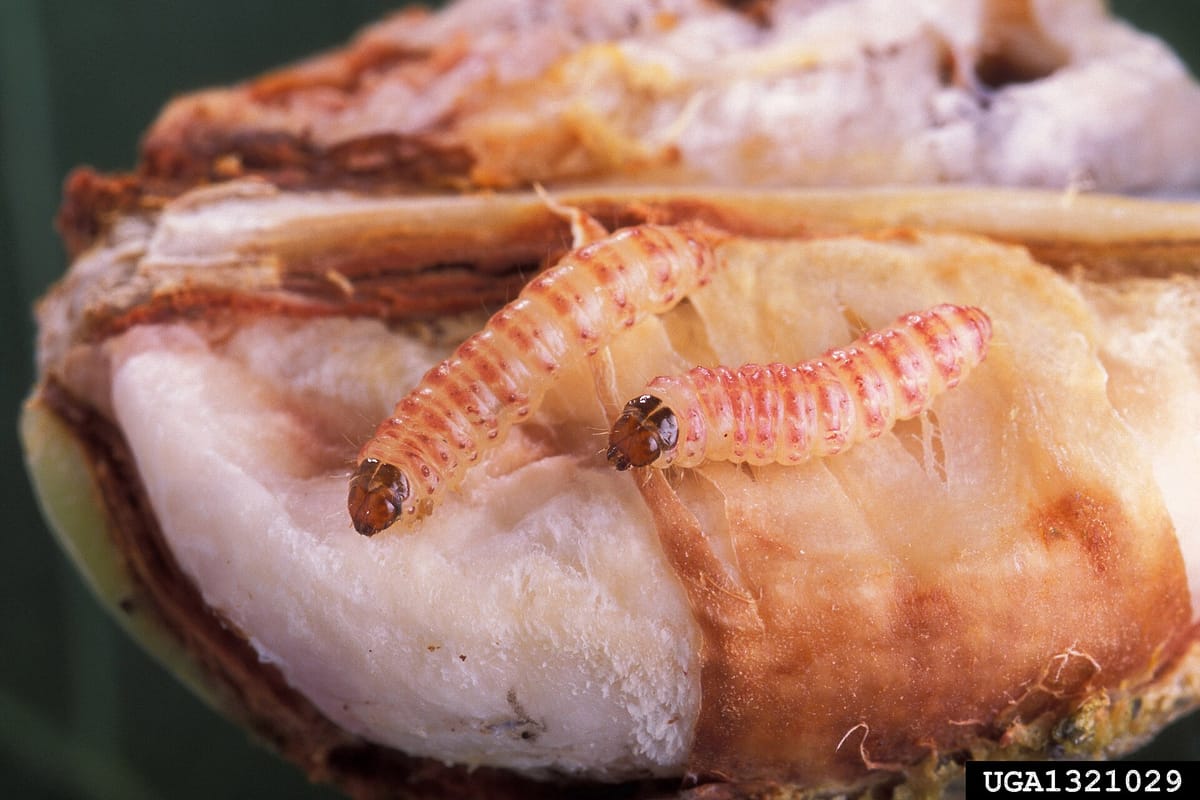
Bt stands for Bacillus thuringiensis, a soil bacterium. A gene from it is put into the cotton plant. The plant then makes a protein that kills bollworm caterpillars that eat it. Such a plant with a gene from another organism is called transgenic (genetically modified).
Bt bacterium gene→Cotton plant→Toxic to bollworm
QUICK FACT
Ethylene is a plant hormone and a gas. Ripening fruit gives it off. Ripening chambers use ethylene gas to ripen green bananas and mangoes evenly. Using calcium carbide, which gives off acetylene, is unsafe and banned for this.
QUICK CHECK
PYQ · Punjab Police Constable 2025 — Pink bollworm (Gulabi Sundi) is a major pest that affects which of the following crops?
Tap an option to answer
Answer: C — Cotton
The pink bollworm larva bores into cotton bolls and spoils the lint and seed. It is a major pest in the Malwa cotton belt.
QUICK CHECK
PYQ · PPSC DSSO 2018 — Consider the following statements. I. In Bt cotton a transgenic plant Bt refers to Clostridium thuringiensis. II. The Bt gene is derived from a fungi. III. Nematode resistant transgenic cotton has been produced by inserting Bt gene. Which of the statement(s) given above is/are correct?
Tap an option to answer
Answer: D — None of these
All three are wrong. Bt is Bacillus (not Clostridium), a bacterium (not a fungus), and its gene protects against insects like bollworm, not nematodes.
QUICK CHECK
PYQ · Punjab Police SI 2016 — The gas used for artificial ripening of green fruit is
Tap an option to answer
Answer: A — ethylene
Ethylene is the fruit's own ripening hormone. Acetylene from calcium carbide also ripens fruit, but it is harmful and illegal.
Farm revolutions and animal husbandry
Rule in one line: each 'revolution' is a big jump in one farm product — learn the colour with the product.
Revolution
Product
Linked names
Green
Food grains, mainly wheat
M. S. Swaminathan (India); Norman Borlaug (high-yield wheat)
White
Milk
Verghese Kurien; Operation Flood
Blue
Fish (aquaculture)
—
Yellow
Oilseeds
—
Golden
Horticulture (fruits) and honey
—
Round
Potato
—
Grey
Fertilisers
—
Silver
Eggs (poultry)
—
Farm revolutions of India. Yellow is oilseeds, not eggs.
KEY TERM
The Green Revolution
From the mid-1960s, India used high-yielding varieties (HYV) of wheat and rice, with irrigation, chemical fertilisers and pesticides. Grain output rose fast, and Punjab led the change. It worked best for wheat. Crop insurance was not part of this package.
HYV seeds→Irrigation→Fertilisers→More grain
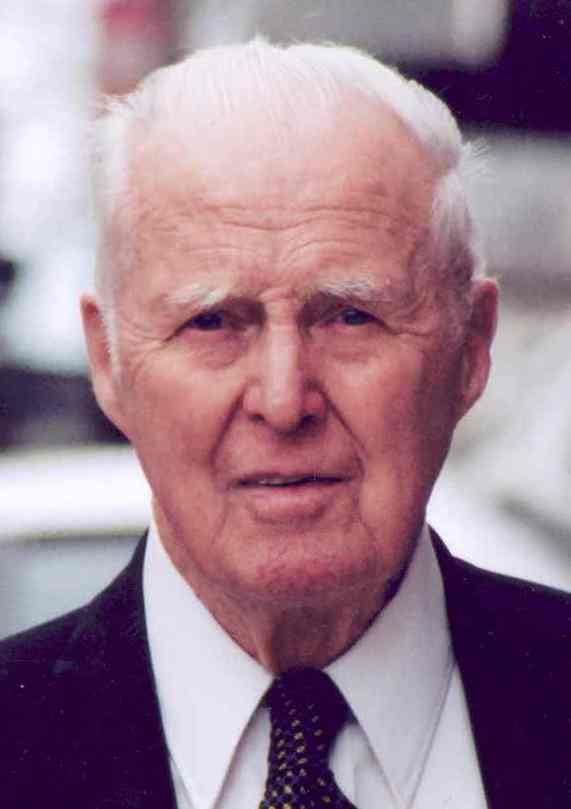
Norman Borlaug (2004). He bred the high-yield, short-stemmed wheat used in the Green Revolution and won the Nobel Peace Prize in 1970. Image: Ben Zinner, USAID, Wikimedia Commons · Public domain
QUICK CHECK
PYQ · Punjab Election Kanungo 2021 — Who is the originator of the 'Green Revolution' in India?
Tap an option to answer
Answer: B — MS Swaminathan
M. S. Swaminathan led the Green Revolution in India. Borlaug bred the high-yield wheat and is called the father of the Green Revolution worldwide. Punjab Excise Inspector 2018 asked the same question.
QUICK CHECK
PYQ · PPSC OHE 2016 — Who is known as the ‘Father of White Revolution’?
Tap an option to answer
Answer: A — V Kurien
Verghese Kurien led Operation Flood through Amul and the National Dairy Development Board. India became the world's largest milk producer.
QUICK CHECK
PYQ · PPSC EO 2018 — Consider the following: 1. Yellow Revolution – Eggs 2. Golden Revolution – Oilseeds 3. Round Revolution – Potato 4. Grey Revolution – Fertilizers. Which of the above is/are correctly matched?
Tap an option to answer
Answer: B — 3 and 4
Round = potato and Grey = fertilisers are right. Yellow is oilseeds and Golden is horticulture and honey, so 1 and 2 are wrong. PPSC SSO 2018 repeated it.
Area
What it means
Notes
Dairy (cattle)
Rearing cows and buffaloes for milk
Murrah buffalo; Sahiwal and Red Sindhi cows
Poultry
Rearing hens
Layers give eggs; broilers give meat
Apiculture
Rearing honey bees
Honey and wax
Pisciculture
Rearing fish
Rohu, catla in ponds
Sericulture
Rearing silkworms
Silk from cocoons
Animal husbandry
More facts that are asked once in a whileTap to open
Loss of water vapour from leaves is transpiration. It cools the plant and pulls water up.
Soybean is both a pulse (legume) and an oilseed crop.
Hydroponics is growing plants in nutrient-rich water, without soil.
Rice was the first crop plant whose genome was sequenced.
The age of a tree can be found by counting its annual rings.
Neem leaves are kept with stored grain to keep insects away.
Drip irrigation gives water drop by drop at the roots. It suits fruit trees and dry areas.
Traps and practice
Last revision — where the options try to fool you.
COMMON TRAPS
Chlorophyll has magnesium; haemoglobin has iron.
At night trees give off carbon dioxide, not carbon monoxide.
Nitrogen-fixing bacteria live in the root nodules of legumes, not in leaves.
Maize, paddy, cotton are kharif; wheat, barley, mustard, gram are rabi.
Monocropping = one crop every year; catch crop = short crop between two main crops.
Bt is a bacterium (Bacillus), not a fungus; Bt cotton fights bollworm.
Fruit is ripened with ethylene, not ethane or acetylene.
Green = grain, White = milk, Blue = fish, Yellow = oilseeds, Round = potato, Grey = fertilisers.
CHECK YOURSELF
Why is it good to grow moong between two cereal crops?
Show answer
Moong is a pulse. Rhizobium in its root nodules fixes nitrogen from the air. So the soil gets nitrogen back and less urea is needed.
FLASHCARDS
Plant and crop flashcards
Metal in chlorophyll
Magnesium
Pores on leaves
Stomata
Nitrogen-fixing bacterium of pulses
Rhizobium
Parasitic plant
Cuscuta (amarbel)
Pest of cotton
Pink bollworm
Fruit-ripening gas
Ethylene
Green Revolution in India
M. S. Swaminathan
White Revolution
Verghese Kurien
QUICK BYTES
6CO2 + 6H2O → C6H12O6 + 6O2, with sunlight and chlorophyll
What are the raw materials and products of photosynthesis?
Carbon dioxide and water are the raw materials. Sunlight gives the energy and chlorophyll traps it. Glucose and oxygen are the products.
Which metal is present in chlorophyll?
Magnesium, at the centre of the molecule. Haemoglobin has iron instead.
Why should we not sleep under a tree at night?
At night there is no photosynthesis, only respiration. So the tree gives off carbon dioxide.
Where are nitrogen-fixing bacteria found?
In the root nodules of legumes such as gram, pea and moong. The bacterium is Rhizobium.
What is the difference between rabi and kharif crops?
Kharif crops such as paddy, maize and cotton are sown with the monsoon in June–July. Rabi crops such as wheat, barley and mustard are sown in October–November and harvested in spring.
What is monocropping?
Growing only one crop on the same land year after year. It drains the same nutrients and lets pests build up.
What is a catch crop?
A short-duration crop grown in the gap between two main seasonal crops, such as summer moong after wheat.
What is Bt cotton?
Cotton that carries a gene from the bacterium Bacillus thuringiensis. It makes a protein that kills bollworm caterpillars.
Which gas is used to ripen fruit?
Ethylene, the natural ripening hormone of fruit. Calcium carbide, which gives off acetylene, is unsafe and banned.
Who led the Green and White Revolutions in India?
M. S. Swaminathan led the Green Revolution (grain), with Punjab in front. Verghese Kurien led the White Revolution (milk) through Operation Flood.
Now sit the questions they actually set
Previous-year PPSC questions on this topic, free to read with the worked answer.