How living things make more of their kind, how traits pass from parents to children through chromosomes and DNA, blood groups, and how species change over time.
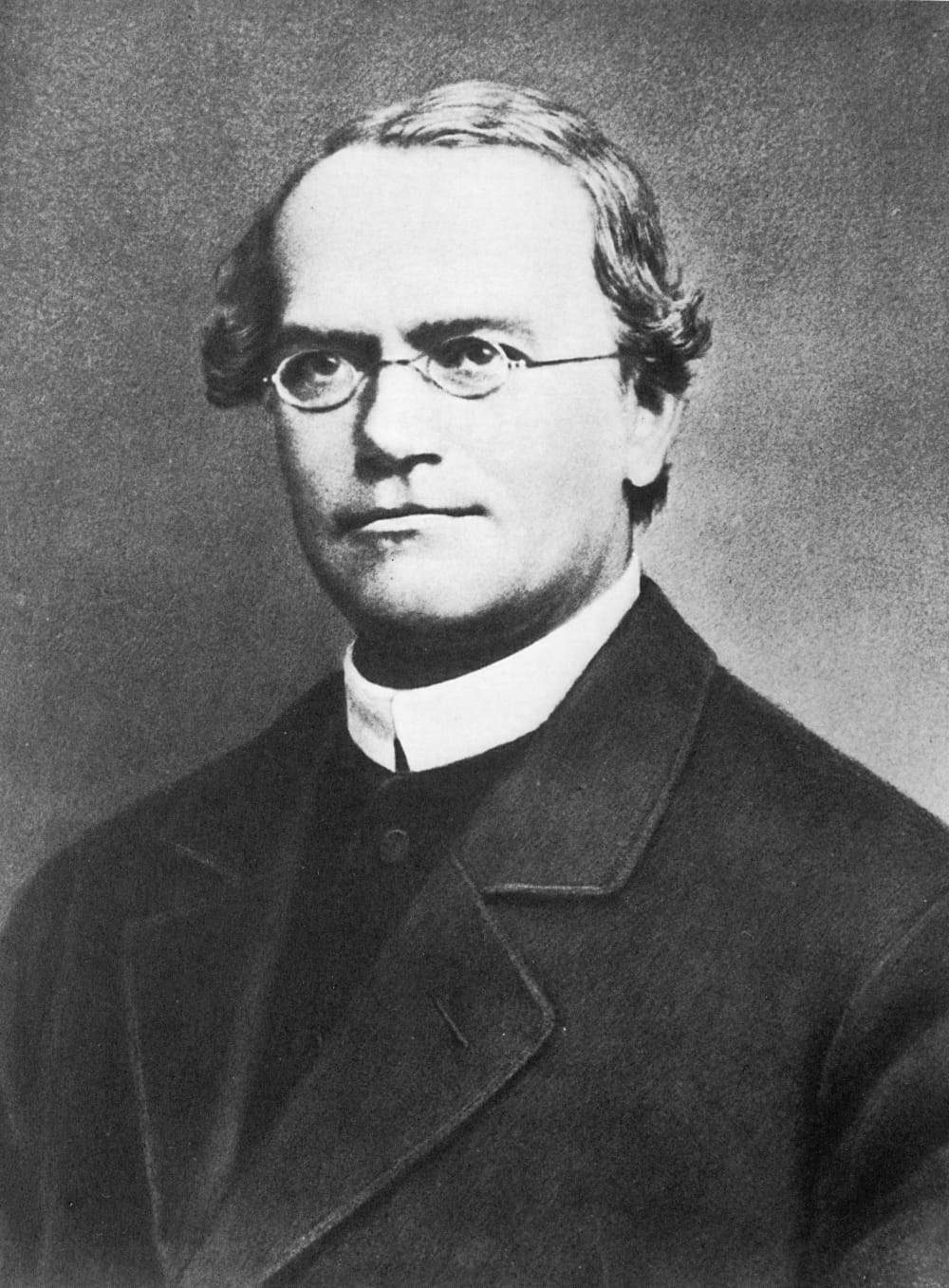
Gregor Mendel (1822–1884), a monk who grew garden peas in his monastery garden. He found the basic laws of heredity. He is called the father of genetics. Image: Unknown author, Wikimedia Commons · Public domain
Reproduction lets a species go on after its members die. Some organisms just split or grow buds (asexual reproduction). Most plants and animals join a male and a female cell (sexual reproduction). Traits pass from parents to children through genes on chromosomes. Over many generations, these small changes add up to evolution.
On this page you will learn:
Asexual reproduction, the parts of a flower, and cloning
Human reproduction, the 46 chromosomes and how a baby's sex is decided
Mendel's pea experiments and sex-linked traits such as colour blindness
DNA, RNA, DNA fingerprinting and Dolly the sheep
ABO blood groups: donors and receivers
Darwin, Lamarck, fossils and homologous organs
46
Chromosomes in a human body cell
23 pairs; asked in SI 2016
XX / XY
Sex chromosomes
Female / male
3 : 1
Mendel's F2 ratio
Tall : dwarf pea plants
Asexual reproduction and the flower
Rule in one line: asexual means one parent and copies; in plants, the flower is the sex organ.
Method
How it works
Examples
Fission
The cell splits into two (binary) or many (multiple)
Amoeba (binary), Plasmodium (multiple)
Budding
A bud grows on the parent and breaks off
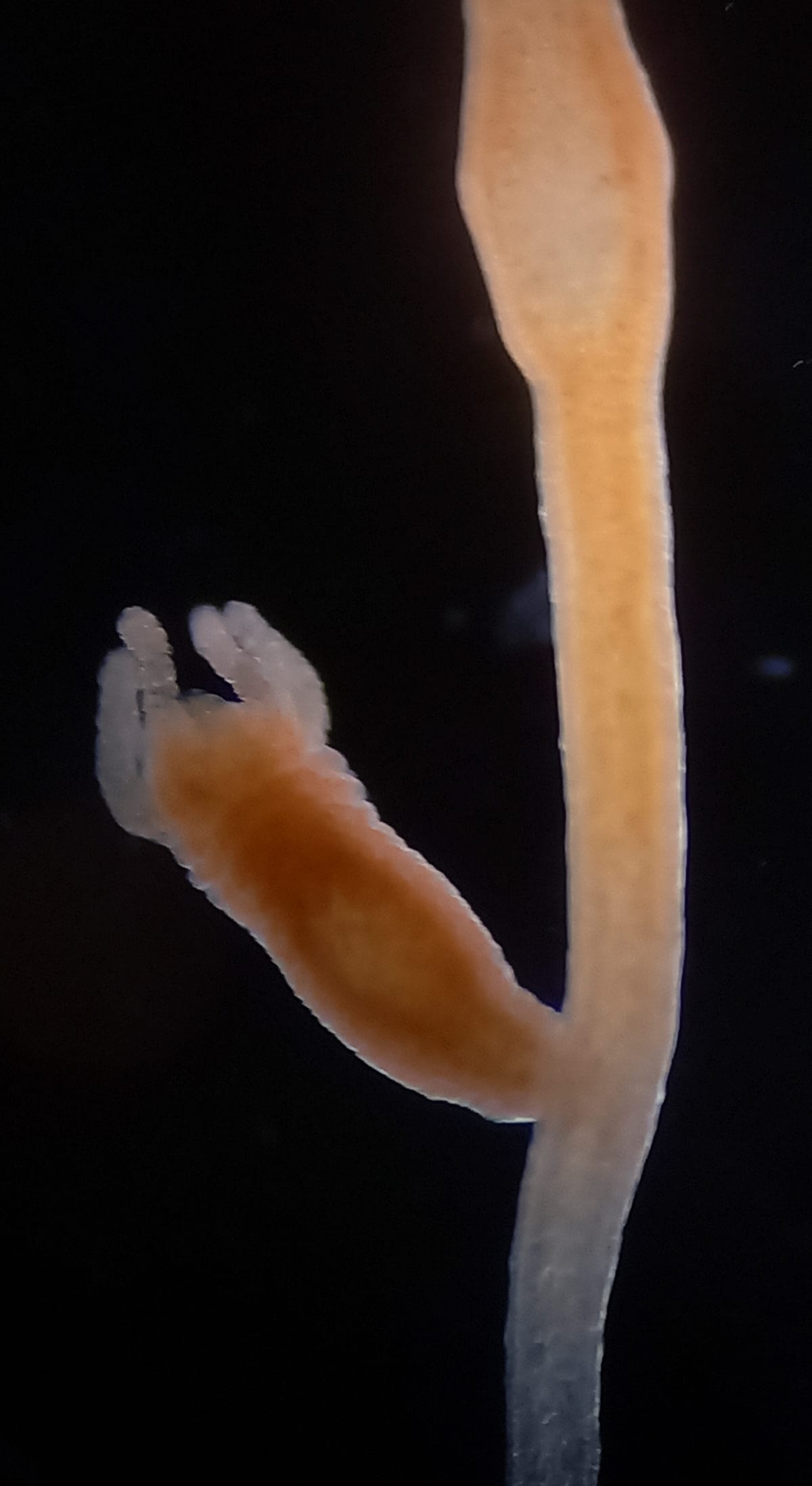
Hydra, yeast
Fragmentation
The body breaks into pieces; each grows into a new one
Spirogyra
Regeneration
A cut part grows into a whole organism
Planaria, Hydra
Spore formation
Tiny spores spread and grow in good conditions
Bread mould (Rhizopus), ferns
Vegetative propagation
New plants from roots, stems or leaves
Potato eyes, ginger, Bryophyllum leaf, rose cutting
Kinds of asexual reproduction. Grafting (mango) and layering are man-made vegetative methods.
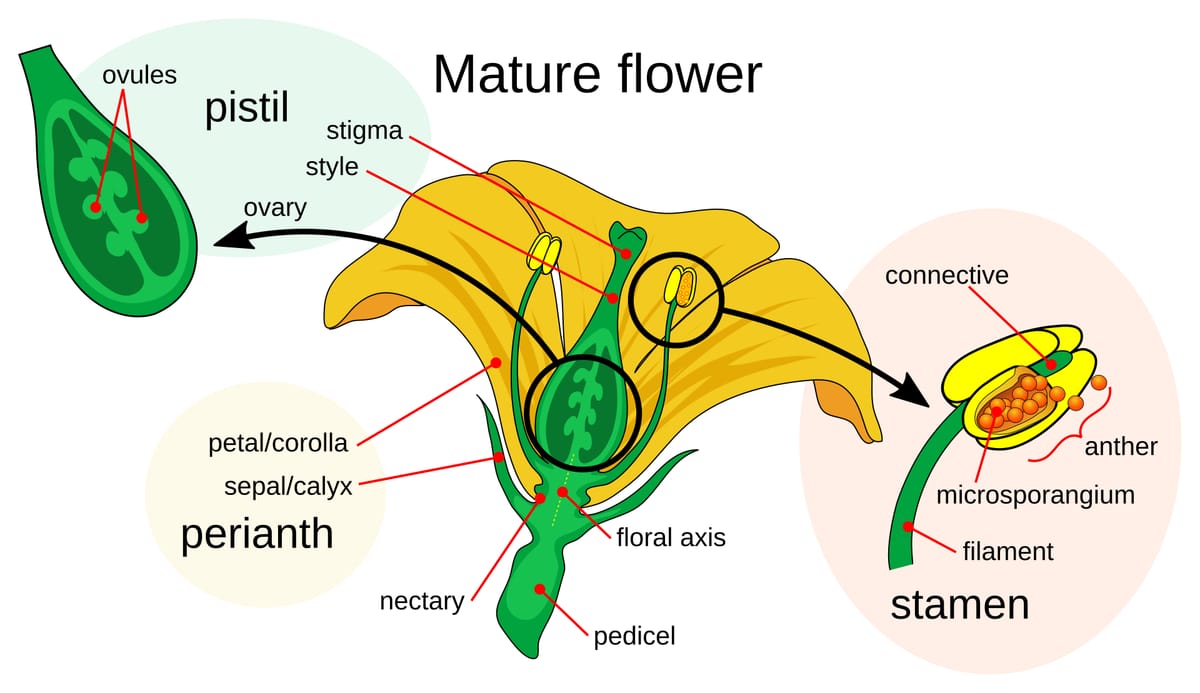
A Hydra budding, seen under a microscope. The small hydra on the left is a bud. It already has tentacles and will soon break off as a new animal. Image: Brandon Antonio Segura Torres & Priscilla Vieto Bonilla, Wikimedia Commons · CC BY-SA 4.0Parts of a flower. Stamen (anther + filament) is male; pistil (stigma + style + ovary) is female. The ovary holds the ovules. Petals and sepals are not sex organs. Image: Mariana Ruiz (LadyofHats), Wikimedia Commons · Public domain
FROM FLOWER TO FRUIT
1
Pollination
Pollen reaches the stigma — by wind, insects or water.
↓
2
Fertilisation
The male cell joins the egg in the ovule and forms a zygote.
↓
3
Seed
The ovule becomes the seed; the zygote becomes the embryo.
↓
4
Fruit
The ovary grows into the fruit. Its wall becomes the fruit wall, the pericarp.
SELF- VS CROSS-POLLINATION
Self-pollination
Cross-pollination
Pollen goes to
Same flower or plant
Another plant
Agent needed
Usually none
Wind, insects, water
Variety
Little
More
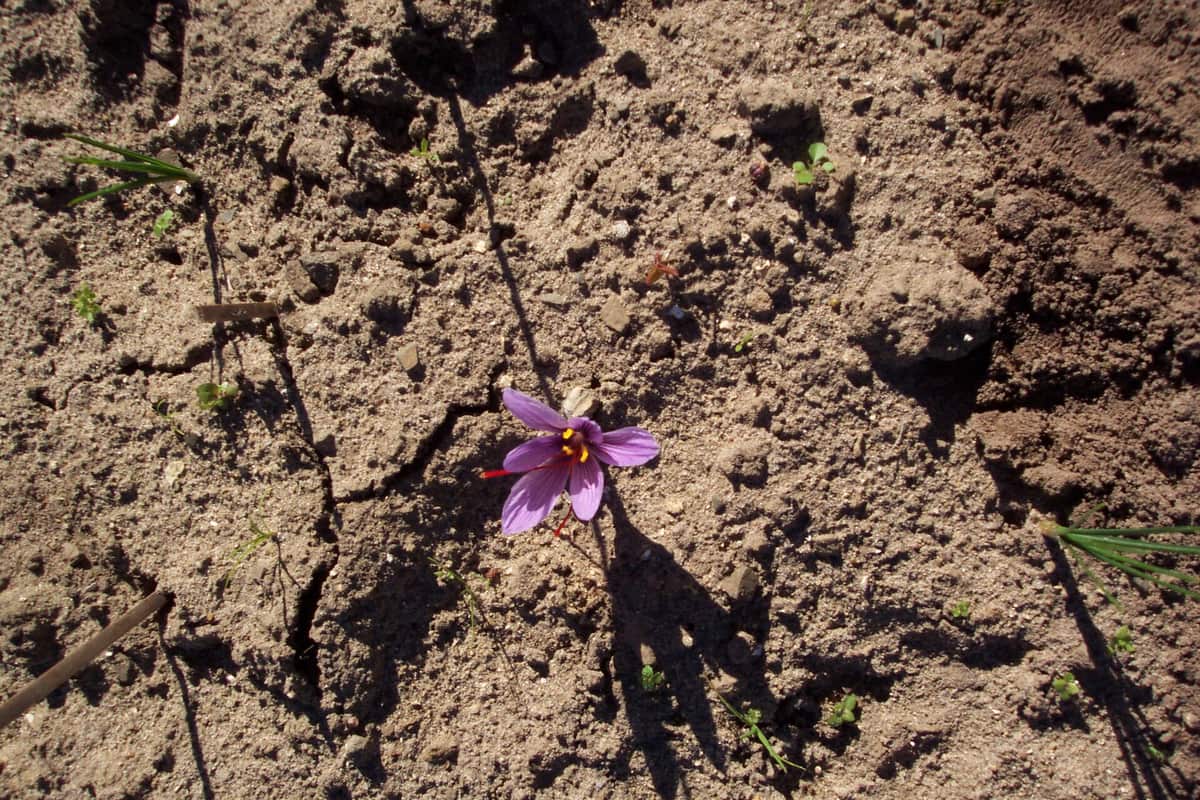
Flowers with only stamens or only a pistil are unisexual (papaya, watermelon). Flowers with both are bisexual (hibiscus, mustard).Saffron (kesar) is the dried red stigma of the saffron crocus flower. See the red threads in the photo. In India it is grown mainly in Kashmir. It is costly because each flower gives only three stigmas, picked by hand. Image: Emilie40, Wikimedia Commons · CC0
QUICK CHECK
PYQ · PSSSB Excise Inspector 2023 — Which of the following is not a part of the flower?
Tap an option to answer
Answer: D — Pericarp
The pericarp is the wall of the fruit. It forms from the ovary wall after fertilisation, so it is not a part of the flower.
QUICK CHECK
PYQ · PPSC SEVE 2016 — In making the saffron spice, which one of the following parts of the plant is used?
Tap an option to answer
Answer: D — Stigma
Saffron threads are the dried stigmas of Crocus sativus. The stigma is the top of the pistil that catches pollen.
Human reproduction and chromosomes
Rule in one line: body cells have 46 chromosomes; sperm and egg have 23 each; the father's sperm decides the sex.
Organ
Job
Testes
Make sperms and the hormone testosterone
Ovaries
Release eggs (ova) and make oestrogen
Oviduct (fallopian tube)
Where fertilisation happens
Uterus
The embryo grows here, fed through the placenta
Human reproductive organs. A baby grows in the uterus for about 9 months.
VIVIPAROUS VS OVIPAROUS
Viviparous
Oviparous
Young ones
Born alive
Hatch from eggs
Examples
Humans, cow, dog
Hen, frog, fish, lizard
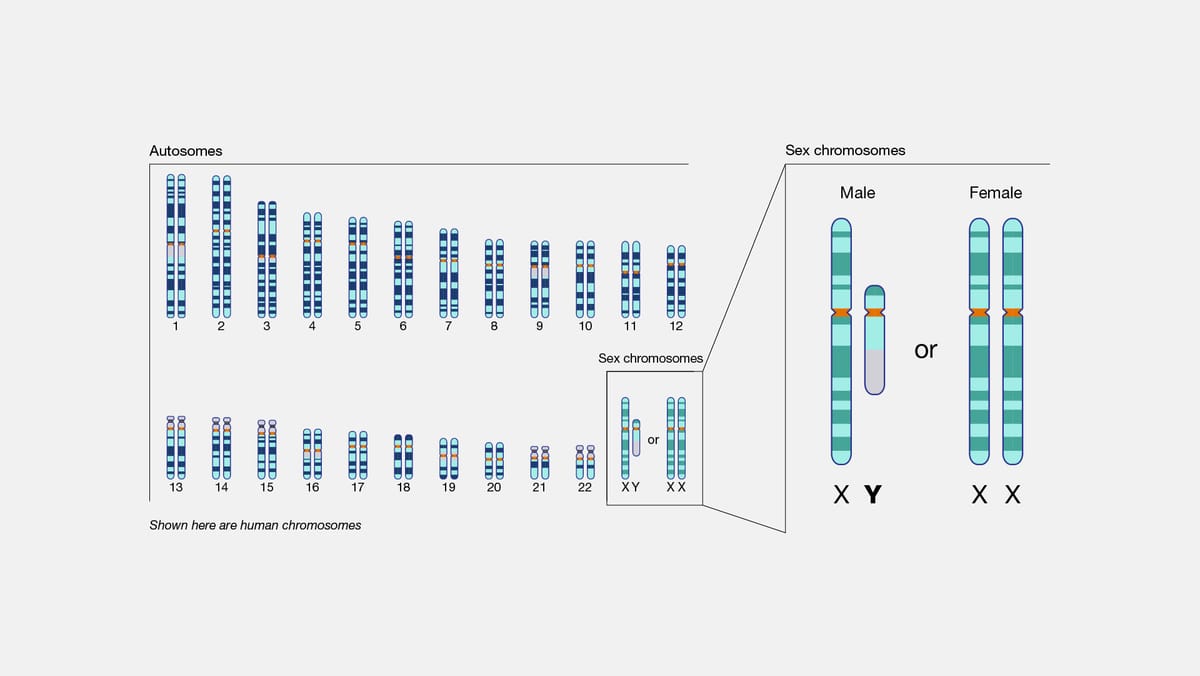
Fertilisation is internal in humans, cows and hens. It is external (in water) in frogs and most fish. A frog changes from tadpole to adult by metamorphosis.The human set: 22 pairs of autosomes + 1 pair of sex chromosomes = 46. A male has XY; a female has XX. The Y is much smaller than the X. Image: National Human Genome Research Institute (NHGRI), Wikimedia Commons · Public domain
Mother's egg
Father's sperm
Child
X
X
XX — girl
X
Y
XY — boy
Every egg carries an X. A sperm carries X or Y, so the father's sperm decides the sex. Each case has an equal chance.
QUICK FACT
Identical twins come from one zygote that splits into two. Non-identical twins come from two eggs. In IVF, egg and sperm are joined outside the body ('test-tube baby'). In some reptiles, the temperature of the eggs decides the sex.
QUICK CHECK
PYQ · Punjab Police SI 2016 — The number of chromosomes in a normal human body cell is
Tap an option to answer
Answer: D — 46
46 chromosomes, in 23 pairs. Sperm and egg carry 23 each, so the zygote gets 46 again. PPSC TM 2015 asked the same fact.
QUICK CHECK
PYQ · PPSC EO 2018 — The sex of a newborn baby is determined by the chromosome inherited from:
Tap an option to answer
Answer: B — The father
The mother always gives an X. The father gives either X (girl) or Y (boy). PPSC SSO 2018 repeated this question.
QUICK CHECK
PYQ · RSMSSB LDC 2024 — Sex determination in humans is based on _____ type chromosome.
Tap an option to answer
Answer: A — X Y
Humans follow the XY type: XX is female and XY is male. The XO type is found in some insects, such as grasshoppers.
Heredity: Mendel's peas
Rule in one line: each trait has two forms; the dominant form shows, the recessive form hides.
KEY TERM
Dominant and recessive
Mendel crossed pure tall pea plants with pure dwarf ones. All first-generation (F1) plants were tall. So tallness is dominant and dwarfness is recessive. When F1 plants bred among themselves, the F2 plants were tall and dwarf in the ratio 3 : 1. With two traits at once, the F2 ratio is 9 : 3 : 3 : 1.
Tall × dwarf→F1: all tall→F2: 3 tall : 1 dwarf
Trait
Dominant
Recessive
Stem height
Tall
Dwarf
Seed shape
Round
Wrinkled
Seed colour
Yellow
Green
Flower colour
Violet
White
Flower position
Axial (along the stem)
Terminal (at the tip)
Pod shape
Inflated (full)
Constricted
Pod colour
Green
Yellow
Mendel's seven pairs of pea traits. Note: green is recessive for the seed but dominant for the pod.
QUICK CHECK
PYQ · RSMSSB LDC 2024 — Which of the following is NOT a dominant trait in a Garden Pea as studied by Mendel?
Tap an option to answer
Answer: B — Terminal flower position
Axial flowers are dominant; terminal flowers are recessive. Inflated pod, yellow seed and green pod are all dominant.
KEY TERM
Sex-linked traits
Some genes sit on the X chromosome. Colour blindness and haemophilia (blood that does not clot) are caused by recessive genes on the X. A man has only one X, so one faulty gene shows its effect. A woman has two X's, so a normal X usually hides the faulty one. That is why these problems are more common in men.
NOT SEX-LINKED
Down's syndrome comes from an extra copy of chromosome 21, not from the X. Skin colour is controlled by many genes on other chromosomes.
QUICK CHECK
PYQ · PPSC TM 2015 — An example of human X – linked trait:
Tap an option to answer
Answer: C — Colour blindness
Colour blindness is carried on the X chromosome. Down's syndrome is an extra chromosome 21.
QUICK CHECK
PYQ · PPSC PCSEB 2018 — Consider the two statements given below, one labelled as Assertion (A) and the other labelled as Reason (R). Assertion (A): There are more colourblind men than women throughout the world. Reason (R): Colourblindness is a sex-linked disease resulting from a recessive gene on the Y chromosome. In the context of the above statements, which one of the following is correct?
Tap an option to answer
Answer: C — A is true but R is false
A is true: more men are colour-blind. R is false: the gene is on the X, not the Y.
DNA, genes and cloning
Rule in one line: DNA stores the code; RNA carries it; proteins do the work.
DNA VS RNA
DNA
RNA
Full name
Deoxyribonucleic acid
Ribonucleic acid
Strands
Two (double helix)
Usually one
Bases
A, T, G, C
A, U, G, C
Job
Stores genes
Helps make proteins
A = adenine, T = thymine, G = guanine, C = cytosine, U = uracil. Uracil is found in RNA, not in DNA. Watson and Crick described the double helix in 1953.
FROM GENE TO PROTEIN
1
DNA
The gene, in the nucleus
↓
2
mRNA
Copied from DNA: transcription
↓
3
Protein
Built at ribosomes: translation
Copying DNA into DNA, before a cell divides, is called replication.
KEY TERM
DNA fingerprinting
Parts of every person's DNA are unique, except in identical twins. DNA fingerprinting compares these parts. Police use it to identify criminals from blood, hair or skin left at a crime scene. It also settles questions about who a child's parents are. Alec Jeffreys of Britain developed it in 1984.
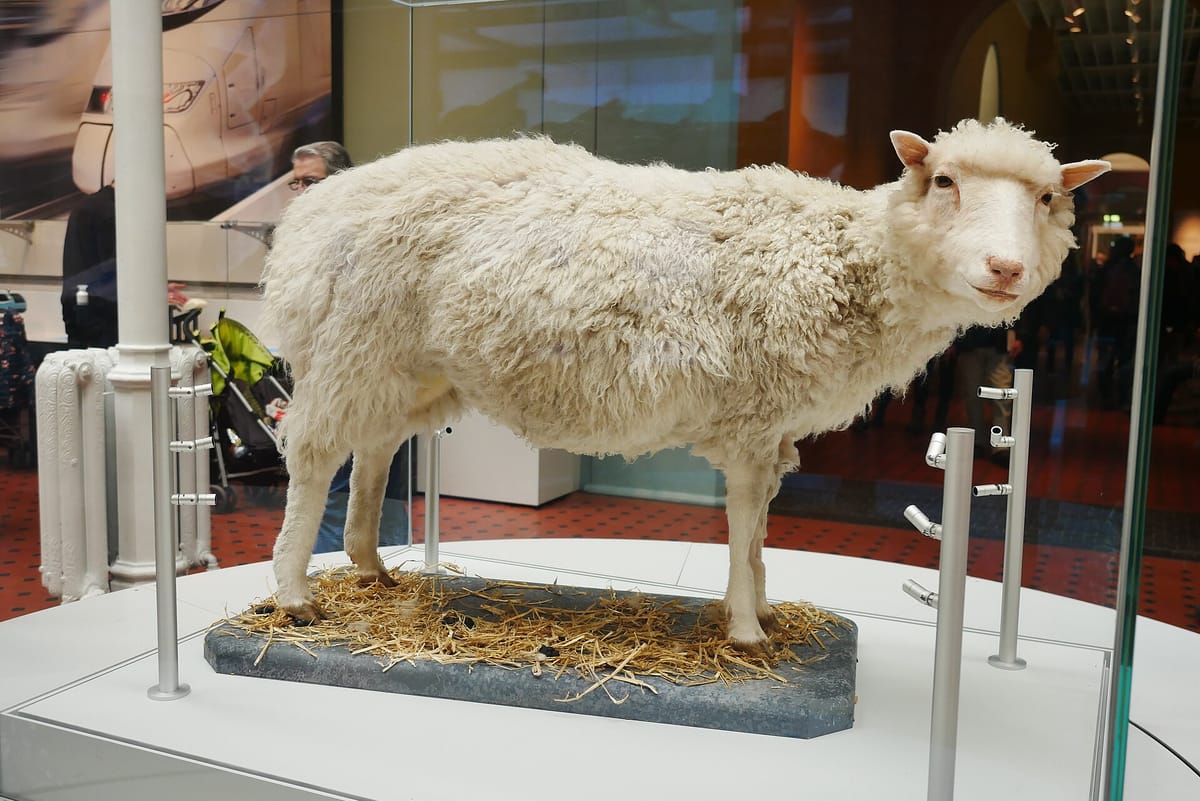
Dolly the sheep, now in the National Museum of Scotland, Edinburgh. Born in 1996 at the Roslin Institute, she was the first mammal cloned from an adult cell. Her birth was announced in 1997. Image: Sgerbic, Wikimedia Commons · CC BY-SA 4.0
QUICK CHECK
PYQ · RSMSSB LDC 2024 — The nitrogenous base not present in DNA is:
Tap an option to answer
Answer: A — Uracil
DNA has A, T, G and C. Uracil takes the place of thymine in RNA.
QUICK CHECK
PYQ · RSMSSB LDC 2024 — Identify the correct process for DNA to Protein formation: DNA →(a)→ mRNA →(b)→ Protein.
Tap an option to answer
Answer: B — a: transcription, b: translation
DNA is first copied into mRNA (transcription). The mRNA message is then read to build protein (translation).
QUICK CHECK
PYQ · RSMSSB LDC 2024 — Which of the following techniques is useful identification tool in forensic science?
Tap an option to answer
Answer: B — DNA fingerprinting
DNA fingerprinting matches DNA from a crime scene to a person. Gene therapy treats disease; it does not identify people.
QUICK CHECK
PYQ · PPSC TM 2015 — In 1997 the world was astonished by the announcement of generation of a new born lamb which was a product of cloning. The name of the lamb is :
Tap an option to answer
Answer: C — Dolly
Dolly, cloned at the Roslin Institute, Scotland, by Ian Wilmut's team. She was born in 1996; the news came out in 1997.
ABO blood groups
Rule in one line: you carry antibodies against the antigen you do not have.
Group
Antigen on red cells
Antibody in plasma
Can receive from
A
A
Anti-B
A, O
B
B
Anti-A
B, O
AB
A and B
None
All groups — universal recipient
O
None
Anti-A and anti-B
O only — but gives to all: universal donor
Karl Landsteiner discovered the ABO groups in 1900. Blood groups are inherited from parents through genes.
REMEMBER
AB has nothing to fight (no antibodies), so it accepts all. O has nothing on its cells, so it can be given to all.
QUICK CHECK
PYQ · PSSSB Election Kanungo 2018 — The universal recipient blood group is:
Tap an option to answer
Answer: C — AB
AB plasma has no anti-A or anti-B, so it does not attack donated red cells of any ABO group. O is the universal donor.
QUICK CHECK
PYQ · RSMSSB LDC 2024 — Match List-I (Blood Group) with List-II (Antibodies in plasma): a-A, b-B, c-AB, d-O with I-Anti-A, II-Anti-A,B, III-Anti-B, IV-Nil.
Tap an option to answer
Answer: D — a-III, b-I, c-IV, d-II
A has anti-B (III), B has anti-A (I), AB has none (IV), and O has both anti-A and anti-B (II).
Evolution
Rule in one line: nature selects the variations that suit the environment; acquired traits are not inherited.
DARWIN VS LAMARCK
Darwin
Lamarck
Theory
Natural selection
Inheritance of acquired characters
Key idea
The fittest variants survive
Use and disuse of organs
Book
On the Origin of Species, 1859
Philosophie Zoologique, 1809
Today
Accepted, with genetics
Not accepted
Lamarck's example: the giraffe's neck grew longer by stretching. But muscles built by exercise are not passed to children. The phrase 'survival of the fittest' was coined by Herbert Spencer.
DARWIN'S NATURAL SELECTION IN FOUR STEPS
1
Variation
Members of a species differ a little.
↓
2
Struggle
More young are born than food and space allow.
↓
3
Selection
Those with useful variations survive and breed more.
↓
4
New species
Over many generations, the changes add up (speciation).
EVIDENCE FOR EVOLUTION
Homologous organs
Analogous organs
Structure
Same basic plan
Different
Function
Can differ
Same
Example
Forelimbs of frog, bird, human
Wings of butterfly and bird
Shows
Common ancestor
Similar needs
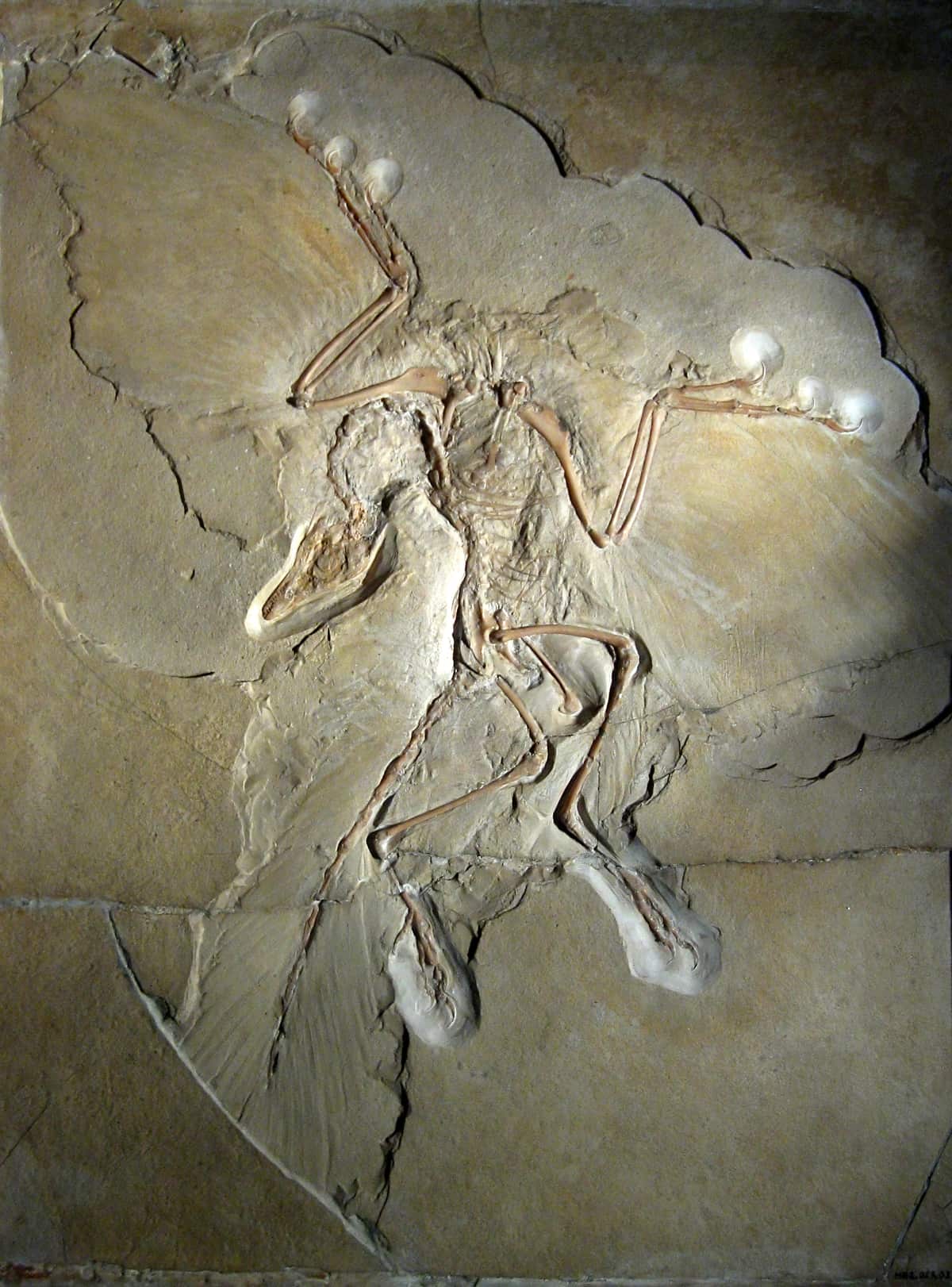
Archaeopteryx fossil (Berlin specimen). It had feathers like a bird, but also teeth, claws and a bony tail like a reptile. So it is a link between reptiles and birds. Image: H. Raab (Vesta), Wikimedia Commons · CC BY-SA 3.0
QUICK CHECK
PYQ · PSSSB Election Kanungo 2018 — The Lamarckian theory of organic evolution is known as the theory of:
Tap an option to answer
Answer: C — Inheritance of acquired characters
Lamarck said traits gained in a lifetime pass to the young. Natural selection is Darwin's idea; continuity of germplasm is Weismann's.
QUICK CHECK
PYQ · PPSC SEVE 2016 — Charles Darwin's theory of evolution is based on which one of the following?
Tap an option to answer
Answer: D — Natural Selection
Darwin: natural selection (1859). Use and disuse is Lamarck; mutation theory is Hugo de Vries.
More facts that are asked once in a whileTap to open
A gene is a part of DNA that controls one trait.
Mendel published his work in 1866. It was rediscovered in 1900.
Vestigial organs, such as the human appendix, no longer do much work.
Fossils are the preserved remains of old organisms. Their age is found by methods such as radiocarbon dating.
Darwin studied finches and other animals of the Galapagos Islands on his voyage in HMS Beagle.
Besides ABO, blood has the Rh factor: Rh-positive or Rh-negative.
Pre-natal sex testing of the foetus is banned in India to stop female foeticide.
Traps and practice
Last revision — where the options try to fool you.
COMMON TRAPS
The pericarp is part of the fruit, not the flower. Saffron is the stigma, not the petal.
Body cells have 46 chromosomes; sperm and egg have 23.
The father, not the mother, decides the sex of the child.
Colour blindness is on the X chromosome, not the Y.
Green seed is recessive, but green pod is dominant. Terminal flower is recessive.
AB is the universal recipient; O is the universal donor.
Darwin = natural selection; Lamarck = acquired characters (use and disuse).
CHECK YOURSELF
Why do children of the same parents look different from each other?
Show answer
Each child gets half its genes from the mother and half from the father. Every egg and sperm carries a different mix. Only identical twins share the same genes.
Colour blindness, haemophilia: X-linked, more in men
DNA: A T G C; RNA: A U G C
AB universal recipient; O universal donor
Darwin 1859: natural selection; Lamarck: acquired characters
❧
Frequently Asked Questions
Who is called the father of genetics?
Gregor Mendel. He worked out the basic laws of heredity by crossing garden pea plants.
How many chromosomes does a human body cell have?
46, in 23 pairs: 22 pairs of autosomes and 1 pair of sex chromosomes. Sperm and egg have 23 each.
Who decides the sex of a child?
The father's sperm. Every egg carries an X. A sperm with X gives a girl (XX); a sperm with Y gives a boy (XY).
Why is colour blindness more common in men?
Its gene is recessive and lies on the X chromosome. Men have only one X, so one faulty copy is enough. Women need two faulty copies.
Which base is found in RNA but not in DNA?
Uracil. DNA has adenine, thymine, guanine and cytosine; RNA has uracil in place of thymine.
What are transcription and translation?
Transcription copies a gene from DNA into mRNA. Translation reads the mRNA at the ribosome to build a protein.
What was Dolly?
A sheep, the first mammal cloned from an adult cell. She was born in 1996 at the Roslin Institute, Scotland, and announced in 1997.
Which blood group is the universal recipient?
AB, because its plasma has no anti-A or anti-B antibodies. O is the universal donor because its red cells carry no A or B antigen.
What is the difference between Darwin's and Lamarck's theories?
Darwin said nature selects useful variations (natural selection). Lamarck said traits gained by use and disuse are inherited; this is not accepted today.
What is the difference between homologous and analogous organs?
Homologous organs have the same basic structure but may do different jobs, like the forelimbs of a frog, bird and human. Analogous organs do the same job but are built differently, like butterfly and bird wings.
Now sit the questions they actually set
Previous-year PPSC questions on this topic, free to read with the worked answer.