- Press Fly through the storm
- Tap a label on the picture
- Open Cyclones on the globe
- Tap a photo to make it bigger
Satellite image of the Earth: NASA Blue Marble. Photos are from Wikimedia Commons; each photo carries its credit.
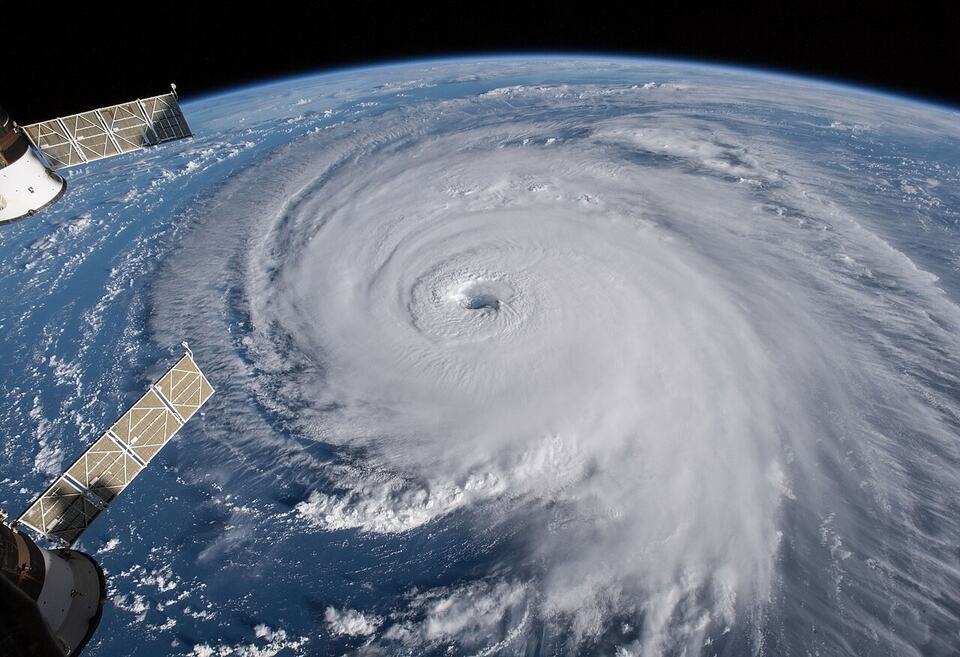
A cyclone is air spinning around low pressure: anticlockwise in the north, clockwise in the south. Tropical cyclones need a warm sea and cannot form at the Equator. The calm centre is the eye. They are hurricanes in the Atlantic, typhoons in the Pacific and cyclones in the Indian Ocean.
Eye = calm. Eyewall = worst. Atlantic hurricane, Pacific typhoon, Indian Ocean cyclone, Australia willy-willy. No cyclones at the Equator.
Tropical cyclones
What is a cyclone?
A cyclone is a large mass of air spinning around a centre of very low pressure. Tropical cyclones are the most violent storms on Earth, born over warm seas.
| What is a cyclone? | What to remember |
|---|---|
| Cyclone | Winds spiralling inward around a centre of low pressure |
| Direction of spin | Anticlockwise in the northern hemisphere and clockwise in the southern hemisphere |
| Why it spins | The Coriolis force of the turning Earth |
| Two kinds | Tropical cyclones, and temperate cyclones of the middle latitudes |
| Width | A tropical cyclone is usually a few hundred kilometres across |
| Weather office that tracks them in India | The India Meteorological Department (IMD) |
How a tropical cyclone forms
A tropical cyclone is a heat engine. Warm, moist air rises from the sea; its vapour condenses into cloud and releases heat, which makes the air rise faster still and pulls in more air below.
| How a tropical cyclone forms | What to remember |
|---|---|
| Warm sea | The sea surface must be about 27 °C or warmer |
| Source of energy | The latent heat given out when water vapour condenses |
| Coriolis force | Needed to start the spin, so cyclones do not form within about 5° of the Equator |
| Season | Late summer and autumn, when the sea is warmest |
| Over land | The cyclone loses its supply of moisture and dies out |
| Path | It moves west with the trade winds and then curves toward the pole |
Eye, eyewall and rain bands
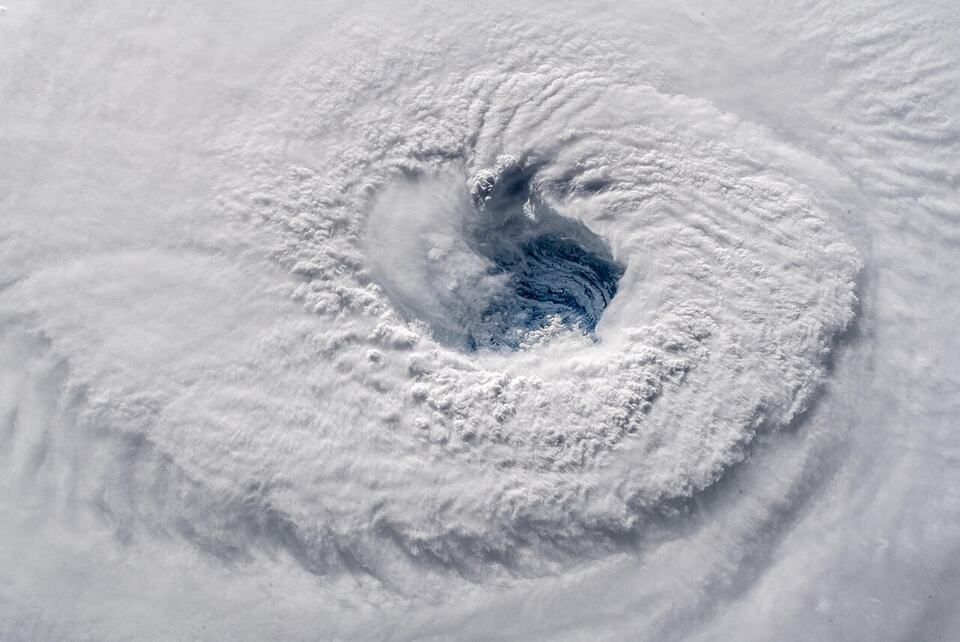
At the very centre of a cyclone is a small calm area, the eye. Around it stands the eyewall, a ring of towering cloud where the storm is at its worst.
| Eye, eyewall and rain bands | What to remember |
|---|---|
| Eye (PYQ) | The calm, clear centre of a cyclone |
| Pressure | Lowest in the eye |
| In the eye | Air sinks, so the sky is clear and the wind is light |
| Eyewall | The ring of cloud around the eye, with the strongest winds and heaviest rain |
| Rain bands | Spiral bands of cloud and rain farther out |
| When the eye passes | The wind drops, then returns from the opposite direction |
Storm surge and other dangers
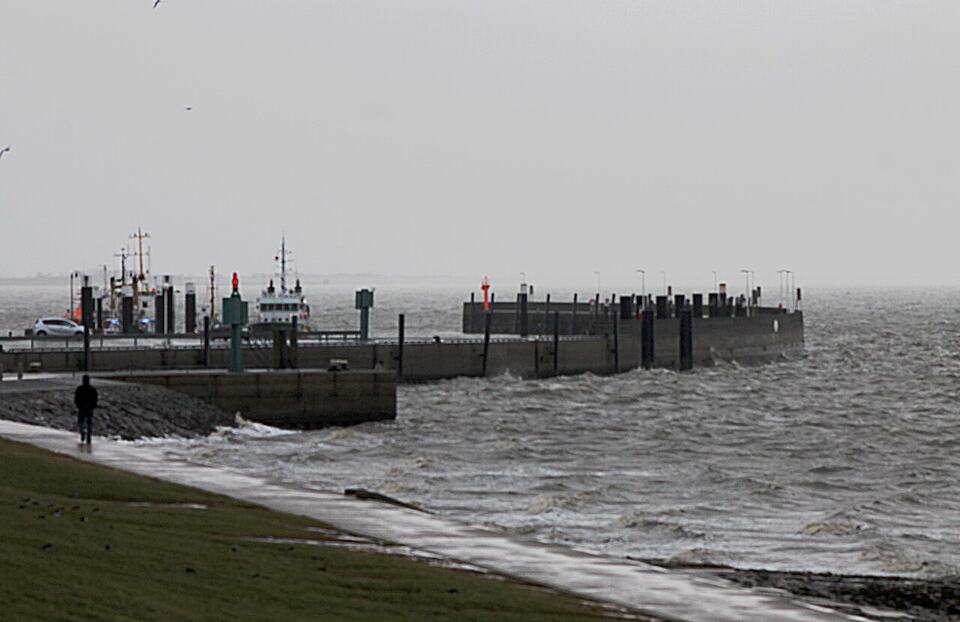
A cyclone attacks the coast in three ways: wind, rain and the sea itself. The rise of the sea, the storm surge, takes the most lives.
| Storm surge and other dangers | What to remember |
|---|---|
| Storm surge | A sudden rise of the sea, pushed ashore by the wind and the low pressure |
| Deadliest part | The storm surge, which floods low coasts |
| Also | Violent winds, very heavy rain and river floods |
| Protection | Early warning, cyclone shelters, embankments and mangrove forests |
| Mangroves | Break the force of the waves. The Sundarbans shield Bengal |
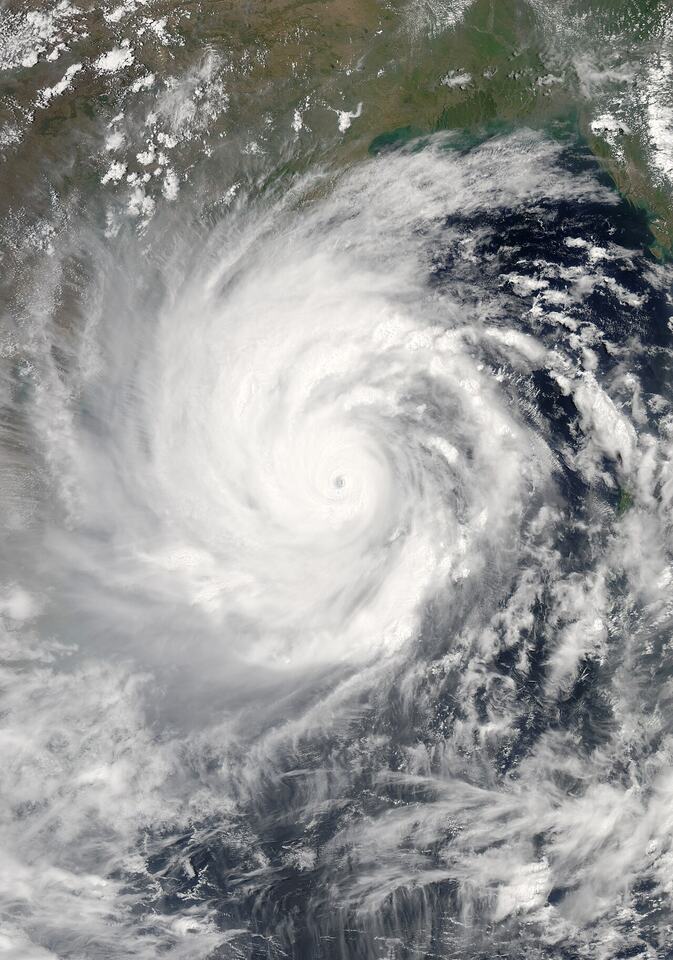
Cyclones around the world
Different names for the same storm
A tropical cyclone has a different name in each part of the world, but it is the same kind of storm everywhere.
| Different names for the same storm | What to remember |
|---|---|
| Hurricane (PYQ) | In the Atlantic Ocean, the Caribbean Sea and the north-east Pacific |
| Typhoon | In the north-west Pacific and the China Sea |
| Cyclone | In the Indian Ocean |
| Willy-willy | Off Australia |
| Scale for hurricanes | The Saffir-Simpson scale, categories 1 to 5 |
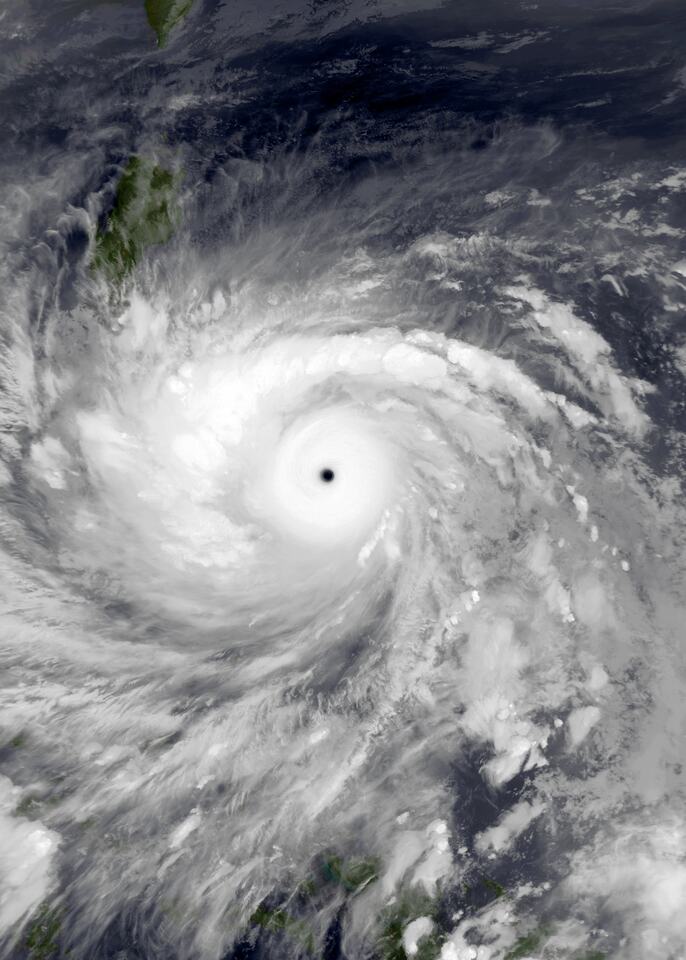
Where cyclones form
Tropical cyclones form over warm tropical oceans, but not at the Equator itself. They travel west, then curve away toward the poles.
| Where cyclones form | What to remember |
|---|---|
| Belt | Mostly between 5° and 30° of latitude, north and south |
| Not at the Equator | The Coriolis force is too weak there to make the air spin |
| No cyclones in (PYQ) | The South Atlantic and the south-east Pacific |
| Why not (PYQ) | The sea there is cool, and the Inter-Tropical Convergence Zone seldom reaches those waters |
| Most active ocean | The north-west Pacific, the home of typhoons |
Cyclones and India
Cyclones of India
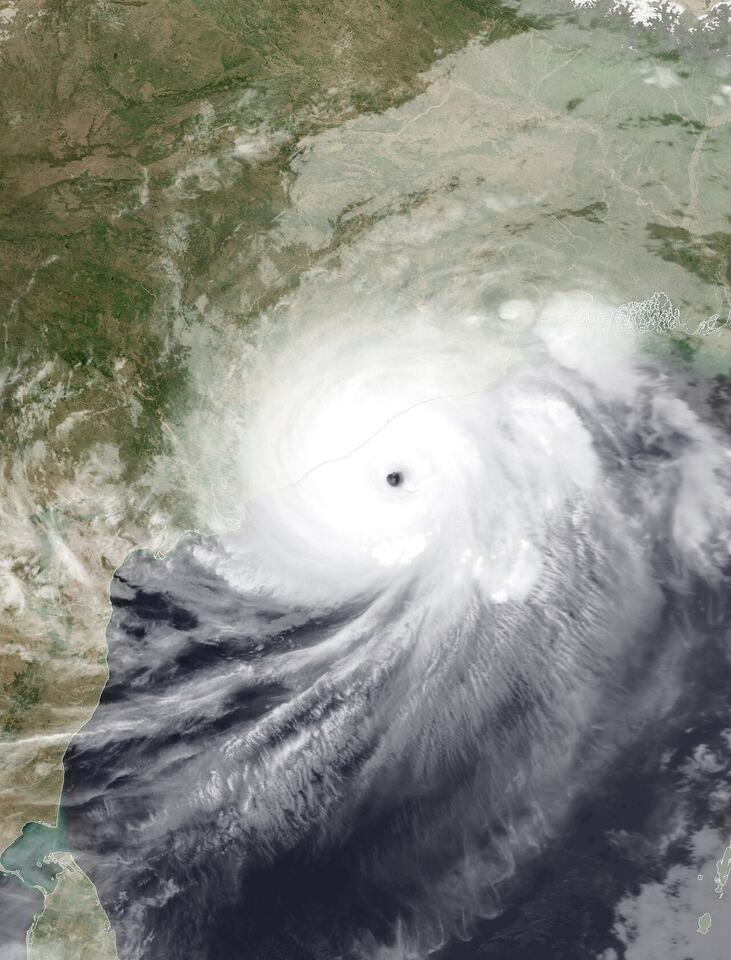
India's long coast faces two seas where cyclones form. The east coast is struck far more often than the west.
| Cyclones of India | What to remember |
|---|---|
| Two seasons | April to June before the monsoon, and October to December after it |
| Bay of Bengal | Has more cyclones than the Arabian Sea |
| States struck most | Odisha, Andhra Pradesh, West Bengal and Tamil Nadu on the east coast; Gujarat on the west |
| Named by | The IMD's centre in New Delhi, from a list given by 13 countries of the region |
| Naming began | In 2004 |
| The 13 countries | Bangladesh, India, Iran, Maldives, Myanmar, Oman, Pakistan, Qatar, Saudi Arabia, Sri Lanka, Thailand, the UAE and Yemen |
Major cyclones that struck India
The cyclones most often asked about, with the year and the coast they struck.
| Major cyclones that struck India | What to remember |
|---|---|
| 1999 · Odisha super cyclone | Struck near Paradip in October 1999. About 10,000 people died |
| 2013 · Phailin | Odisha, near Gopalpur |
| 2014 · Hudhud | Andhra Pradesh, at Visakhapatnam |
| 2017 · Ockhi | Kerala, Tamil Nadu and Lakshadweep |
| 2019 · Fani | Odisha, near Puri, in May |
| 2020 · Amphan | West Bengal. A super cyclone over the Bay of Bengal |
| 2021 · Tauktae and Yaas | Tauktae struck Gujarat; Yaas struck Odisha |
| 2023 · Biparjoy | Gujarat, in Kutch |
| 2024 · Remal, Dana and Fengal | Remal struck the coast of Bangladesh and West Bengal, Dana struck Odisha, and Fengal struck Tamil Nadu near Puducherry |
| 2025 · Montha | Andhra Pradesh, near Narasapuram |
How India grades a cyclone
The IMD grades a storm by the speed of its winds. A depression that keeps growing becomes a cyclonic storm and is then given a name.
| How India grades a cyclone | What to remember |
|---|---|
| Depression | 31 to 49 km an hour |
| Deep depression | 50 to 61 km an hour |
| Cyclonic storm | 62 to 88 km an hour. It gets a name at this stage |
| Severe cyclonic storm | 89 to 117 km an hour |
| Very severe cyclonic storm | 118 to 165 km an hour |
| Extremely severe cyclonic storm | 166 to 220 km an hour |
| Super cyclonic storm | Above 220 km an hour |
Other spinning storms
Temperate cyclones and anticyclones
Outside the tropics, cyclones form where cold polar air meets warm air. They are wider and gentler than tropical cyclones, and they form over land as well as sea.
| Temperate cyclones and anticyclones | What to remember |
|---|---|
| Temperate cyclone | Forms along a front, where warm and cold air meet, between about 35° and 65° latitude |
| Also called | Extra-tropical cyclone or depression |
| Moves | From west to east, with the westerlies |
| India's example | The western disturbances that bring winter rain to the north-west |
| Anticyclone | The opposite of a cyclone: high pressure at the centre, winds blowing outward, calm and clear weather |
| Spin of an anticyclone | Clockwise in the northern hemisphere |
Tornado and waterspout
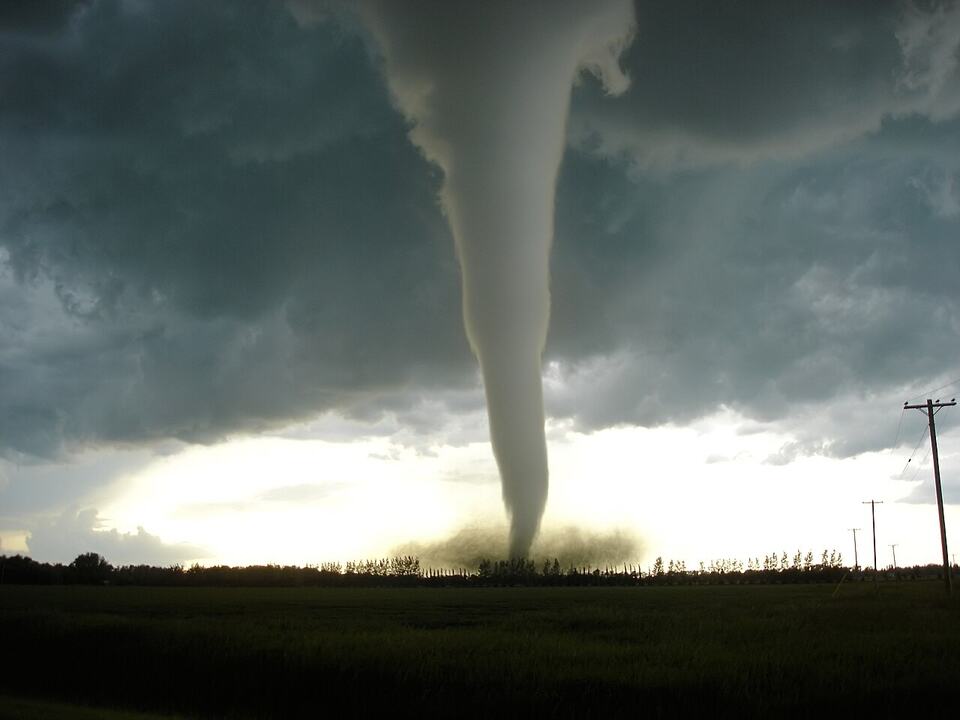
A tornado is a narrow, violently spinning funnel of air that reaches from a thundercloud to the ground. It is small and short-lived but has the fastest winds on Earth.
| Tornado and waterspout | What to remember |
|---|---|
| Tornado | A funnel-shaped storm over land |
| Most common in | The central plains of the USA |
| Local name in the USA | Twister |
| Scale | The Fujita scale |
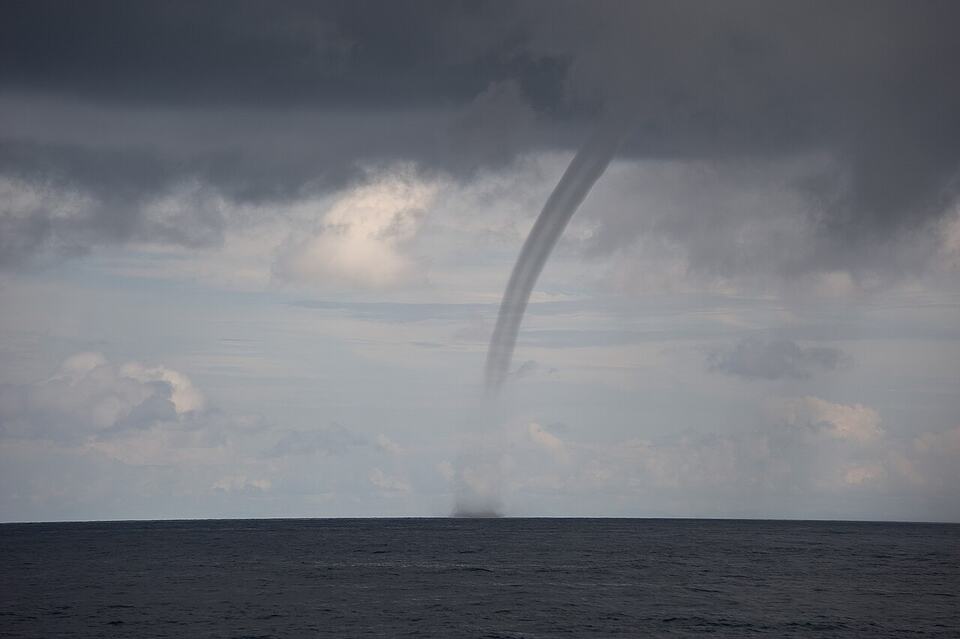
| Waterspout | A tornado over the sea or a lake |
| Difference from a cyclone | A tornado is a few hundred metres wide and lasts minutes; a cyclone is hundreds of kilometres wide and lasts days |
Quick questions
The questions exams ask most often, with short answers.
| Question | Answer |
|---|---|
| What is the calm centre of a cyclone called? | The eye. |
| What are tropical cyclones called in the Atlantic? | Hurricanes. |
| What are tropical cyclones called in the north-west Pacific? | Typhoons. |
| Why do cyclones not form at the Equator? | The Coriolis force is too weak there to make the air spin. |
| In which oceans do tropical cyclones not form? | The South Atlantic and the south-east Pacific. |
| Which direction does a cyclone spin in the northern hemisphere? | Anticlockwise. |
| Which sea gives India more cyclones? | The Bay of Bengal. |
| Who names cyclones in the north Indian Ocean? | The India Meteorological Department's centre in New Delhi, from a list given by 13 countries. |
| What is a storm surge? | A sudden rise of the sea, pushed ashore by a cyclone's winds and low pressure. |
| What is an anticyclone? | A system of high pressure with winds blowing outward and calm, clear weather. |
- What is the calm centre of a cyclone called?
- The eye.
- What are tropical cyclones called in the Atlantic?
- Hurricanes.
- What are tropical cyclones called in the north-west Pacific?
- Typhoons.
- Why do cyclones not form at the Equator?
- The Coriolis force is too weak there to make the air spin.
- In which oceans do tropical cyclones not form?
- The South Atlantic and the south-east Pacific.
- Which direction does a cyclone spin in the northern hemisphere?
- Anticlockwise.
- Which sea gives India more cyclones?
- The Bay of Bengal.
- Who names cyclones in the north Indian Ocean?
- The India Meteorological Department's centre in New Delhi, from a list given by 13 countries.
- What is a storm surge?
- A sudden rise of the sea, pushed ashore by a cyclone's winds and low pressure.
- What is an anticyclone?
- A system of high pressure with winds blowing outward and calm, clear weather.