- Tap a label on the cut-open volcano
- Press Watch an eruption
- Open World map and tap a volcano
- Tap a photo to make it bigger
Satellite image of the Earth: NASA Blue Marble. Photos are from Wikimedia Commons and the US Geological Survey; each photo carries its credit.
Molten rock is magma below the ground and lava once it comes out. By shape, volcanoes are shield, composite (stratovolcano), cinder cone or lava dome. By activity they are active, dormant or extinct. More than half of the world's volcanoes stand around the Pacific Ocean, on the Ring of Fire.
Active erupts. Dormant sleeps and may wake. Extinct is dead. A sill lies along the rock layers; a dyke cuts through them.
Inside a volcano
What is a volcano?
A volcano is a vent through which molten rock, ash and gases from inside the Earth reach the surface. The hill or mountain built around the vent is also called a volcano.
| What is a volcano? | What to remember |
|---|---|
| Magma and lava (PYQ) | Molten rock is called magma while it is below the ground and lava once it comes out |
| How many | About 1,350 potentially active volcanoes on land. About 500 of them have erupted in recorded history |
| Where most are found (PYQ) | Along the edges of the plates, above all around the Pacific Ocean: the Pacific Ring of Fire |
| Erupting right now | Usually 40 to 50 volcanoes around the world at any time |
| Countries with the most volcanoes | The United States, Japan, Indonesia, Russia and Chile |
| India's only active volcano (PYQ) | Barren Island, in the Andaman Sea |
Parts of a volcano
Magma collects in a chamber deep under the volcano. It rises through a pipe and comes out at the vent. Each eruption adds a layer to the cone.
| Parts of a volcano | What to remember |
|---|---|
| Magma chamber | The store of molten rock under the volcano |
| Conduit (pipe) | The passage through which magma rises |
| Vent | The opening where lava, ash and gases come out |
| Crater | The bowl-shaped hollow around the vent at the top |
| Cone | The hill built from layers of lava and ash |
| Side vent | A smaller opening on the slope. It can build a small cone of its own |
| Ash cloud | Tiny pieces of rock and glass blown into the air. Volcanic ash is rock, not burnt material |
| Lava flow | Molten rock running down the slope |
How a volcano erupts
Magma is lighter than the rock around it, so it rises. Gas trapped in the magma expands near the surface and drives the eruption.
| How a volcano erupts | What to remember |
|---|---|
| Quiet eruption | Thin, runny lava lets gas escape easily. It pours out in fountains and flows, as in Hawaii |
| Explosive eruption | Thick, sticky magma traps gas. The pressure blasts ash and rock high into the air |
| Volcanic Explosivity Index | A scale from 0 to 8 that measures how big an explosive eruption is |
| Largest eruption in recorded history | Tambora, Indonesia, in 1815. It reached 7 on the index |
| Krakatoa, 1883 | Reached 6 on the index. Its sound was heard about 4,800 km away |
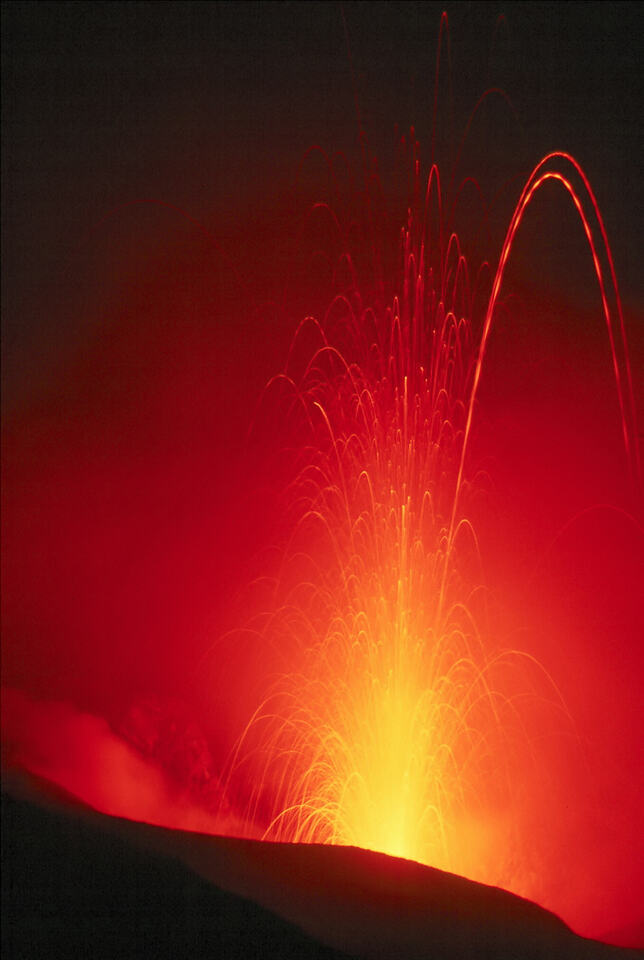
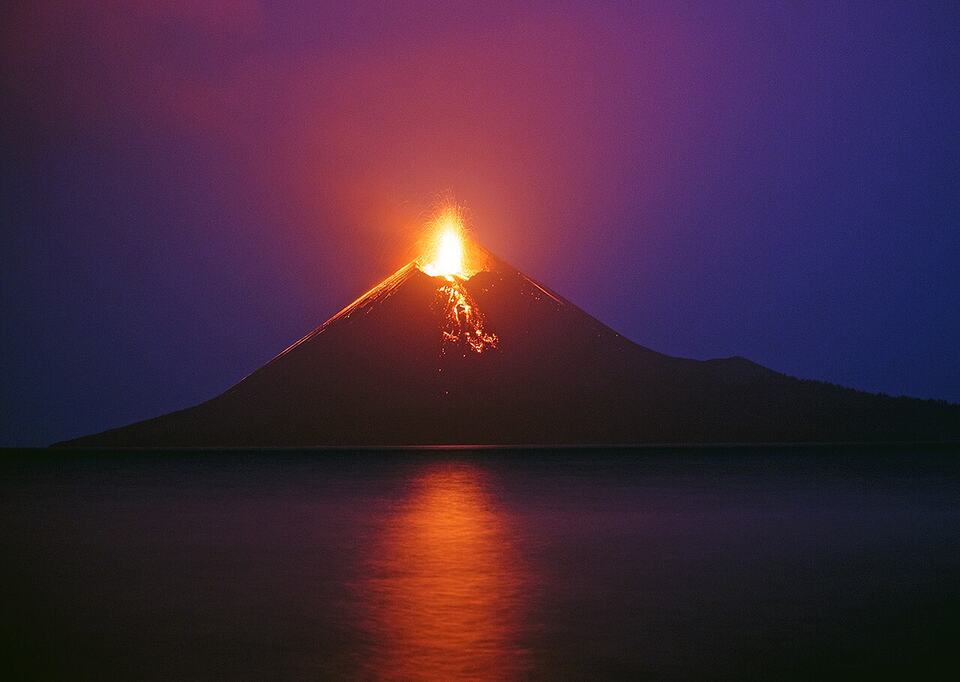
| Strombolian eruption | Small, regular bursts of glowing lava, named after Stromboli in Italy |
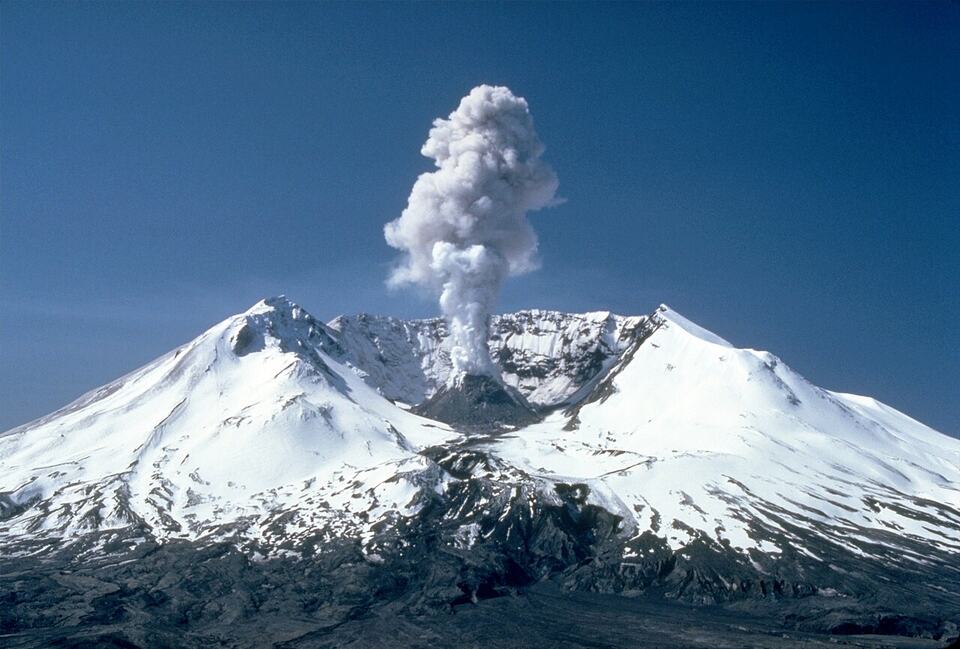
Types of volcano
Shield volcano
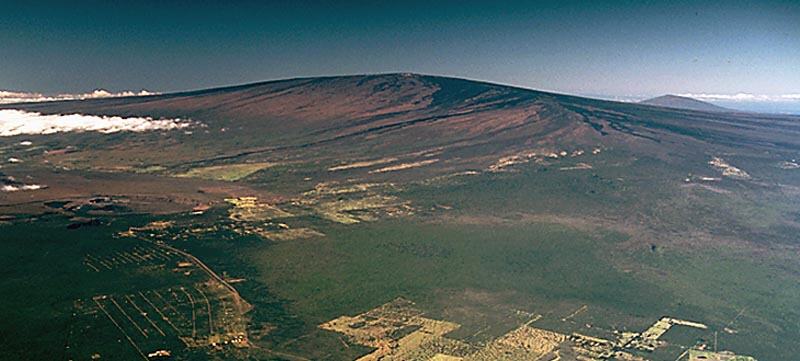
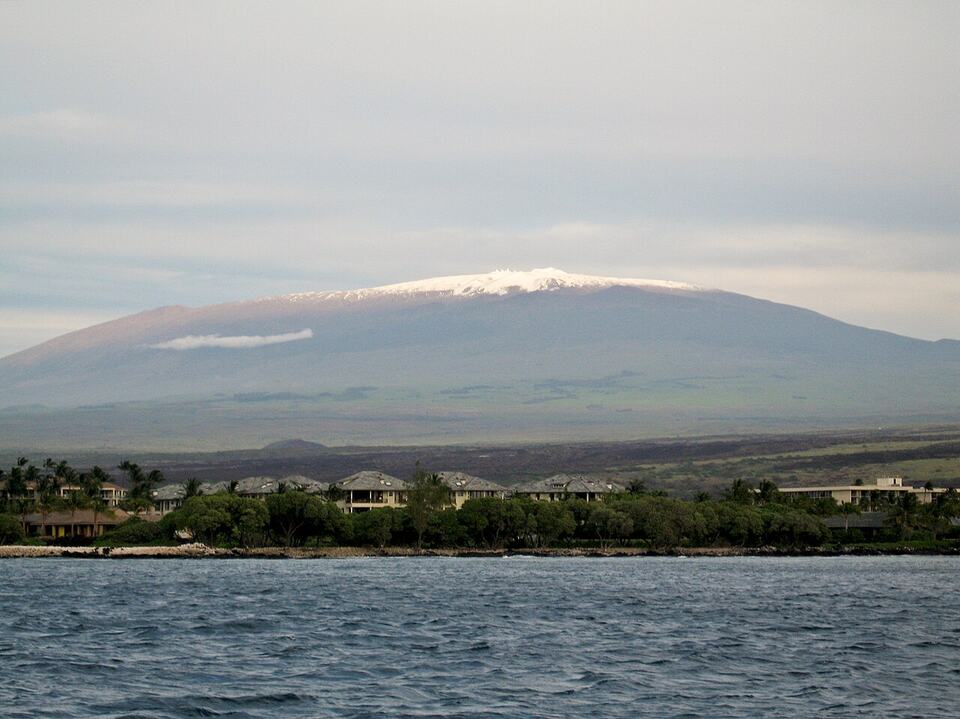
A shield volcano is built almost wholly of thin, runny lava that spreads far before it cools. It looks like a warrior's shield laid on the ground.
| Shield volcano | What to remember |
|---|---|
| Made of | Layer upon layer of fluid basalt lava |
| Shape | Very broad, with gentle slopes |
| Eruptions | Mostly quiet: lava fountains and long lava flows |
| Size | The largest volcanoes on Earth are shield volcanoes |
| Examples | Mauna Loa, Mauna Kea and Kilauea in Hawaii |
Composite volcano
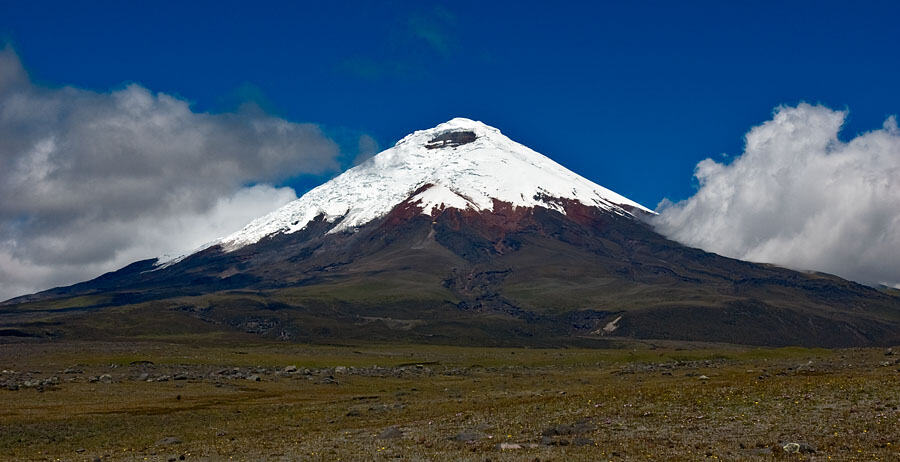
A composite volcano is a tall, steep cone built of layers of lava and layers of ash, one over the other. Most of the famous volcanoes are of this kind.
| Composite volcano | What to remember |
|---|---|
| Made of | Alternate layers of lava, ash and rock fragments |
| Shape | A tall cone with steep sides and a crater at the top |
| Eruptions | Often explosive |
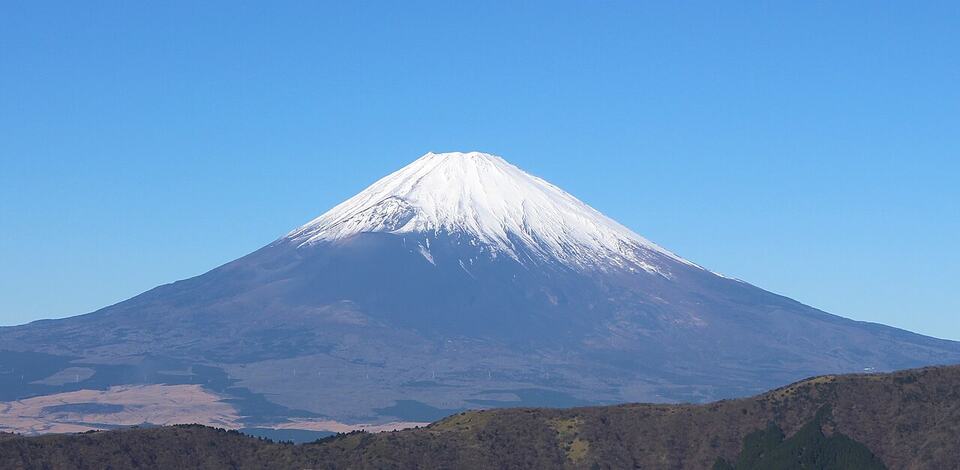
| Examples | Fuji in Japan, Pinatubo in the Philippines, St Helens in the USA, Cotopaxi in Ecuador and Etna in Italy |
| In India | Barren Island is a composite volcano |
Cinder cone
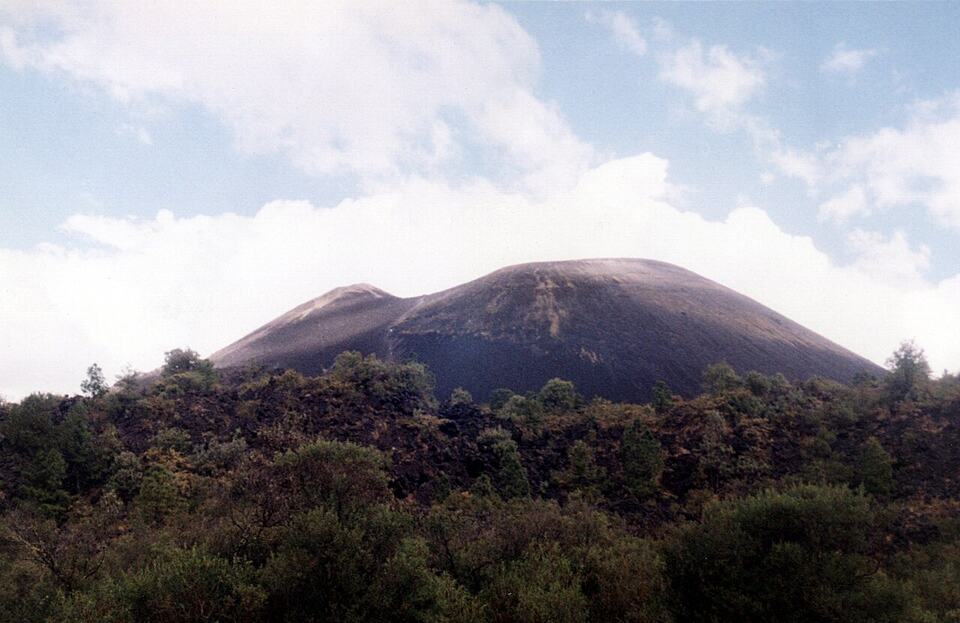
A cinder cone is a small, steep hill of loose bits of lava that were thrown out of one vent and fell back around it.
| Cinder cone | What to remember |
|---|---|
| Made of | Loose cinders, ash and small rocks |
| Shape | A small cone with straight, steep sides and a bowl-shaped crater |
| Size | The smallest of the main types |
| Example | Parícutin in Mexico. It began growing in a farmer's field in 1943 and now stands about 365 m (1,200 feet) above the plain |
Lava dome
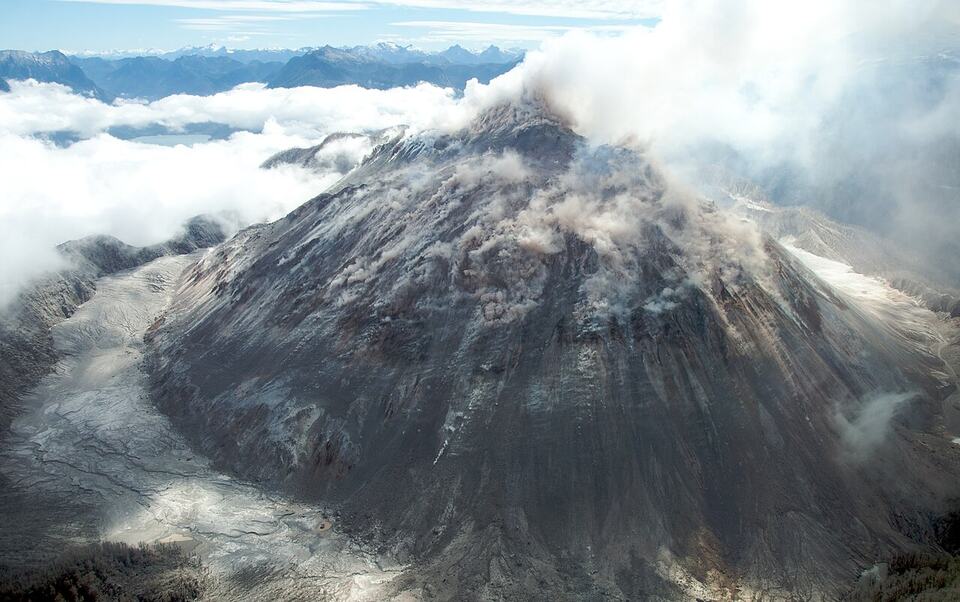
A lava dome forms when lava is too thick to flow away. It piles up over the vent as a rounded mound.
| Lava dome | What to remember |
|---|---|
| Made of | Thick, sticky lava that cools near the vent |
| Where | Often inside the crater or on the side of a composite volcano |
| Danger | A dome can collapse and send a pyroclastic flow down the slope |
| Example | The dome inside the crater of Mount St Helens, USA |
Active, dormant and extinct
Active volcano
An active volcano is erupting now or has erupted in recent times and is expected to erupt again.
| Active volcano | What to remember |
|---|---|
| Scientists' rule | A volcano that has erupted in the last 10,000 years or so is counted as active |
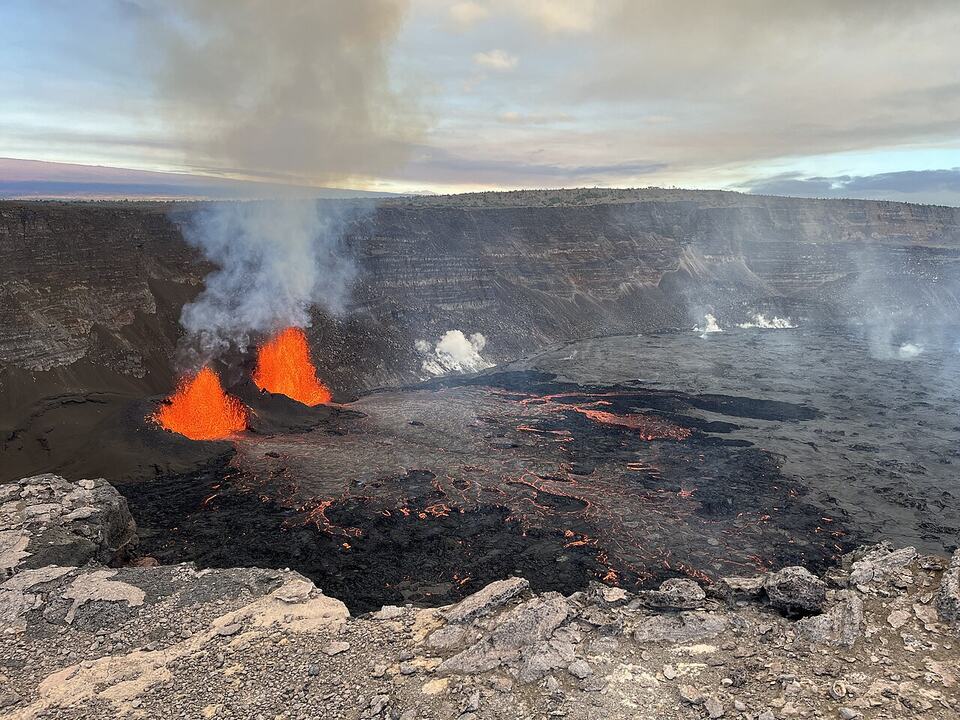
| Kilauea, Hawaii | Its present summit eruption began on 23 December 2024 and comes in short bursts of lava fountains |
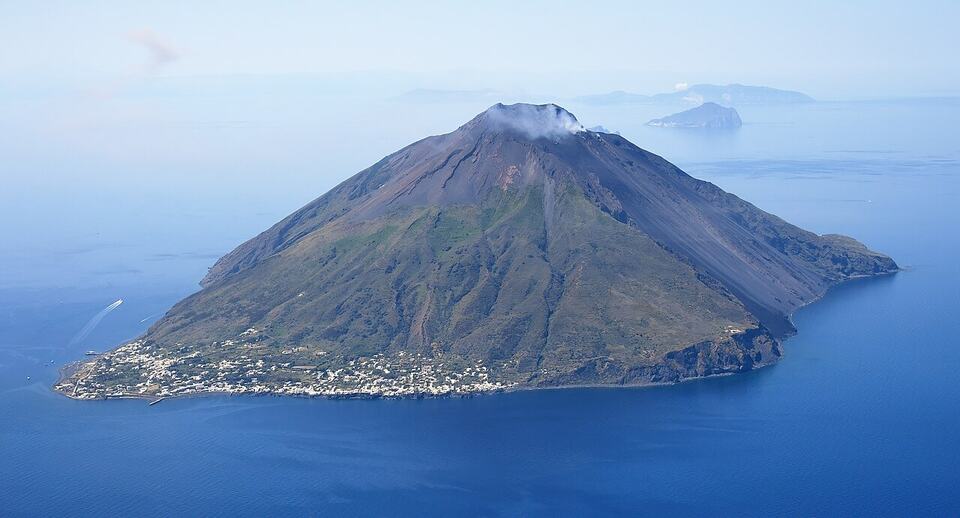
| Stromboli, Italy | Has erupted almost without a break for about 2,000 years. Called the Lighthouse of the Mediterranean |
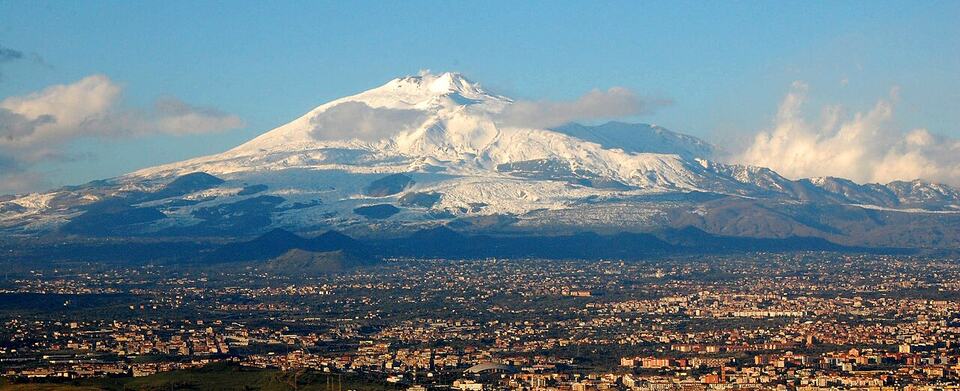
| Etna, Italy | The highest active volcano in Europe. It erupts very often |
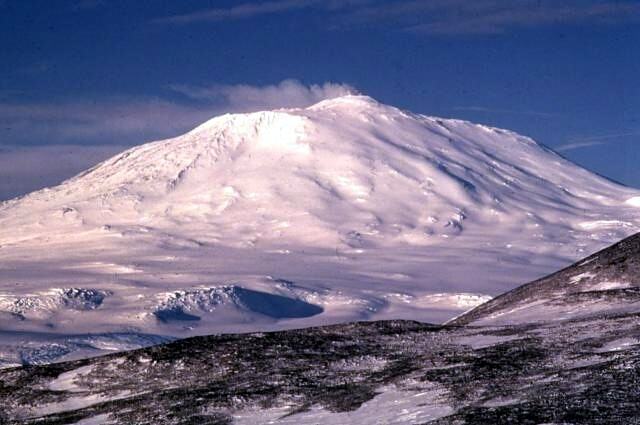
| Mount Erebus, Antarctica | The southernmost active volcano on Earth |
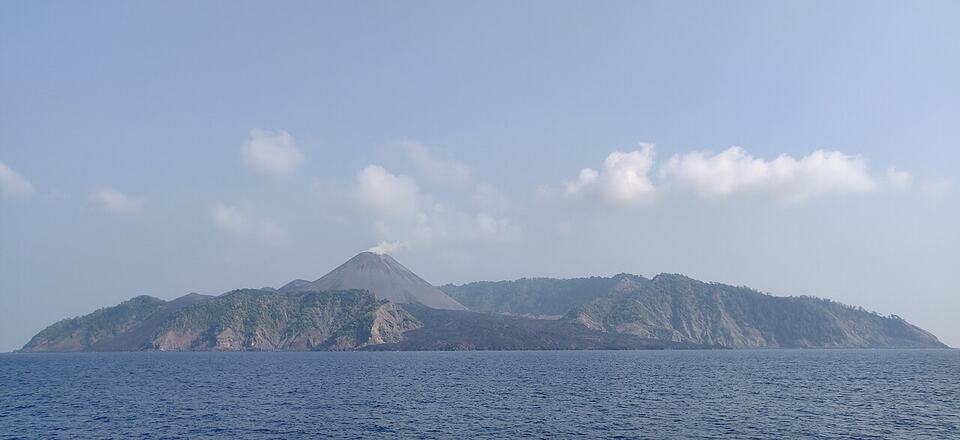
| Barren Island, India (PYQ) | India's only active volcano. Minor eruptions were reported in September 2025 |
Dormant volcano
A dormant volcano has been quiet for a long time but still has magma below it and may erupt again.
| Dormant volcano | What to remember |
|---|---|
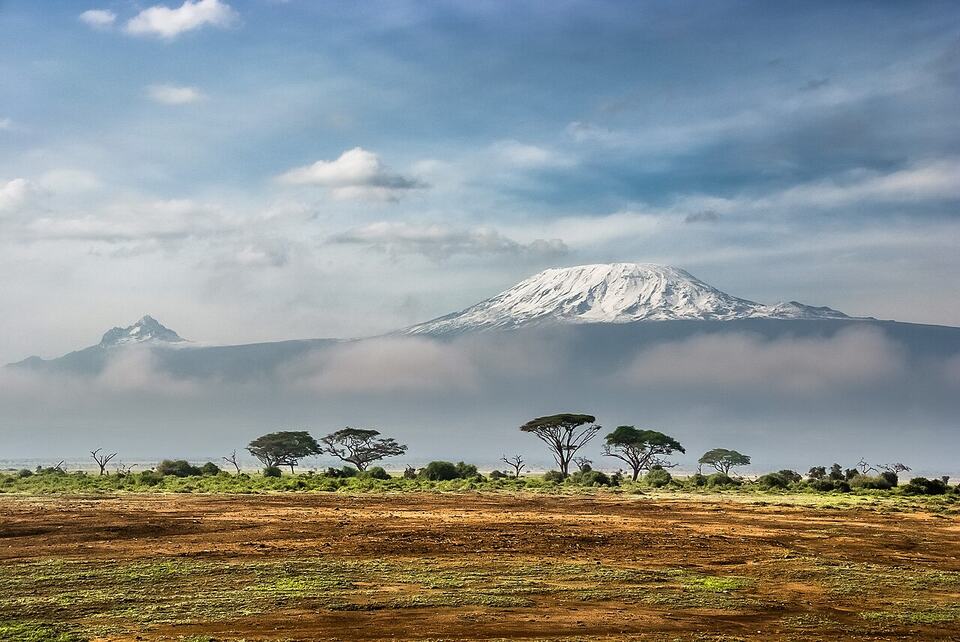
| Kilimanjaro, Tanzania | A dormant volcano and the highest mountain in Africa. Its Kibo cone is dormant; Mawenzi and Shira are extinct |
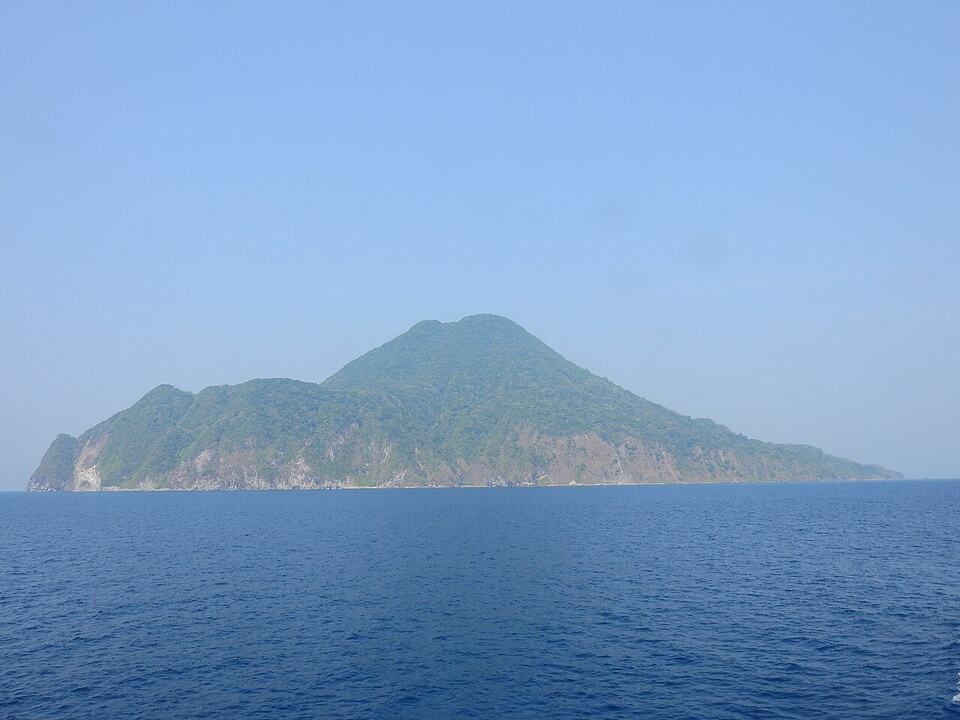
| Narcondam Island, India | Classed as a dormant volcano by the Geological Survey of India |
| Mauna Kea, Hawaii | Last erupted about 4,600 years ago |
| Mount Fuji, Japan | Last erupted in 1707. It is still counted as active, because it can erupt again |
| Why the word misleads | Pinatubo had been quiet for about 500 years before 1991, and St Helens for 123 years before 1980 |
Extinct volcano
An extinct volcano has no supply of magma left and is not expected to erupt again. Rain and rivers slowly wear its cone away.
| Extinct volcano | What to remember |
|---|---|
| Meaning (PYQ) | A volcano that is not expected to erupt again |
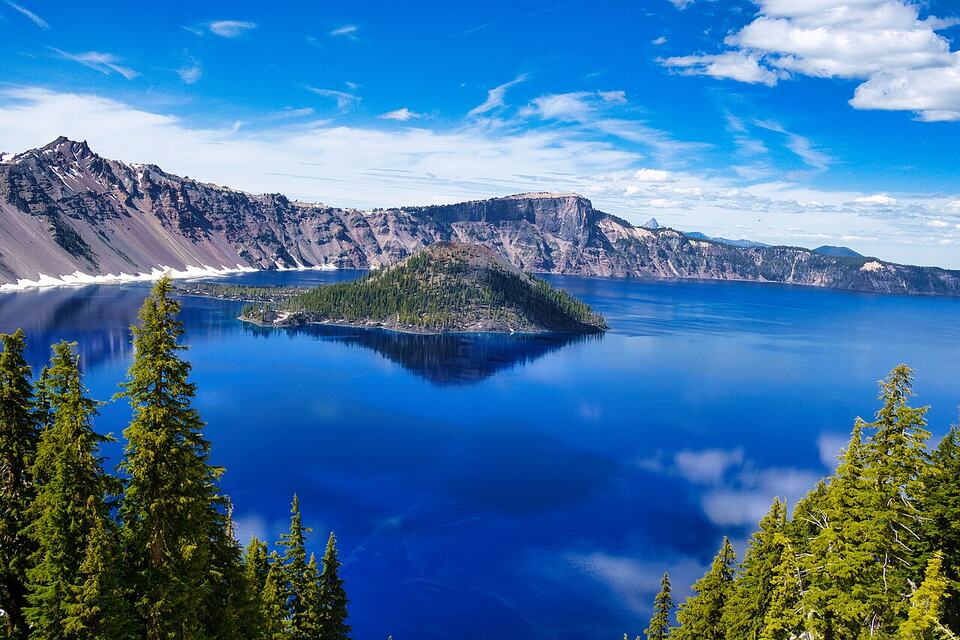
| What is left | A worn cone, sometimes with a lake in the crater |
| Examples | Mawenzi and Shira, the two older cones of Kilimanjaro |
| In India | The volcanoes that built the Deccan Traps of the Deccan Plateau are extinct |
| Remember | Active: erupts. Dormant: sleeping, may wake. Extinct: dead |
Lava and landforms
Lava and its types
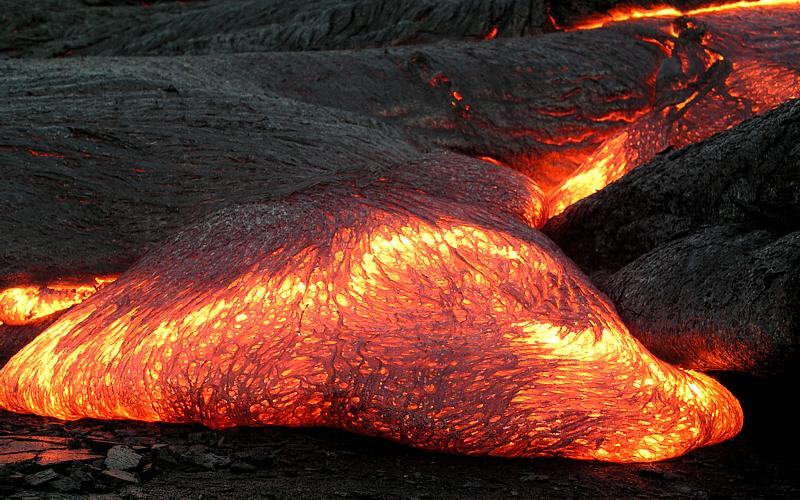
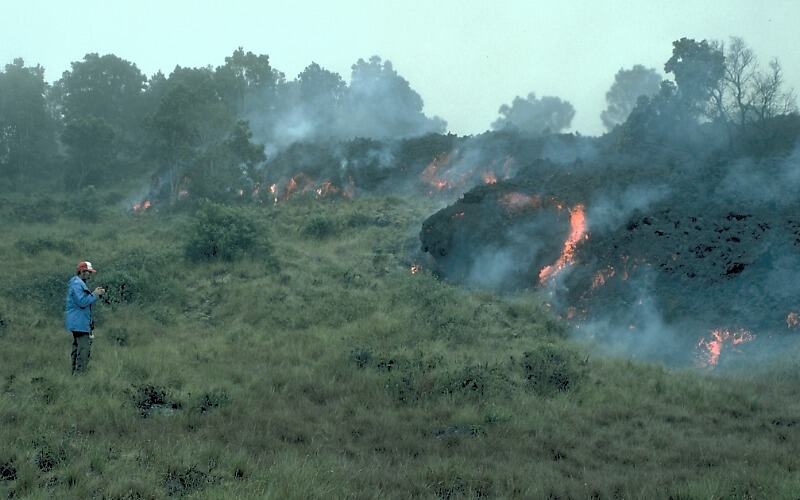
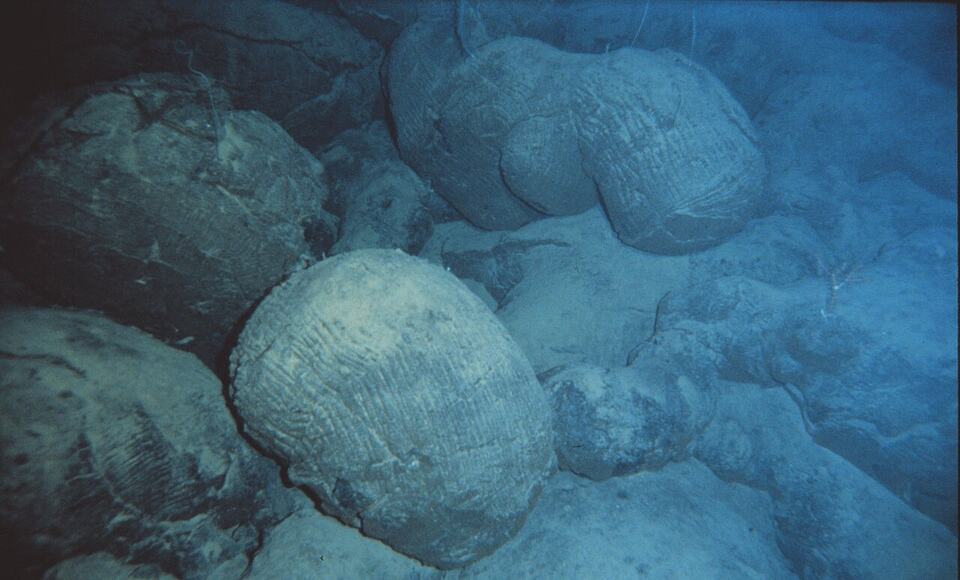
Lava is molten rock that has reached the surface. How it looks when it cools depends on how runny it is and where it cools.
| Lava and its types | What to remember |
|---|---|
| Pahoehoe | Lava with a smooth, billowy or ropy surface. The name is Hawaiian |
| Aa | Lava with a rough, jagged, clinkery surface. Also a Hawaiian name |
| Pillow lava | Rounded, pillow-shaped lumps that form when lava erupts under water |
| Basalt lava | Low in silica, so it is thin and flows far. It builds shield volcanoes |
| Silica-rich lava | Thicker and slower. It builds steep cones and lava domes |
| Rock formed (PYQ) | Lava cools and hardens into igneous rock |
Volcanic landforms on the surface
Eruptions build some landforms and destroy others. The biggest are calderas and lava plateaus.
| Volcanic landforms on the surface | What to remember |
|---|---|
| Crater | The bowl-shaped hollow at the top of a volcano |
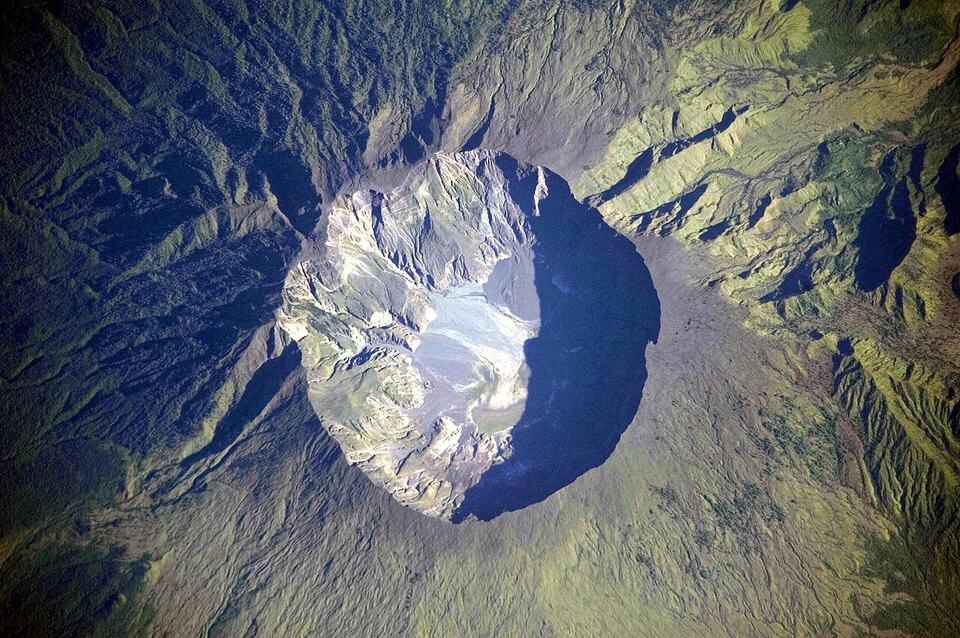
| Caldera | A very large hollow made when a volcano collapses into its emptied magma chamber |
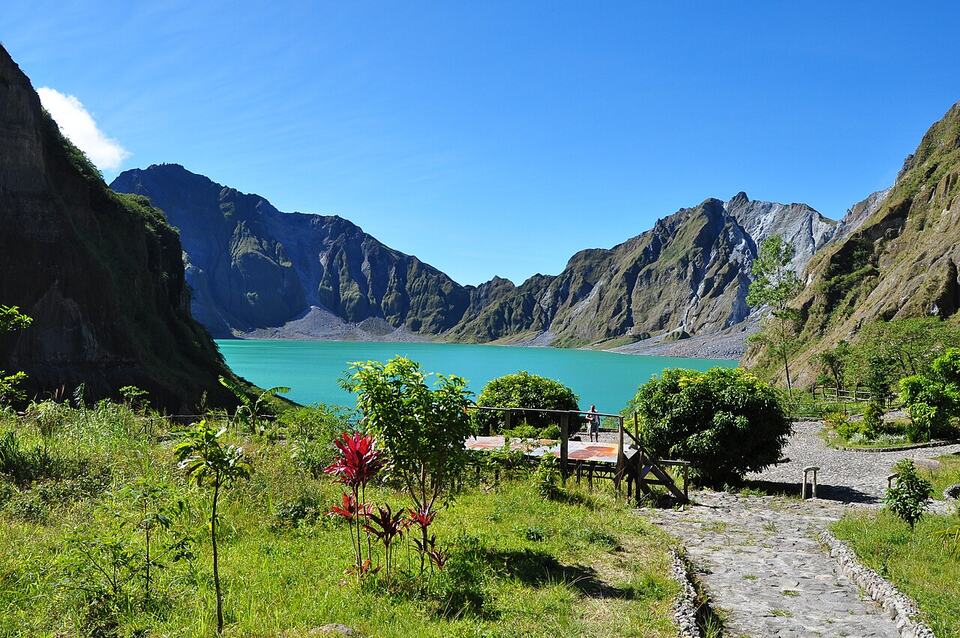
| Crater lake | A lake that fills a crater or caldera. Examples: Crater Lake in the USA, Lake Pinatubo in the Philippines |
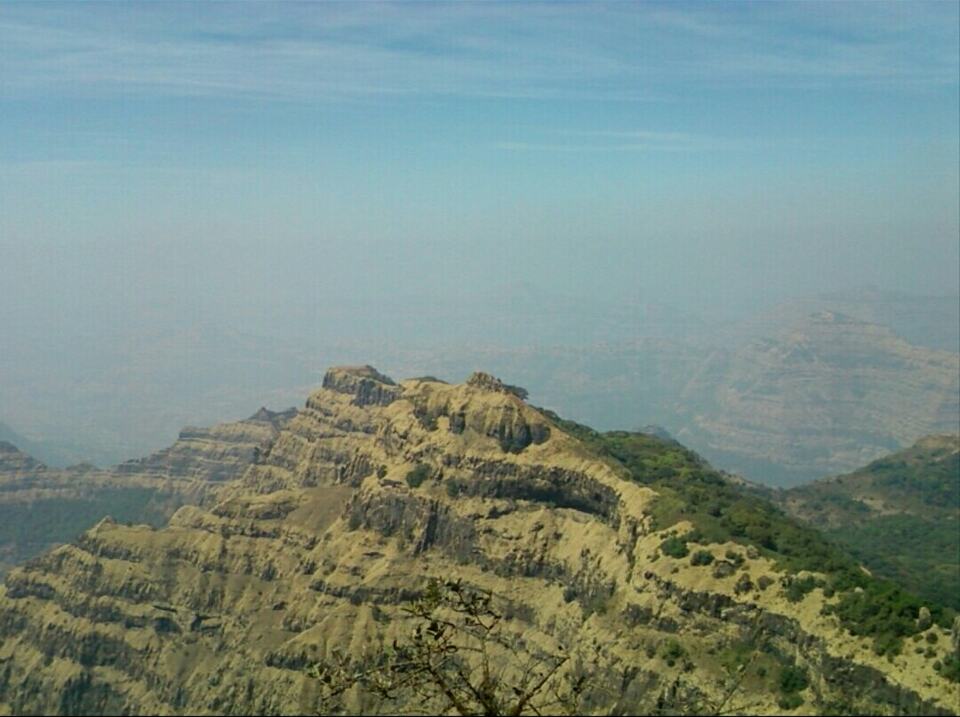
| Lava plateau | A wide upland built by sheets of lava that poured out of long cracks (fissures), layer on layer |
| Deccan Traps | India's great lava plateau. It covers about 5 lakh sq km and is more than 2 km thick in places |
| Black soil (PYQ) | India's black soil comes from the lava rock of the Deccan Traps |
Landforms inside the crust
Not all magma reaches the surface. Some cools and hardens inside the crust. These intrusive forms are seen only after the rock above is worn away.
| Landforms inside the crust | What to remember |
|---|---|
| Batholith (PYQ) | A very large mass of igneous rock formed when magma cooled deep in the crust |
| Laccolith | A dome-shaped or lens-shaped body that pushes the rock layers above it upward |
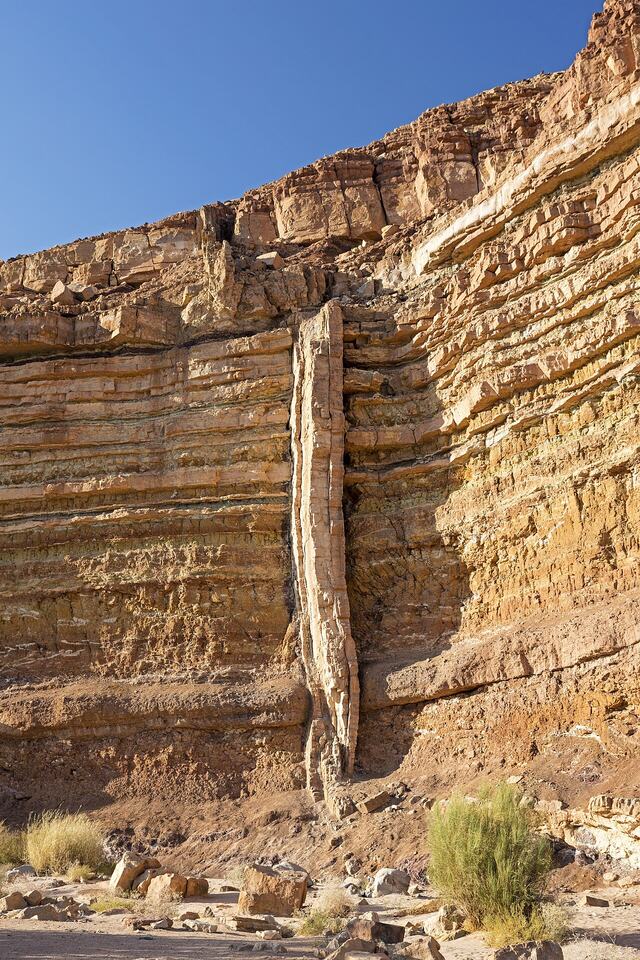
| Sill | A sheet of magma that hardened between rock layers, parallel to them |
| Dyke | A wall of magma that hardened while cutting across the rock layers |
| Remember | Sill: lies along the layers. Dyke: cuts through the layers |
| Rock formed (PYQ) | Rock made by the cooling of magma is igneous rock. Granite is an example |
Hazards and benefits
Hazards of volcanoes
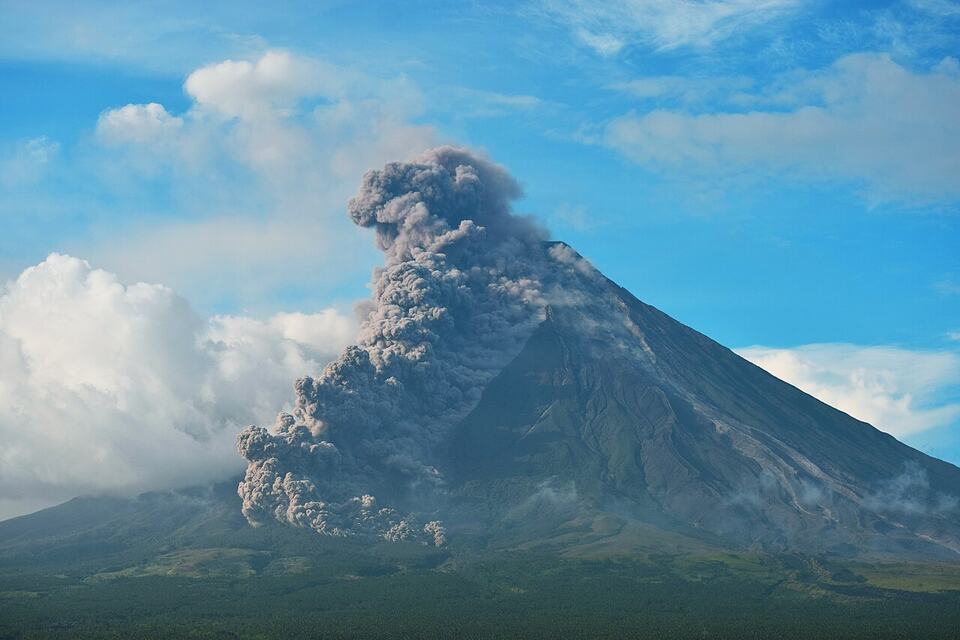
Lava moves slowly and rarely kills. The deadliest dangers are fast flows of hot ash and of mud.
| Hazards of volcanoes | What to remember |
|---|---|
| Pyroclastic flow | A fast avalanche of hot ash, rock and gas that rushes down the slope, at up to about 160 km an hour. The deadliest hazard |
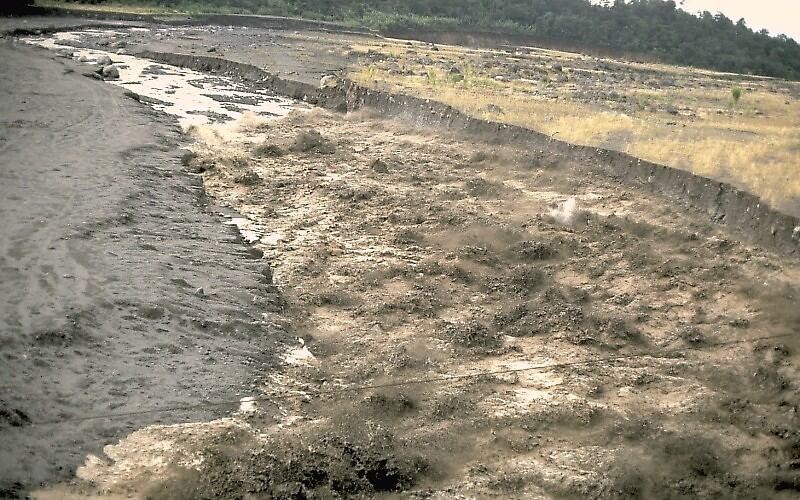
| Lahar | A flow of mud and rock, formed when ash mixes with rain, melted snow or a crater lake |
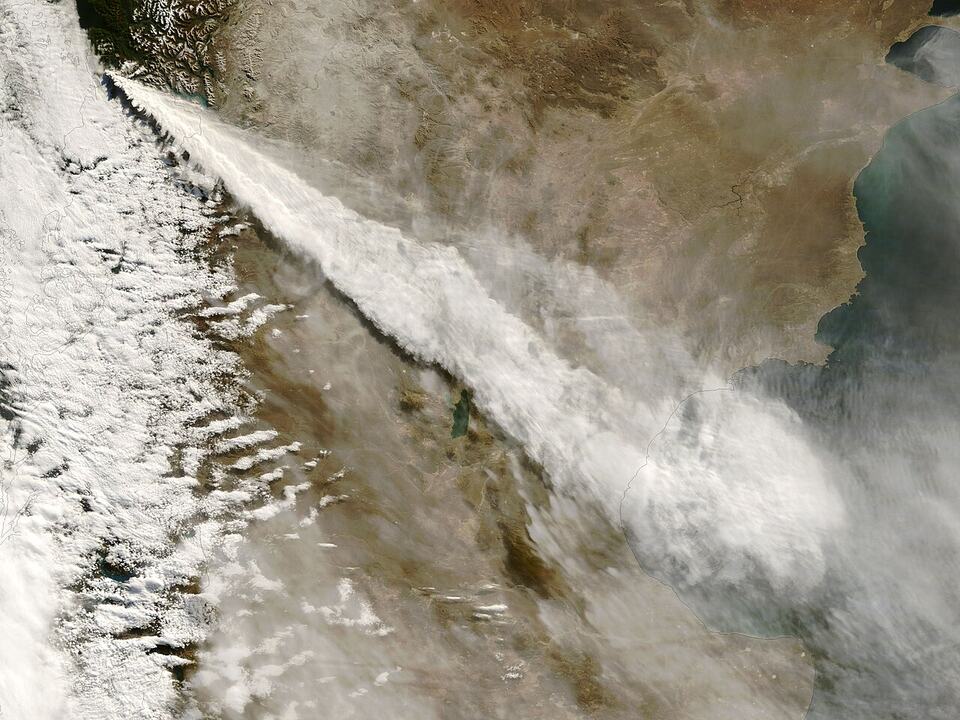
| Ash fall | Heavy ash can collapse roofs. Even light ash damages crops and machines |
| Volcanic gases (PYQ) | Water vapour is the most plentiful gas in an eruption. Gases can escape even when a volcano is quiet |
| Tsunami | Krakatoa's 1883 eruption raised sea waves that killed about 36,000 people |
| Cooler climate | Ash and gas from Tambora in 1815 made 1816 the Year Without a Summer |
Benefits of volcanoes
Millions of people live beside volcanoes because the land around them is rich.
| Benefits of volcanoes | What to remember |
|---|---|
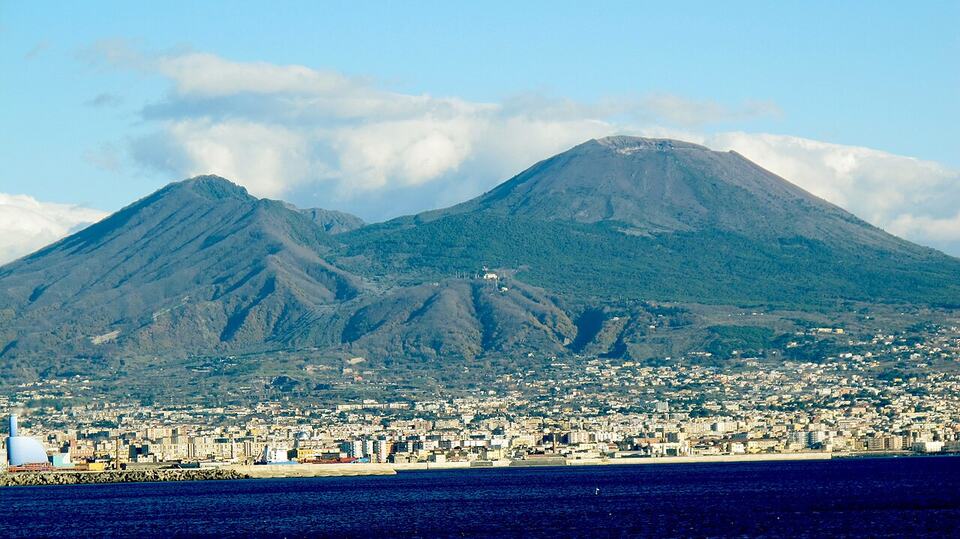
| Fertile soil | Volcanic soil is very fertile. Vineyards and orchards grow around Vesuvius in Italy |
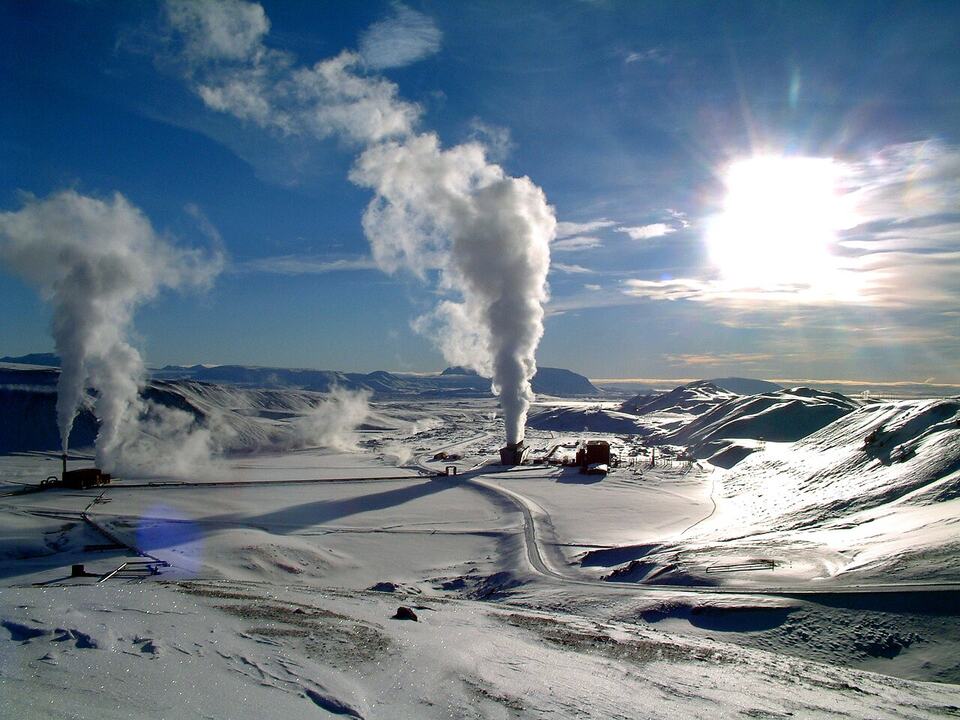
| Geothermal energy | Heat from hot rock is used to make electricity, as in Iceland |
| New land | Lava that flows into the sea builds new land, as on the island of Hawaii |
| Black soil of the Deccan (PYQ) | India's black soil comes from the lava rock of the Deccan Traps |
Volcanoes of the world
Pacific Ring of Fire
The edges of the Pacific Ocean are lined with volcanoes. This horseshoe-shaped belt is called the Pacific Ring of Fire.
| Pacific Ring of Fire | What to remember |
|---|---|
| Where (PYQ) | Around the Pacific Ocean: New Zealand, Indonesia, the Philippines, Japan, Alaska, the west coast of the Americas down to Chile |
| Share of the world's volcanoes | More than half: 687 of the 1,214 volcanoes active in the last 12,000 years |
| Why (PYQ) | Ocean plates sink under the plates around the Pacific. The sinking plate melts and the magma rises |
| Hawaii | Lies in the middle of the Pacific, not on the Ring. Its volcanoes sit over a hot spot |
| Also on it | Most of the world's strong earthquakes |
Volcanoes of India
India has one active volcano and one dormant volcano, both in the Andaman Sea. The mainland has no active volcano.
| Volcanoes of India | What to remember |
|---|---|
| Barren Island (PYQ) | India's only active volcano, and the only one in South Asia. About 140 km north-east of Port Blair |
| Its eruptions | First recorded in 1787. Quiet for about 150 years, then 1991, 2005, 2017 and 2022, and minor eruptions in September 2025 |
| Why it is there | It stands where the Indian plate sinks under the Burmese plate |
| Narcondam Island | A dormant volcano, north of Barren Island |
| Deccan Traps | A lava plateau in western and central India, formed about 6.6 crore years ago. Its volcanoes are extinct |
Major volcanoes of the world
The volcanoes exams ask about, with where each one is and the one fact to remember.
| Volcano | Where and what | Remember |
|---|---|---|
| Barren Island (PYQ) | India; composite volcano; active | Status: Active. India's and South Asia's only active volcano. First recorded eruption: 1787. Latest activity: Minor eruptions on 13 and 20 September 2025. Area: About 8 sq km. |
| Narcondam Island | India; dormant | Status: Dormant, as classed by the Geological Survey of India. Activity: No eruption for thousands of years. |
| Kilauea | USA (Hawaii); shield volcano; active | Type: Shield volcano. Present eruption: Began at the summit on 23 December 2024 and comes in short bursts of lava fountains. |
| Mauna Loa | USA (Hawaii); shield volcano; active | Record: The largest active volcano on Earth. Height: 4,170 m above the sea, and about 9,000 m from the sea floor. Last eruption: November to December 2022, its first since 1984. |
| Mauna Kea | USA (Hawaii); shield volcano; dormant | Record: The tallest mountain on Earth from base to top. Height above the sea: 4,207 m. Last eruption: About 4,600 years ago. |
| Mount St Helens (PYQ) | USA; composite volcano; active | Great eruption: 18 May 1980. It killed 57 people. Before that: It had been quiet for 123 years. Mountain range: The Cascade Range, part of the Ring of Fire. |
| Parícutin | Mexico; cinder cone | Type: Cinder cone. Born: 1943, in a field near the village of Parícutin. |
| Cotopaxi | Ecuador; composite volcano; active | Type: Composite volcano. Mountain range: The Andes. |
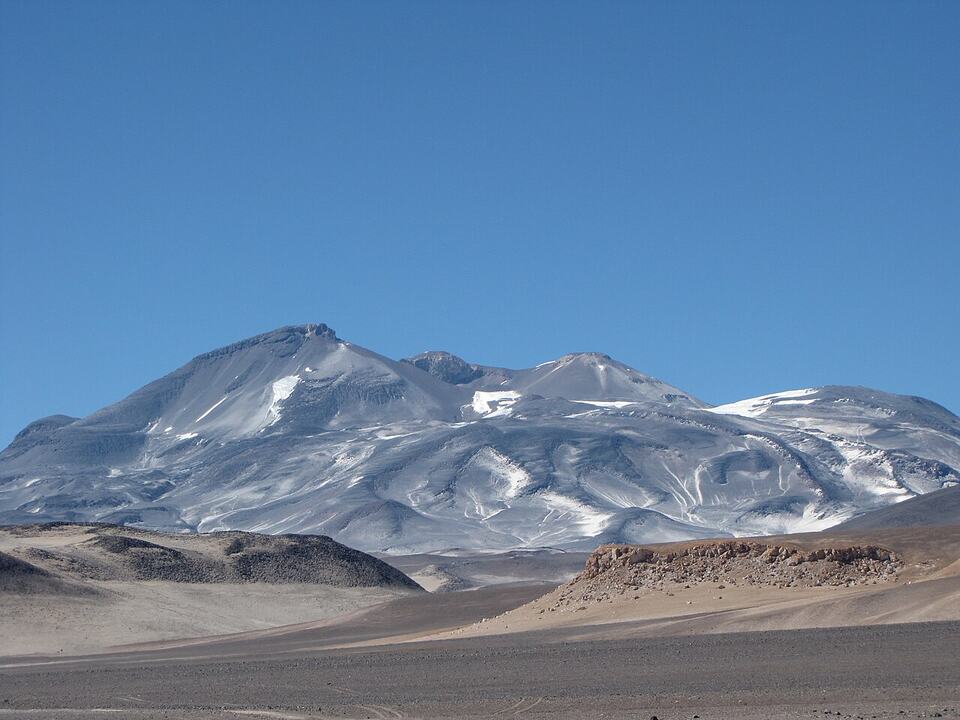
| Ojos del Salado | Chile and Argentina; the highest volcano | Record: The world's highest volcano, about 6,890 m. Mountain range: The Andes. |
| Mount Etna | Italy; composite volcano; active | Record: The highest active volcano in Europe. Height: About 3,350 m. It changes with each eruption. |
| Stromboli | Italy; composite volcano; active | Called: The Lighthouse of the Mediterranean. Activity: Almost continuous for about 2,000 years. Gave its name to: Strombolian eruptions. |
| Mount Vesuvius | Italy; composite volcano; active | Famous eruption: AD 79: Pompeii and Herculaneum were buried in ash. Last eruption: 1944. Note: The only active volcano on the mainland of Europe. |
| Kilimanjaro | Tanzania; composite volcano; dormant | Record: The highest point of Africa. Three cones: Kibo (dormant), Mawenzi and Shira (extinct). |
| Mount Fuji | Japan; composite volcano; active | Record: The highest point of Japan. Last eruption: 1707. Status: Quiet for over 300 years, but still counted as active. |
| Mount Pinatubo | Philippines; composite volcano; active | 1991 eruption: The second largest eruption of the 20th century. After the eruption: A lake, Lake Pinatubo, filled the new caldera. |
| Krakatoa | Indonesia; active | Where: The Sunda Strait, between Java and Sumatra. 1883 eruption: Destroyed most of the island. Its tsunami killed about 36,000 people. Anak Krakatau: The Child of Krakatoa, a new island that rose from the sea between 1927 and 1930. |
| Mount Tambora | Indonesia; composite volcano; active | 1815 eruption: The largest in recorded history. Effect: 1816 became the Year Without a Summer across the northern world. Today: A caldera several kilometres wide. |
| Mount Erebus | Antarctica; composite volcano; active | Record: The southernmost active volcano on Earth. Height: 3,794 m. |
Quick questions
The questions exams ask most often, with short answers.
| Question | Answer |
|---|---|
| Which is the only active volcano in India? | Barren Island, in the Andaman Sea. It is also the only active volcano in South Asia. |
| What is the difference between magma and lava? | Molten rock is called magma while it is below the ground and lava once it reaches the surface. |
| What are active, dormant and extinct volcanoes? | An active volcano erupts now or has erupted in recent times. A dormant volcano is quiet but may erupt again. An extinct volcano is not expected to erupt again. |
| What is the Pacific Ring of Fire? | A horseshoe-shaped belt of volcanoes around the Pacific Ocean, where ocean plates sink under the plates around them. More than half of the world's volcanoes are on it. |
| Which is the largest active volcano in the world? | Mauna Loa in Hawaii. It last erupted in November and December 2022. |
| Which volcano is called the Lighthouse of the Mediterranean? | Stromboli, in Italy, because it has erupted almost without a break for about 2,000 years. |
| What is the difference between a sill and a dyke? | A sill is a sheet of hardened magma lying between rock layers, parallel to them. A dyke cuts across the rock layers. |
| Which is the highest volcano in the world? | Ojos del Salado, on the border of Chile and Argentina, about 6,890 m high. |
| Which eruption was the largest in recorded history? | Tambora, Indonesia, in 1815. The next year, 1816, was called the Year Without a Summer. |
| Which is a dormant volcano in India? | Narcondam Island, in the Andaman Sea. |
| What is a caldera? | A very large hollow formed when a volcano collapses into its emptied magma chamber. |
| Mount St Helens is in which country? | The United States of America. |
- Which is the only active volcano in India?
- Barren Island, in the Andaman Sea. It is also the only active volcano in South Asia.
- What is the difference between magma and lava?
- Molten rock is called magma while it is below the ground and lava once it reaches the surface.
- What are active, dormant and extinct volcanoes?
- An active volcano erupts now or has erupted in recent times. A dormant volcano is quiet but may erupt again. An extinct volcano is not expected to erupt again.
- What is the Pacific Ring of Fire?
- A horseshoe-shaped belt of volcanoes around the Pacific Ocean, where ocean plates sink under the plates around them. More than half of the world's volcanoes are on it.
- Which is the largest active volcano in the world?
- Mauna Loa in Hawaii. It last erupted in November and December 2022.
- Which volcano is called the Lighthouse of the Mediterranean?
- Stromboli, in Italy, because it has erupted almost without a break for about 2,000 years.
- What is the difference between a sill and a dyke?
- A sill is a sheet of hardened magma lying between rock layers, parallel to them. A dyke cuts across the rock layers.
- Which is the highest volcano in the world?
- Ojos del Salado, on the border of Chile and Argentina, about 6,890 m high.
- Which eruption was the largest in recorded history?
- Tambora, Indonesia, in 1815. The next year, 1816, was called the Year Without a Summer.
- Which is a dormant volcano in India?
- Narcondam Island, in the Andaman Sea.
- What is a caldera?
- A very large hollow formed when a volcano collapses into its emptied magma chamber.
- Mount St Helens is in which country?
- The United States of America.