- Press Travel across the floor
- Tap a label on the slice
- Open Currents on the globe
- Red arrows are warm, blue are cold
Satellite image of the Earth: NASA Blue Marble. Photos are from Wikimedia Commons; each photo carries its credit.
The ocean floor has four main parts: continental shelf, continental slope, abyssal plain and trenches. Warm currents flow from the Equator to the poles and cold currents from the poles to the Equator. Where they meet, fishing is rich and fog is thick.
Shelf, slope, plain, deep. Warm currents: Gulf Stream, Kuroshio, Brazil, Agulhas. Cold currents: Labrador, Canary, California, Humboldt, Benguela, Oyashio.
The ocean floor
Relief of the ocean floor
The ocean floor is not flat. Going out from a continent you cross the continental shelf, drop down the continental slope to the deep abyssal plain, and meet ridges, seamounts and trenches.
| Relief of the ocean floor | What to remember |
|---|---|
| Four main divisions | Continental shelf, continental slope, abyssal (deep sea) plain and ocean deeps or trenches |
| Other features | Mid-ocean ridges, seamounts, guyots, submarine canyons and coral reefs |
| Oceans cover | About 71% of the Earth's surface |
| Average depth of the oceans | About 3,700 m |
| Mapped by | Sonar: sound waves sent from ships and timed as they bounce back |
Continental shelf
The continental shelf is the gently sloping edge of the continent that lies under shallow sea. It is the most useful part of the ocean.
| Continental shelf | What to remember |
|---|---|
| Depth | Shallow: usually down to about 200 m |
| Slope | Very gentle |
| Why it matters | Sunlight reaches the bottom, so plankton and fish thrive. The world's richest fishing grounds are on shelves |
| Minerals | Much of the world's offshore oil and natural gas comes from shelves. Example: Mumbai High |
| Ocean with the widest shelf (PYQ) | The Arctic Ocean |
Continental slope and rise
At the edge of the shelf the sea bed drops steeply. This is the continental slope, the true edge of the continent.
| Continental slope and rise | What to remember |
|---|---|
| Continental slope | The steep slope from the shelf edge down to the deep sea floor |
| Depth | From about 200 m down to about 3,000 m |
| Submarine canyons | Deep valleys cut into the slope |
| Continental rise | The gentle pile of sediment at the foot of the slope |
Abyssal plain
Beyond the slope lies the abyssal plain, the flat floor of the deep ocean. It is among the flattest and smoothest places on Earth.
| Abyssal plain | What to remember |
|---|---|
| Depth | About 3,000 to 6,000 m |
| Covered with | Fine mud and the remains of tiny sea creatures |
| Light | None. Sunlight reaches only the top 200 m or so of the sea |
| Share | It makes up the largest part of the ocean floor |
Mid-ocean ridge
A mid-ocean ridge is a long chain of mountains on the ocean floor. It forms where two plates move apart and magma rises to make new sea floor.
| Mid-ocean ridge | What to remember |
|---|---|
| Forms at | A divergent plate boundary |
| Best-known | The Mid-Atlantic Ridge, which runs down the middle of the Atlantic Ocean |
| Above the sea | Iceland is a part of the Mid-Atlantic Ridge that rises above the water |
| In the Indian Ocean | The Carlsberg Ridge and the Central Indian Ridge |
| Ninety East Ridge | A long, straight underwater ridge in the Indian Ocean, along 90° East. It is not a spreading ridge |
Seamount and guyot
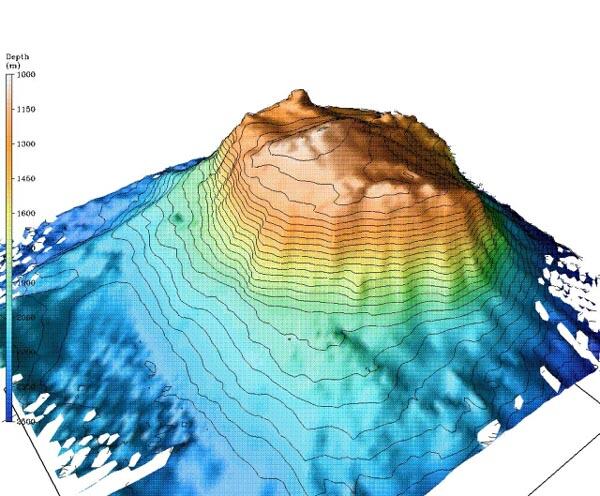
A seamount is a volcano that rises from the sea floor but does not reach the surface. A guyot is a seamount with a flat top.
| Seamount and guyot | What to remember |
|---|---|
| Seamount | An underwater mountain of volcanic origin with a pointed top |
| Guyot | A flat-topped seamount. Waves wore its top flat when it stood at sea level, and it later sank |
| Volcanic island | A seamount tall enough to rise above the sea. Hawaii is an example |
Ocean trench
A trench is a long, narrow and very deep trough. It forms where one plate sinks under another. Trenches are also called ocean deeps.
| Ocean trench | What to remember |
|---|---|
| Deepest trench (PYQ) | The Mariana Trench, in the Pacific Ocean |
| Deepest point | Challenger Deep, in the Mariana Trench, about 11,000 m deep |
| Deepest in the Atlantic | The Puerto Rico Trench |
| Deepest in the Indian Ocean | The Java (Sunda) Trench |
| Ocean with the most trenches | The Pacific |
| Beside a trench | A chain of volcanic islands or volcanic mountains |
Coral reefs and atolls
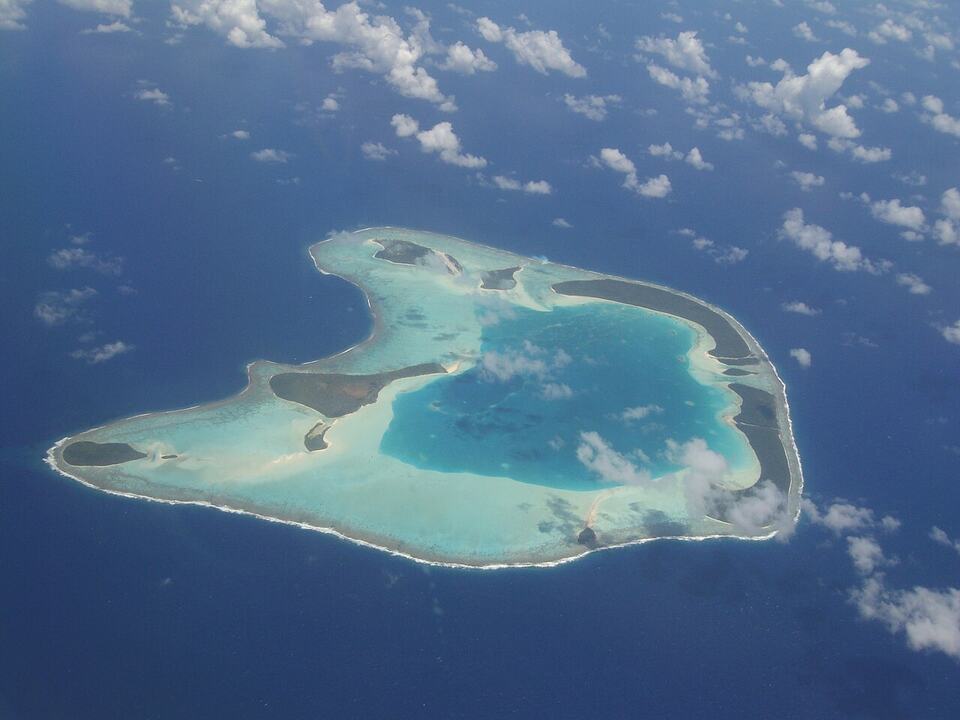
Coral reefs are built over thousands of years from the hard skeletons of tiny animals called coral polyps. They grow in warm, clear, shallow sea water.
| Coral reefs and atolls | What to remember |
|---|---|
| Corals need (PYQ) | Warm tropical water, sunlight, clear water and salt water. Most reefs are in tropical seas |
| Fringing reef | Grows close to the shore |
| Barrier reef | Lies farther out, with a lagoon between it and the shore |
| Atoll | A ring of coral around a lagoon |
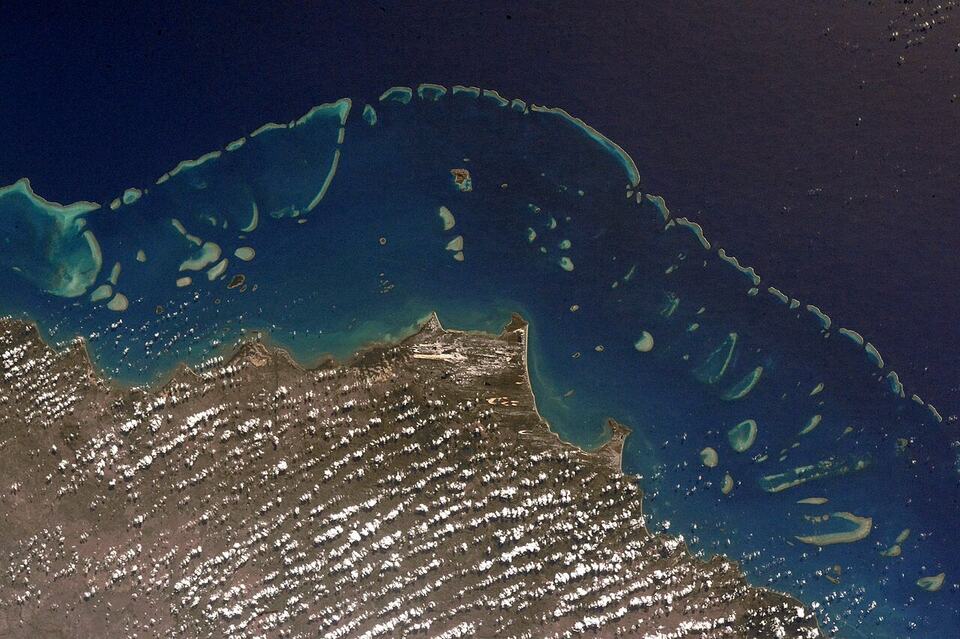
| Largest coral reef in the world (PYQ) | The Great Barrier Reef, off north-east Australia |
| In India | The Lakshadweep islands are coral atolls. Reefs also fringe the Andaman and Nicobar Islands, the Gulf of Mannar and the Gulf of Kachchh |
Oceans and sea water
The five oceans
All the oceans are joined into one world ocean. By size they are the Pacific, the Atlantic, the Indian, the Southern and the Arctic.
| The five oceans | What to remember |
|---|---|
| Largest and deepest | The Pacific Ocean. It covers about one third of the Earth |
| Second largest | The Atlantic Ocean, shaped like the letter S. It is the busiest ocean for trade |
| Third largest | The Indian Ocean, the only ocean named after a country |
| Southern Ocean | Surrounds Antarctica |
| Smallest and shallowest (PYQ) | The Arctic Ocean. It has the widest continental shelf |
| Deepest point on Earth (PYQ) | Challenger Deep in the Mariana Trench, Pacific Ocean |
Salinity of sea water
Sea water is salty because rivers have carried dissolved salts into the sea for millions of years, while evaporation takes away only fresh water.
| Salinity of sea water | What to remember |
|---|---|
| Salinity means (PYQ) | The amount of salt, in grams, dissolved in 1,000 grams of sea water |
| Average salinity of the oceans | About 35 parts per thousand |
| Commonest salt | Sodium chloride, the common salt |
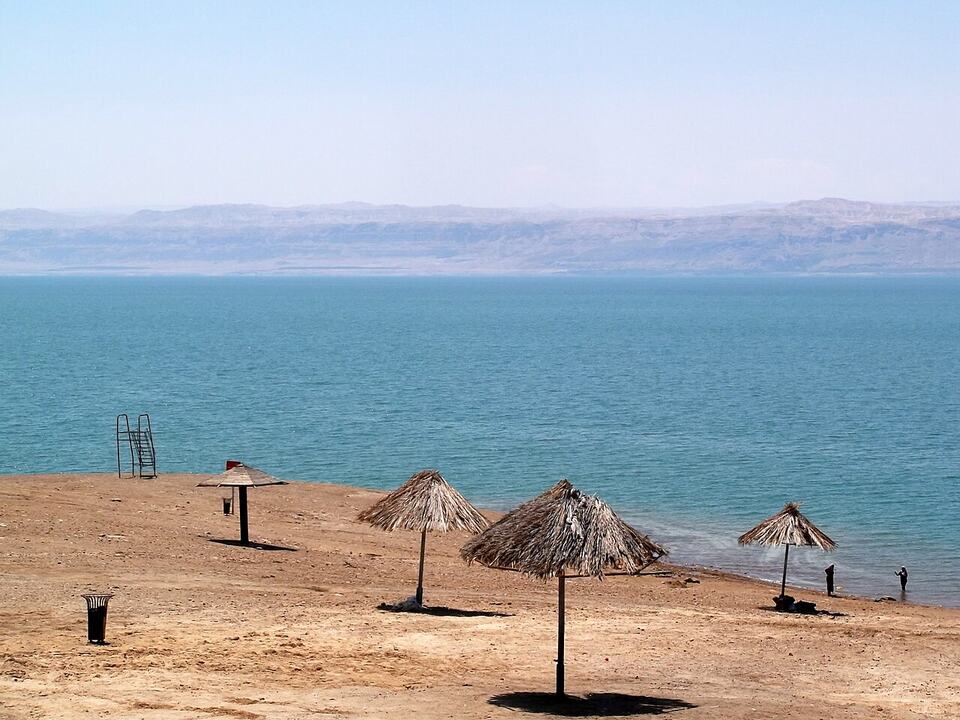
| Very high salinity (PYQ) | The Dead Sea, far saltier than the ocean |
| Where it is higher | In hot, dry regions with much evaporation and few rivers, such as the Red Sea |
| Where it is lower | Near the Equator (heavy rain), near river mouths and near melting ice |
Tides
Tides are the regular rise and fall of the sea, caused mainly by the pull of the Moon and partly by the Sun.
| Tides | What to remember |
|---|---|
| Cause | The gravitational pull of the Moon and the Sun |
| How often | Two high tides and two low tides in about 24 hours 50 minutes |
| Time between two high tides (PYQ) | About 12 hours 25 minutes |
| Spring tide | The highest tides, on full moon and new moon days, when the Sun, Moon and Earth are in a line |
| Neap tide | The lowest tides, at the half-moon phases, when the Sun and Moon pull at right angles |
| Highest tides in the world | The Bay of Fundy, Canada |
| Use | Tides help ships enter shallow ports and can be used to make electricity |
Ocean currents
Ocean currents
An ocean current is a stream of water flowing through the ocean in a fixed direction. Warm currents flow from the Equator toward the poles and cold currents from the poles toward the Equator.
| Ocean currents | What to remember |
|---|---|
| Caused by | The planetary winds, the rotation of the Earth, and differences in temperature and salinity |
| Direction | Clockwise in the northern hemisphere and anticlockwise in the southern hemisphere |
| Warm currents | Usually flow along the east coasts of continents in low latitudes |
| Cold currents | Usually flow along the west coasts of continents in low latitudes |
| So in the tropics (PYQ) | The western sides of the oceans are warmer than the eastern sides |
| Indian Ocean | Its northern currents reverse direction with the monsoon winds |
Warm currents
Warm currents carry warm water from the tropics toward the poles and raise the temperature of the coasts they pass.
| Warm currents | What to remember |
|---|---|
| Atlantic Ocean | Gulf Stream, North Atlantic Drift, Brazil Current, North and South Equatorial Currents |
| Pacific Ocean | Kuroshio (Japan) Current, North Pacific Current, East Australian Current, Alaska Current |
| Indian Ocean | Agulhas and Mozambique Currents, South Equatorial Current |
| Gulf Stream | Flows from the Gulf of Mexico along the east coast of the USA |
| North Atlantic Drift | Keeps the ports of western Europe free of ice in winter |
| Kuroshio | The warm current off Japan. Its name means black stream |
Cold currents
Cold currents bring cold water from polar seas toward the Equator. They cool the coasts and make them dry.
| Cold currents | What to remember |
|---|---|
| Atlantic Ocean | Labrador, Canary, Benguela, Falkland and East Greenland Currents |
| Pacific Ocean | Oyashio (Kurile), California and Humboldt (Peru) Currents |
| Indian Ocean | West Australian Current |
| Around Antarctica | The West Wind Drift, the largest current of all. It flows right round the world |
| Humboldt Current | The cold current off Peru and Chile. Its rich waters make Peru a great fishing country |
Effects of ocean currents
Currents change the climate of coasts and decide where the fish are. Where a warm and a cold current meet, plankton grows well and thick fog forms.
| Effects of ocean currents | What to remember |
|---|---|
| Grand Banks, Newfoundland | The warm Gulf Stream meets the cold Labrador Current: a famous fishing ground with dense fog |
| Off Japan | The warm Kuroshio meets the cold Oyashio: another great fishing ground |
| Deserts | Cold currents dry the coasts beside them: the Atacama (Humboldt Current) and the Namib (Benguela Current) |
| Warm coasts | The North Atlantic Drift gives western Europe mild winters |
| Sargasso Sea | A calm area in the North Atlantic ringed by currents, full of floating seaweed. It is a sea without a coast |
Quick questions
The questions exams ask most often, with short answers.
| Question | Answer |
|---|---|
| Which is the deepest point in the oceans? | Challenger Deep in the Mariana Trench, in the Pacific Ocean, about 11,000 m deep. |
| Which ocean has the widest continental shelf? | The Arctic Ocean. |
| What is salinity? | The amount of salt in grams dissolved in 1,000 grams of sea water. The ocean average is about 35. |
| Where is the Great Barrier Reef? | Off the north-east coast of Australia. It is the largest coral reef in the world. |
| Name two warm ocean currents. | The Gulf Stream in the Atlantic and the Kuroshio in the Pacific. |
| Name two cold ocean currents. | The Labrador Current in the Atlantic and the Humboldt (Peru) Current in the Pacific. |
| Why is the Grand Banks a rich fishing ground? | The warm Gulf Stream meets the cold Labrador Current there, so plankton and fish are plentiful. |
| What is the time gap between two high tides? | About 12 hours 25 minutes. |
| What is a guyot? | A flat-topped seamount. |
| Which is the largest ocean? | The Pacific Ocean. |
- Which is the deepest point in the oceans?
- Challenger Deep in the Mariana Trench, in the Pacific Ocean, about 11,000 m deep.
- Which ocean has the widest continental shelf?
- The Arctic Ocean.
- What is salinity?
- The amount of salt in grams dissolved in 1,000 grams of sea water. The ocean average is about 35.
- Where is the Great Barrier Reef?
- Off the north-east coast of Australia. It is the largest coral reef in the world.
- Name two warm ocean currents.
- The Gulf Stream in the Atlantic and the Kuroshio in the Pacific.
- Name two cold ocean currents.
- The Labrador Current in the Atlantic and the Humboldt (Peru) Current in the Pacific.
- Why is the Grand Banks a rich fishing ground?
- The warm Gulf Stream meets the cold Labrador Current there, so plankton and fish are plentiful.
- What is the time gap between two high tides?
- About 12 hours 25 minutes.
- What is a guyot?
- A flat-topped seamount.
- Which is the largest ocean?
- The Pacific Ocean.