State Government: Governor, Chief Minister and State Legislature
Part VI in simple words: how the Governor is appointed, his powers and discretion, the Chief Minister and Council of Ministers, Vidhan Sabha and Vidhan Parishad, and how Punjab's legislature works.
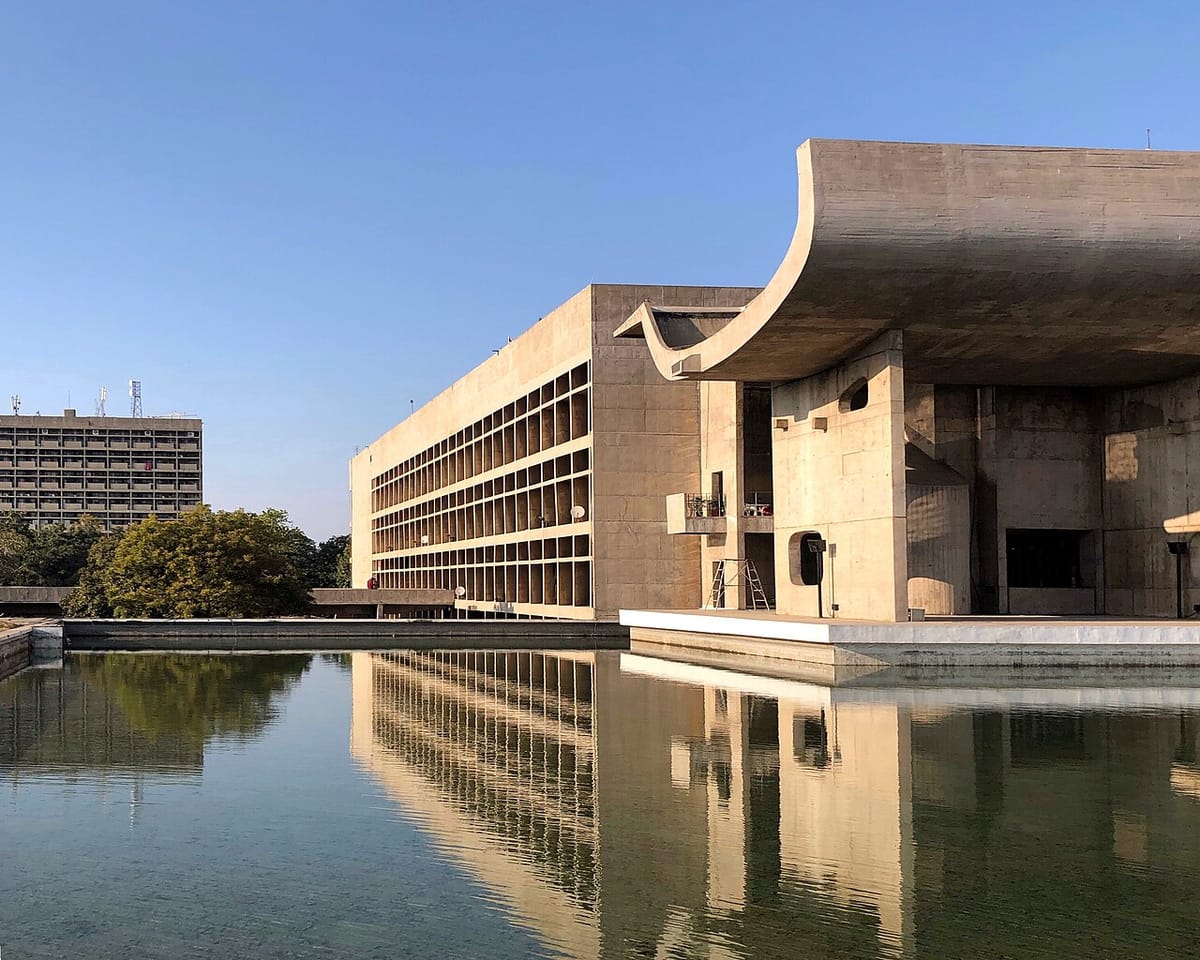
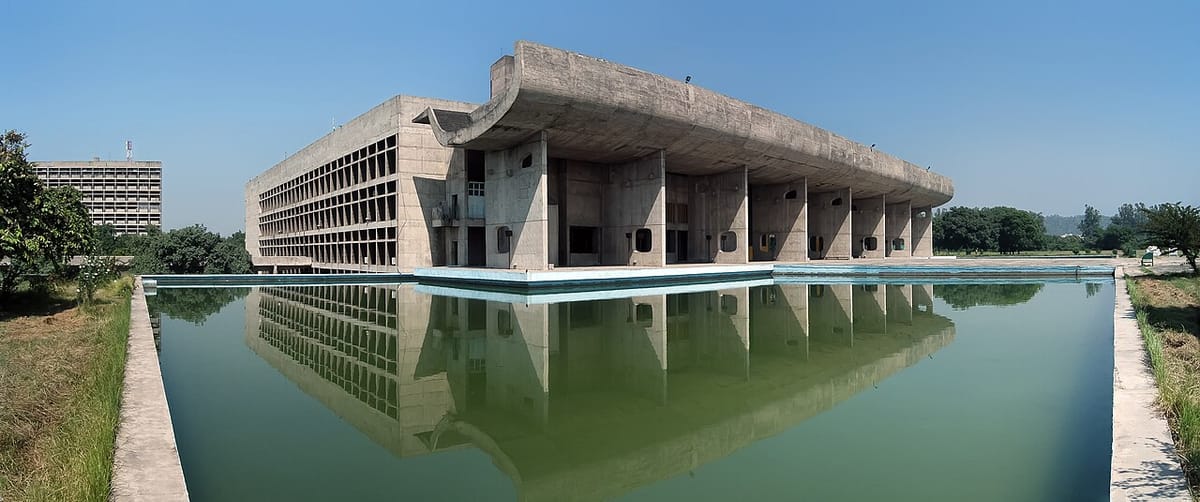
The Palace of Assembly, Capitol Complex, Chandigarh, designed by Le Corbusier. It houses the Punjab Vidhan Sabha (117 seats) and the Haryana Vidhan Sabha. Image: UnpetitproleX, 2021 · Wikimedia Commons · CC BY-SA 4.0
Every state is run on the same plan as the Union. The Governor is the head of the state, like the President. The Chief Minister runs the government, like the Prime Minister. The State Legislature makes the state's laws, like Parliament. All of this is in Part VI of the Constitution.
153–167
Articles
State executive
35
Governor's minimum age
Article 157
6
States with a Council
Vidhan Parishad
117
Punjab Vidhan Sabha
One House since 1970
The Governor: who and how
Appointed, not elected, and holds office at the President's pleasure.
Article 153 says there shall be a Governor for each state. The 7th Amendment (1956) allowed one person to be Governor of two or more states. The Governor is the nominal head of the state. Real power lies with the Chief Minister and the Council of Ministers.
The President is elected, but the Governor is appointed by the President (Article 155). In practice the Union government chooses. The Constituent Assembly preferred this because an elected Governor could clash with the elected Chief Minister.
Point
Rule
Appointment
By the President by warrant under his hand and seal (Article 155).
Term
5 years, but holds office during the pleasure of the President (Article 156).
Qualifications
Citizen of India, at least 35 years old (Article 157).
Conditions
Not a member of any legislature; no office of profit. Pay fixed by Parliament (Article 158).
Oath
Given by the Chief Justice of the state High Court (Article 159).
Resignation
Written to the President.
Removal
No impeachment. The President can remove or transfer him at any time.
The Governor at a glance
KEY TERM
During the pleasure of the President
The Governor's five-year term is not secure. The President, acting on Union advice, can remove him without giving a reason. The Supreme Court (B. P. Singhal case, 2010) said this power still cannot be used in an arbitrary way, for example just because a new party wins at the Centre.
President appoints→Five-year term→Can be removed any time→Not arbitrarily (2010 ruling)
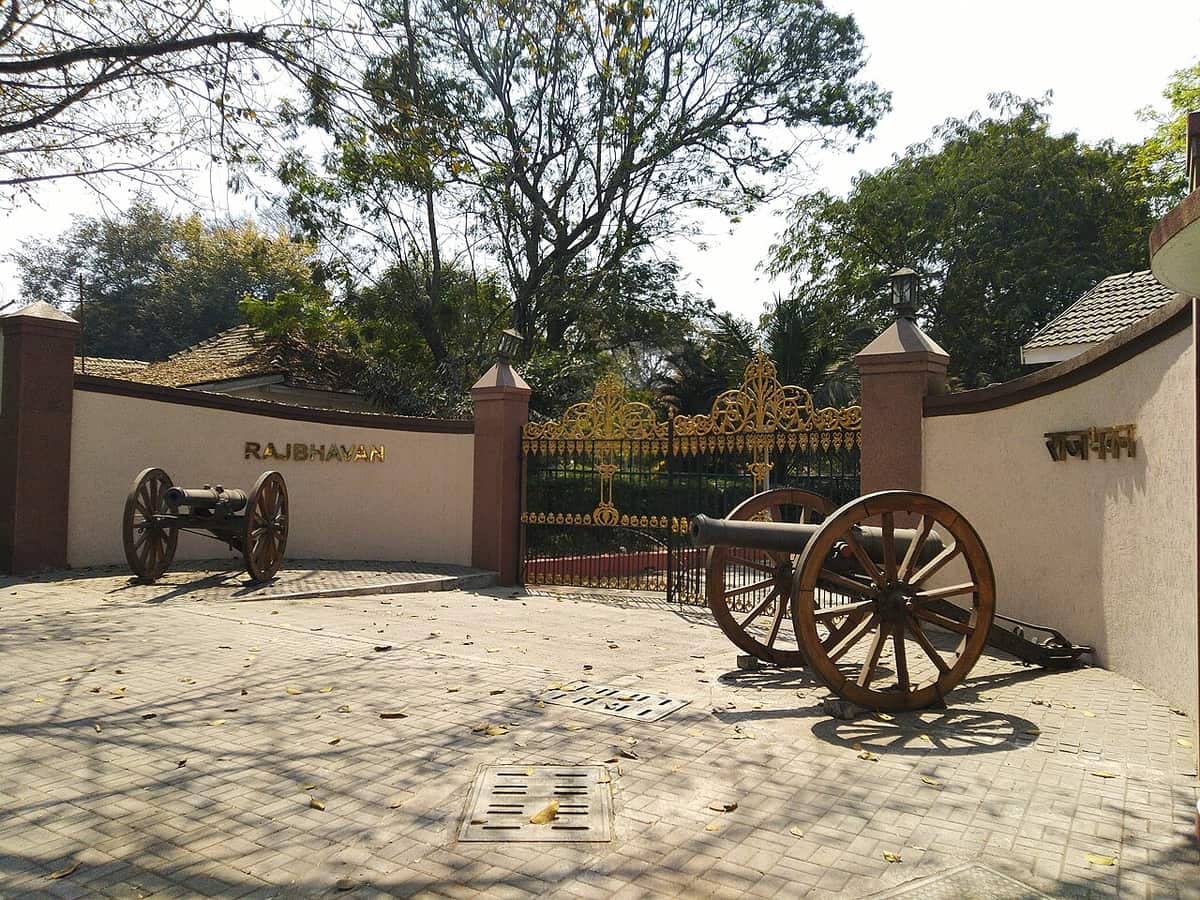
Entrance of Raj Bhavan, Pune, a residence of the Governor of Maharashtra. Each Governor lives and works in a Raj Bhavan. Article 159: the Governor's oath is given by the Chief Justice of the High Court. Image: DesiBoy101, 2023 · Wikimedia Commons · CC BY-SA 4.0
QUICK CHECK
PYQ · Punjab Police Constable 2025 In 2024, the Governor of Gujarat approved a bill to ban the sale of liquor in cities. Which Article of the Indian Constitution defines the office of the Governor?
Tap an option to answer
Answer: C — Article 153
Article 153 says there shall be a Governor for each state. Article 154 vests the state's executive power in him, Article 161 is his pardoning power and Article 200 is assent to bills.
QUICK CHECK
PYQ · Punjab Police SI 2023 Which of the following Constitutional Amendment Acts made it possible to appoint the same person as Governor for two or more states?
Tap an option to answer
Answer: A — Seventh
The 7th Amendment of 1956, which also reorganised the states, allowed one Governor for two or more states. PPSC PCSEB 2018 asked the same question.
QUICK CHECK
PYQ · Punjab Police SI 2023 In India, Who administers the oath or affirmation to the Governor?
Tap an option to answer
Answer: C — Chief Justice of High Court
Under Article 159 the Chief Justice of the state's High Court, or in his absence the senior-most judge there, gives the oath. Punjab Police SI 2023 (another shift) and PPSC SEVE 2016 asked the same.
The Governor's powers and discretion
Four kinds of power, plus a few decisions he takes on his own.
Executive
Appoints
The Chief Minister, other ministers, the Advocate General, the State Election Commissioner and State PSC members.
Legislative
Summons and assents
Summons and prorogues the legislature, dissolves the Assembly, gives assent to bills, issues ordinances (Article 213).
Financial
Money matters
No Money Bill or demand for grants without his recommendation. The state budget is laid in his name.
Judicial
Pardons
Can pardon, reprieve, respite, remit or commute sentences for offences against state law (Article 161).
Most of these powers are used on the advice of the Council of Ministers (Article 163).
WHAT HAPPENS TO A STATE BILL (ARTICLES 200 AND 201)
Bill passed by the legislature
It goes to the Governor.
↓
Governor's four choices
Assent, withhold assent, return it for reconsideration (not a Money Bill), or reserve it for the President.
↓
If returned and passed again
The Governor must assent.
↓
If reserved (Article 201)
The President may assent or withhold. He can ask the House to reconsider within 6 months, but even then he is not bound to assent.
A bill that would weaken the High Court's powers must be reserved for the President.
ARTICLE 163: WHERE THE GOVERNOR USES DISCRETION
The Council of Ministers aids and advises the Governor "except in so far as he is required … to exercise his functions … in his discretion". The President has no such clause. Common cases: reserving a bill for the President, reporting for President's Rule (Article 356), choosing a Chief Minister in a hung Assembly, and dismissing a ministry that has lost its majority. If a doubt arises whether a matter is discretionary, the Governor's decision is final (Article 163(2)).
PARDONING POWER: PRESIDENT VS GOVERNOR
President (Art. 72)
Governor (Art. 161)
Laws covered
Union laws
State laws
Court martial
Yes
No
Death sentence
Can pardon it
Can suspend, remit or commute; exam books say not pardon
Both can grant all five forms: pardon, commutation, remission, respite, reprieve.
QUICK FACT
Ordinances (Article 213): the Governor can issue one only when the legislature is not in session. It must be approved within 6 weeks of the House meeting again, or it lapses. Like the President's ordinance, it is issued on ministerial advice.
Court rulings and the 2025 assent debateTap to open
S. R. Bommai (1994): a ministry's majority must be tested on the floor of the House, not by the Governor's opinion.
B. P. Singhal (2010): the President may remove a Governor without reasons, but not arbitrarily.
Tamil Nadu case (April 2025): a two-judge bench set time limits for Governors to act on bills.
Presidential reference (November 2025): a five-judge bench said courts cannot fix deadlines and there is no "deemed assent". But long, unexplained delay can be reviewed by a court, which may ask the Governor to act.
The Sarkaria Commission (1988) said a Governor should be an eminent person from outside the state, not recently active in politics, chosen after consulting the Chief Minister. The Punchhi Commission (2010) suggested removing the words "during the pleasure of the President". Neither has been made law.
QUICK CHECK
PYQ · Punjab Police Constable 2025 In 2024, the West Bengal Assembly passed a law to improve school safety after a Kolkata building collapse. Which Article of the Indian constitution gives the Governor the power to approve such state laws?
Tap an option to answer
Answer: D — Article 200
Article 200 deals with the Governor's assent to state bills. Article 201 covers bills he reserves for the President. Article 171 is the Legislative Council's composition.
QUICK CHECK
PYQ · PPSC PRIN 2020 Consider the following statements about the Governor : I. He submits his resignation letter to the Chief Justice of the State. II. He should have completed 35 years of age. III. His emoluments, allowances and privileges are determined by the President. IV. No criminal proceedings can be instituted against him. Which of the statements given above are incorrect ?
Tap an option to answer
Answer: A — I and III
The Governor resigns to the President, and his pay is fixed by Parliament, so I and III are wrong. He must be 35, and while in office no criminal case can be started against him (Article 361).
The Chief Minister and Council of Ministers
Articles 163, 164 and 167: the real executive of the state.
The Chief Minister is the real head of the state government. Article 164 says the Governor appoints the Chief Minister, and the other ministers on the CM's advice. By convention the Governor appoints the leader the majority party's MLAs elect. If no one has a clear majority, the Governor uses discretion and may ask the new CM to prove his majority on the floor.
Point
Rule
Non-member minister
Must become an MLA or MLC within six months (Article 164(4)).
Answerable to
Collectively responsible to the Legislative Assembly (Article 164(2)).
Size
At most 15% of Assembly strength, but at least 12 (Article 164(1A), 91st Amendment).
Oath
Given by the Governor: oath of office and secrecy.
CM's duty
Tell the Governor all Cabinet decisions and give information he asks for (Article 167).
Tribal welfare minister
Must exist in Chhattisgarh, Jharkhand, Madhya Pradesh and Odisha.
Rules for the state Council of Ministers
PRIME MINISTER VS CHIEF MINISTER
Prime Minister
Chief Minister
Appointed by
President (Art. 75)
Governor (Art. 164)
Answerable to
Lok Sabha
Vidhan Sabha
Duty to inform
Article 78
Article 167
Ministry size
Up to 15%, no minimum
Up to 15%, minimum 12
If the CM dies or resigns, the whole state Council of Ministers ends with him.
QUICK FACT
Advocate General (Article 165): the state's top lawyer. Appointed by the Governor, must be qualified to be a High Court judge, and holds office at the Governor's pleasure. He can speak in the state legislature but cannot vote.
PYQ · Punjab Police Constable 2025 How is the Chief Minister of a state chosen after elections?
Tap an option to answer
Answer: D — The MLAs belonging to the ruling party elect their leader, who becomes the Chief Minister.
The majority party's MLAs choose their leader, and the Governor then formally appoints that leader under Article 164. People do not vote for the CM directly.
QUICK CHECK
PYQ · Punjab Police Constable 2024 According to the Indian Constitution, the number of members of the Council of Ministers, including the Chief Minister in a State, shall not be less than _______.
Tap an option to answer
Answer: B — 12
The 91st Amendment (2003) set a floor of 12 and a ceiling of 15% of Assembly strength for state ministries (Article 164(1A)).
QUICK CHECK
PYQ · Punjab Police Constable 2025 As per the Indian Constitution, to whom is the duty assigned to inform the Governor about all decisions taken by the Council of Ministers?
Tap an option to answer
Answer: C — Chief Minister
Article 167 makes this the Chief Minister's duty. PSSSB Jail Warder 2021 asked which Article covers the CM's duties: Article 167.
Also asked: when a CM dies, and the Governor's rankTap to open
QUICK CHECK
PYQ · PPSC PCSEB 2018 In the event of the death of a Chief Minister
Tap an option to answer
Answer: C — The council of ministers automatically stands dissolved
The Council exists only with its head. When the CM dies or resigns, the Council ends and the Governor must appoint a new CM. The same question came in the second PPSC PCSEB paper of 2018.
QUICK CHECK
PYQ · Punjab Police SI 2023 Which of the following holds the next position in rank and precedence? 1.President, 2. Vice- President, 3. Prime Minister, 4. ______________
Tap an option to answer
Answer: B — Governor of States within their respective States
In the Order of Precedence, Governors come fourth inside their own states, after the President, Vice-President and Prime Minister. Former Presidents and the Deputy PM come after them.
The State Legislature
Every state has a Vidhan Sabha; only six have a Vidhan Parishad.
Under Article 168, a state legislature is the Governor plus one or two Houses. The Legislative Assembly (Vidhan Sabha) is the lower House, directly elected. A few states also have a Legislative Council (Vidhan Parishad). Articles 168 to 212 cover the state legislature.
VIDHAN SABHA VS VIDHAN PARISHAD
Vidhan Sabha
Vidhan Parishad
Exists in
Every state
Six states
Members
60 to 500 (Art. 170)
40 to one-third of Assembly (Art. 171)
Chosen
Directly by people
Mostly indirectly; one-sixth nominated
Minimum age
25
30
Term
5 years; can be dissolved
Permanent; members 6 years
Money Bill
Starts only here
Can delay only 14 days
Small states are exceptions to the 60 minimum: Sikkim 32, Goa 40, Mizoram 40.
Council make-up: one-third elected by local bodies, one-third by MLAs, one-twelfth by graduates, one-twelfth by teachers, one-sixth nominated by the Governor.
One-third of Council members retire every 2 years.
On an ordinary bill the Council can only delay it: up to 3 months the first time and 1 month the second. There is no joint sitting in a state.
The Speaker decides whether a bill is a Money Bill. Money Bills cannot start in the Council (Article 198).
The gap between two sessions cannot be more than 6 months (Article 174).
CREATING OR ABOLISHING A LEGISLATIVE COUNCIL (ARTICLE 169)
State Assembly passes a resolution
By a majority of total membership and two-thirds of members present and voting.
↓
Parliament passes a law
By a simple majority. It is not treated as a constitutional amendment under Article 368.
↓
Council created or abolished
Example: Tamil Nadu abolished its Council in 1986; Punjab in 1970.
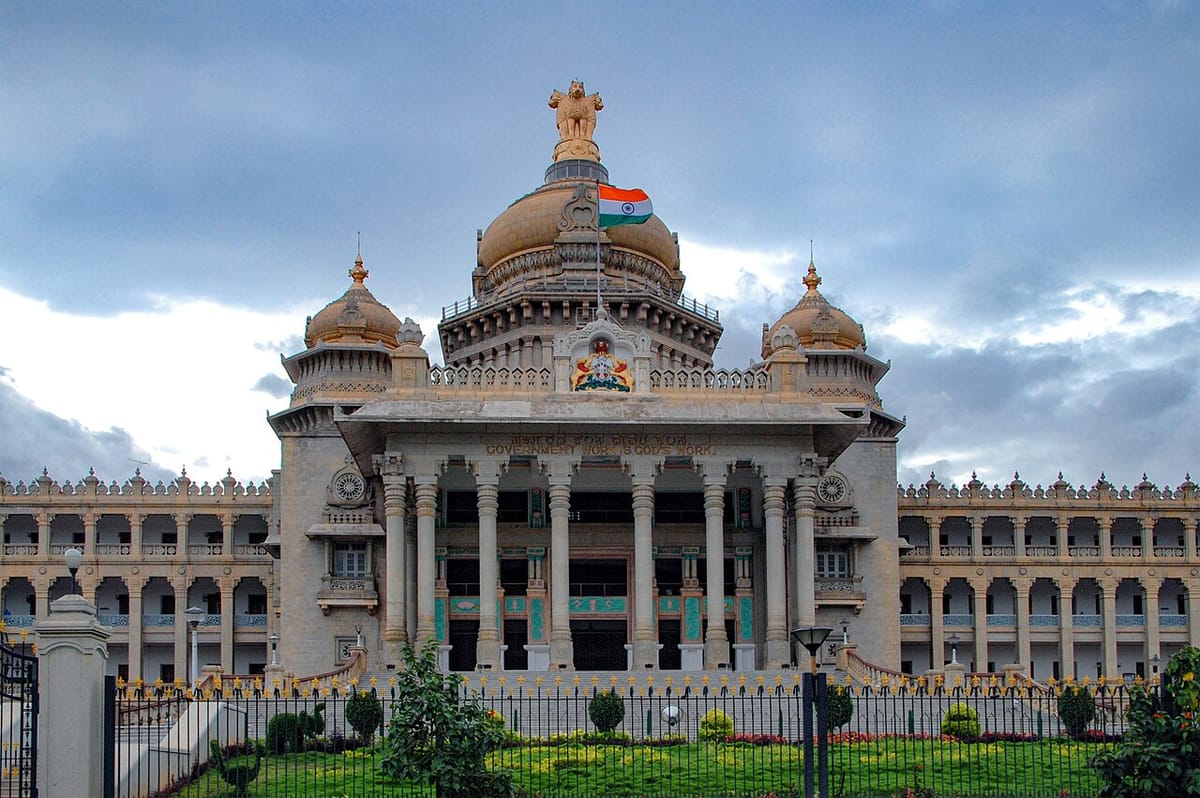
Vidhana Soudha, Bengaluru, seat of the Karnataka legislature. Karnataka is one of the six states with a Legislative Council: Andhra Pradesh, Bihar, Karnataka, Maharashtra, Telangana and Uttar Pradesh. Image: Moheen Reeyad · Wikimedia Commons · CC BY-SA 4.0
QUICK CHECK
PYQ · Punjab Police SI 2023 With reference to the State Legislative Assembly in India, which of the following statements is/are correct? 1. To become a member of the Legislative Assembly, a person must be 30 years of age. 2. The number of members of the Legislative Assembly cannot exceed 500. 3. The total number of members in the Legislative Council of a state should not be more than half the total members of the Legislative Assembly.
Tap an option to answer
Answer: C — Only 2
An MLA must be at least 25 (30 is for the Council), and the Council can be at most one-third of the Assembly, not half. Only the 500 limit is right. Punjab Police SI 2021 and 2023 also asked the 25/30 ages and the 60–500 range.
QUICK CHECK
PYQ · Punjab Police SI 2023 In India resolution for abolition or creation of Legislative Council has to be passed by a majority of not less than _________ of the members of the Assembly present and voting.
Tap an option to answer
Answer: B — two-third
Under Article 169 the Assembly's resolution needs two-thirds of members present and voting (and a majority of its total membership). Parliament then acts by a simple majority.
QUICK CHECK
PYQ · Punjab Police Constable 2025 Which of the following states does NOT have a Legislative Council (Vidhan Parishad)?
Tap an option to answer
Answer: D — Rajasthan
Rajasthan has only an Assembly. Bihar, Karnataka and Maharashtra are among the six states with a Council. Punjab Police SI 2023 asked it the other way round: Bihar has a bicameral legislature.
Punjab's government and legislature
One House, 117 seats, and a Governor with an extra job.
The Palace of Assembly seen across the Capitol Complex plaza. The Capitol Complex is part of Le Corbusier's works listed as a UNESCO World Heritage Site (2016). Image: duncid, 2006 · Wikimedia Commons · CC BY-SA 2.0
Punjab has a unicameral legislature: only the Vidhan Sabha, with 117 seats, 34 of them reserved for Scheduled Castes. Punjab once had a Legislative Council, but it was abolished on 1 January 1970. The Governor of Punjab also works as the Administrator of Chandigarh, the Union Territory that is the capital of both Punjab and Haryana.
PUNJAB'S LEGISLATURE SINCE 1952
1952
Two Houses
Punjab starts with a Vidhan Sabha and a Legislative Council.
1956
PEPSU merges
The Assembly grows as PEPSU joins Punjab.
1966
Reorganisation
Haryana is carved out; Punjab's Assembly shrinks.
1970
Council abolished
From 1 January 1970 Punjab has one House only.
1977
117 seats
The Vidhan Sabha reaches its present size of 117.
QUICK CHECK
PYQ · Punjab Police Constable 2021 The Upper House i.e. Legislative Council of Punjab was abolished on 1st January _____.
Tap an option to answer
Answer: D — 1970
Punjab's Legislative Council was abolished from 1 January 1970, so Punjab now has a one-House legislature.
QUICK CHECK
PYQ · Punjab Police SI 2016 How many seats are there in the Punjab Legislative assembly ?
Tap an option to answer
Answer: A — 117
The Punjab Vidhan Sabha has 117 seats, 34 of them reserved for Scheduled Castes. (Telangana's Assembly has 119.)
Everything on one look
Articles, numbers and the Union–state differences.
KEY NUMBERS
Governor: 35 years, 5-year term
State ministry: 15% cap, minimum 12
Assembly: 60 to 500; Council: 40 to one-third
Ages: MLA 25, MLC 30
Council: one-third retire every 2 years
Max gap between sessions: 6 months
KEY ARTICLES
153: a Governor for each state
155/156: appointment; pleasure of President
161: pardon; 163: advice and discretion
164: CM and ministers; 167: CM's duties
169: create or abolish a Council
200/201: assent and reservation; 213: ordinance
UNION VS STATE
Union
State
Head
President, elected
Governor, appointed
Removal of head
Impeachment
At President's pleasure
Discretion clause
None in Art. 74
Yes, Art. 163
Upper House
Rajya Sabha, always
Council in six states
Joint sitting
Yes (Art. 108)
No
COMMON TRAPS
The Governor is appointed by the President, not by the Union Cabinet or elected by MLAs.
The Governor's oath is given by the High Court Chief Justice, not the CJI or the President.
The Governor resigns to the President; his pay is fixed by Parliament.
One Governor for two or more states came with the 7th Amendment (1956).
MLA minimum age is 25; MLC is 30; Governor is 35.
A Council can be at most one-third of the Assembly, not half.
Article 169 needs the Assembly to act first; Parliament then uses a simple majority.
Punjab's Council was abolished in 1970; Punjab is unicameral.
There is no joint sitting in a state legislature.
QUICK BYTES
Part VI: the states
State executive: Articles 153–167
State legislature: Articles 168–212
Governor appointed by: the President
Governor's oath: High Court Chief Justice
Same Governor for 2+ states: 7th Amendment
Governor's discretion: Article 163
Assent to state bills: Article 200
Bills reserved for President: Article 201
Governor's ordinance: Article 213
CM's duties to Governor: Article 167
Advocate General: Article 165
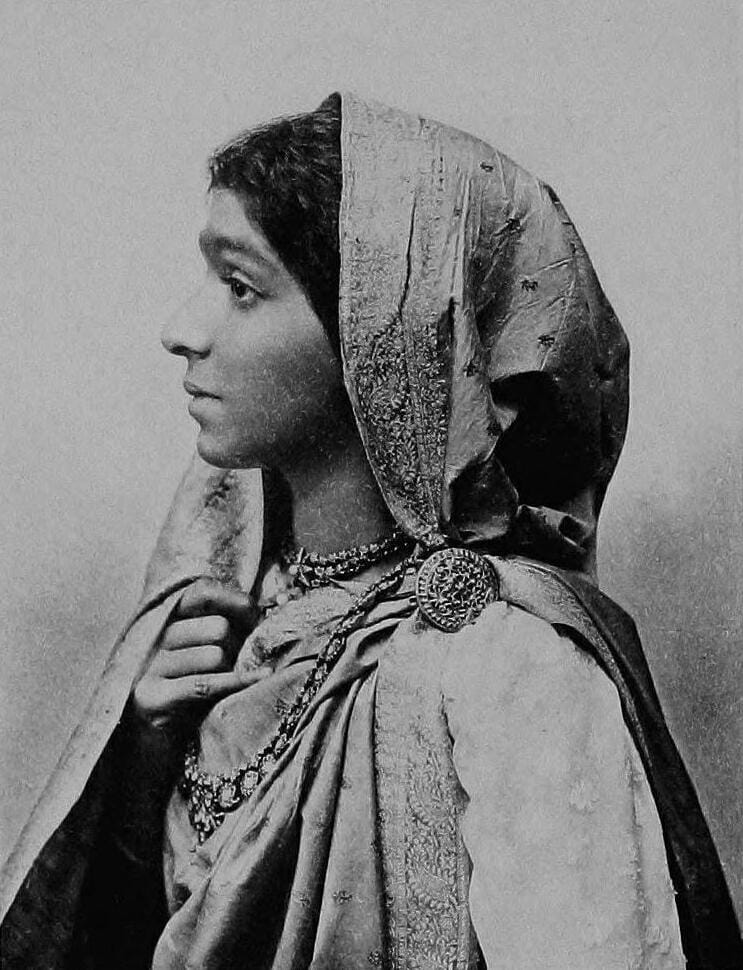
First woman Governor: Sarojini Naidu
First woman CM: Sucheta Kripalani
Punjab Vidhan Sabha: 117 seats
Punjab Council abolished: 1 January 1970
CHECK YOURSELF
A state Assembly passes a bill that cuts the powers of the High Court. The Governor also wants to return a Money Bill for changes. What can he do in each case?
Show answer
A bill that weakens the High Courtmust be reserved for the President under Article 200; the President then decides under Article 201. A Money Bill cannot be returned for reconsideration; the Governor can only assent, withhold assent or reserve it.
❧
Frequently Asked Questions
Who appoints the Governor of a state?
The President, under Article 155, by warrant under his hand and seal. In practice the Union government chooses the person. The Governor is not elected.
What is the term of a Governor?
Five years under Article 156. But he holds office during the pleasure of the President, so he can be removed or transferred earlier. There is no impeachment process for a Governor.
Who administers the oath to the Governor?
The Chief Justice of the High Court of that state, or in his absence the senior-most judge of that High Court. This is under Article 159.
What are the discretionary powers of the Governor?
Article 163 lets the Governor act on his own in some matters. These include reserving a bill for the President, reporting for President's Rule, choosing a Chief Minister in a hung Assembly, and dismissing a ministry that has lost its majority.
What can a Governor do with a bill passed by the state legislature?
Under Article 200 he can give assent, withhold assent, return it for reconsideration (except a Money Bill) or reserve it for the President. If a returned bill is passed again, he must assent.
Who appoints the Chief Minister?
The Governor, under Article 164. By convention he appoints the leader chosen by the majority party's MLAs. Other ministers are appointed on the Chief Minister's advice.
What is the minimum and maximum size of a state Council of Ministers?
At least 12 ministers, and at most 15% of the Legislative Assembly's total strength, including the Chief Minister. The 91st Amendment of 2003 added both limits.
Which states have a Legislative Council?
Six states: Andhra Pradesh, Bihar, Karnataka, Maharashtra, Telangana and Uttar Pradesh. All other states, including Punjab, have only a Legislative Assembly.
How is a Legislative Council created or abolished?
Under Article 169 the state Assembly must pass a resolution by a special majority. Parliament then passes a law by a simple majority. This is not counted as a constitutional amendment.
How many seats does the Punjab Vidhan Sabha have?
117 seats, of which 34 are reserved for Scheduled Castes. Punjab's legislature is unicameral because its Legislative Council was abolished on 1 January 1970.