Vice-President of India: Election, Role and Removal
Articles 63 to 71 in simple words: the Vice-President's two jobs, who votes in the election, who can stand, the oath, acting as President, and how removal works.
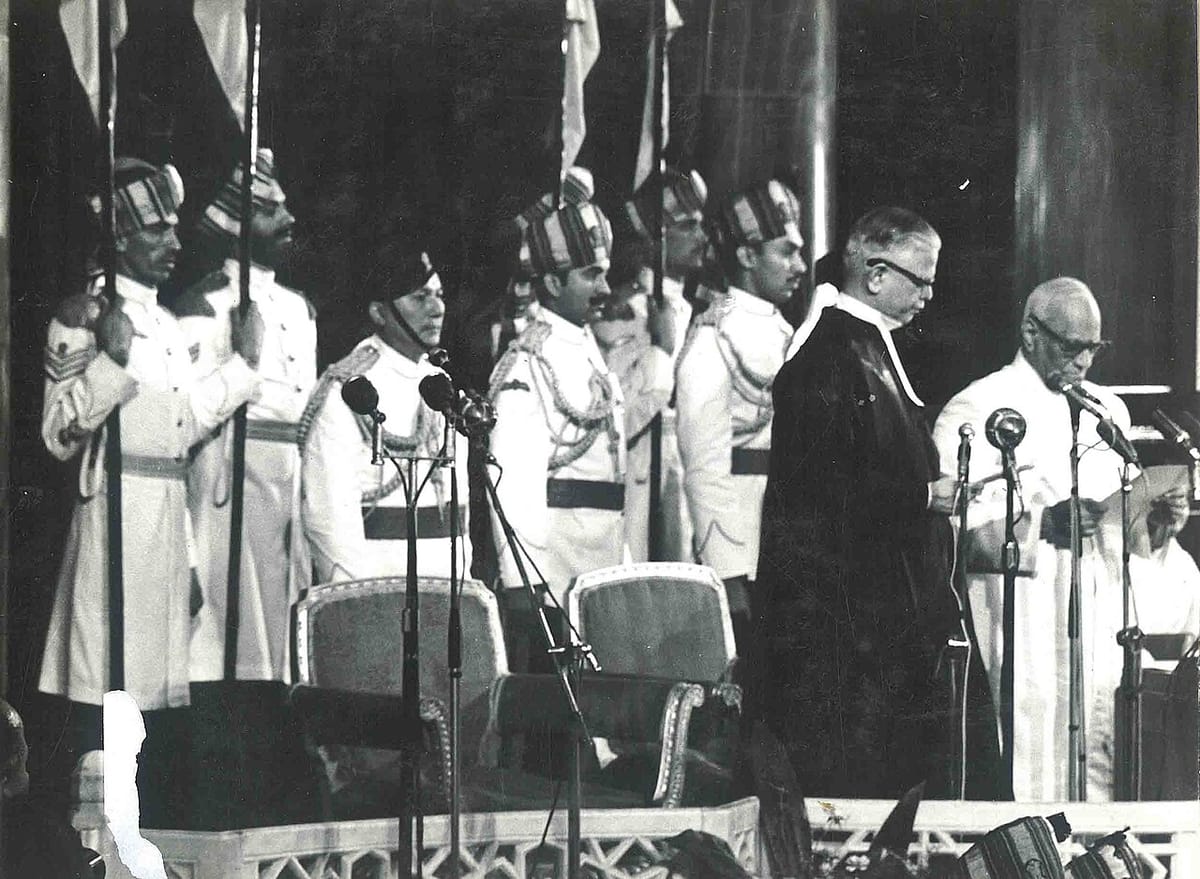
V. V. Giri is sworn in as President in Parliament House, 1969. He was Vice-President, acted as President after Zakir Husain died, resigned to contest the election, and won it. Image: President's Secretariat, 1969 · Wikimedia Commons · CC BY-SA 4.0
The Vice-President holds the second-highest office in India. The office has two jobs. Every day, the Vice-President runs the Rajya Sabha as its Chairman. When the President's office is empty, the Vice-President acts as President. The rules are in Articles 63 to 71.
63–71
Articles
Part V
35
Minimum age
Years
5
Term
Years
20 + 20
Nomination
Proposers + seconders
One office, two jobs
Chairman of the Rajya Sabha every day; President when needed.
Article 63 says there shall be a Vice-President of India. Article 64 makes the Vice-President the ex officio Chairman of the Rajya Sabha. "Ex officio" means the job comes with the office; there is no separate election for it. The Vice-President is part of the Union executive and ranks just after the President.
Article 64
Chairman of the Rajya Sabha
Runs its sittings, keeps order, decides who speaks, and has a casting vote in a tie. He is not a member of the House.
Article 65
Acting President
Takes over the President's work when the office is vacant, or when the President is ill or away.
No other office
No office of profit
Cannot hold any other paid post. His salary is paid as Chairman of the Rajya Sabha, not as Vice-President.
What the Vice-President does.
POWERS AS CHAIRMAN
As Chairman, his powers are like the Speaker's in the Lok Sabha. He decides on defection cases of Rajya Sabha members under the Tenth Schedule. A Deputy Chairman, elected by the Rajya Sabha, presides when he is absent. But only the Speaker, not the Chairman, certifies a Money Bill and presides over a joint sitting.
INDIAN VICE-PRESIDENT VS AMERICAN VICE-PRESIDENT
India
USA
Presides over
Rajya Sabha
Senate
If the President's post falls vacant
Acts as President till a new one is elected
Becomes President for the rest of the term
Longest time in the top chair
About 6 months
Up to the full remaining term
India's office was modelled on the American one, but our Vice-President only acts; he never simply succeeds.
PYQ · PPSC NE 2019 The Vice-President is the ex-officio Chairman of
Tap an option to answer
Answer: A — The Rajya Sabha
Article 64 makes the Vice-President the ex officio Chairman of the Rajya Sabha. The Prime Minister heads NITI Aayog. PPSC RO 2019 and TA 2019 asked the same question.
QUICK CHECK
PYQ · Punjab Police SI 2016 The Chairman of Rajya Sabha is elected by
Tap an option to answer
Answer: B — Members of Lok Sabha and Rajya Sabha
The Chairman is the Vice-President, who is elected by all members of both Houses, nominated members included. The Rajya Sabha alone elects only its Deputy Chairman.
QUICK CHECK
PYQ · PSSSB Patwari 2016 The Union executive of the Govt. of India consists of :
Tap an option to answer
Answer: B — the President, the Vice-President, and the Council of Ministers with the Prime Minister as the head to aid and advise the President
The Union executive (Part V, Chapter I) covers the President, the Vice-President, the Prime Minister with the Council of Ministers, and the Attorney General. The Chief Justice belongs to the judiciary.
Order of precedenceTap to open
The Table of Precedence fixes the order of rank of high officials. It is issued by the President's Secretariat, not the Prime Minister's Office. The top three are the President, the Vice-President and the Prime Minister, in that order. Governors come next, within their own states.
QUICK CHECK
PYQ · PPSC PCSEB 2018 Choose the correct statement: Statement I: PMO (Prime Minister's office) deals with the Table of Precedence of rank and order of the officials of Union and State Governments. Statement II: Prime Minister takes precedence after the President, the Chief Justice of India and the Vice-President.
Tap an option to answer
Answer: C — Both Statement I and II are false
The PMO does not issue the Table of Precedence. And the Prime Minister comes third, right after the President and the Vice-President, not after the Chief Justice.
How the Vice-President is elected
Only MPs vote, and nominated MPs count too.
Under Article 66, the Vice-President is elected by an electoral college of all members of both Houses of Parliament. This includes nominated members. MLAs take no part. Voting is by proportional representation through the single transferable vote, by secret ballot. Every MP's vote has the same value.
WHO VOTES: PRESIDENT VS VICE-PRESIDENT
President
Vice-President
Elected MPs
Yes
Yes
Nominated MPs
No
Yes
Elected MLAs
Yes
No
Vote values
Weighted by population
All equal
Nomination needs
50 + 50
20 + 20
Remember it as opposites: nominated MPs vote only for the Vice-President; MLAs vote only for the President.
QUICK FACT
At first, the Vice-President was elected at a joint meeting of both Houses. The 11th Amendment (1961) changed this to an electoral college. The same amendment says an election cannot be challenged just because some seats in the electoral college were vacant.
The Election Commission conducts the election. All doubts and disputes about it are decided by the Supreme Court (Article 71), and its decision is final. If the Court cancels an election, the acts done by that Vice-President before the judgment remain valid.
QUICK CHECK
PYQ · PSSSB Patwari 2016 The Vice-President of India is elected by :
Tap an option to answer
Answer: A — Members of an electoral college consisting of both Houses of Parliament in accordance with the system of proportional representation by means of single transferable vote
Article 66 gives exactly this: members of both Houses, single transferable vote, secret ballot. State assemblies are not part of it. PSCB Manager 2021 asked the same idea (answer: members of the Rajya Sabha and the Lok Sabha).
QUICK CHECK
PYQ · PPSC DDSWO 2023 Consider the following statements about the Electoral College for the President and Vice-President of India: 1. It consists of both elected and nominated members of parliament in case of the President. 2. It consists of only elected members of parliament in case of the President. 3. It does not include members of the state legislature assemblies in case of the Vice President. 4. It consists of both elected and nominated members of parliament in case of the Vice President. Which of the following statements are true?
Tap an option to answer
Answer: C — 2, 3 and 4 only
Statement 1 is wrong: nominated MPs do not vote for the President. Statements 2, 3 and 4 are right: only elected MPs vote for the President, while all MPs (and no MLAs) vote for the Vice-President.
QUICK CHECK
PYQ · Punjab Police Constable 2024 All doubts and disputes in connection with the election of the Vice-President are inquired into and decided by the ___________, whose decision is final.
Tap an option to answer
Answer: D — Supreme Court of India
Article 71 gives the Supreme Court the final word on disputes about the election of the President or Vice-President.
Qualifications, term and oath
Fit for the Rajya Sabha, sworn in by the President.
Rule
Detail
Article
Citizen
Must be a citizen of India
66
Age
At least 35 years
66
Rajya Sabha test
Must be qualified to become a Rajya Sabha member
66
No office of profit
Cannot hold a paid government post
66
No seat in a House
An MP or MLA who wins loses that seat on taking office
66
Term
5 years; stays on until the successor takes over
67
Resignation
Written to the President
67
Oath
Taken before the President (or a person he appoints)
69
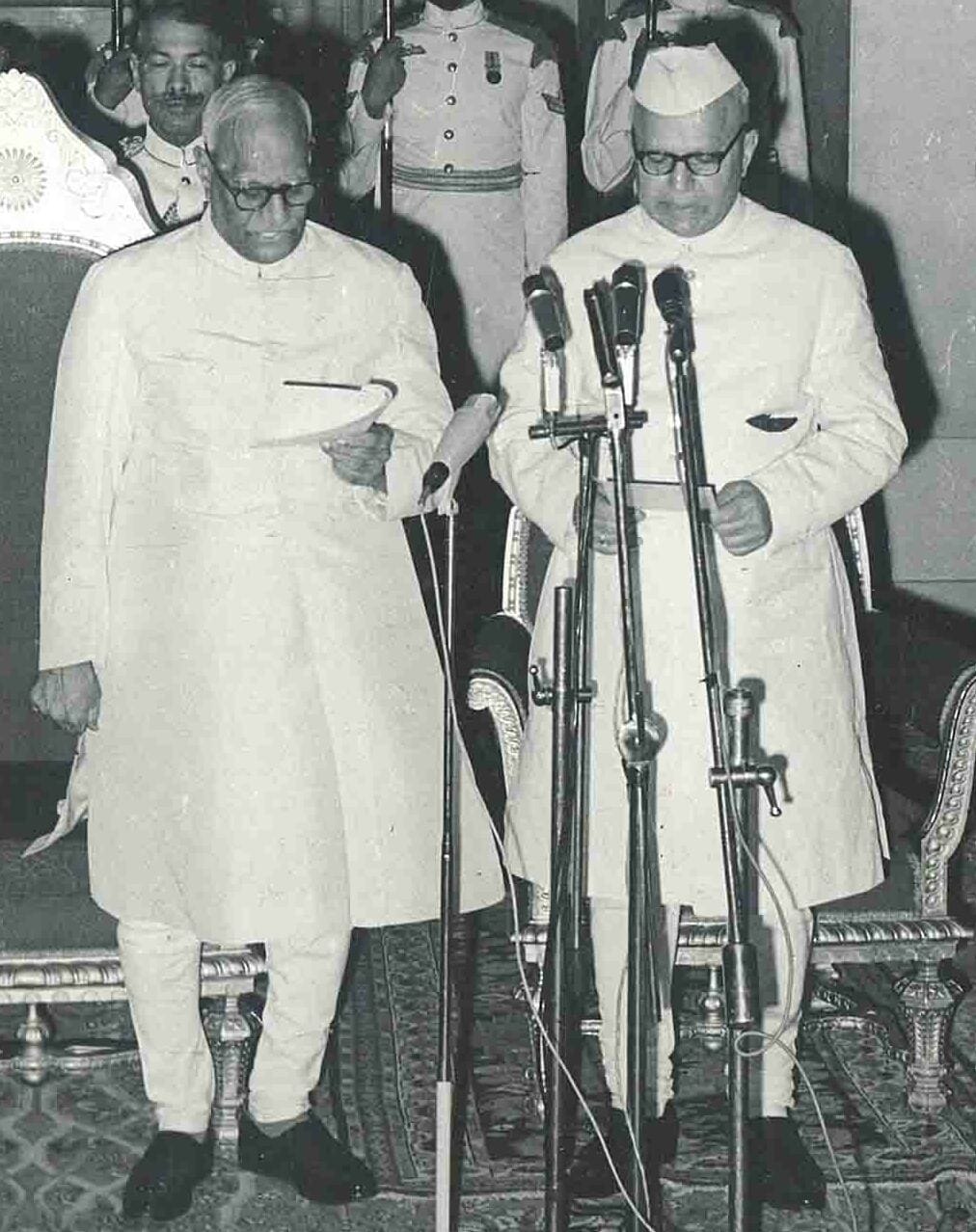
President V. V. Giri gives the oath of office to the new Vice-President G. S. Pathak at Rashtrapati Bhavan, 1969. The President swears in the Vice-President (Article 69). Image: President's Secretariat, 1969 · Wikimedia Commons · CC BY-SA 4.0
REMEMBER
Cross-over rule. The President must be fit for the Lok Sabha; the Vice-President for the Rajya Sabha (the House he will run). The Chief Justice swears in the President; the President swears in the Vice-President. The President resigns to the Vice-President; the Vice-President resigns to the President.
If the post falls vacant through death, resignation or removal, a new election is held as soon as possible (Article 68). The person elected gets a full five-year term from the day he takes office, not just the rest of the old term.
QUICK CHECK
PYQ · PPSC DSSO 2018 Which of the following statements about the Vice President of India are not correct? I. In order to be Vice President, a person must be qualified for election as a member of Lok Sabha. II. A member of the State Legislative Assembly can seek election to that office. III. The term of the office of the Vice President is the same as that of the President. IV. He can be removed through a formal impeachment. Select the correct answer using the code given below:
Tap an option to answer
Answer: C — I and IV
I is wrong: he must be fit for the Rajya Sabha. IV is wrong: there is no formal impeachment, only a Rajya Sabha resolution. II and III are right: an MLA can stand (and gives up his seat if he wins), and both terms are 5 years. The same question came in PPSC MBP, SCIAT, SECO and SUPH 2018.
QUICK CHECK
PYQ · PPSC ICS 2016 Who among the following is not appointed by the President of India?
Tap an option to answer
Answer: D — The Vice-President of India
The Vice-President is elected by the members of Parliament, not appointed. The President appoints Governors and the Chief Justices of the Supreme Court and High Courts.
Acting as President, and removal
Standing in for the President, and how the office can be ended early.
TWO WAYS THE VICE-PRESIDENT STEPS IN (ARTICLE 65)
Vacancy
President unable to work
When
President dies, resigns or is removed
President is ill, away or unable for another reason
Vice-President
Acts as President
Discharges the functions of the President
Until
A new President takes office (election within 6 months)
The President resumes work
In both cases he gets the President's powers and salary. He does not chair the Rajya Sabha then; the Deputy Chairman does.
If the offices of both the President and the Vice-President are empty, the Chief Justice of India acts as President. If he too is not available, the senior-most Supreme Court judge does. This comes from a law Parliament made in 1969.
THE FIRST SIX VICE-PRESIDENTS
1
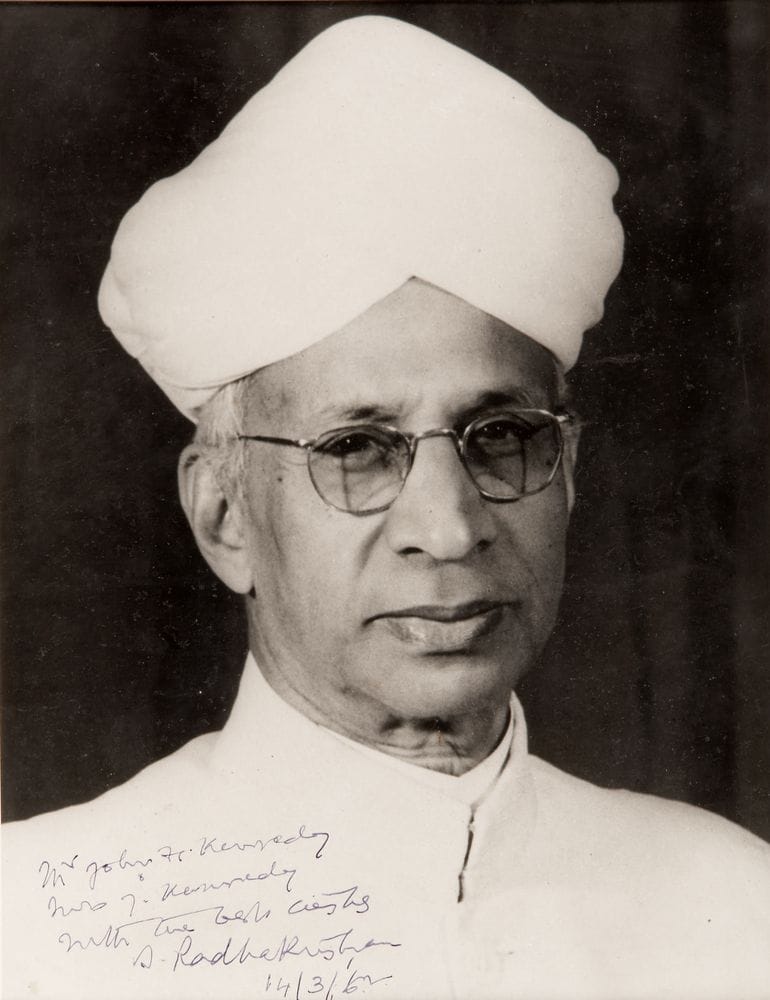
S. Radhakrishnan
1952–1962 · First Vice-President; later President
│
2
Zakir Husain
1962–1967 · Later President
│
3
V. V. Giri
1967–1969 · Acting President in 1969; then elected President
│
4
G. S. Pathak
1969–1974 · Sworn in by President Giri
│
5
B. D. Jatti
1974–1979 · Acting President in 1977 after Fakhruddin Ali Ahmed died
│
6
M. Hidayatullah
1979–1984 · Earlier Chief Justice; had acted as President in 1969
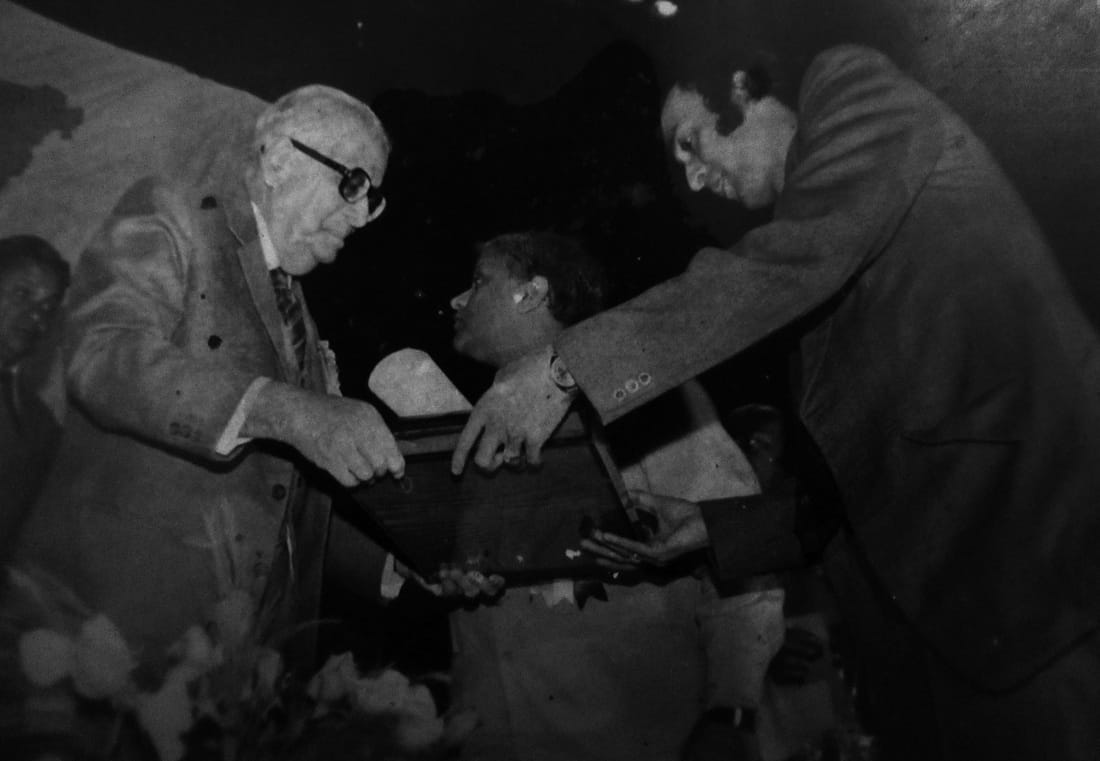
A succession list, not a family. Six Vice-Presidents later became President: Radhakrishnan, Zakir Husain, Giri, R. Venkataraman, Shankar Dayal Sharma and K. R. Narayanan.Vice-President Mohammad Hidayatullah presents an award, 1982. He is the only person to have been Chief Justice, acting President (1969) and Vice-President. Image: Soulmoksha, 1982 · Wikimedia Commons · CC BY-SA 4.0
HOW A VICE-PRESIDENT IS REMOVED (ARTICLE 67)
Rajya Sabha
Notice in the Rajya Sabha
At least 14 days' notice of the resolution. It can start only in the Rajya Sabha.
↓
Rajya Sabha
Rajya Sabha passes it
By an effective majority: a majority of all the then members of the House.
↓
Lok Sabha
Lok Sabha agrees
By a simple majority of members present and voting.
↓
Result
Removed
The Vice-President leaves office. No ground has to be proved.
While a resolution for his removal is being considered, he does not preside over the Rajya Sabha (Article 92).
REMOVAL IS NOT IMPEACHMENT
The Constitution gives no ground for removing a Vice-President, and calls it removal, not impeachment. Compare the President: impeachment needs violation of the Constitution and two-thirds of the total membership in both Houses. For the Vice-President, the resolution must begin in the Rajya Sabha, and the Lok Sabha only has to agree.
QUICK CHECK
PYQ · PPSC DSSO 2018 In the event of a vacancy in the offices of both the President and the Vice President of India, the person who performs the duty of a President is
Tap an option to answer
Answer: B — The Chief Justice of India
Under the 1969 law, the Chief Justice of India (or the senior-most Supreme Court judge) acts when both offices are vacant. This happened in 1969, when Chief Justice Hidayatullah acted. PPSC MBP, SCIAT, SECO and SUPH 2018 asked the same question.
QUICK CHECK
PYQ · PPSC OHE 2016 The resolution of removing the Vice-President can be moved in the
Tap an option to answer
Answer: D — Rajya Sabha
Article 67(b): the resolution is moved in the Rajya Sabha, passed by an effective majority there, and then agreed to by the Lok Sabha. PPSC PRIN 2020 asked the same question.
Everything on one look
Articles, numbers and the traps examiners set.
Article
What it says
63
There shall be a Vice-President of India
64
Ex officio Chairman of the Rajya Sabha
65
Acts as President in a vacancy or absence
66
Election and qualifications
67
Term, resignation and removal
68
Filling a vacancy
69
Oath before the President
70
President's functions in other cases
71
Election disputes decided by the Supreme Court
Articles at a glance
KEY NUMBERS
Minimum age: 35
Term: 5 years, re-election allowed
Nomination: 20 proposers + 20 seconders
Removal notice: 14 days, in the Rajya Sabha
Acting President: until a new President, at most about 6 months
11th Amendment (1961): electoral college instead of joint meeting
FIRSTS AND ONLYS
First Vice-President: S. Radhakrishnan (1952)
Two full terms: Radhakrishnan and Hamid Ansari
Only one to die in office: Krishan Kant (2002)
Acting Presidents: V. V. Giri (1969), B. D. Jatti (1977)
Chief Justice, acting President and Vice-President: M. Hidayatullah
Vice-Presidents who became President: six
COMMON TRAPS
MLAs do not vote for the Vice-President; only MPs do.
Nominated MPs can vote for the Vice-President, but not for the President.
The Vice-President must be fit for the Rajya Sabha, not the Lok Sabha.
The President, not the Chief Justice, gives the Vice-President his oath.
The Vice-President resigns to the President.
Removal starts only in the Rajya Sabha, needs no ground, and is not a formal impeachment.
The Rajya Sabha needs an effective majority; the Lok Sabha a simple majority.
While acting as President, he does not chair the Rajya Sabha.
The Chairman is not a member of the Rajya Sabha; the Deputy Chairman is.
QUICK BYTES
Vice-President: Articles 63–71
Second in the order of precedence
Model borrowed from: USA
Ex officio Chairman of: Rajya Sabha
Elected by: all MPs (elected and nominated)
Method: single transferable vote
Conducted by: Election Commission
Disputes decided by: Supreme Court
Qualification: fit for the Rajya Sabha
Oath given by: the President
Resignation to: the President
Removal begins in: Rajya Sabha
Both offices vacant: Chief Justice acts
First Vice-President: S. Radhakrishnan
CHECK YOURSELF
A President dies in office. Who takes over, for how long, and who chairs the Rajya Sabha in the meantime?
Show answer
The Vice-President acts as President (Article 65) until a newly elected President takes office. The election must be held within 6 months. During this time the Vice-President has the President's powers and salary, and the Deputy Chairman chairs the Rajya Sabha.
❧
Frequently Asked Questions
Who elects the Vice-President of India?
All members of both Houses of Parliament, including nominated members (Article 66). Members of state Legislative Assemblies take no part. Voting is by the single transferable vote and secret ballot.
What is the main role of the Vice-President?
The Vice-President is the ex officio Chairman of the Rajya Sabha and runs its sittings. When the President's office is vacant, or the President cannot work, the Vice-President acts as President.
What are the qualifications for Vice-President?
The person must be a citizen of India, at least 35 years old, and qualified to be a Rajya Sabha member. He must not hold any office of profit under a government.
Who administers the oath to the Vice-President?
The President, or a person appointed by the President (Article 69). The President, in turn, takes the oath before the Chief Justice of India.
How is the Vice-President removed?
By a resolution moved only in the Rajya Sabha after 14 days' notice, passed by an effective majority there and agreed to by the Lok Sabha. No ground is laid down, and it is not a formal impeachment.
How long can the Vice-President act as President?
Only until a new President is elected and takes office. The election to fill a vacancy must be held within six months, so the acting period is at most about six months.
Does the Vice-President chair the Rajya Sabha while acting as President?
No. The Deputy Chairman presides over the Rajya Sabha during that time. The Vice-President gets the President's salary, not the Chairman's.
Who acts as President if both the President and Vice-President posts are vacant?
The Chief Justice of India, and if he is not available, the senior-most judge of the Supreme Court. Chief Justice M. Hidayatullah did this in 1969.
Who was the first Vice-President of India?
Sarvepalli Radhakrishnan, from 1952 to 1962. He served two full terms and then became the second President of India.
What is the difference between the President's and the Vice-President's election?
The President is elected by elected MPs and elected MLAs, with weighted votes. The Vice-President is elected only by MPs, both elected and nominated, and every vote has the same value.
Now sit the questions they actually set
Previous-year PPSC questions on this topic, free to read with the worked answer.