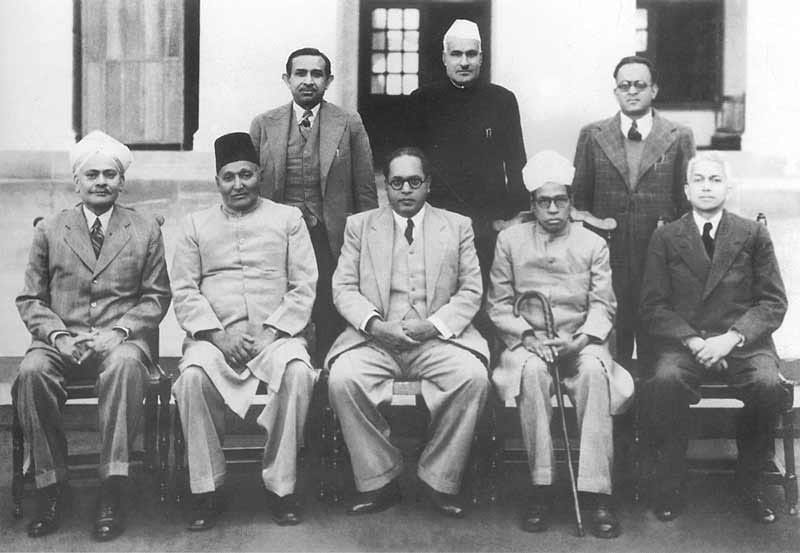
A constitution is the basic rulebook of a country. It says who will govern, how they are chosen, and what they can never do to the people. India's Constitution was written by Indians themselves, in the Constituent Assembly, between 1946 and 1949. It was adopted on 26 November 1949 and came into force on 26 January 1950.
Why India needed its own Constitution
From British Acts to the demand for an Assembly.
Under British rule, India was run by Acts passed in London. Each Act gave Indians a little more say. But the British always kept the final power. Indians could advise. They could not decide.
- 1773Regulating Act
First step by the British Parliament to control the East India Company.
- 1858Government of India Act
After the Revolt of 1857, the Crown took over from the Company.
- 1909Morley-Minto Reforms
Separate electorates for Muslims.
- 1919Montagu-Chelmsford Reforms
Dyarchy in the provinces; a two-house central legislature.
- 1935Government of India Act
Federal plan, three lists of subjects, provincial autonomy. The biggest single source of our Constitution.
- 1947Indian Independence Act
India became free on 15 August 1947. The Constituent Assembly became a sovereign body.
Each of these Acts is explained in detail on the Modern History page on the Government of India Acts. For this topic, remember just one link: much of our Constitution's structure came from the Act of 1935.
So the demand grew: Indians must write India's Constitution themselves. The idea of a Constituent Assembly for India was first put forward by M. N. Roy in 1934. The Congress made it an official demand in 1935.
Britain accepted that Indians could frame their own constitution, but only after the war.
Offered an elected body to frame a constitution, but let any province stay out. Rejected.
Fixed exactly how the Constituent Assembly would be formed. This plan worked.
Britain moved step by step during the Second World War. The Cabinet Mission plan is the one that finally set up the Assembly.
The Constituent Assembly
How it was formed, who led it, and who stayed away.
The Assembly was formed in 1946 under the Cabinet Mission plan. Its members were not elected directly by the people. In 1946 only a small part of adults could vote. So the members of the provincial assemblies chose the members of the Constituent Assembly. This is called indirect election.
People voted for the provincial assemblies. Those members then elected the Constituent Assembly members by proportional representation using the single transferable vote. Seats were shared by population, about one seat per ten lakh people. In each province they were divided among General and Muslim voters, and in Punjab also Sikh voters. Princely states sent members nominated by their rulers.
| Group | Seats |
|---|---|
| Governors' provinces (British India) | 292 |
| Chief Commissioners' provinces | 4 |
| Princely states | 93 |
| Total | 389 |
In the 1946 elections, the Congress won most seats and the Muslim League came second. But the League boycotted the Assembly. After Partition in 1947, members from the areas that went to Pakistan left. The strength fell from 389 to 299.
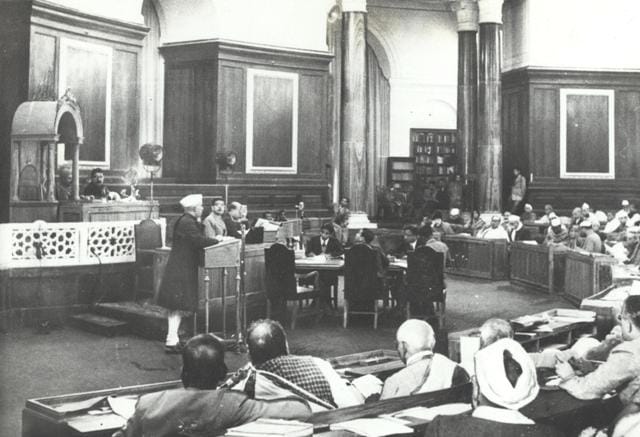
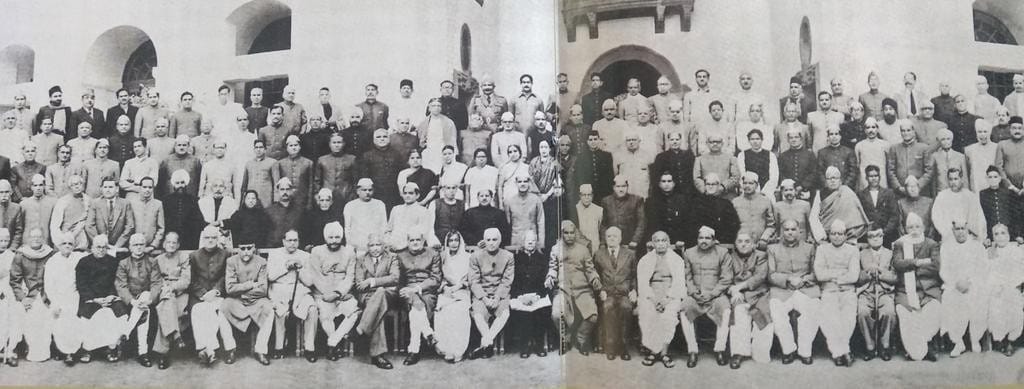
The first sitting was held on 9 December 1946 in New Delhi. Sachchidananda Sinha, the oldest member, became the temporary President. This custom was taken from France. On 11 December 1946, Rajendra Prasad was elected the permanent President. H. C. Mukherjee and V. T. Krishnamachari were the two Vice-Presidents.
S before P: Sinha Starts (9 December, temporary), Prasad is Permanent (11 December).
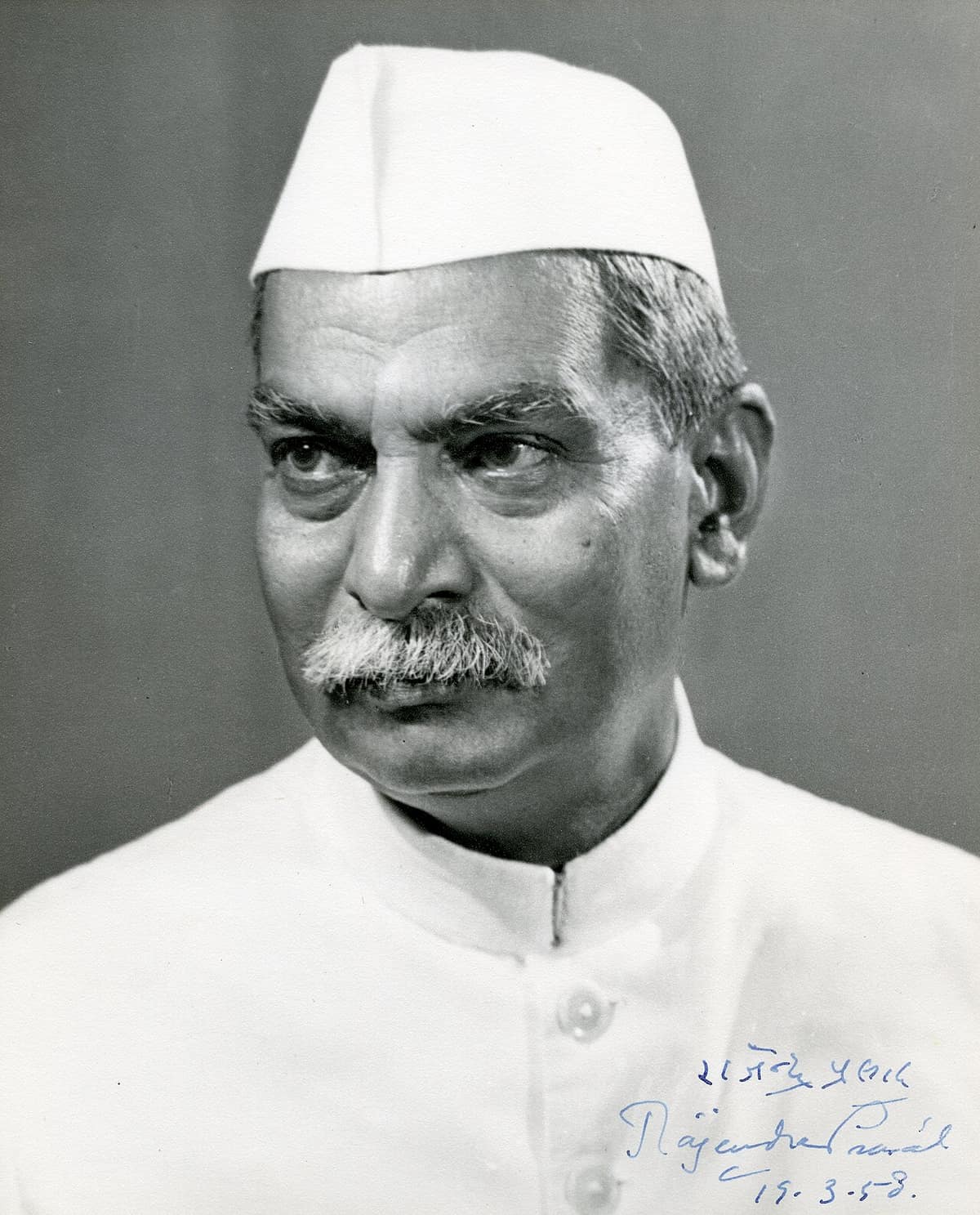
- Elected on 11 December 1946
- Elected first President of India by the Assembly on 24 January 1950
- Oldest member
- Chaired the first sitting, 9 December 1946
- Called the chief architect of the Constitution
- Moved the Draft Constitution in the Assembly
- Prepared the first working draft
- Not a member of the Drafting Committee
Mahatma Gandhi was never a member of the Constituent Assembly.
From aims to adoption
Objectives Resolution, committees, the drafting work and the two big dates.
Before writing any article, the Assembly agreed on its aims. On 13 December 1946, Jawaharlal Nehru moved the Objectives Resolution. It called India an independent sovereign republic where all power comes from the people. It promised justice, equality and freedom to all, and safeguards for minorities. The Assembly adopted it on 22 January 1947. Later it became the Preamble.
Almost 300 people cannot write a document line by line together. So the Assembly made committees. Each committee studied one area and reported back to the full house. There were eight major committees and many smaller ones.
| Committee | Chairman |
|---|---|
| Drafting Committee | B. R. Ambedkar |
| Union Powers Committee | Jawaharlal Nehru |
| Union Constitution Committee | Jawaharlal Nehru |
| States Committee (talks with princely states) | Jawaharlal Nehru |
| Provincial Constitution Committee | Sardar Patel |
| Advisory Committee on Fundamental Rights, Minorities and Tribal Areas | Sardar Patel |
| Rules of Procedure Committee | Rajendra Prasad |
| Steering Committee | Rajendra Prasad |
Nehru = Union (powers, constitution, states). Patel = Provinces and rights. Prasad = Procedure (rules, steering).
The Drafting Committee was set up on 29 August 1947. It turned all the committee reports into numbered articles. It had seven members: B. R. Ambedkar (chairman), N. Gopalaswamy Ayyangar, Alladi Krishnaswamy Ayyar, K. M. Munshi, Syed Mohammad Saadulla, N. Madhava Rau (in place of B. L. Mitter) and T. T. Krishnamachari (in place of D. P. Khaitan).
- 1948Draft publishedThe Drafting Committee published its draft in February 1948. People could send comments.
- Nov 1948First readingAmbedkar moved the draft in the Assembly in November 1948.
- 1948–49Second readingClause-by-clause debate. Thousands of amendments were moved.
- 26 Nov 1949Third reading and adoptionThe Constitution was adopted on 26 November 1949.
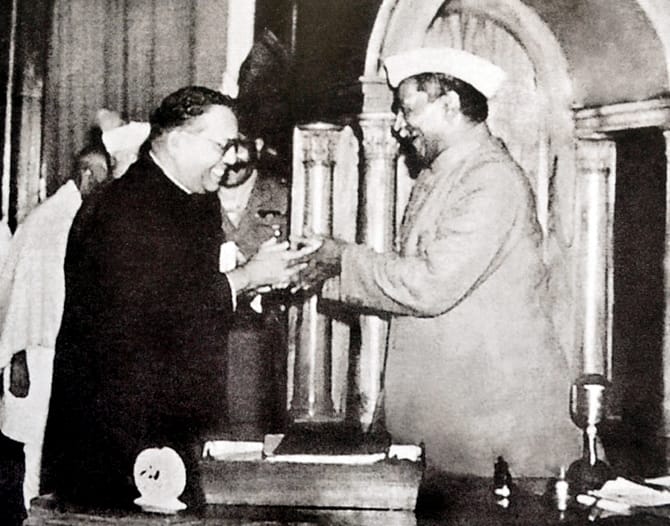
B. N. Rau prepared the first draft as Constitutional Adviser. He was not on the Drafting Committee. And Ambedkar did not write the Constitution alone: the Drafting Committee had seven members, and the whole Assembly debated every article.
The Assembly adopted the Constitution. Now celebrated as Constitution Day (Samvidhan Divas). A few articles started that same day.
India became a Republic. The date honours 26 January 1930, when the Congress observed Purna Swaraj (complete independence) Day.
Framing the Constitution took 2 years, 11 months and 18 days. The Assembly held 11 sessions over 165 days. Members moved about 7,635 amendments to the draft, and about 2,473 were actually discussed.
Article 394 says some provisions started on the day of adoption itself. These were on citizenship (Articles 5 to 9), elections (Article 324), the provisional Parliament, and some temporary rules. The rest of the Constitution started on 26 January 1950.
Other work of the Assembly (also asked)Tap to open
| Date | What the Assembly did |
|---|---|
| 22 July 1947 | Adopted the National Flag |
| May 1949 | Approved India's membership of the Commonwealth |
| 24 January 1950 | Adopted the National Anthem and National Song; elected the first President |
After 15 August 1947 the Assembly had two jobs. It made the Constitution, and it also worked as India's first Parliament (legislature). After 26 January 1950 it carried on as the provisional Parliament until the first general elections of 1951–52.
Sources: what India borrowed
The framers took what worked and shaped it for India.
The framers studied many constitutions. They took the ideas that suited India and changed them where needed. Ambedkar said there was nothing to be ashamed of in borrowing good ideas. The biggest single source was the Government of India Act, 1935. It gave the federal scheme, the office of Governor, the judiciary, public service commissions, the emergency provisions and many details of administration.
- Britain (UK)
- Parliamentary government, rule of law, law-making procedure, single citizenship, cabinet system, writs, two-house legislature.
- USA
- Fundamental Rights, independent judiciary, judicial review, impeachment of the President, removal of judges, post of Vice-President.
- Ireland
- Directive Principles, nominating members to the Rajya Sabha, method of electing the President.
- Canada
- Federation with a strong Centre, residuary powers with the Centre, Governors appointed by the Centre, advisory jurisdiction of the Supreme Court.
- Australia
- Concurrent List, freedom of trade and commerce across states, joint sitting of the two Houses.
- Germany (Weimar)
- Suspension of Fundamental Rights during an Emergency.
- USSR (Soviet Union)
- Fundamental Duties; the ideal of social, economic and political justice in the Preamble.
- France
- Republic; the ideals of liberty, equality and fraternity in the Preamble.
- South Africa
- Procedure for amending the Constitution; election of Rajya Sabha members.
- Japan
- Procedure established by law (in Article 21).
Pairs exams love: USA = Rights, Ireland = Directive Principles, USSR = Duties, Canada = strong Centre, Australia = Concurrent List, Germany = Emergency.
Salient features and nature of the Constitution
What makes our Constitution different, in short cards.
395 Articles, 22 Parts and 8 Schedules at the start. One document for the Union and all states.
Some parts change by a simple majority, most need a special majority, some also need half the states (Article 368).
The Council of Ministers is answerable to the Lok Sabha. The President is the formal head.
Powers divided between Centre and states, but the Centre is stronger.
Only Indian citizenship. No separate citizenship of a state, unlike the USA.
Every citizen aged 18 can vote (Article 326). The age was cut from 21 by the 61st Amendment.
One chain: Supreme Court, High Courts, lower courts. Courts can strike down unconstitutional laws.
No official religion. The word secular was added to the Preamble in 1976 (42nd Amendment).
The salient features most often asked in exams.
An indestructible Union of destructible States.
Scholars have given the Constitution famous labels. K. C. Wheare called India quasi-federal (like a federation, but not fully). Ivor Jennings called it a "lawyers' paradise" because it is long and detailed.
Everything on one look
Dates, numbers, people and sources to remember.
| Date | Event |
|---|---|
| 1934 | M. N. Roy suggests a Constituent Assembly |
| 1946 | Cabinet Mission plan; Assembly formed |
| 9 Dec 1946 | First sitting; Sinha temporary President |
| 11 Dec 1946 | Rajendra Prasad elected President |
| 13 Dec 1946 | Nehru moves the Objectives Resolution |
| 22 Jan 1947 | Objectives Resolution adopted |
| 22 Jul 1947 | National Flag adopted |
| 29 Aug 1947 | Drafting Committee set up |
| 26 Nov 1949 | Constitution adopted |
| 24 Jan 1950 | Signed; Anthem and Song adopted; first President elected |
| 26 Jan 1950 | Constitution comes into force |
| Article | What it says |
|---|---|
| 1 | India, that is Bharat, shall be a Union of States. |
| 326 | Elections on the basis of adult suffrage (now age 18). |
| 368 | Power and procedure to amend the Constitution. |
| 393 | Short title: "the Constitution of India". |
| 394 | Commencement: some articles from 26 Nov 1949, the rest from 26 Jan 1950. |
| 395 | Repeals the Indian Independence Act, 1947 and the Government of India Act, 1935. |
- 389 seats planned, 299 after Partition
- 292 provinces + 4 chief commissioners' + 93 princely states
- 7 members in the Drafting Committee
- 8 major committees
- 11 sessions, 165 days
- 2 years, 11 months, 18 days
- 395 Articles, 22 Parts, 8 Schedules at the start
- Idea (1934): M. N. Roy
- Temporary President: Sachchidananda Sinha
- President: Rajendra Prasad
- Drafting Committee chairman: B. R. Ambedkar
- Constitutional Adviser: B. N. Rau
- Objectives Resolution: Jawaharlal Nehru
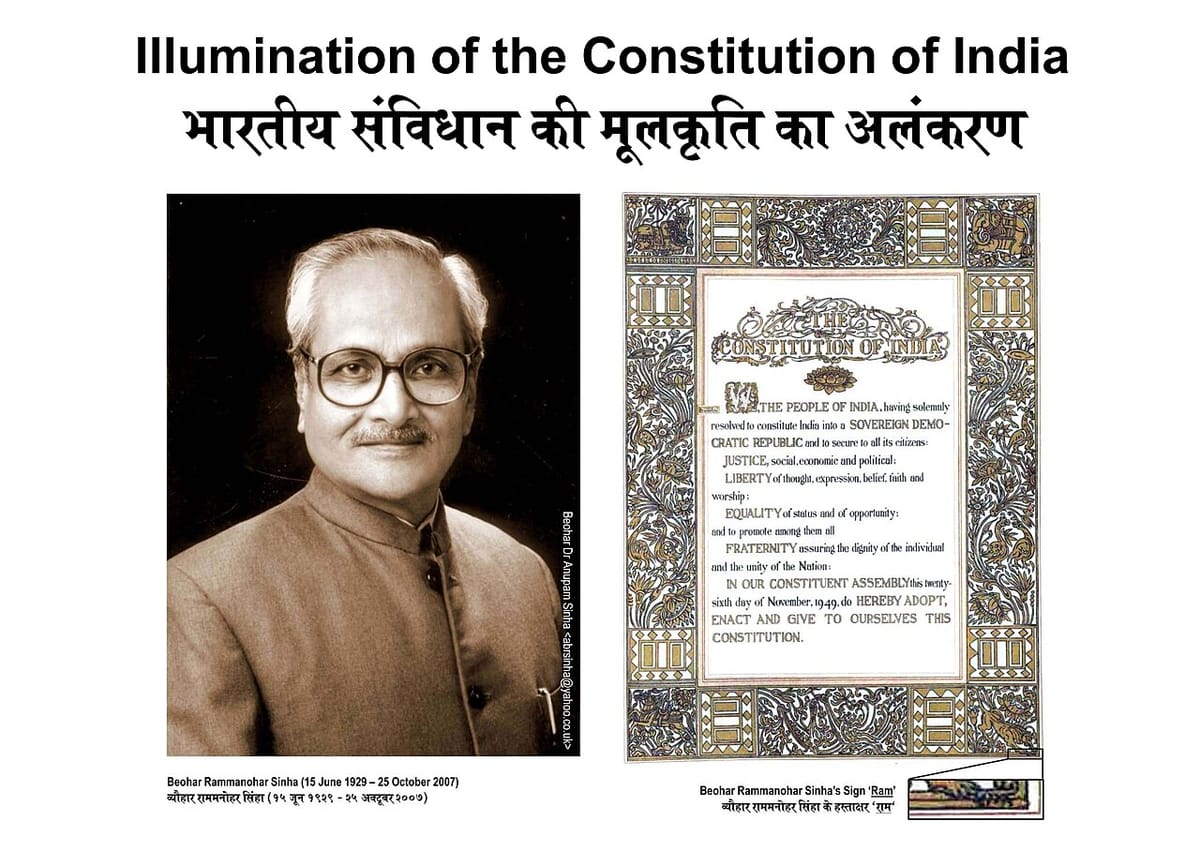
- Calligrapher: Prem Behari Narain Raizada
- The Assembly was indirectly elected, not elected directly by the people.
- B. N. Rau was Constitutional Adviser, not a Drafting Committee member.
- Sinha was temporary President; Prasad was the elected President.
- Adopted on 26 November 1949; in force on 26 January 1950.
- The Government of India Act, 1935 is the biggest single source, not any foreign constitution.
- USA gave Fundamental Rights; Ireland gave Directive Principles; USSR gave Fundamental Duties.
- The Objectives Resolution became the Preamble, not the other way round.
- Gandhi was not a member of the Constituent Assembly.
- The word federation is not in the Constitution; Article 1 says Union of States.
- Idea of Constituent Assembly: M. N. Roy, 1934
- Assembly formed under: Cabinet Mission plan, 1946
- Members chosen by: provincial assemblies (indirect)
- First sitting: 9 December 1946
- Boycotted by: Muslim League
- Temporary President: Sachchidananda Sinha
- Permanent President: Rajendra Prasad
- Objectives Resolution: Nehru, 13 Dec 1946
- Drafting Committee: 29 Aug 1947, 7 members
- Chairman: B. R. Ambedkar
- Constitutional Adviser: B. N. Rau
- Adopted: 26 November 1949
- In force: 26 January 1950
- National Anthem adopted: 24 January 1950
- Biggest source: Government of India Act, 1935
- Longest written constitution in the world
A friend says, "The people of India elected the Constituent Assembly, and Ambedkar wrote the Constitution alone." Correct both parts.
Show answer
The people did not elect it directly. Members were chosen by the provincial assemblies (indirect election), and princely states nominated theirs. Ambedkar chaired the seven-member Drafting Committee, but the whole Assembly debated and passed every article, with B. N. Rau as Constitutional Adviser.