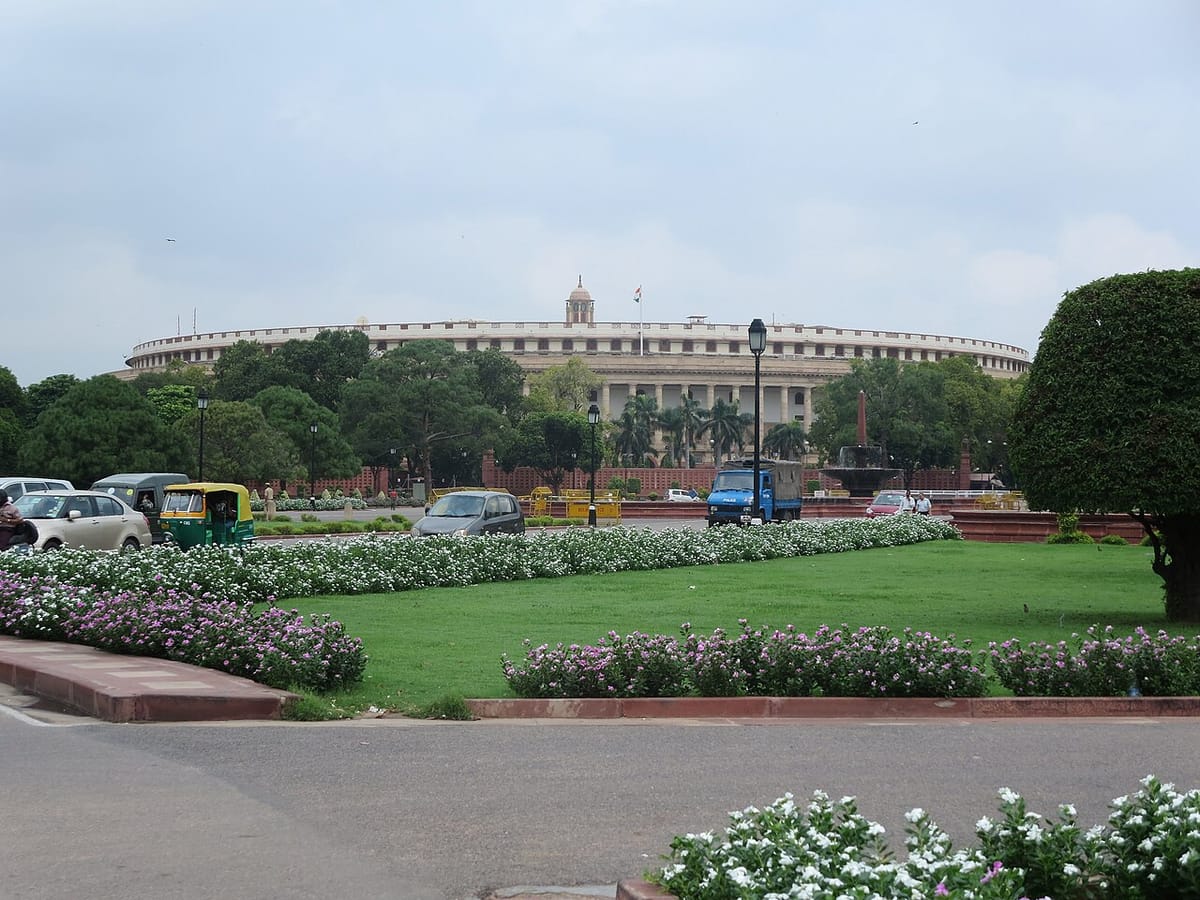
Parliament is the law-making body of India. It is made of the President, the Rajya Sabha and the Lok Sabha. It makes laws, approves the government's money and keeps a daily check on the ministers. The rules for it are in Part V of the Constitution, Articles 79 to 122.
What Parliament is and who can be an MP
Three parts, one law-maker.
India follows the parliamentary system, taken from Britain. In this system the government comes from Parliament and must answer to it. Ministers sit in Parliament. If the Lok Sabha stops trusting them, they must go.
Parliament means the President plus two Houses: the Council of States (Rajya Sabha) and the House of the People (Lok Sabha). The President never sits in either House. But no bill becomes a law until the President signs it. So the President is a part of Parliament.
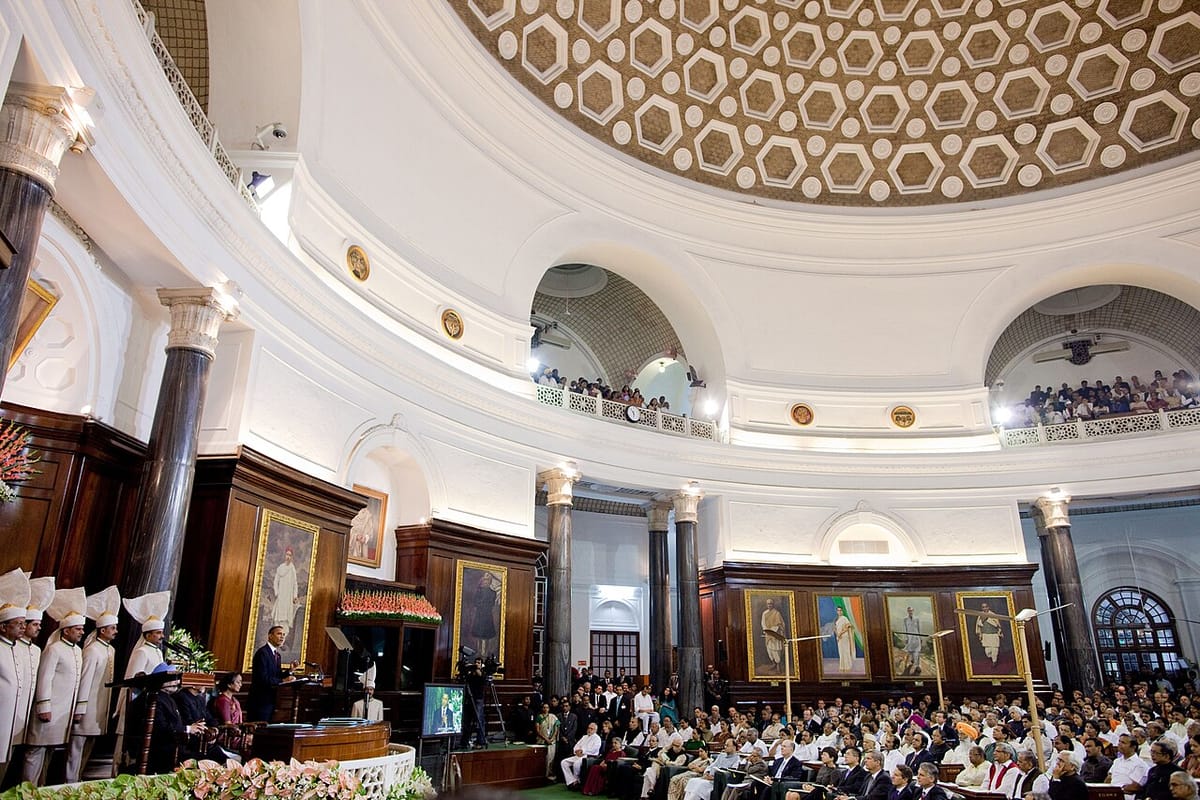
The President has other jobs in Parliament too. The President summons (calls) both Houses, prorogues (closes) a session and can dissolve the Lok Sabha. Under Article 87, the President addresses both Houses together at the start of the first session after a general election and at the start of the first session of every year.
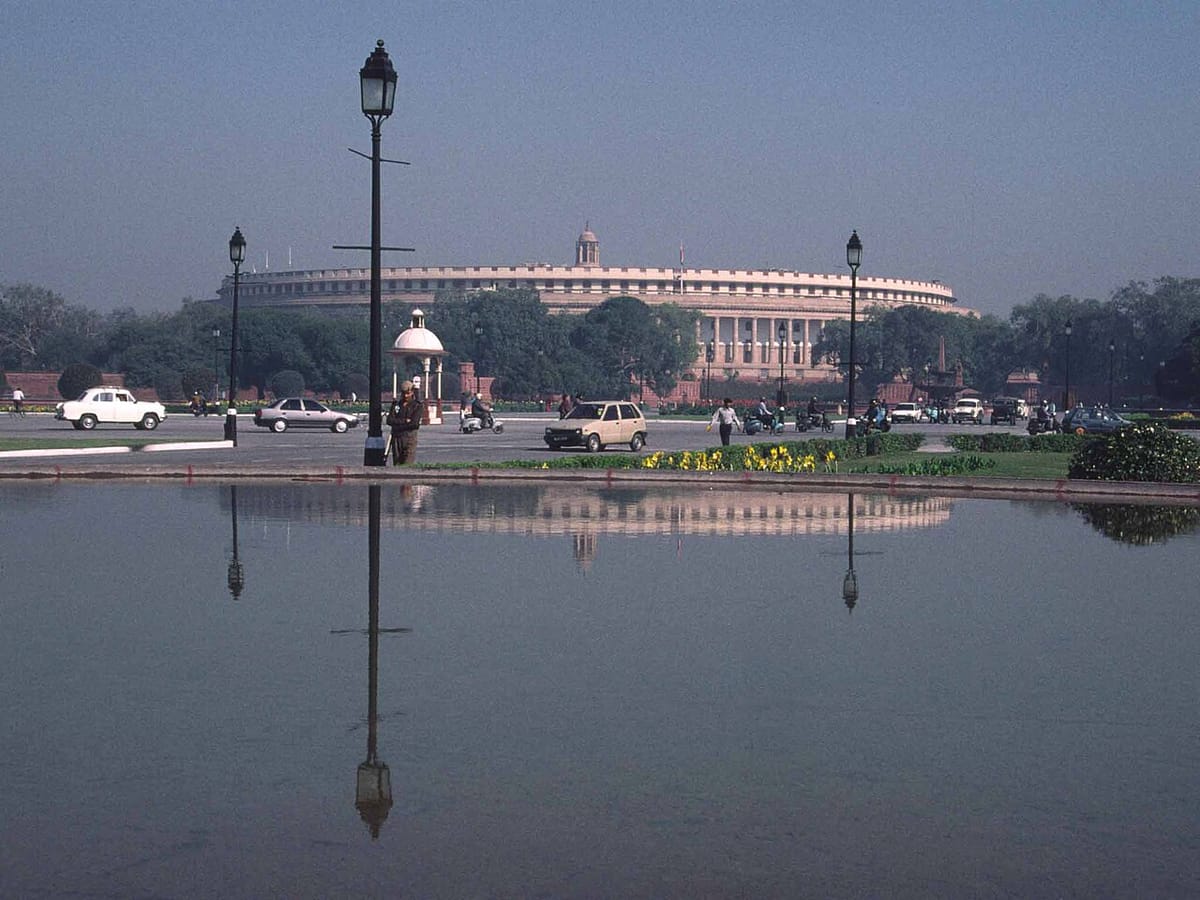
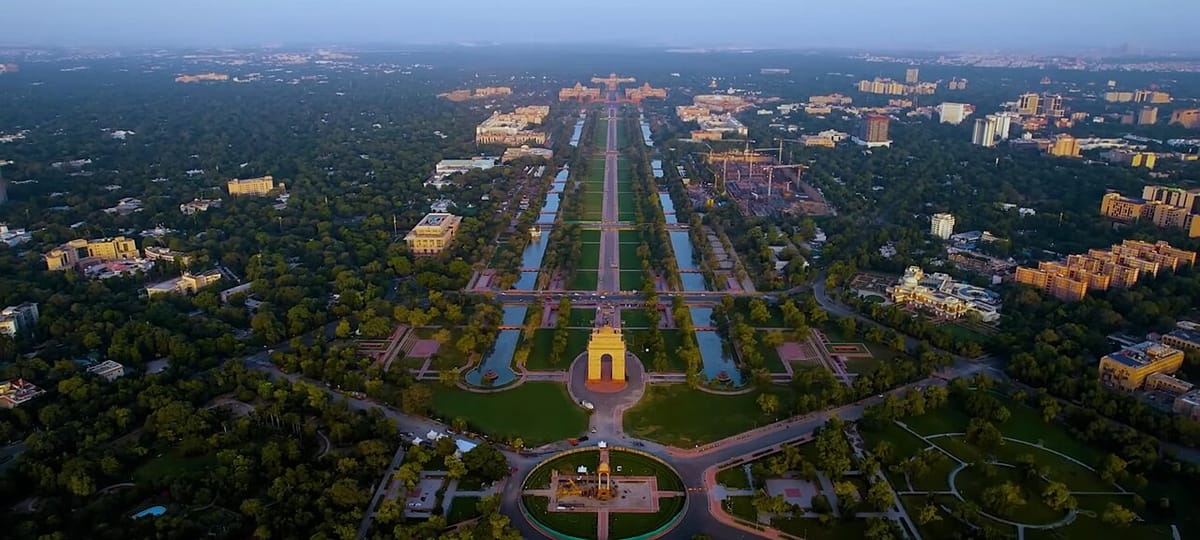
The new Parliament building was inaugurated on 28 May 2023. Both Houses began sitting there in September 2023. Its Lok Sabha hall has 888 seats and its Rajya Sabha hall has 384, so there is room for more MPs after a future delimitation. The first bill taken up in the new building was the 106th Amendment (2023) on women's reservation.
| To become an MP you must… | Where the rule is |
|---|---|
| Be a citizen of India | Article 84 |
| Be at least 25 for the Lok Sabha, 30 for the Rajya Sabha | Article 84 |
| Take an oath before a person chosen by the President (form in the Third Schedule) | Articles 84 and 99 |
| Be a voter (elector) in some parliamentary constituency | Representation of the People Act, 1951 |
- Office of profit: holding a paid government post, unless Parliament has exempted that post.
- Unsound mind, declared so by a court.
- Undischarged insolvent: someone declared bankrupt who has not cleared it.
- Not a citizen, or has taken another country's citizenship or loyalty.
- Disqualified by a law of Parliament, for example after certain criminal convictions.
- Defection under the Tenth Schedule (explained in the last part).
Article 102 lists the grounds for disqualification above. If a question arises on these grounds (not defection), the President decides under Article 103, after taking the Election Commission's opinion. Under Article 101, a member absent for 60 days without permission can lose the seat. A person elected to both Parliament and a state legislature must give up the state seat within 14 days, or the seat in Parliament becomes vacant.
Lok Sabha and Rajya Sabha
One House speaks for the people, the other for the states.
The Lok Sabha is the lower House. Its members are directly elected by the people. The Rajya Sabha is the upper House. It represents the states, and its members are indirectly elected. The Lok Sabha is the stronger House, because the government lives or falls by its vote.
The elected MLAs of each state choose the state's Rajya Sabha members. They vote by proportional representation using the single transferable vote. Seats are shared by population, as listed in the Fourth Schedule. Uttar Pradesh has the most (31). Punjab has 7 Rajya Sabha seats and 13 Lok Sabha seats. The 12 nominated members are experts in literature, science, art and social service.
The Rajya Sabha is never dissolved. Instead, one-third of its members retire every second year, and new ones take their place. The Constitution does not fix a member's term. The six-year term comes from the Representation of the People Act, 1951.
The Lok Sabha's term is 5 years. The 42nd Amendment (1976) made it 6 years, and the 44th Amendment (1978) brought it back to 5. During a National Emergency, Parliament can extend it by 1 year at a time, but not beyond 6 months after the Emergency ends.
- Start a Money Bill
- Pass a no-confidence motion and remove the government
- Vote on the demands for grants in the budget
- Pass a resolution to end a National Emergency
- Let Parliament make a law on a State List subject (Article 249)
- Allow a new All-India Service (Article 312)
- Start the removal of the Vice-President
- Approve an Emergency when the Lok Sabha is dissolved
Speaker, Chairman and sessions
Who runs each House, and when Parliament meets.
Each House needs a person to run its meetings. In the Lok Sabha this is the Speaker, elected by the members from among themselves (Article 93). In the Rajya Sabha it is the Chairman. The Vice-President is Chairman by virtue of office (ex officio). The Chairman is not a member of the Rajya Sabha.
Elected by Lok Sabha members. Removed by a resolution passed by a majority of all the then members, after 14 days' notice.
Elected by Lok Sabha members. Presides when the Speaker is absent. Not under the Speaker; answers to the House.
Appointed by the President after an election, usually a senior member. Gives the oath to new members.
The Vice-President, ex officio. Removed only when removed as Vice-President.
Elected by Rajya Sabha members from among themselves. Presides when the Chairman is absent.
A few members named by the presiding officer. One presides when both the top officers are absent.
Who presides over each House, and when.
- Decides whether a bill is a Money Bill; this decision is final (Article 110).
- Presides over a joint sitting of both Houses (Article 108).
- Decides disqualification for defection of Lok Sabha members (Tenth Schedule).
- Has only a casting vote, used when votes are tied (Article 100).
- Appoints the chairmen of Lok Sabha committees and heads the Business Advisory and Rules committees.
- Stays in office after the Lok Sabha is dissolved, until the new House first meets.
- Salary is charged on the Consolidated Fund, so it is not voted on every year.
- 1G. V. Mavalankar1952–1956 · First Speaker; called the father of the Lok Sabha
- 2M. A. Ayyangar1956–1962 · Was Deputy Speaker before
- 3Hukam Singh1962–1967 · Sikh leader from Punjab
- 4N. Sanjiva Reddy1967–1969 · Later became President of India
- 5Gurdial Singh Dhillon1969–1975 · From Punjab
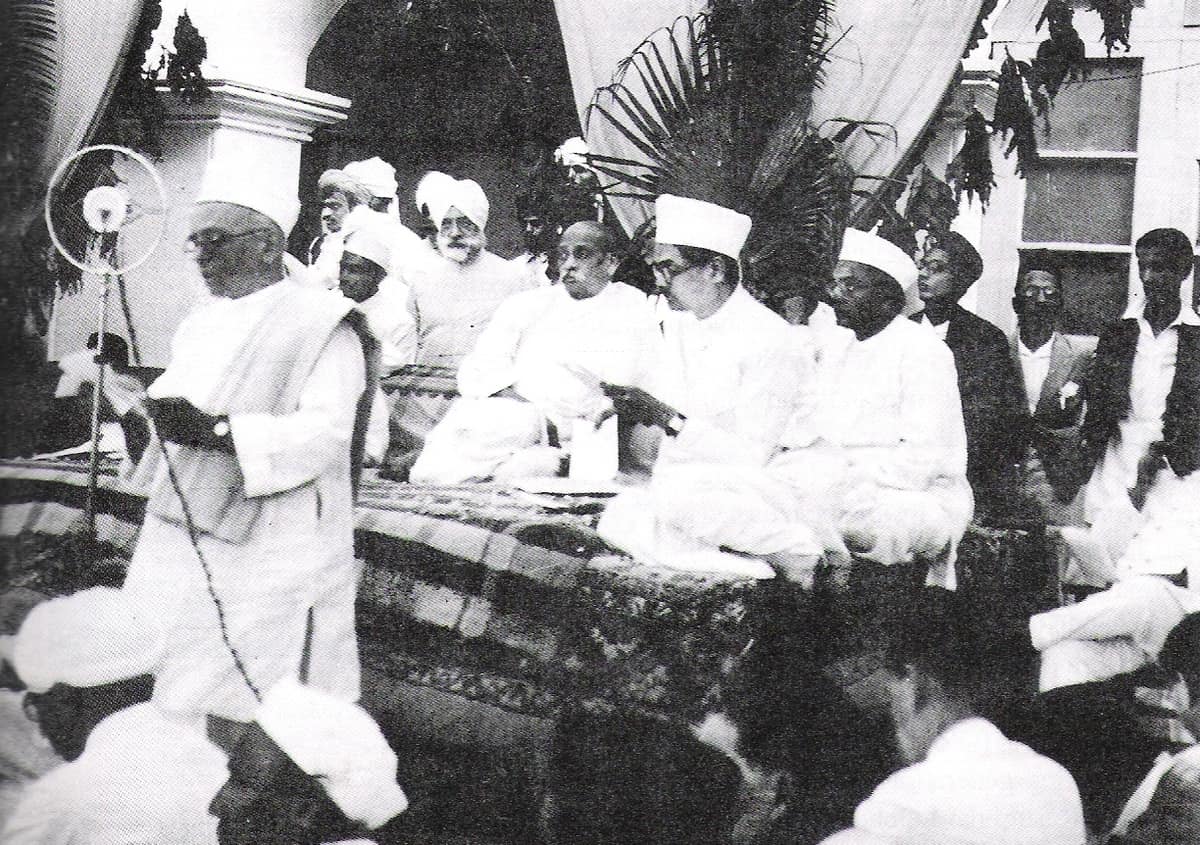
Parliament does not sit all year. It meets in sessions. Article 85 has one rule: the gap between two sessions must not be more than 6 months. So Parliament must meet at least twice a year. In practice it meets three times: the Budget session (February–May), the Monsoon session (July–September) and the Winter session (November–December).
| Word | Who does it | What it means |
|---|---|---|
| Summoning | President | Calling a House to meet |
| Adjournment | Presiding officer | A pause of hours or days; the session goes on |
| Adjournment sine die | Presiding officer | A pause with no date fixed for the next sitting |
| Prorogation | President | Ends the session; pending bills stay alive |
| Dissolution | President | Ends the life of the Lok Sabha; many pending bills lapse |
Quorum is the least number of members needed for a sitting: one-tenth of the House, counting the presiding officer (Article 100). When the Lok Sabha is dissolved, bills pending in it lapse. A bill pending only in the Rajya Sabha (not yet passed by the Lok Sabha) does not lapse. A bill already passed by both Houses and waiting for the President's assent also survives.
Question Hour, Zero Hour and motionsTap to open
The first hour of a sitting is usually Question Hour. Members ask ministers about their work. A starred question (marked with a star) gets an oral answer, so follow-up questions are allowed. An unstarred question gets a written answer laid on the table, with no follow-up. A short notice question is on an urgent matter and is answered orally.
Zero Hour comes right after Question Hour, around noon. Members raise urgent matters without the usual notice. It is an Indian practice; it is not in the Constitution or the rules of procedure.
| Motion | What it does |
|---|---|
| No-confidence motion | Says the House has lost faith in the Council of Ministers. Lok Sabha only; needs 50 members to support it; no reason needs to be given. If passed, the government must resign. |
| Censure motion | Blames a minister or the government for a specific act. Must give the reasons. If passed, the government need not resign. |
| Adjournment motion | Sets aside normal business to discuss an urgent public matter. Lok Sabha only; needs 50 members to support it. |
| Calling attention motion | Draws a minister's attention to an urgent matter; the minister makes a statement. An Indian innovation. |
| Motion of thanks | Thanks the President for the address. If it is defeated, it counts as a defeat of the government. |
| Cut motions | Try to cut a budget demand: policy cut (to ₹1), economy cut (by a stated amount), token cut (by ₹100). |
How a bill becomes law, and money bills
Three readings, two Houses, one signature.
A bill is a draft law. A bill brought by a minister is a government bill. One brought by any other member is a private member's bill. An ordinary bill can start in either House. It goes through the same steps in each House.
- House 1First readingThe bill is introduced and published. There is no debate.
- House 1Second readingGeneral debate, often a committee study, then clause-by-clause voting on changes.
- House 1Third readingThe House votes to pass or reject the bill as a whole.
- House 2Other HouseThe same three readings. If the Houses disagree, a joint sitting may follow.
- ActPresident's assentThe President signs, withholds assent, or returns it once for a second look (Article 111).
A joint sitting is called by the President when the Houses deadlock on an ordinary bill. This happens if one House rejects it, they disagree on changes, or 6 months pass without the other House passing it. The Speaker presides. A simple majority of members present and voting decides. There is no joint sitting for a Money Bill or a Constitutional Amendment Bill. It has happened only three times: 1961 (Dowry Prohibition), 1978 (Banking Service Commission Repeal) and 2002 (Prevention of Terrorism).
A bill is a Money Bill only if it deals only with matters like taxes, government borrowing, the Consolidated Fund or Contingency Fund, spending from the Consolidated Fund, or audit of accounts. The Speaker's decision on this is final. The Rajya Sabha cannot reject or amend it. It can only recommend changes within 14 days. The Lok Sabha may accept or ignore them.
A Financial Bill has money matters plus other matters. A Financial Bill under Article 117(1) must start in the Lok Sabha with the President's recommendation. After that, both Houses have equal power, as with an ordinary bill. A bill that only involves spending from the Consolidated Fund (Article 117(3)) can start in either House, but needs the President's recommendation before it is considered.
- Step 1PresentationThe Annual Financial Statement (Article 112) is laid before both Houses. Since 2017 it comes on 1 February.
- Step 2General discussionBoth Houses discuss the whole budget. There is no vote yet.
- Step 3Committee scrutinyDepartment-related standing committees study each ministry's demands.
- Step 4Voting on demandsOnly the Lok Sabha votes on the demands for grants (Article 113). Left-over demands are passed together on the last day: the guillotine.
- Step 5Appropriation BillAllows money to be taken out of the Consolidated Fund (Article 114).
- Step 6Finance BillPuts the tax proposals into law.
The word "budget" is not in the Constitution; it says Annual Financial Statement. Some spending is charged on the Consolidated Fund and is not voted: for example the salaries of the President, the Speaker and Chairman, Supreme Court judges and the CAG, and interest on government debt. No money can leave the Consolidated Fund (Article 266) without a law passed by Parliament. Since 2017 the Railway Budget is part of the Union Budget.
Committees and the anti-defection law
Small groups that check the money, and a law that stops party-hopping.
Parliament has too much work to do everything on the floor. So it uses committees: small groups of MPs, elected by the House or appointed by the Speaker or Chairman. Members come from among the MPs themselves. Standing committees are permanent. Ad hoc committees, such as a Joint Parliamentary Committee (JPC), end when their job is done.
22 members (15 Lok Sabha + 7 Rajya Sabha). Checks the CAG's audit reports on how money was spent. Its chairman is appointed by the Speaker.
30 members, all from the Lok Sabha. The largest committee. Suggests economy in the budget estimates.
22 members (15 + 7). Examines the reports and accounts of public sector companies.
24 committees, each with up to 31 members (21 + 10). Study each ministry's bills and budget demands.
The financial committees and the ministry-wise committees.
Defection means an MP or MLA leaving his party after being elected on its ticket. The 52nd Amendment (1985) added the Tenth Schedule to stop this. A member is disqualified if he voluntarily gives up his party, or votes or abstains against the party's direction. An independent member is disqualified if he joins a party. A nominated member may join a party only within 6 months. The Speaker or Chairman decides.
- 1967"Aaya Ram, Gaya Ram"
Haryana MLA Gaya Lal changed party several times in a short span. The phrase became a name for party-hopping.
- 198552nd Amendment
Tenth Schedule added. A split of one-third of a legislature party was allowed.
- 1992Kihoto Hollohan case
Supreme Court: the presiding officer acts like a tribunal, and his decision can be reviewed by courts.
- 200391st Amendment
The split exception was removed. Only a merger backed by two-thirds is protected. Council of Ministers capped at 15% of the Lok Sabha. A defector cannot become a minister.
Everything on one look
Articles, numbers and the traps examiners set.
| Article | What it says |
|---|---|
| 79 | Parliament = President + Rajya Sabha + Lok Sabha |
| 80 / 81 | Make-up of the Rajya Sabha / Lok Sabha |
| 83 | Term of the Houses |
| 84 | Qualifications for MPs |
| 85 | Summoning, prorogation, dissolution; 6-month gap rule |
| 87 | President's special address |
| 89 / 93 | Chairman and Deputy Chairman / Speaker and Deputy Speaker |
| 100 | Voting, casting vote, quorum |
| 101 / 102 | Vacation of seats / disqualification |
| 105 | Powers and privileges of MPs |
| 108 | Joint sitting |
| 110 | Definition of Money Bill |
| 111 | President's assent to bills |
| 112 | Annual Financial Statement (budget) |
| 116 | Vote on account |
| 120 | Language in Parliament |
- Lok Sabha: 543 now, 550 maximum
- Rajya Sabha: 245 now, 250 maximum, 12 nominated
- Minimum age: 25 (Lok Sabha), 30 (Rajya Sabha)
- Term: 5 years (Lok Sabha); 6 years per Rajya Sabha member
- Gap between sessions: at most 6 months
- Money Bill in Rajya Sabha: 14 days
- Punjab: 13 Lok Sabha, 7 Rajya Sabha seats
- First Speaker: G. V. Mavalankar (1952)
- First woman Speaker: Meira Kumar (2009)
- 52nd (1985): Tenth Schedule, anti-defection
- 91st (2003): split exception removed
- 104th: Anglo-Indian seats ended (2020)
- 106th (2023): women's reservation, not yet in force
- New Parliament building: 28 May 2023
- The President is part of Parliament, but never sits in either House.
- The Chairman of the Rajya Sabha (the Vice-President) is not a member of it.
- The Rajya Sabha is never dissolved; one-third of members retire every second year.
- The 6-year Rajya Sabha term is fixed by the RPA 1951, not by the Constitution.
- No joint sitting for a Money Bill or an Amendment Bill; the Speaker presides over a joint sitting.
- The Speaker, not the President, certifies a Money Bill.
- Estimates Committee (30, Lok Sabha only) is the largest; PAC is the oldest (1921).
- No-confidence motion: Lok Sabha only, needs 50 members' support, and is not in the Constitution.
- Prorogation ends a session; dissolution ends the Lok Sabha itself.
- 106th Amendment is passed but not yet in force.
- Parliament: Part V, Articles 79–122
- System borrowed from: Britain
- Lok Sabha: House of the People
- Rajya Sabha: Council of States
- Rajya Sabha seats: Fourth Schedule
- Oath forms: Third Schedule
- Anti-defection: Tenth Schedule
- Hindi names adopted: 1954
- Presides over joint sitting: Speaker
- Joint sittings held: 1961, 1978, 2002
- Money Bill: Article 110
- Budget: Article 112
- Vote on account: Article 116
- Quorum: one-tenth of the House
- Zero Hour: Indian innovation
- Largest committee: Estimates
The Lok Sabha passes an ordinary bill. The Rajya Sabha sits on it for seven months without passing it. What can be done, and who will preside?
Show answer
Since more than 6 months have passed, the President can call a joint sitting under Article 108. The Speaker of the Lok Sabha presides, and a simple majority of members present and voting decides. This would not be possible for a Money Bill or a Constitutional Amendment Bill.