Peasant and Tribal Movements in India: Santhal, Munda, Kuka and More
Long before Gandhi, farmers and tribal people rose against planters, moneylenders and British rule: each rising with its leader, year and cause, plus Punjab's Kuka revolt and Pagri Sambhal Jatta.
Punjab PolicePSSSBPPSCSSCBankState PSCPatwari16 MIN READਪੰਜਾਬੀ ਵਿੱਚ ਪੜ੍ਹੋ
Take the test — coming soon
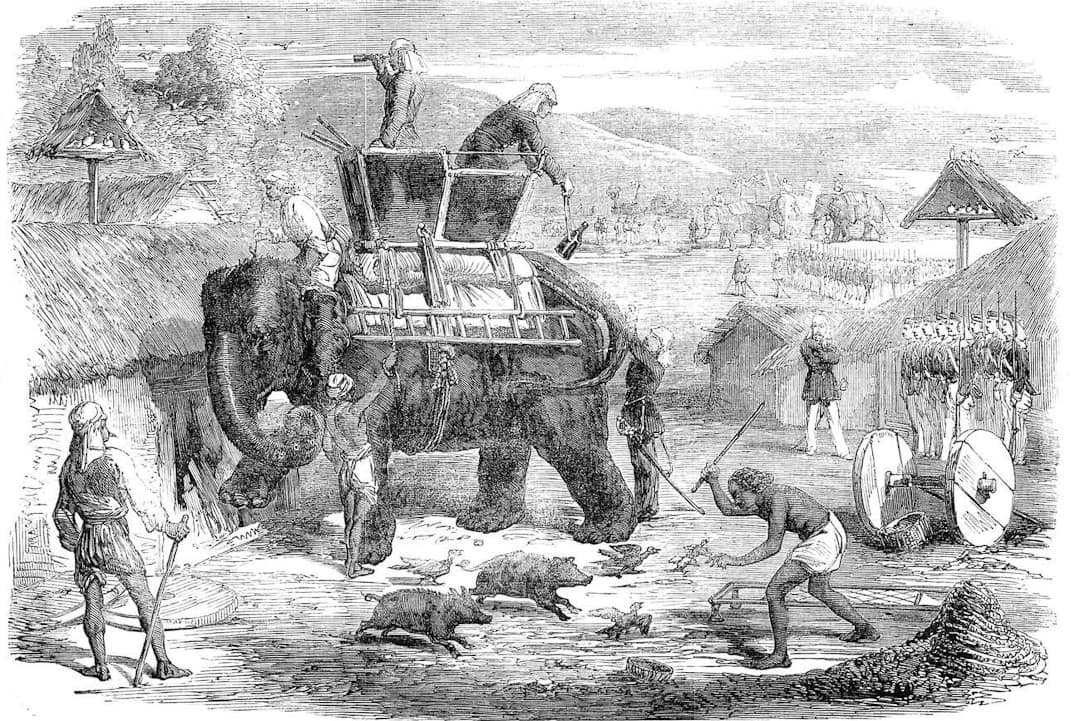
The Santhal rising, 1855–56, as drawn for a London newspaper in February 1856. The artist was not an eyewitness. The rising was led by the brothers Sidhu and Kanhu Murmu.
British rule brought new landlords, moneylenders, planters and forest laws. Farmers and tribal people lost land and fell into debt. Many of them rose up, often long before the Congress existed. Each rising had a clear enemy and a clear leader. That is exactly what exams ask.
1855
Santhal Hul
Sidhu and Kanhu
1859
Indigo revolt
Bengal
1872
Kuka revolt
Malerkotla, Punjab
1899
Munda Ulgulan
Birsa Munda
Tribal risings
Forests, land and the hated outsider.
Tribal people lived by forests and shifting farming. British laws took away their forests. Outsiders called dikus (moneylenders, traders, landlords) took their land through debt. Tribal risings usually wanted to bring back the old way of life.
MAIN TRIBAL RISINGS
1831–32
Kol rising
Chotanagpur. Led by Buddhu Bhagat and others, against outsiders taking Kol land.
1855–56
Santhal Hul
Rajmahal hills. Brothers Sidhu and Kanhu Murmu against moneylenders, zamindars and police.
1879
Rampa rising
Hills of Andhra, against new forest and toddy rules.
1899–1900
Munda Ulgulan
Near Ranchi. Led by Birsa Munda.
1922–24
Second Rampa rising
Led by Alluri Sitarama Raju, who was killed in 1924.
KEY TERM
Santhal Hul, 1855–56
The Santhals of the Rajmahal hills were trapped in debt by outside moneylenders (mahajans). On 30 June 1855 the brothers Sidhu and Kanhu called them to revolt. The British crushed it with troops and martial law. Then they made a separate Santhal Parganas district, with special rules for the Santhals.
Debt to mahajans→Land lost→1855: Hul→Santhal Parganas formed
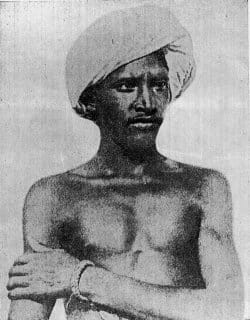
The face of the Ulgulan
Birsa Munda
1875–1900 · Munda Ulgulan, near Ranchi
Called Dharti Aba (Father of the Earth)
Arrested 3 Feb 1900; died in Ranchi jail, June 1900
His birthday, 15 November, is Janjatiya Gaurav Divas
WHAT ULGULAN MEANS
Ulgulan is a Mundari word meaning the Great Tumult. Birsa's followers attacked churches, police posts and landlords in 1899–1900. After it, the British passed the Chotanagpur Tenancy Act, 1908. It limited the transfer of tribal land to outsiders.
QUICK CHECK
Who led the Santhal Hul of 1855?
Tap an option to answer
Answer: B — Sidhu and Kanhu
The brothers Sidhu and Kanhu Murmu called the Santhals of the Rajmahal hills to revolt on 30 June 1855. Birsa Munda led the Munda Ulgulan (1899–1900); Alluri Sitarama Raju led the Rampa rising (1922–24).
QUICK CHECK
PYQ · PPSC A2 2022 Which one of the following is associated with Birsa Munda?
Tap an option to answer
Answer: B — Ulgulan Movement
Birsa Munda led the Ulgulan ('Great Tumult') near Ranchi in 1899–1900. Tebhaga was a Bengal sharecroppers' movement of 1946–47.
QUICK CHECK
PYQ · Punjab Police SI 2023 Who among the following started the 'Faraizi movement' in the early 19th century?
Tap an option to answer
Answer: C — Haji Shariatullah
Haji Shariatullah began the Faraizi movement in Bengal in 1818. Syed Ahmad Barelvi led the Wahabi movement; Mirza Ghulam Ahmad founded the Ahmadiyya.
Peasants against planters, moneylenders and landlords
From the Indigo revolt to Bardoli.
In Bengal, European planters forced farmers to grow indigo for a very low price. In 1859–60 the farmers simply refused to sow it. The play Neel Darpan (1860) by Dinabandhu Mitra showed the planters' cruelty. A government Indigo Commission (1860) followed, and indigo planting in Bengal soon collapsed.
THREE PEASANT RISINGS, THREE ENEMIES
Indigo revolt
Pabna revolt
Deccan riots
Year, place
1859–60, Bengal
1873, Pabna (Bengal)
1875, Poona, Ahmednagar
Enemy
European indigo planters
Zamindars raising rent
Moneylenders
Method
Refused to sow indigo
Agrarian league, court cases
Burned debt bonds
Result
Indigo Commission, 1860
Bengal Tenancy Act, 1885
Deccan Agriculturists' Relief Act, 1879
QUICK CHECK
Who wrote the play Neel Darpan (1860) about the cruelty of indigo planters?
Tap an option to answer
Answer: C — Dinabandhu Mitra
Dinabandhu Mitra wrote Neel Darpan during the Indigo revolt of Bengal (1859–60). Rev. James Long published its English translation and was jailed for it. Bankim Chandra wrote Anandamath.
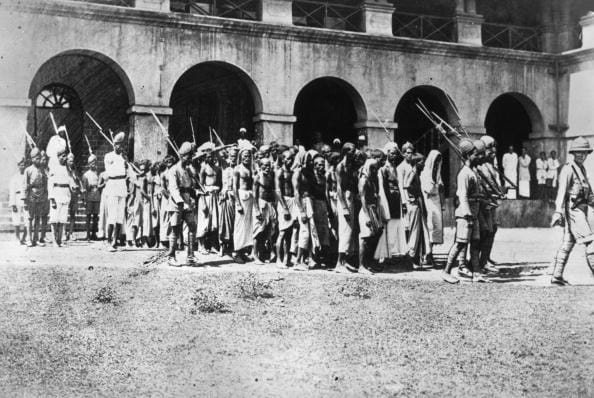
The Moplah (Mappila) rising of 1921 broke out in Malabar (Kerala). Muslim tenants rose against landlords and British rule. It mixed with the Khilafat movement and, in places, turned communal. The British put it down with martial law.
Moplah prisoners being taken for trial at Calicut, after the 1921 rising in Malabar (press photograph).
Gandhian struggle
Year
Key facts
Champaran (Bihar)
1917
Against the tinkathia system of forced indigo. Gandhi's first satyagraha in India.
Kheda (Gujarat)
1918
Crops failed but revenue was still demanded. Gandhi, with Vallabhbhai Patel.
Bardoli (Gujarat)
1928
Revenue raised by about 22%. Led by Vallabhbhai Patel; women called him "Sardar".
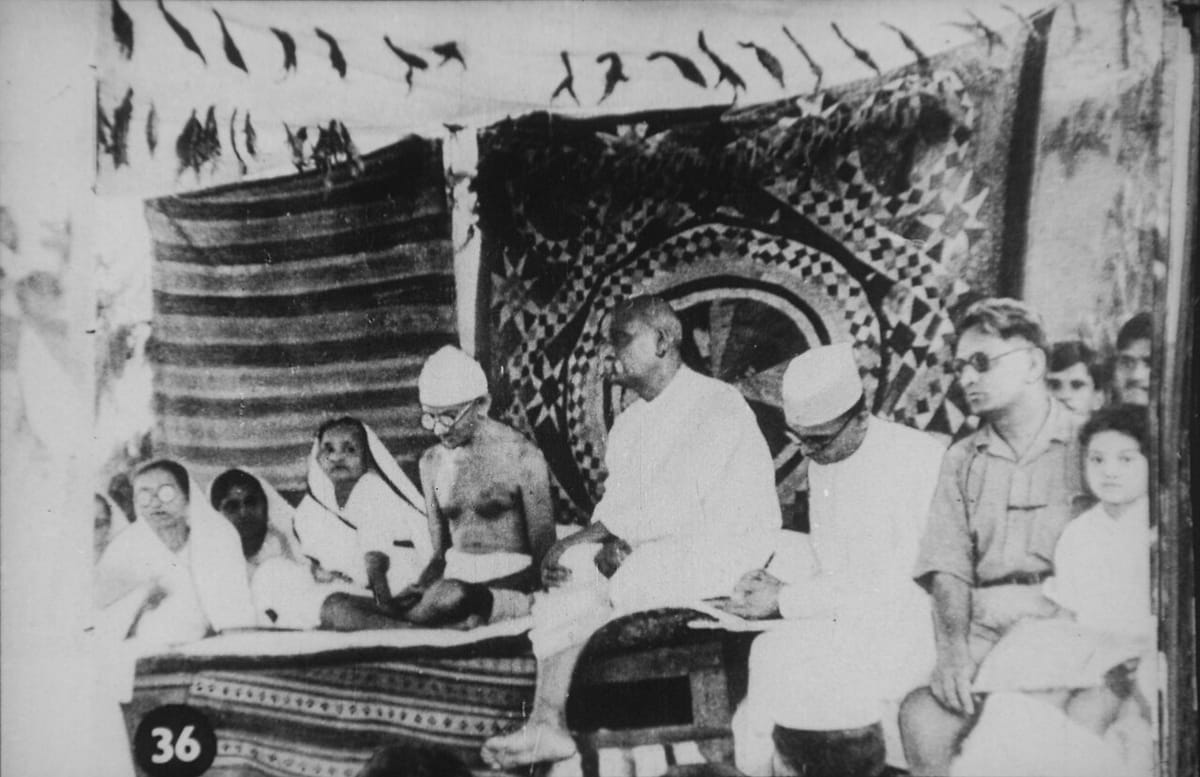
Gandhi and Vallabhbhai Patel, 1928, the year of the Bardoli Satyagraha. Patel led it; an inquiry cut the revenue rise to about 6%.
QUICK CHECK
PYQ · PSSSB Excise Inspector 2021 At which of the following places did Mahatma Gandhi start a Satyagraha against the oppressive plantation system?
Tap an option to answer
Answer: C — Champaran
Champaran (1917) was against the tinkathia system of forced indigo planting. Kheda (1918) was about revenue after crop failure.
QUICK CHECK
PYQ · PSSSB Excise Inspector 2023 The Bardoli Satyagraha was led by:
Tap an option to answer
Answer: C — Vallabhbhai Patel
Patel led the Bardoli Satyagraha of 1928 against a revenue rise of about 22%. Rajendra Prasad worked with Gandhi at Champaran.
QUICK CHECK
PYQ · PPSC PCSEB 2018 Which of the following statements is/are true? 1) Mahatma Gandhi led the Bardoli Satyagraha, 1928 against the unjust raising of taxes by the Bombay Presidency 2) Gandhi ji invited Vallabhbhai Patel to Bardoli to act as representative of people and raise their demands at government level. 3) Large number of women took active part in the movement and gave Vallabhbhai Patel, the sobriquet of 'Sardar' Which of the above statement/(s) is/are correct
Tap an option to answer
Answer: B — Only 3
Patel, not Gandhi, led Bardoli, and it was the local people who invited him. The women of Bardoli gave him the title 'Sardar'.
Punjab: the Kuka revolt
A religious movement that defied the British.
The Namdhari or Kuka movement began as Sikh religious reform. From 1857, Baba Ram Singh led it from Bhaini Sahib near Ludhiana. His followers chanted loudly in ecstasy, so people called them Kukas (from kook, a cry). They wore white and lived simply.
KEY TERM
Kuka boycott
Ram Singh told his followers to boycott British goods, schools, courts and the postal service. They used their own messengers and settled disputes among themselves. Some historians call this an early form of non-cooperation. The Kukas also stood strongly for cow protection.
Religious reform→Boycott of British→Clashes over cow slaughter→Crushed in 1872
THE KUKA REVOLT
1857
Bhaini Sahib
Baba Ram Singh begins his mission at Baisakhi.
1871
Clashes over cow slaughter
Kukas attack butchers at Amritsar and Raikot.
Jan 1872
Malerkotla
Kukas march on Malerkotla. About 66 of them are executed without trial, on the orders of British officials.
1872
Ram Singh exiled
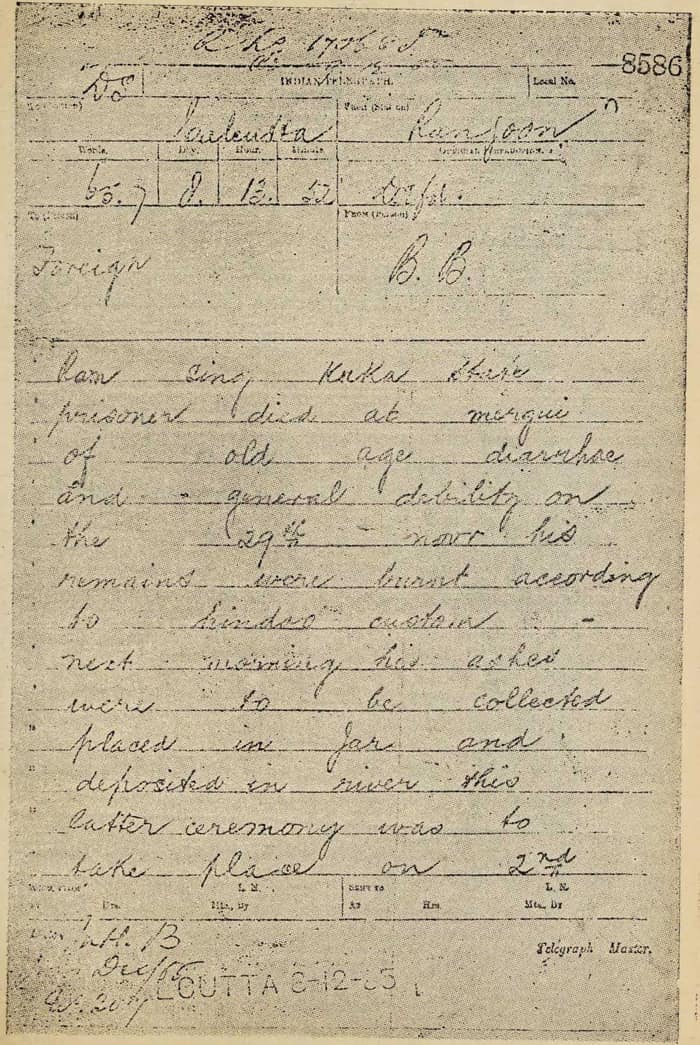
He is deported to Burma. British records report his death there in 1885.
The Kukas in old pictures
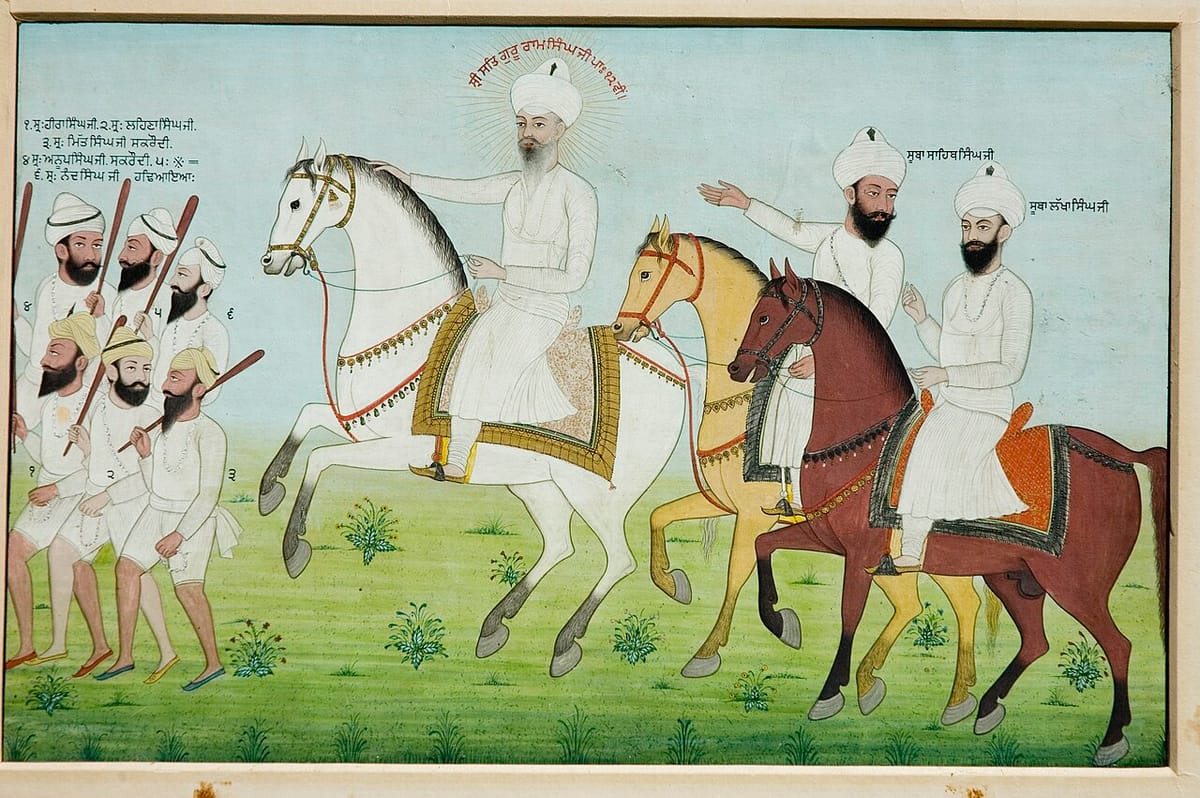
Baba Ram Singh on horseback with his subas (deputies), a 19th-century painting.
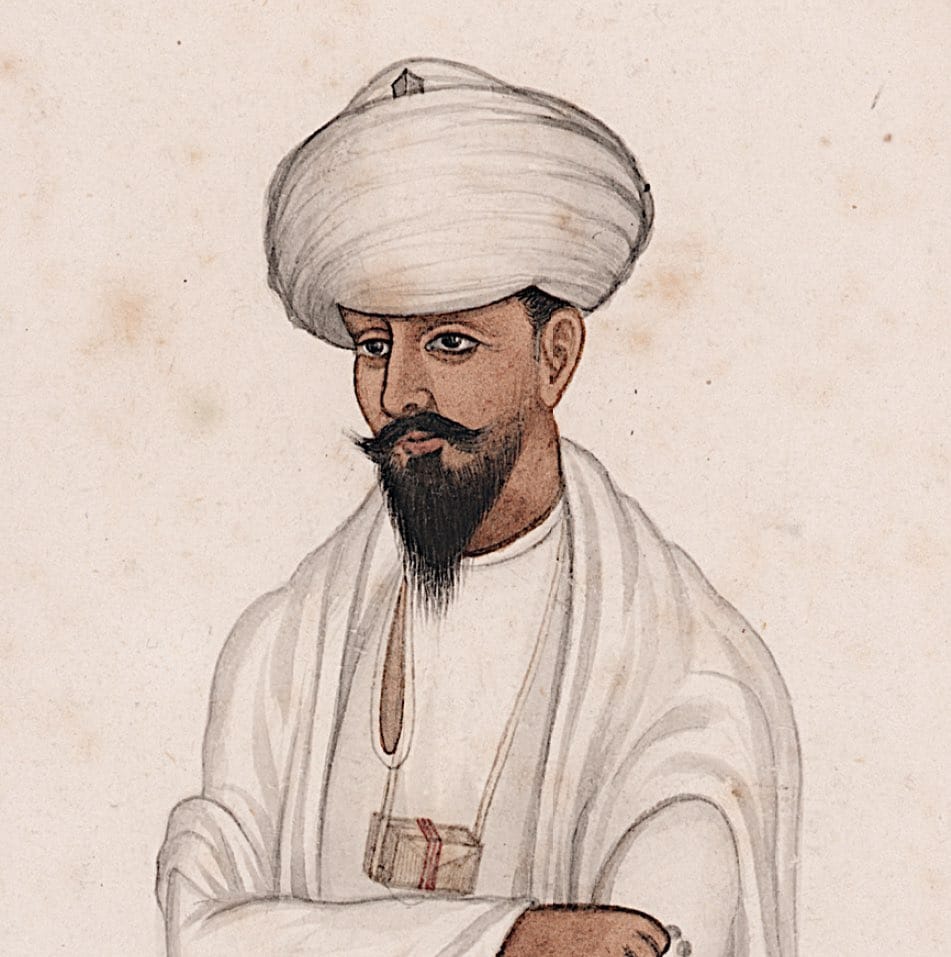
A Kuka Sikh in white, painted at Amritsar around 1860–65.
A telegram from Rangoon, 8 Dec 1885, reporting Ram Singh's death in Burma.
Image
QUICK CHECK
PYQ · PPSC DDSWO 2026 Who led the Kuka revolt?
Tap an option to answer
Answer: C — Baba Ram Singh
Baba Ram Singh led the Kukas from Bhaini Sahib. Ajit Singh led the later 1907 agitation. PSSSB Excise Inspector 2021 and Punjab Police Constable 2021 asked the same fact.
QUICK CHECK
PYQ · PSSSB Excise Inspector 2018 Which animal was worshipped in the Kuka Movement?
Tap an option to answer
Answer: A — Cow
Cow protection was central to the Kukas. Their attacks on butchers in 1871–72 led to the Malerkotla executions. Election Kanungo 2021 repeated this question.
QUICK CHECK
PYQ · Punjab Police Constable 2025 What were the long-term socio-economic consequences for the Kukas after their rebellion?
Tap an option to answer
Answer: B — Their properties were confiscated, and many were exiled or executed.
After 1872 many Kukas were executed or exiled, and their leader was sent to Burma. The movement was kept under watch for years.
Punjab, 1907: Pagri Sambhal Jatta
Canal colony farmers stand up.
The British had settled farmers in new canal colonies, like the Chenab Colony around Lyallpur. In 1906–07 a Colonisation Bill cut their rights over their own land. Canal water rates were raised too. The farmers protested across Punjab in 1907.
THE 1907 AGITATION
Colonisation Bill and higher water rates
Canal colony farmers lose rights and pay more.
↓
Ajit Singh
Mass meetings, 1907
Sardar Ajit Singh, uncle of Bhagat Singh, leads the protest.
↓
"Pagri Sambhal Jatta"
The song by Banke Dayal, editor of Jhang Sial, becomes the movement's cry.
↓
Mandalay
May 1907: deportation
Lajpat Rai and Ajit Singh are sent to Mandalay in Burma without trial.
↓
The Bill is dropped
Viceroy Lord Minto refuses to sign it. The farmers win.
QUICK FACT
"Pagri Sambhal Jatta" means "Guard your turban, O farmer", that is, guard your honour. It was written by Banke Dayal. The movement it named was led by Ajit Singh.
QUICK CHECK
PYQ · PSSSB Senior Assistant 2025 The agrarian agitation of Punjab in 1907 was launched for which of the following reasons?
Tap an option to answer
Answer: A — Colonisation Bill
The Punjab Colonisation Bill cut the rights of canal colony settlers, and water rates rose too. The Rowlatt Bill came much later, in 1919.
QUICK CHECK
PYQ · PSSSB Clerk 2021 Who among the following wrote the famous song, 'Pagri Sambhal Jatta'?
Tap an option to answer
Answer: A — Banke Dayal
Banke Dayal, editor of Jhang Sial, wrote it in 1907. Kishan Singh was Bhagat Singh's father. PSSSB Jail Warder 2026 asked the same.
QUICK CHECK
PYQ · PSSSB Election Kanungo 2018 Who is associated with the Agrarian Unrest of 1907 in the Punjab?
Tap an option to answer
Answer: D — Sardar Ajit Singh
Ajit Singh led the 1907 agitation and was deported to Mandalay with Lajpat Rai. Lala Har Dayal belongs to the later Ghadar movement.
The 1907 deportationsTap to open
Lala Lajpat Rai and Ajit Singh were deported to Mandalay (Burma) in May 1907, without trial.
Both were released in November 1907, after the Bill had been dropped.
QUICK CHECK
PYQ · PSSSB Excise Inspector 2023 In which year was Lala Lajpat Rai deported to Mandalay for organising the agrarian movement in Punjab?
Tap an option to answer
Answer: B — 1907
Lajpat Rai and Ajit Singh were deported in May 1907. PPSC ICS 2016 asked where he was sent: Mandalay.
Kisan Sabhas and the last big struggles
Peasants organise across India.
Awadh, 1920–22
Kisan Sabha and Eka
Baba Ramchandra led the Awadh Kisan Sabha; Madari Pasi led the Eka (unity) movement.
Lucknow, 1936
All India Kisan Sabha
First president Swami Sahajanand Saraswati; secretary N. G. Ranga.
Bengal, 1946–47
Tebhaga
Sharecroppers demanded two-thirds of the crop instead of half.
Hyderabad, 1946–51
Telangana struggle
Peasants against the Nizam and big landlords.
Later peasant struggles, from the 1920s to independence.
FLASHCARDS
Movement → leader
Santhal Hul (1855)
Sidhu and Kanhu Murmu
Munda Ulgulan (1899)
Birsa Munda
Faraizi movement
Haji Shariatullah, then Dudu Miyan
Second Rampa rising
Alluri Sitarama Raju
Neel Darpan (1860)
Dinabandhu Mitra
Bardoli (1928)
Vallabhbhai Patel
Kuka revolt (1872)
Baba Ram Singh
Pagri Sambhal Jatta (1907)
Song: Banke Dayal; leader: Ajit Singh
All India Kisan Sabha (1936)
Swami Sahajanand Saraswati
QUICK CHECK
PYQ · Punjab Police SI 2023 Who among the following was the first President of All India Kisan Sabha that was formed in 1936?
Tap an option to answer
Answer: D — Swami Sahajanand Saraswati
Sahajanand Saraswati of Bihar was the first president; N. G. Ranga was general secretary.
QUICK CHECK
PYQ · PPSC PCSEB 2018 In which session of the INC was the foundation of the 'All India Kisan Sabha' (All India Peasants Union) accomplished?
Tap an option to answer
Answer: D — 1936, Lucknow
The All India Kisan Sabha was formed at Lucknow in April 1936, at the time of the Congress session there.
Everything on one look
Every rising, its leader, year and cause.
TRIBAL AND EARLY RISINGS
Kol, 1831–32: Chotanagpur
Santhal Hul, 1855–56: Sidhu and Kanhu
Munda Ulgulan, 1899–1900: Birsa Munda
Chotanagpur Tenancy Act, 1908
Rampa, 1922–24: Alluri Sitarama Raju
Faraizi, 1818: Haji Shariatullah
PEASANT AND PUNJAB RISINGS
Indigo revolt, 1859–60: Neel Darpan
Pabna, 1873; Deccan riots, 1875
Moplah, 1921: Malabar
Bardoli, 1928: Vallabhbhai Patel
Kuka revolt, 1872: Baba Ram Singh
1907: Ajit Singh, Pagri Sambhal Jatta
COMMON TRAPS
Sidhu and Kanhu led the Santhals; Birsa Munda led the Mundas.
Ulgulan = Munda rising (1899–1900); Hul = Santhal rising (1855).
Indigo revolt (1859–60) was in Bengal; Champaran (1917) was in Bihar.
Neel Darpan was written by Dinabandhu Mitra.
Deccan riots were against moneylenders; Pabna was against zamindars.
Bardoli was led by Patel, not Gandhi; the women gave him the title Sardar.
Kuka revolt: Baba Ram Singh, not Ajit Singh.
"Pagri Sambhal Jatta" was written by Banke Dayal; the movement was led by Ajit Singh.
1907 agitation was against the Colonisation Bill, not the Rowlatt Bill (1919).
All India Kisan Sabha: Lucknow, 1936, president Sahajanand Saraswati.
Why did the Punjab farmers protest in 1907, and what was the result?
Show answer
The Colonisation Bill cut the rights of canal colony settlers, and water rates were raised. Ajit Singh led the protest, with the song "Pagri Sambhal Jatta" by Banke Dayal. Ajit Singh and Lajpat Rai were deported to Mandalay, but Lord Minto dropped the Bill.
❧
Frequently Asked Questions
Who led the Santhal rebellion of 1855–56?
The brothers Sidhu and Kanhu Murmu led it in the Rajmahal hills. The Santhals rose against moneylenders, zamindars and police. After it the British created the Santhal Parganas district.
What is the Munda Ulgulan and who led it?
Ulgulan means 'the Great Tumult' in Mundari. It was the Munda rising of 1899–1900 near Ranchi, led by Birsa Munda. He died in Ranchi jail in June 1900.
Why is Birsa Munda called Dharti Aba?
Dharti Aba means 'Father of the Earth'. His followers gave him this title as their religious and political leader. His birthday, 15 November, is now marked as Janjatiya Gaurav Divas.
What was the Indigo revolt?
A rising of Bengal farmers in 1859–60 against European indigo planters. The farmers refused to sow indigo. Dinabandhu Mitra's play Neel Darpan (1860) showed the planters' cruelty.
What were the Deccan riots of 1875?
Peasants of Poona and Ahmednagar attacked moneylenders and burned their debt bonds. The British then passed the Deccan Agriculturists' Relief Act of 1879.
What was the Moplah rebellion?
A rising of Muslim tenants (Mappilas) in Malabar, Kerala, in 1921. It was against landlords and British rule and mixed with the Khilafat movement. In places it turned communal.
Who led the Bardoli Satyagraha?
Vallabhbhai Patel led it in 1928 against a revenue rise of about 22%. The women of Bardoli gave him the title 'Sardar'. An inquiry later cut the rise to about 6%.
Who led the Kuka revolt in Punjab?
Baba Ram Singh, from Bhaini Sahib near Ludhiana. The Kukas boycotted British goods, courts and schools. After the Malerkotla events of 1872, he was deported to Burma.
Who wrote 'Pagri Sambhal Jatta'?
Banke Dayal, editor of the paper Jhang Sial, wrote the song in 1907. It became the cry of the farmers' agitation led by Sardar Ajit Singh against the Colonisation Bill.
When was the All India Kisan Sabha formed?
At Lucknow in April 1936, at the time of the Congress session there. Swami Sahajanand Saraswati was its first president and N. G. Ranga its general secretary.
Preparing for the Punjab Patwari exam? This note is part of the Punjab Patwari 2026 course — with previous year papers, mock tests and chapter-wise practice.