Cabinet Mission, Independence and Partition (1946–47)
The last steps to freedom in simple words: the Cabinet Mission plan, Direct Action Day, Attlee's deadline, the Mountbatten Plan, the Indian Independence Act and the Radcliffe Line through Punjab.
Punjab PolicePSSSBPPSCSSCBankState PSCPatwari17 MIN READਪੰਜਾਬੀ ਵਿੱਚ ਪੜ੍ਹੋ
Take the test — coming soon
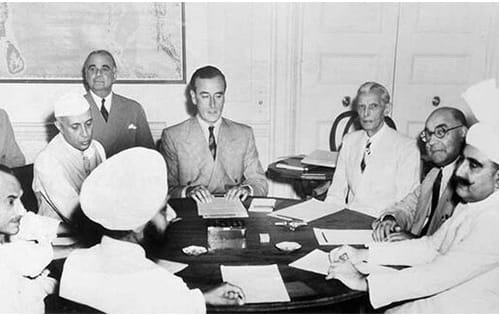
Lord Mountbatten with Nehru, Jinnah and other leaders, 1947. Talks like this led to the 3 June Plan, which accepted the partition of India.
By 1946 Britain had decided to leave India. The question was: one country or two? The Cabinet Mission (1946) tried to keep India united, and failed. The Mountbatten Plan (3 June 1947) accepted partition. The Indian Independence Act made it law, and freedom came on 15 August 1947. The Radcliffe Line cut Punjab and Bengal in two.
16 May 1946
Cabinet Mission Plan
United India, weak centre
3 June 1947
Mountbatten Plan
Partition accepted
18 July 1947
Independence Act
Royal assent
17 Aug 1947
Radcliffe Line
Made public
The road to 1946
From the Pakistan demand to the end of the war.
In the 1940s the Muslim League, led by Muhammad Ali Jinnah, began to demand a separate Muslim homeland. The Congress wanted one free India. Britain, busy with the Second World War, made offers that both sides rejected. When the war ended in 1945, a new Labour government under Clement Attlee decided to hand over power.
STEPS BEFORE THE CABINET MISSION
1933
The name 'Pakistan'
Coined by Choudhary Rahmat Ali, a student at Cambridge, in a pamphlet.
March 1940
Lahore Resolution
The Muslim League demands separate states for Muslim-majority areas. It is also called the Pakistan Resolution.
March 1942
Cripps Mission
Offers dominion status after the war. Congress rejects it.
August 1942
Quit India Movement
Launched after the failure of the Cripps offer.
June–July 1945
Wavell Plan, Simla Conference
Viceroy Wavell proposes a new Executive Council. Talks fail over who would name the Muslim members.
1945–46
Elections
Congress wins most general seats; the League wins most Muslim seats.
QUICK FACT
The Cripps offer promised freedom only after the war. Gandhi is said to have called it a post-dated cheque. Its failure led straight to the Quit India Movement of August 1942.
QUICK CHECK
PYQ · PPSC DDSWO 2023 Who coined the name Pakistan?
Tap an option to answer
Answer: C — Chaudhary Rehmat Ali
Choudhary Rahmat Ali coined it in his 1933 pamphlet 'Now or Never'. Muhammad Iqbal had earlier, in 1930, spoken of a Muslim state in the north-west.
The Cabinet Mission, 1946
The last plan to keep India one country.
In March 1946 Attlee sent three British cabinet ministers to India. They were Lord Pethick-Lawrence (Secretary of State for India, the leader), Sir Stafford Cripps and A. V. Alexander. The Mission rejected a separate Pakistan. Its plan of 16 May 1946 offered a united India with a weak centre.
The Mission at work, 1946
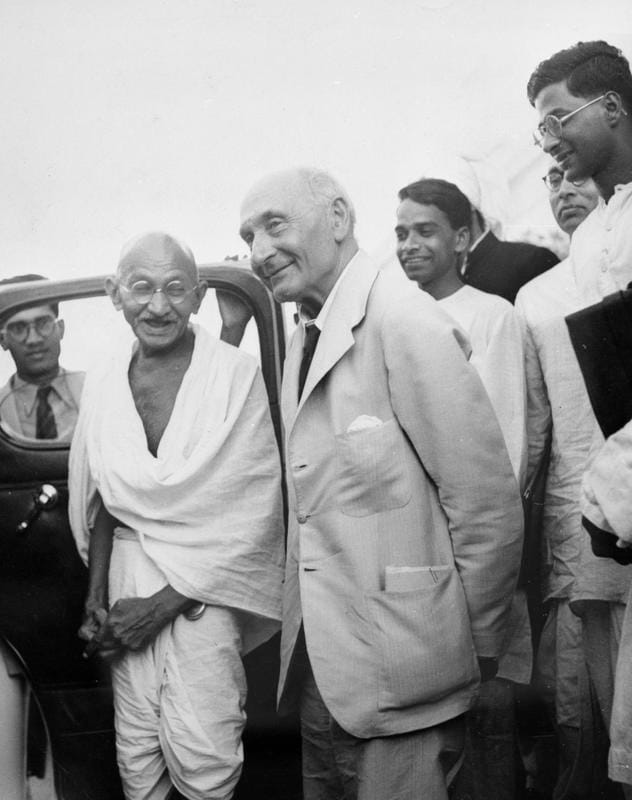
Gandhi with Lord Pethick-Lawrence, leader of the Mission, after talks on 18 April 1946.
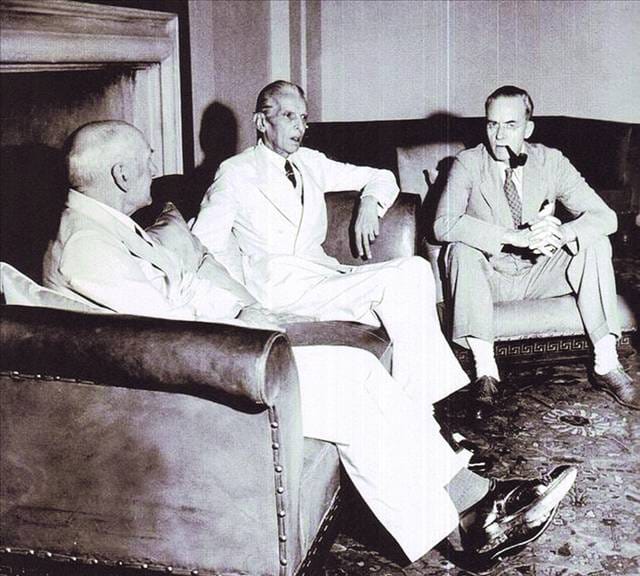
Jinnah with Sir Stafford Cripps and Pethick-Lawrence, 1946. Cripps had also led the 1942 mission.
Image
THE THREE-TIER PLAN
Weak centre
Union of India (top)
Only defence, foreign affairs and communications.
↓
Groups of provinces (middle)
A: Hindu-majority provinces. B: Punjab, NWFP, Sind (north-west). C: Bengal and Assam (north-east).
↓
Provinces (bottom)
All other subjects stay with the provinces.
↓
Constituent Assembly
Elected by the provincial assemblies, not directly by the people.
↓
Interim Government
To run India while the constitution was being made.
THE GROUPING QUARREL
Muslim League
Congress
Grouping was…
Compulsory
Optional
Why
Groups B and C looked like a Pakistan in the making
A province like Assam or NWFP should not be forced in
Result
Accepted plan, then withdrew (July 1946)
Accepted the Assembly part
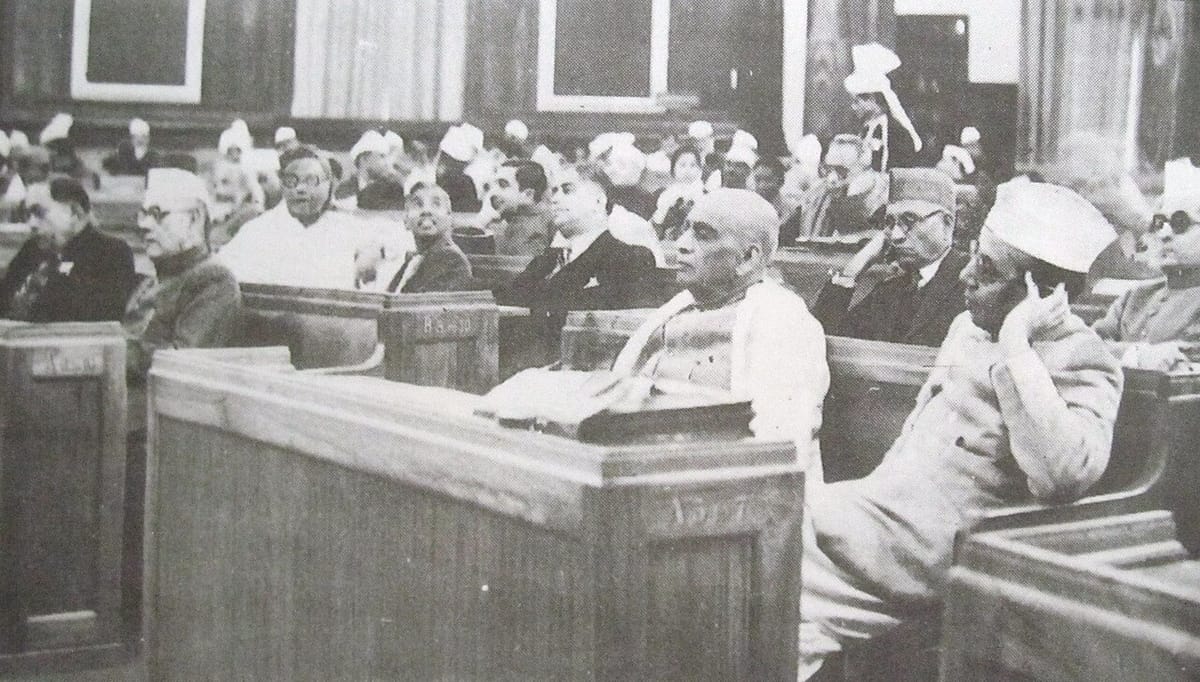
The Mission said grouping was compulsory at first, but a province could leave its group after the first elections under the new constitution.The Constituent Assembly, December 1946. It met first on 9 December 1946. Sachchidananda Sinha was temporary chairman; Rajendra Prasad was elected permanent President on 11 December. The Muslim League stayed away.
WHAT SURVIVED THE MISSION
The Cabinet Mission failed in its main aim. But the Constituent Assembly it created went on to write the Constitution of India. So a failed plan gave India the body that made the republic.
QUICK CHECK
PYQ · PPSC NT 2020 Which of the following are true about the Cabinet Mission Plan? I. It recommended a three-tier union with a weak central government controlling foreign affairs, defence and communications. II. For electing the Constituent Assembly, the provincial assemblies were to be divided into three sections: A (Hindu-majority provinces), B (north-western Muslim-majority provinces) and C (north-eastern Muslim-majority provinces). III. Grouping would be compulsory at first, but provinces would have the right to opt out after the new constitution and elections. IV. On this basis, in March 1947 the Congress divided Punjab into two — a Muslim-majority west and a Hindu/Sikh-majority east — and asked for the same pattern to be applied in Bengal. Choose the correct answer:
Tap an option to answer
Answer: D — I, II, III and IV
Statements I–III describe the plan of May 1946. Statement IV refers to the Congress Working Committee resolution of 8 March 1947, which called for Punjab to be divided. This question was asked in Punjabi; the English here is a translation.
QUICK CHECK
PYQ · PPSC Veterinary Officer 2024 The Constituent Assembly met on 9th December, 1946 and Dr Rajendra Prasad was elected its President. Which amongst the following political parties did not participate?
Tap an option to answer
Answer: A — The Muslim League
The League boycotted the Assembly to press its demand for Pakistan. It had withdrawn its acceptance of the Cabinet Mission plan in July 1946.
QUICK CHECK
PYQ · Punjab Police SI 2022 The first meeting of the Constituent Assembly was presided over by Dr. Sachidanand Sinha. Who among the following was later elected the President of Constituent Assembly?
Tap an option to answer
Answer: C — Dr. Rajendra Prasad
Rajendra Prasad was elected permanent President on 11 December 1946. Ambedkar chaired the Drafting Committee. PSCB Senior Manager 2021 asked the same fact.
From Direct Action to the Mountbatten Plan
August 1946 to June 1947: the slide to partition.
TEN MONTHS THAT DECIDED PARTITION
16 Aug 1946
Direct Action Day
Called by the Muslim League to press for Pakistan. Large-scale riots break out in Calcutta, then spread to Noakhali, Bihar and later Punjab.
2 Sept 1946
Interim Government
Formed under Jawaharlal Nehru. The League joins in October 1946, but the two sides clash at every step.
20 Feb 1947
Attlee's deadline
Britain will leave India not later than June 1948.
2 Mar 1947
Punjab ministry falls
Premier Khizar Hayat Khan Tiwana (Unionist) resigns. Governor's rule follows; violence grows.
24 Mar 1947
Mountbatten takes over
He replaces Wavell as the last Viceroy.
3 June 1947
Mountbatten Plan
Partition accepted; date brought forward to 15 August 1947.
KEY TERM
The Mountbatten Plan (3 June Plan)
It accepted partition, which the Cabinet Mission had refused. The members of the Punjab and Bengal assemblies would vote, sitting in two parts, on dividing their province. NWFP and Sylhet (Assam) would decide by referendum. (NWFP then had a Congress ministry under Dr Khan Sahib, so its vote could not be left to the assembly.) A Boundary Commission would draw the lines. Princely states could join India or Pakistan. Congress and the League both accepted it.
Cabinet Mission fails→Riots spread→3 June Plan: partition→Freedom on 15 Aug 1947
CABINET MISSION VS MOUNTBATTEN PLAN
Cabinet Mission, 1946
Mountbatten Plan, 1947
Partition?
Rejected
Accepted
Led by
Pethick-Lawrence
Viceroy Mountbatten
Key idea
Three tiers, weak centre
Two dominions
Led to
Constituent Assembly
Indian Independence Act
QUICK CHECK
PYQ · PPSC PRIN 2020 On February 20, 1947, Prime Minister Attlee announced the British Government's decision to withdraw from India latest by
Tap an option to answer
Answer: C — June 1948
Attlee set June 1948 as the last date and named Mountbatten as Viceroy. Mountbatten's plan then brought the date forward to 15 August 1947.
QUICK CHECK
PYQ · PSSSB Election Kanungo 2018 Who was the last Premier of the United Punjab?
Tap an option to answer
Answer: C — Khizar Hayat Khan
Khizar Hayat Khan Tiwana of the Unionist Party led Punjab from 1942 until his coalition resigned on 2 March 1947. Sikandar Hayat Khan was Premier before him (1937–42).
QUICK CHECK
PYQ · PPSC SEVE 2016 The plan to transfer of power to the Indians and partition of the country was laid down in the:
Tap an option to answer
Answer: D — The Mountbatten Plan
The 3 June 1947 plan provided for both the transfer of power and partition. The Cabinet Mission had rejected partition, and the Cripps Mission (1942) offered dominion status after the war.
The Indian Independence Act, 1947
The law that created two dominions.
The British Parliament turned the Mountbatten Plan into law. The Indian Independence Act got royal assent on 18 July 1947. Under it, India and Pakistan became two independent dominions on 15 August 1947. Pakistan marks its independence on 14 August, the day power was handed over in Karachi. 15 August 1947 was a Friday. On that day East Punjab became a province of the Indian Union; it was renamed Punjab in 1950.
Two dominions, India and Pakistan, from 15 August 1947.
Each Constituent Assembly got full power to make its own constitution and laws.
British paramountcy over the princely states ended. They could join either dominion.
The British king dropped the title Emperor of India. The post of Secretary of State for India ended.
Until new constitutions came, each dominion ran under the Government of India Act 1935, with a Governor-General as head.
GOVERNORS-GENERAL OF FREE INDIA
1
Lord Mountbatten
1947–48 · Last Viceroy, then first Governor-General of free India
│succeeded by
2
C. Rajagopalachari
1948–50 · First and last Indian Governor-General
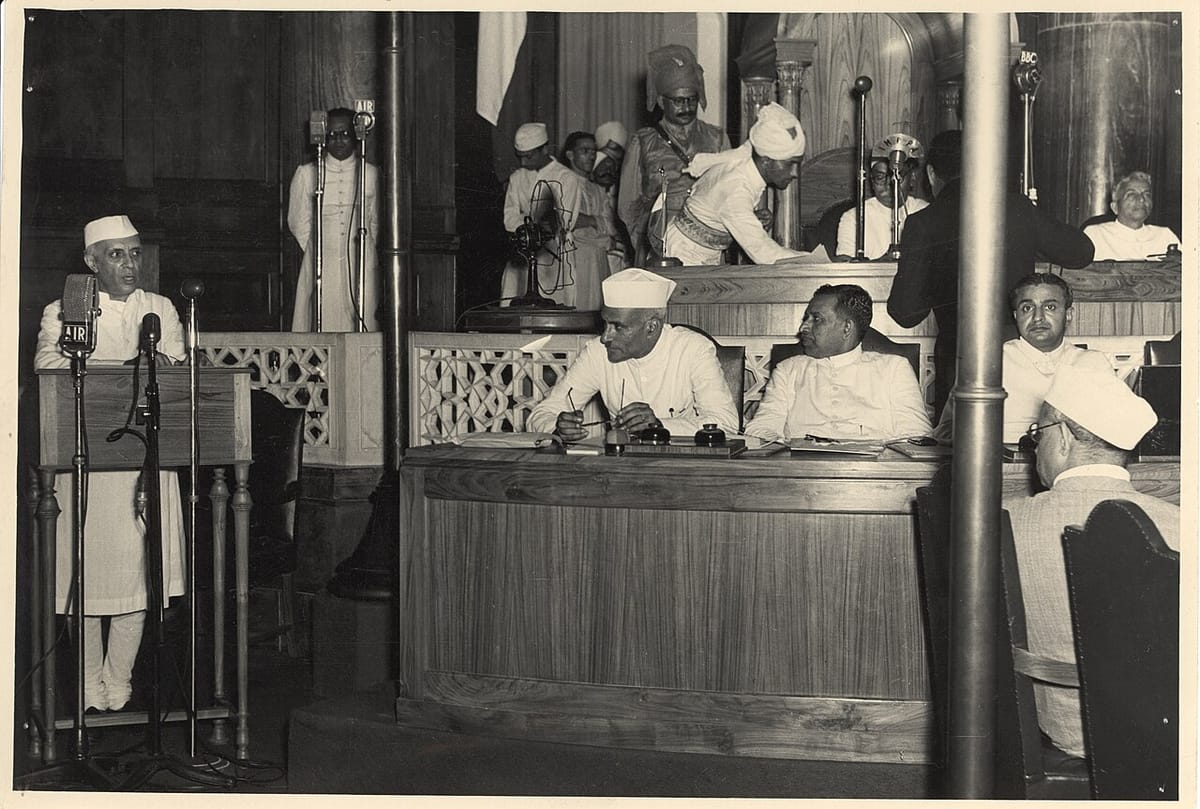
In Pakistan, Jinnah became the first Governor-General. India's post ended on 26 January 1950, when India became a republic.Nehru's 'Tryst with Destiny' speech, at the midnight session of the Constituent Assembly, 14–15 August 1947. He became free India's first Prime Minister.
QUICK CHECK
PYQ · PPSC DDSWO 2026 _________ became the basis of independence act
Tap an option to answer
Answer: A — Mountbatten Plan
The 3 June Plan was turned into the Indian Independence Act, passed in July 1947. Radcliffe only drew the boundary; the Marshall Plan was American aid for post-war Europe.
QUICK CHECK
PYQ · PPSC NE 2019 At the time of partition, the government in North-West Frontier Province was constituted by
Tap an option to answer
Answer: A — Congress Party
NWFP had a Congress ministry under Dr Khan Sahib, brother of Khan Abdul Ghaffar Khan. That is why the 3 June Plan gave it a referendum (July 1947); NWFP voted to join Pakistan. The same question came in PPSC RO and TA 2019.
QUICK CHECK
PYQ · PPSC NT 2020 What day of the week was 15 August 1947?
Tap an option to answer
Answer: C — Friday
15 August 1947 was a Friday, so 14 August was a Thursday. This question was asked in Punjabi; the English here is a translation.
QUICK CHECK
PYQ · Punjab Police Constable 2024 Punjab (originally East Punjab) became a state in the Union of India on ______.
Tap an option to answer
Answer: A — 15 August 1947
East Punjab came into being with independence on 15 August 1947. The name 'Punjab' was adopted later, in 1950.
The Radcliffe Line and Punjab
One line, two Punjabs, millions on the move.
A line had to be drawn through Punjab and Bengal. A British lawyer, Sir Cyril Radcliffe, chaired both Boundary Commissions. He had never been to India before and had about five weeks. His award was ready by 12 August, but it was made public only on 17 August 1947, two days after freedom.
Undivided Punjab's 29 districts in 1947
To East Punjab (India)
13 districts
To West Punjab (Pakistan)
16 districts
Only Gurdaspur and Lahore districts were split by the line. Princely states such as Patiala were outside these 29.
PUNJAB PAID THE HEAVIEST PRICE
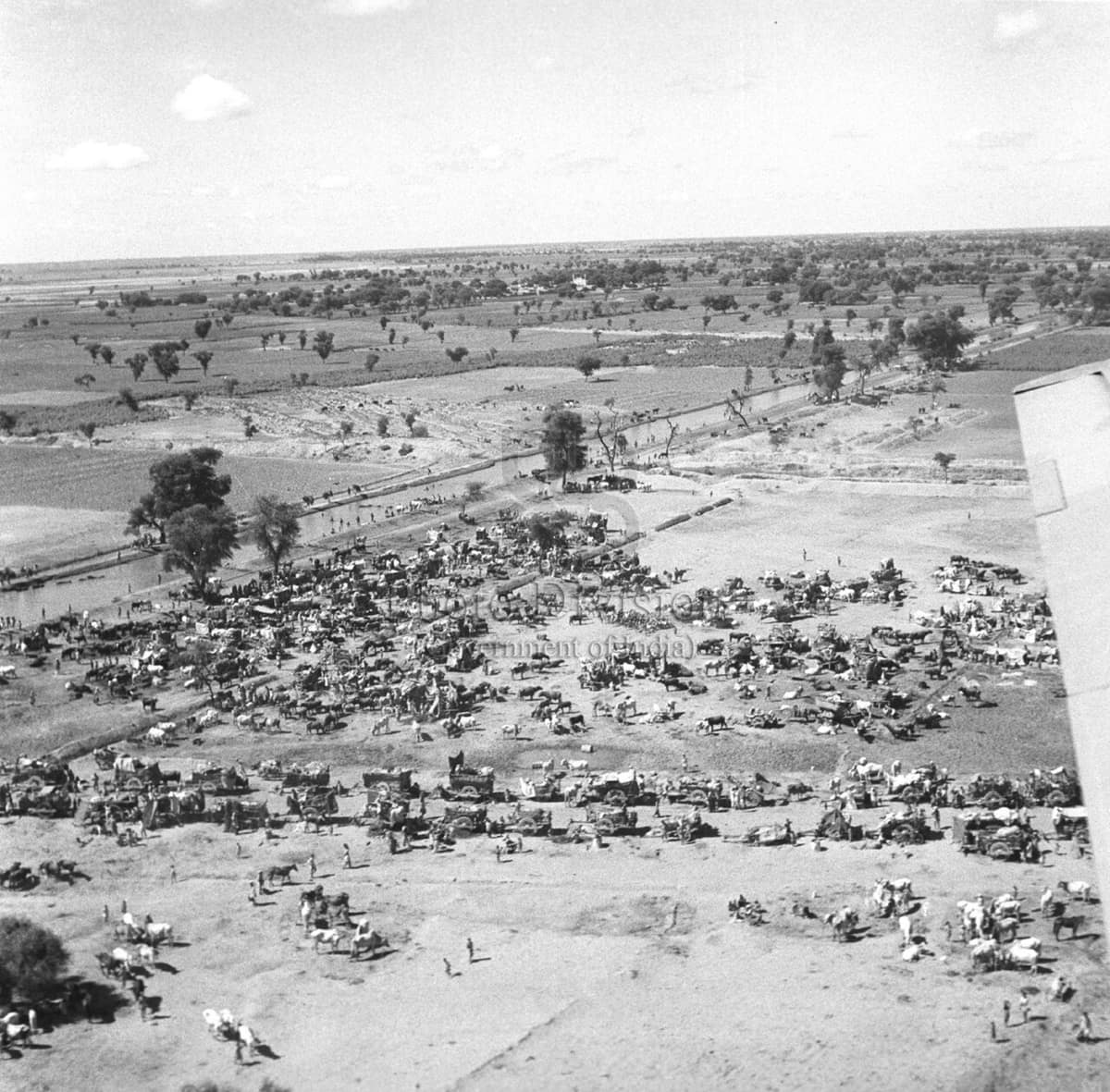
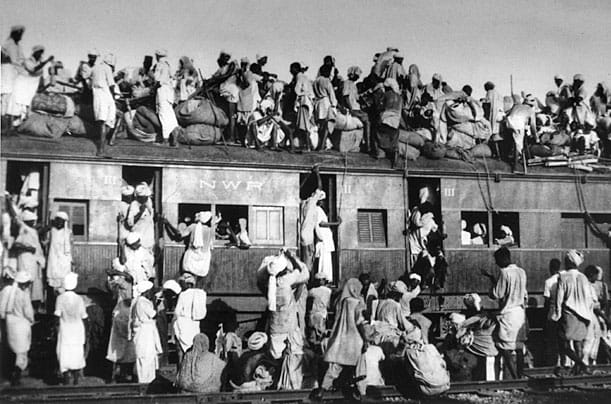
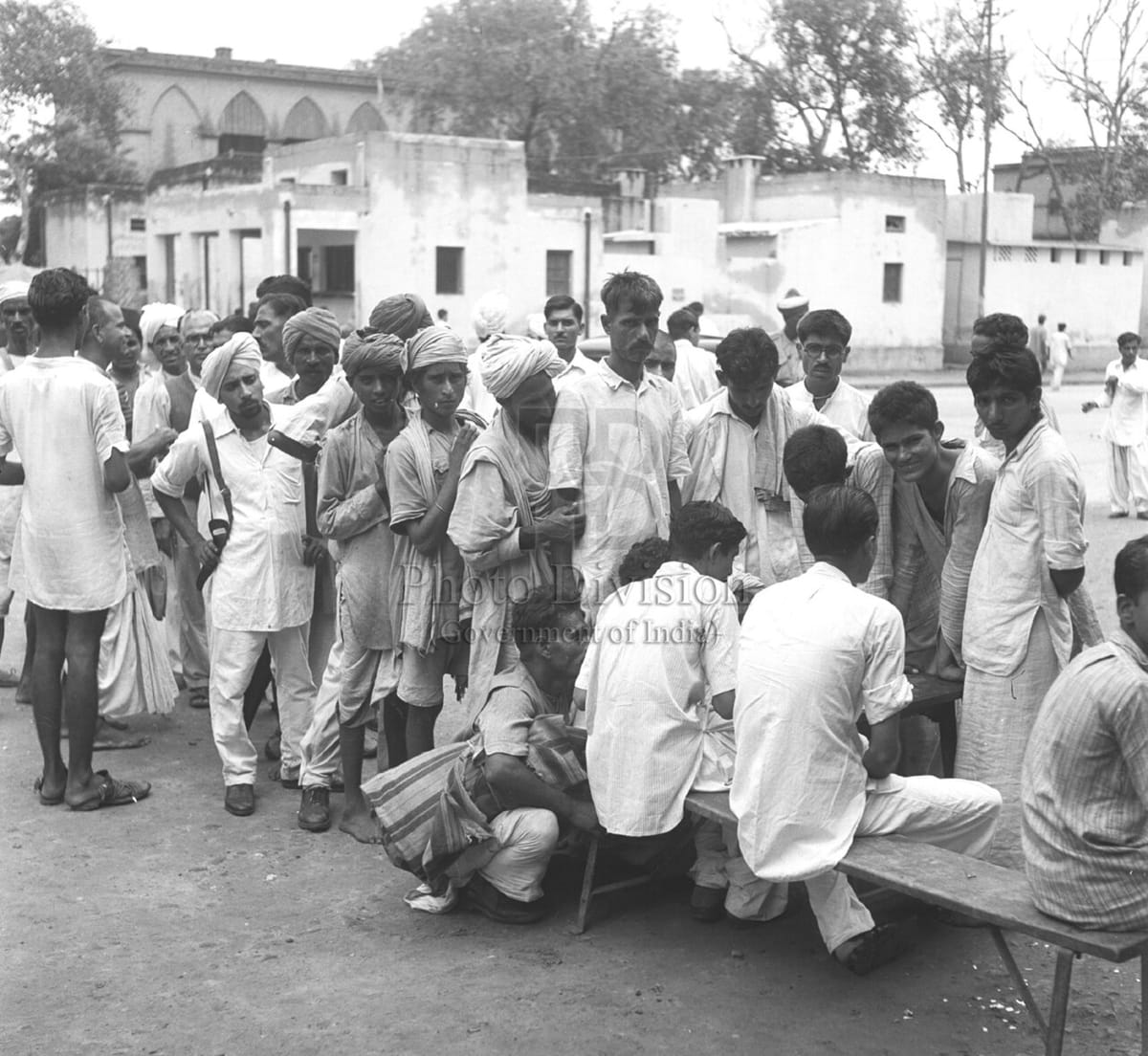
About 10 to 15 million people crossed the new borders in 1947. Muslims moved west; Hindus and Sikhs moved east. Hundreds of thousands lost their lives in riots, and Punjab suffered the most. East Punjab lost Lahore, its capital, and had to build a new one, Chandigarh.
Punjab in 1947
Columns of refugees from West Punjab moving towards India, near Baloke Head, September 1947.
An overcrowded refugee train in Punjab, 1947. Trains carried people in both directions.
Refugees from West Punjab registering for camps in Delhi, September 1947.
Image
QUICK CHECK
PYQ · Punjab Police SI 2016 The boundary between India and Pakistan was demarcated by
Tap an option to answer
Answer: B — Cyril Radcliffe
Radcliffe chaired the Punjab and Bengal Boundary Commissions. McMahon drew the India–China line in the east (1914). PPSC NE, RO and TA 2019 asked the same question.
QUICK CHECK
PYQ · PPSC JEE 2022 What is the name of the border that separates India and Pakistan?
Tap an option to answer
Answer: D — Radcliffe Line
The Radcliffe Line is the international border. The Line of Control is only the ceasefire line in Jammu and Kashmir, and the Durand Line separates Pakistan from Afghanistan. PPSC APRO and OHE 2016 and PSCB Clerk 2021 asked similar questions.
QUICK CHECK
PYQ · Punjab Police SI 2023 How many districts were there in undivided Punjab before the partition of 1947?
Tap an option to answer
Answer: A — 29
British Punjab had 29 districts in five divisions: Ambala, Jullundur, Lahore, Rawalpindi and Multan. 13 went to India and 16 to Pakistan.
QUICK CHECK
PYQ · Punjab Police Constable 2021 Where is Partition Museum located in Punjab?
Tap an option to answer
Answer: D — Amritsar
The Partition Museum is in the old Town Hall building, Amritsar, near the Golden Temple.
FLASHCARDS
Match the name
Leader of the Cabinet Mission
Lord Pethick-Lawrence
Other two members
Stafford Cripps, A. V. Alexander
Direct Action Day
16 August 1946, Muslim League
Head of Interim Government
Jawaharlal Nehru, 2 Sept 1946
Permanent President, Constituent Assembly
Rajendra Prasad
Last Viceroy
Lord Mountbatten
Last Premier of united Punjab
Khizar Hayat Khan Tiwana
Drew the India–Pakistan border
Sir Cyril Radcliffe
Everything on one look
The Mission, the plan, the Act and the line.
1946
Cabinet Mission: Pethick-Lawrence, Cripps, Alexander
Plan of 16 May 1946: united India, weak centre
Groups A, B, C; grouping quarrel
Direct Action Day: 16 Aug 1946
Interim Government under Nehru: 2 Sept 1946
Constituent Assembly first met: 9 Dec 1946
1947
Attlee: leave by June 1948 (20 Feb 1947)
Mountbatten Plan: 3 June 1947
Indian Independence Act: 18 July 1947
Freedom: 15 August 1947 (a Friday)
Radcliffe Line made public: 17 Aug 1947
Punjab: 29 districts, 13 to India
COMMON TRAPS
The Cabinet Mission rejected partition; the Mountbatten Plan accepted it.
Cabinet Mission leader: Pethick-Lawrence, not Cripps. Cripps also led the 1942 mission.
Quit India followed the Cripps offer, not the Cabinet Mission.
The name Pakistan: Rahmat Ali (1933), not Jinnah or Iqbal.
The Simla Conference (1945) was under Wavell, not Mountbatten.
Attlee's first deadline was June 1948; it was brought forward to 15 August 1947.
The Act became law on 18 July 1947; freedom came on 15 August.
The Radcliffe Line was made public on 17 August, after independence.
NWFP had a Congress government in 1947, yet voted for Pakistan in a referendum.
Radcliffe Line = India–Pakistan. McMahon = India–China. Durand = Pakistan–Afghanistan.
QUICK BYTES
Name 'Pakistan': Rahmat Ali, 1933
Lahore (Pakistan) Resolution: March 1940
Cripps Mission: March 1942
Simla Conference: 1945, Wavell
Cabinet Mission arrived: March 1946
Members: Pethick-Lawrence, Cripps, Alexander
Plan announced: 16 May 1946
Union subjects: defence, foreign affairs, communications
Direct Action Day: 16 August 1946
Interim Government: 2 September 1946, Nehru
Constituent Assembly: 9 December 1946
Permanent President: Rajendra Prasad
Attlee's statement: 20 February 1947
Last Premier of united Punjab: Khizar Hayat Khan
Mountbatten Plan: 3 June 1947
Indian Independence Act: 18 July 1947
First Indian Governor-General: C. Rajagopalachari
Radcliffe Line public: 17 August 1947
Partition Museum: Town Hall, Amritsar
CHECK YOURSELF
Why did the Cabinet Mission Plan fail?
Show answer
It broke down over grouping. The League read the grouping of provinces as compulsory, the Congress as optional. After Nehru said in July 1946 that the Assembly would not be bound, the League withdrew its acceptance and called Direct Action Day. The riots that followed made a united India look impossible.
❧
Frequently Asked Questions
What was the Cabinet Mission Plan of 1946?
A plan by three British ministers, led by Lord Pethick-Lawrence with Stafford Cripps and A. V. Alexander. It rejected Pakistan and proposed a united India with a weak centre, three groups of provinces and a Constituent Assembly elected by the provincial assemblies.
Who were the members of the Cabinet Mission?
Lord Pethick-Lawrence, the Secretary of State for India, who led it; Sir Stafford Cripps; and A. V. Alexander. Prime Minister Clement Attlee sent them in March 1946.
Why did the Cabinet Mission Plan fail?
The Muslim League saw grouping of provinces as compulsory, while the Congress saw it as optional. In July 1946 the League withdrew its acceptance and called Direct Action Day on 16 August 1946.
What was Direct Action Day?
A day called by the Muslim League on 16 August 1946 to press for Pakistan. Large-scale riots began in Calcutta and spread to other areas, making partition look unavoidable.
What was the Mountbatten Plan?
Also called the 3 June Plan (1947), it accepted partition. The Punjab and Bengal assemblies would vote on dividing their provinces, NWFP and Sylhet would hold referendums, and freedom was brought forward to 15 August 1947.
What did the Indian Independence Act 1947 provide?
It created two dominions, India and Pakistan, from 15 August 1947. It ended British paramountcy over princely states, gave each Constituent Assembly full powers and dropped the British king's title 'Emperor of India'. It got royal assent on 18 July 1947.
What is the Radcliffe Line?
The boundary between India and Pakistan, drawn by Sir Cyril Radcliffe, who chaired the Punjab and Bengal Boundary Commissions. It was made public on 17 August 1947.
How did partition affect Punjab?
Punjab's 29 districts were split: 13 went to India as East Punjab and 16 to Pakistan. Millions crossed the border and Punjab suffered the worst violence. East Punjab lost Lahore and later built Chandigarh as its capital.
When did the Constituent Assembly first meet?
On 9 December 1946, with Sachchidananda Sinha as temporary chairman. Rajendra Prasad was elected permanent President on 11 December 1946. The Muslim League boycotted it.
Who was the last Viceroy and the first Indian Governor-General?
Lord Mountbatten was the last Viceroy and the first Governor-General of free India. C. Rajagopalachari succeeded him in 1948 as the first and last Indian Governor-General.
Preparing for the Punjab Patwari exam? This note is part of the Punjab Patwari 2026 course — with previous year papers, mock tests and chapter-wise practice.