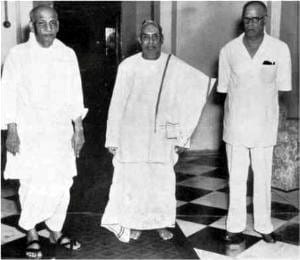
In 1947 about two-fifths of India's land was not ruled directly by the British. It was split into about 565 princely states, ruled by rajas, maharajas and nawabs. When British rule ended, each ruler could join India or Pakistan. Sardar Patel and V. P. Menon brought almost all of them into India by 1949. In Punjab, eight states formed PEPSU.
Princely India in 1947
Hundreds of rulers, one big question.
The princely states accepted British paramountcy: Britain controlled their defence and foreign affairs, and the rulers ran the rest. Some states were huge, like Hyderabad and Kashmir. Many were only a few villages. The Indian Independence Act 1947 ended paramountcy. In theory every ruler was now free to choose.
The supreme power of the British Crown over the princely states. The rulers kept their thrones, but could not have their own foreign policy or army against Britain. When paramountcy lapsed in August 1947, it did not pass to India. So each state had to be brought in by agreement.
People inside the states also wanted freedom and elected government. The All India States People's Conference was formed in 1927. Jawaharlal Nehru became its President at the Ludhiana session in 1939. At Haripura (1938) the Congress said its goal of independence included the princely states, and the Tripuri session (1939) repeated it. In Punjab's states, the Riasti Praja Mandal movement worked for the same goal.
Patel, Menon and the Instrument of Accession
Persuasion first, pressure if needed.
On 5 July 1947 a new States Department was set up. Sardar Vallabhbhai Patel, Home Minister and later Deputy Prime Minister, was in charge. His secretary was V. P. Menon. Lord Mountbatten also urged the rulers to join before 15 August 1947. Almost all of them signed in time.
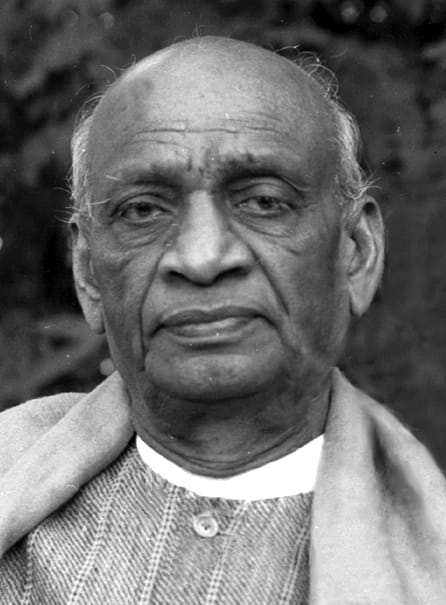
- 19471. Instrument of AccessionThe ruler gives India only defence, external affairs and communications.
- 2. Standstill AgreementOld arrangements (railways, post, customs) carry on for now.
- 3. Merger, 1948–49Small states join a nearby province or form a union of states (like PEPSU). Some become centrally run areas.
- Part B states4. Constitution, 1950Unions such as PEPSU become Part B states, headed by a Rajpramukh.
- 5. Reorganisation, 1956Part B states end. PEPSU merges into Punjab.
Rulers who joined got a yearly Privy Purse and kept some privileges. These were abolished in 1971 by the 26th Constitutional Amendment.
Punjab-region states in 1947: Bahawalpur, a Muslim-majority state west of the new border, joined Pakistan. Little Loharu merged into East Punjab (Hisar district) in 1948 and went to Haryana in 1966. Patiala, Nabha, Kapurthala and Faridkot joined India and later formed part of PEPSU.
The three hard cases
Junagadh, Hyderabad and Kashmir: the most-asked part.
Three states did not join by 15 August 1947. In each, the ruler's choice and the people's wishes pulled in different directions. India solved each one in a different way.
- 15 Aug 1947Junagadh's Nawab chooses Pakistan
Junagadh is a small coastal state in Gujarat, surrounded by Indian territory.
- 22 Oct 1947Raiders enter Kashmir
Tribesmen from Pakistan's frontier attack the state.
- 26 Oct 1947Kashmir accedes
Hari Singh signs the Instrument of Accession. Indian troops land at Srinagar next day.
- Nov 1947India takes over Junagadh
The Nawab has fled to Pakistan.
- 20 Feb 1948Junagadh plebiscite
Of about 1.9 lakh votes, only 91 were for Pakistan.
- 13–17 Sept 1948Operation Polo
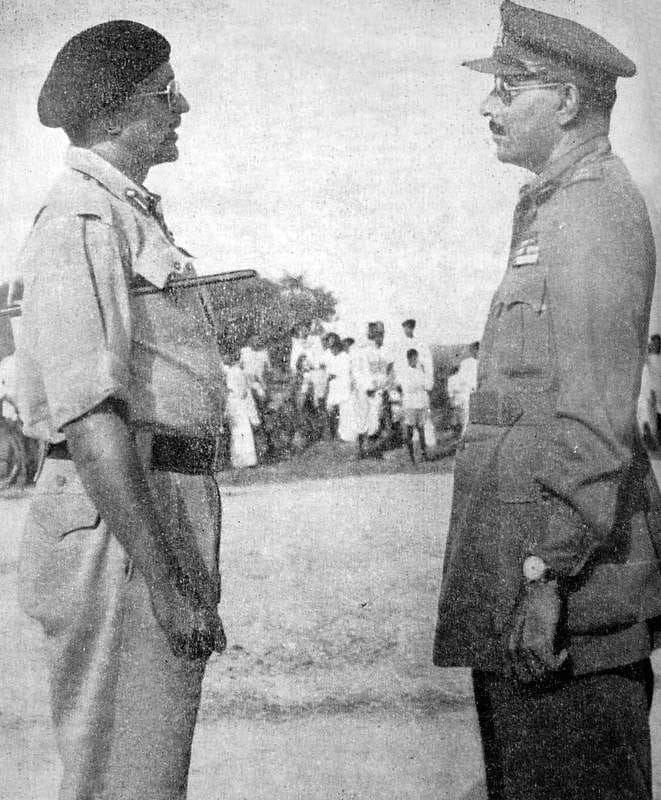
The Indian Army enters Hyderabad. The Nizam's forces surrender on 17 September.
- 1 Jan 1949Ceasefire in Kashmir
A ceasefire arranged through the United Nations ends the first India–Pakistan war.
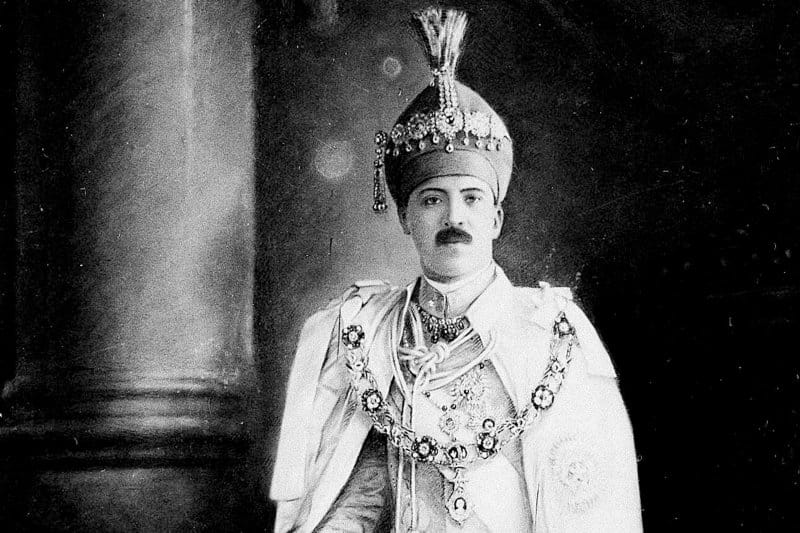
- Wanted Hyderabad to stay independent
- After Operation Polo he became Rajpramukh of Hyderabad State
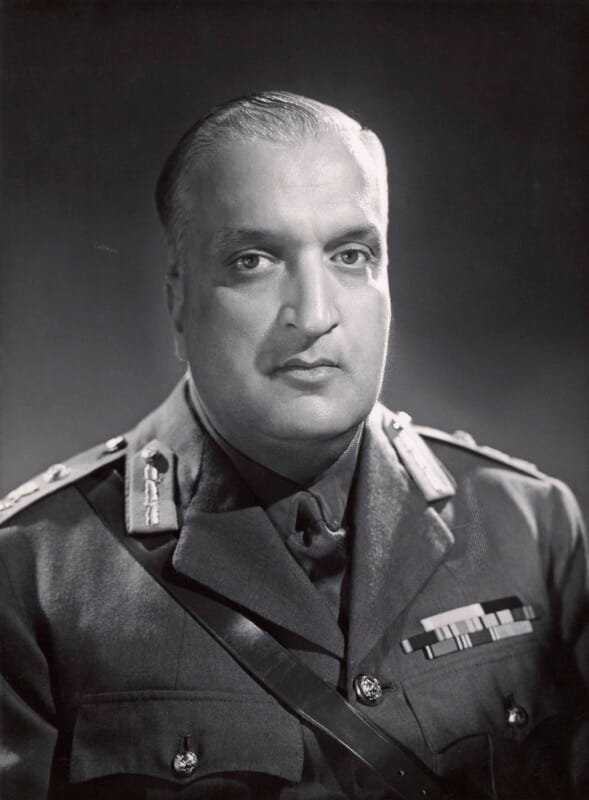
- Signed the Instrument of Accession, 26 Oct 1947
- Photo from 1944
- Acceded to Pakistan in 1947
- Fled to Pakistan before India took over
An armed militia in Hyderabad, led by Qasim Razvi. It tried to stop Hyderabad joining India by force. Operation Polo, also called the Police Action, ended its power in September 1948.
Last pieces of the map
French and Portuguese enclaves, and Sikkim.
Some parts of India were held by France and Portugal, not Britain. They joined India later. Sikkim, a protected kingdom in the Himalayas, became a state only in 1975.
Handed over in 1954; legally Indian from 1962. Chandernagore came earlier, in 1950.
Freed by Operation Vijay, 19 December 1961. Dadra and Nagar Haveli had broken free in 1954.
Became India's 22nd state after a referendum, by the 36th Amendment.
Joined after 1947.
19 December is kept as Goa Liberation Day. Goa became a full state in 1987.
PEPSU: Punjab's union of states
Eight princely states, one state, 1948 to 1956.
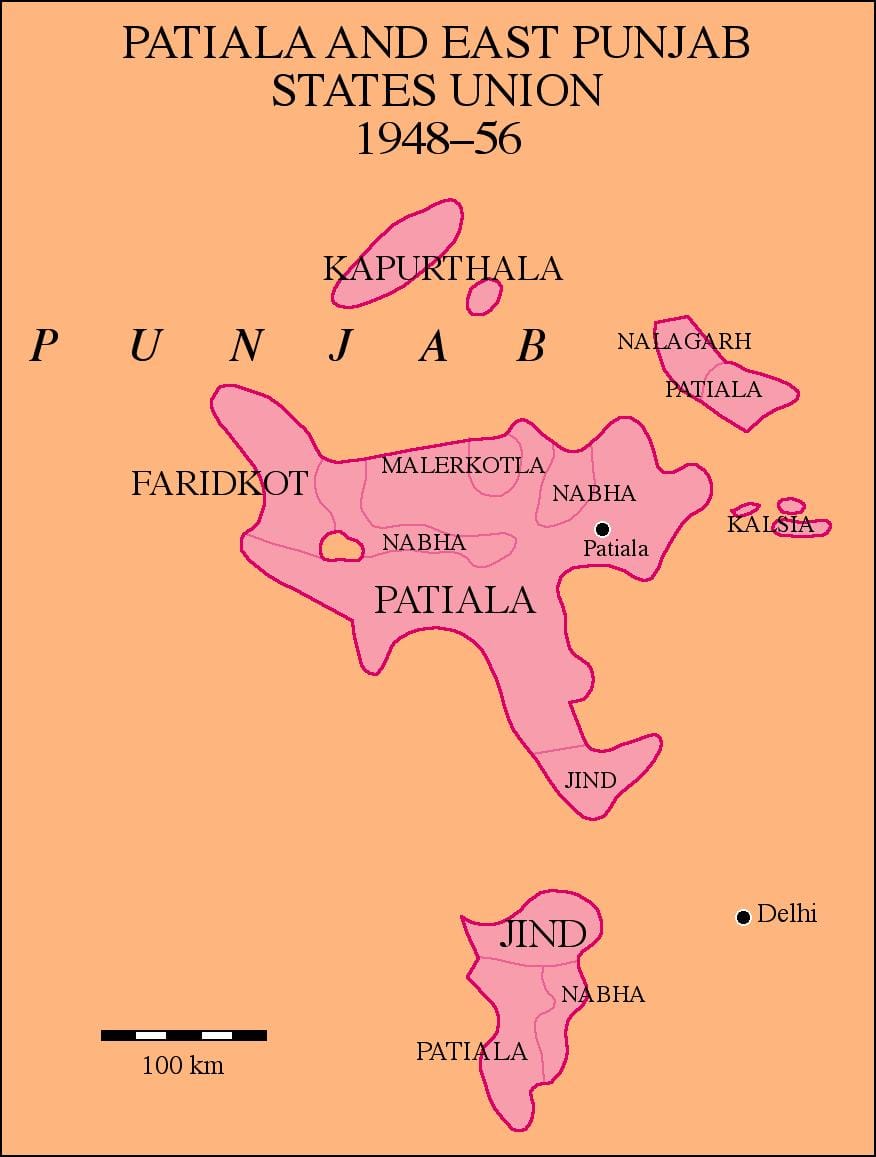
East Punjab had many princely states. The Phulkian states (Patiala, Nabha, Jind) were the biggest. In 1948 eight states joined to form the Patiala and East Punjab States Union (PEPSU). Its capital was Patiala. It lasted until 1 November 1956, when it merged into Punjab.
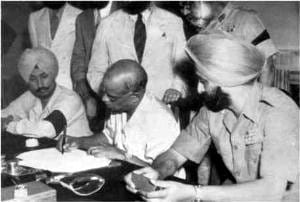
Ruled by descendants of Chaudhary Phul. Patiala was the largest.
Malerkotla had a Muslim Nawab; Kapurthala and Faridkot had Sikh rulers.
Nalagarh lay in the hills; Kalsia near Ambala.
The eight states of PEPSU.
- 5 May 1948Covenant signed
The rulers agree to unite.
- 15 July 1948PEPSU inaugurated
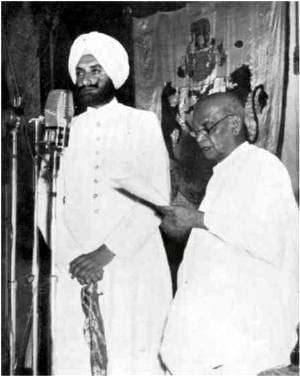
Sardar Patel swears in Maharaja Yadavindra Singh of Patiala as Rajpramukh.
- 1950Part B state
Under the new Constitution.
- 1953President's Rule
Imposed in PEPSU for about a year.
- 1 Nov 1956Merged into Punjab
Under the States Reorganisation Act 1956.
More PEPSU questions from Punjab examsTap to open
- First Chief Minister: Gian Singh Rarewala.
- Last Chief Minister: Brish Bhan (1956).
- Merged into Punjab: 1 November 1956.
- Yadavindra Singh later became a diplomat. He died in 1974 at The Hague, as India's ambassador to the Netherlands.
- Minister for the States, 1947
- Sardar Vallabhbhai Patel
- Secretary, States Department
- V. P. Menon
- Three subjects in the Instrument of Accession
- Defence, external affairs, communications
- Junagadh
- Plebiscite, 20 Feb 1948
- Hyderabad
- Operation Polo, Sept 1948
- Kashmir
- Instrument of Accession, 26 Oct 1947
- Goa
- Operation Vijay, 19 Dec 1961
- Sikkim
- 22nd state, 1975
- PEPSU capital
- Patiala
- Privy Purses ended
- 1971, 26th Amendment
Everything on one look
The men, the method, the hard cases and PEPSU.
- About 565 princely states in 1947
- Patel (minister) and V. P. Menon (secretary)
- Instrument of Accession: 3 subjects
- Junagadh: plebiscite, Feb 1948
- Hyderabad: Operation Polo, Sept 1948
- Kashmir: accession, 26 Oct 1947
- Bahawalpur went to Pakistan
- PEPSU: 8 states, 15 July 1948
- Capital Patiala; Rajpramukh Yadavindra Singh
- First CM Rarewala; last CM Brish Bhan
- Merged into Punjab: 1 Nov 1956
- Loharu went to Haryana (via Hisar), 1966
- Patel led the work; V. P. Menon was his secretary, not the minister.
- Paramountcy lapsed; it did not pass to India.
- Junagadh had a plebiscite; Hyderabad had police action.
- Hyderabad's ruler wanted independence, not Pakistan.
- Kashmir: Hindu ruler, Muslim-majority people (the reverse of Junagadh).
- Kashmir acceded on 26 October 1947, after the raid had begun.
- Operation Vijay = Goa 1961 (and Kargil 1999); Polo = Hyderabad.
- PEPSU had eight states; Nurpur and Pathankot were not among them.
- PEPSU merged in 1956, not 1966. 1966 created Haryana.
- Privy Purses ended in 1971, not in 1947 or 1950.
- Princely states in 1947: about 565
- States Department: 5 July 1947
- Iron Man of India: Sardar Patel
- National Unity Day: 31 October
- Statue of Unity: 182 m, Gujarat
- AISPC: 1927; Nehru President at Ludhiana, 1939
- Instrument of Accession: defence, external affairs, communications
- Junagadh plebiscite: 20 February 1948
- Kashmir accession: 26 October 1947
- Kashmir ceasefire: 1 January 1949
- Operation Polo: 13 September 1948
- Razakars: Qasim Razvi
- Pondicherry: 1954 (de jure 1962)
- Goa: Operation Vijay, 19 December 1961
- Sikkim: 22nd state, 1975
- PEPSU: 15 July 1948, eight states
- PEPSU Rajpramukh: Yadavindra Singh
- PEPSU merged into Punjab: 1 November 1956
- Privy Purses abolished: 1971
How were Junagadh, Hyderabad and Kashmir brought into India, and why were they different?
Show answer
In Junagadh a Muslim Nawab chose Pakistan for a Hindu-majority state; after he fled, a plebiscite (Feb 1948) chose India. In Hyderabad the Nizam wanted independence and the Razakars resisted, so India used Operation Polo (Sept 1948). In Kashmir the Hindu Maharaja of a Muslim-majority state hesitated until raiders attacked, then signed the Instrument of Accession (26 Oct 1947).